
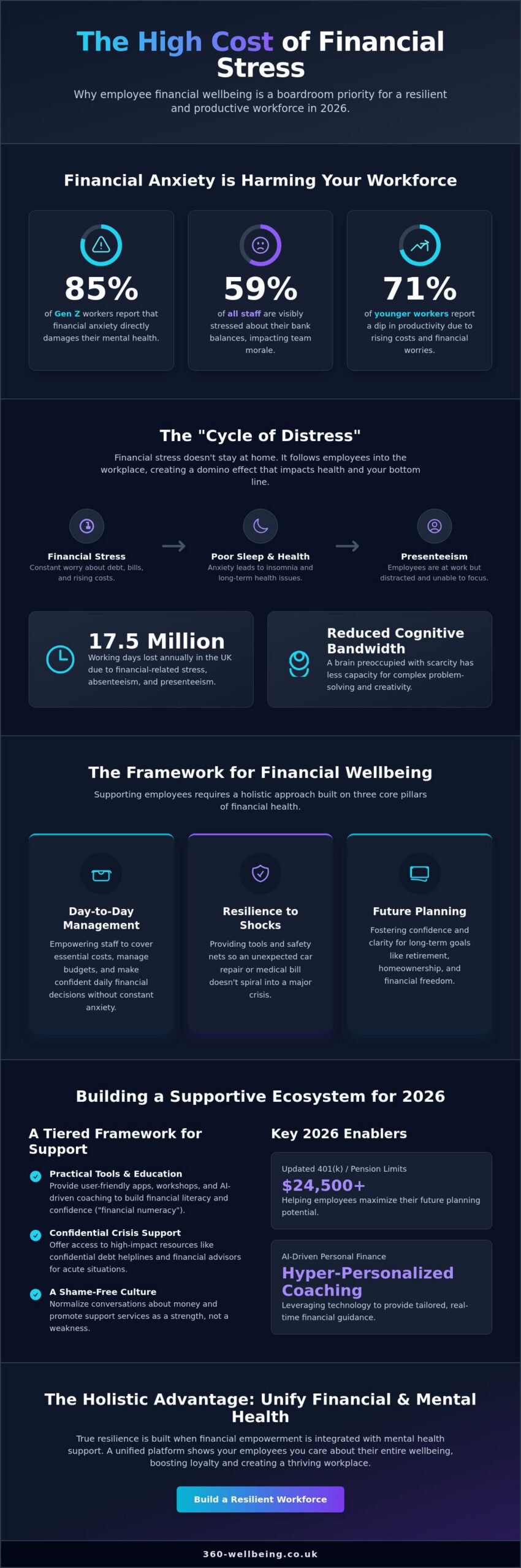
When 85% of your Gen Z workforce reports that financial anxiety is directly damaging their mental health, it stops being a private matter and becomes a boardroom priority. You likely see the symptoms every day: the 59% of staff who are visibly stressed about their bank balances or the 71% of younger workers whose productivity has dipped because they’re distracted by rising costs. It’s frustrating to watch talented people struggle, especially when you feel unqualified to offer debt advice or simply don’t have the budget for across-the-board raises. You know that a distracted team can’t be a high-performing one, yet the path to helping them often feels unclear.
Supporting employee financial wellbeing doesn’t mean you need to become a financial advisor; it means becoming a proactive partner in your team’s stability. In this guide, we’ll show you how to build a resilient workforce by integrating practical financial support into your holistic wellbeing strategy. We’ll explore a clear framework for reducing workplace stress and improving loyalty. This includes how to leverage 2026 updates, such as the $24,500 401(k) contribution limit and AI-driven coaching tools, to provide the reassurance your people need to thrive.
Key Takeaways
- Define the three pillars of financial health—management, resilience, and future planning—to help your team feel secure and empowered.
- Recognize how financial stress fuels a “cycle of distress” and learn how to mitigate the productivity losses caused by presenteeism.
- Master a tiered framework for supporting employee financial wellbeing that provides practical tools and crisis support while maintaining a shame-free culture.
- Follow a clear audit process to identify gaps in your current benefits and introduce high-impact resources like confidential debt helplines.
- See how combining financial empowerment with mental health therapy through a unified platform builds a more resilient and loyal workforce.
What is Employee Financial Wellbeing in 2026?
In 2026, we define financial wellbeing as the state of feeling secure, in control, and empowered regarding personal finances. It isn’t just about the balance in a checking account. Financial wellbeing is the intersection of financial security and mental peace of mind. Supporting employee financial wellbeing involves recognizing that money isn’t just a mathematical problem; it’s a deeply emotional one. While traditional personal finance principles provide the groundwork, wellbeing is the lived experience of that knowledge in action.
This experience rests on three distinct pillars. First, there’s day-to-day management, which involves the ability to cover essential costs without constant anxiety. Second is resilience against shocks, such as the ability to handle an unexpected car repair or medical bill. Finally, future planning ensures that an individual feels on track to meet long-term goals, like retirement or homeownership. When these three areas are in balance, employees can bring their full selves to work.
We must distinguish between financial literacy and financial wellbeing. Literacy is the technical knowledge of how interest rates or tax brackets work. Wellbeing, however, is the emotional result. You can be highly literate but still feel overwhelmed by debt. True wellbeing means having the confidence to make decisions that align with your personal values and long-term security.
The MaPS Framework: Mindset and Ability
The Money and Pensions Service (MaPS) framework identifies mindset and ability as critical components for UK employers to consider. It isn’t enough to provide information. We have to address “financial numeracy,” which is the confidence to use numbers in daily life. In 2026, digital engagement is also vital. Employees need user-friendly tools that make managing money feel like a natural part of their day rather than a chore. This confidence builds a more proactive workforce that feels capable of handling challenges.
Why Paying a Living Wage is Only the Starting Point
A living wage is a fundamental right, but it’s only the starting point for a healthy workforce. Even with fair pay, 44% of employees are currently using credit cards for necessities they can’t otherwise afford. High earners aren’t immune either; without a strategy for resilience, even a six-figure salary can’t prevent the stress of living paycheck to paycheck. Supporting employee financial wellbeing means providing the tools to manage that income effectively. True resilience prevents long-term absenteeism by ensuring that a minor financial setback doesn’t spiral into a mental health crisis that keeps a staff member away from their desk.
The Impact of Financial Stress on Workplace Productivity
Financial stress doesn’t stay at home. It follows employees through the office door, manifesting as a “cycle of distress” that quietly erodes your bottom line. When a team member is burdened by debt, their sleep quality often plummets. This exhaustion leads to preventable errors and safety risks. Research suggests that financial anxiety is a primary driver of insomnia, creating a workforce that’s physically present but cognitively impaired. In the UK, this translates to an estimated 17.5 million working days lost annually to financial-related stress, a figure that continues to rise as the cost of living fluctuates.
We often focus on absenteeism, but “presenteeism” is frequently more damaging. This occurs when staff are at their desks but distracted by money worries. Data from May 2026 shows that 71% of Gen Z employees report reduced productivity because of financial anxiety. They aren’t ignoring their work; they’re simply unable to switch off the mental calculator that’s tallying up bills. This chronic state of worry also takes a physical toll. The constant release of cortisol associated with financial insecurity is directly linked to hypertension and cardiovascular issues, turning a payroll concern into a long-term occupational health challenge. You can start by evaluating how your holistic wellbeing strategy accounts for these hidden productivity drains.
The Brain on Financial Stress: Cognitive Load
A financially stressed brain is biologically less capable of focus. When someone is preoccupied with scarcity, their “mental bandwidth” for complex problem-solving and creativity shrinks. This scarcity mindset forces the brain to prioritize immediate survival over long-term team collaboration. It’s hard to brainstorm a new product or support a colleague when you’re worried about an upcoming rent payment. Supporting employee financial wellbeing helps clear this cognitive fog, allowing your team to reclaim the mental energy they need to innovate.
Retention and the “Cost of Departure”
In a competitive market, employees are far more likely to jump ship for a small pay increase if they feel their current employer doesn’t care about their financial health. Replacing a skilled staff member can cost between 30% and 150% of their annual salary when you factor in recruitment and training. Comprehensive financial benefits act as “golden handcuffs,” creating deep loyalty and making your business a more attractive home for talent. The investment in a wellbeing platform is often a fraction of the cost of losing just one key employee to a competitor.
According to the CFPB Financial Wellness at Work Report, workplaces that offer structured financial support see a measurable improvement in both worker health and retention. By addressing the root cause of the distraction, you aren’t just being a compassionate employer; you’re protecting your most valuable strategic asset.
A Strategic Framework for Supporting Employee Financial Health
Building a resilient workforce requires more than a reactive response to a cost-of-living crisis. It demands a structured, tiered framework that addresses different levels of need. By supporting employee financial wellbeing through a deliberate strategy, you move from simply paying a salary to actively protecting your team’s peace of mind. This framework should be seamlessly integrated into a comprehensive employee wellbeing platform UK, ensuring that financial health is treated with the same clinical care as physical or mental health.
Central to this strategy is the creation of a “shame-free” culture. Money remains one of the last workplace taboos; yet, with 53% of the workforce holding less than $5,000 in emergency savings as of May 2026, it’s a burden many carry in silence. HR’s role isn’t to act as a financial advisor or debt counselor. Instead, your team should act as expert signposters. They provide the bridge between a moment of crisis and professional, confidential support. This approach removes the burden from managers while ensuring employees get the specialized help they need without feeling judged.
Tier 1: Proactive Education and Literacy
Knowledge is the first line of defense. Proactive education helps employees understand how to maximize their earnings and prepare for the future. This includes clear webinars on tax efficiency and navigating the 2026 retirement landscape, such as understanding the $24,500 401(k) employee contribution limit or the $8,000 catch-up option for those over 50. When you make complex topics like pension contributions easy to understand, you encourage a “savings orientation.” This prevents future stress by helping staff build the resilience needed to handle unexpected shocks without dipping into high-interest debt.
Tier 2: Practical Lifestyle Rewards
The second tier focuses on immediate, daily relief. A discount marketplace is a powerful tool that stretches a monthly salary further without increasing your payroll costs. When employees can save on essential costs like groceries, fuel, and utilities, it feels like a tangible “hidden pay rise.” Positioning these perks as part of a total wellbeing package shows that you understand their daily reality. It’s a proactive way to reduce the pressure on household budgets, allowing your team to focus on their roles rather than their receipts. This daily empowerment is a key pillar in maintaining long-term workplace harmony.
Practical Steps for Implementing Financial Support
Implementing a strategy for supporting employee financial wellbeing doesn’t require a massive HR department or a bottomless budget. For many small and medium enterprises, the most effective approach starts with a clear audit of what’s already in place. You might find that existing insurance policies or pension providers offer hidden resources that your team simply isn’t aware of. Identifying these gaps allows you to build a tailored roadmap that addresses the real-world pressures your staff face without unnecessary spending. It’s about making the most of every pound invested in your team’s stability.
Training your managers to spot the “red flags” of financial distress is equally vital. When an employee suddenly requests excessive overtime, becomes unusually irritable, or shows signs of the presenteeism we discussed earlier, it’s often a signal of underlying money worries. Managers don’t need to be experts; they just need to feel confident in gently pointing employees toward the right resources. Regularly reviewing and communicating your strategy ensures that these benefits don’t become “zombie perks” that sit unused. You can learn more about our wellbeing solutions to see how to streamline this communication process effectively.
The Role of Debt Advice and Helplines
Professional, third-party debt advice is often the safest route for both the employer and the employee. It maintains a necessary boundary, ensuring that sensitive financial details remain confidential while the individual receives expert guidance. Providing 24/7 access to financial counseling through an Employee Assistance Program allows staff to seek help the moment they feel overwhelmed, rather than letting the stress build up until it impacts their work. This is a core component of the financial support pillar, offering a lifeline to the 44% of workers currently relying on credit cards for basic necessities.
Complimentary Will Writing and Legal Protection
Legal uncertainty is a significant, yet often overlooked, source of long-term financial anxiety. When an employee knows their family is protected through a valid will or has access to basic legal advice, it removes a massive cognitive burden. This sense of security directly translates to better workplace focus. Offering complimentary will writing is a low-cost, high-value corporate benefit that provides immense peace of mind. It shows your team that you’re invested in their long-term stability and the wellbeing of their loved ones. This proactive care is a powerful driver of loyalty and engagement in a modern workforce.
Holistic Support: The 360 Wellbeing Advantage
Traditional employee benefits often fail because they treat health as a series of disconnected problems. At 360 Wellbeing, we understand that a person’s financial stability is inextricably linked to their mental and physical vitality. By supporting employee financial wellbeing through a single, unified platform, we remove the friction of seeking help. Our approach integrates expert financial guidance with professional mental health therapy, ensuring that when an employee reaches out because of debt, they also receive the emotional support needed to manage the stress that follows. This 360-degree perspective is what transforms a simple benefit into a strategic business asset.
The 360 Rewards marketplace serves as a daily tool for financial empowerment, helping your team stretch their income further on essential purchases. This is complemented by our 24/7 Virtual GP service. In 2026, where healthcare access remains a top concern for 49% of workers, providing instant medical consultations reduces the financial burden of private care and the stress of missing work for appointments. We’ve designed our onboarding process specifically for the needs of SMEs and sole traders. You don’t need a complex HR infrastructure to provide world-class care; our platform is modern, forward-thinking, and easy to deploy, allowing you to start protecting your team almost immediately.
Unified Care: Mental Health Meets Financial Health
A debt helpline is significantly more effective when it’s paired with proactive life coaching. Financial problems aren’t just about spreadsheets; they’re about behavior, mindset, and resilience. As an expert caregiver, 360 Wellbeing looks at the 360-degree perspective of total employee vitality. We help individuals navigate the underlying factors of their stress, providing a clear, structured path forward that restores their confidence and workplace harmony. This seamless integration of physical, mental, and social health ensures that your support feels both scientifically grounded and deeply personal.
Getting Started: A Proactive Partnership
In May 2026, with the Federal Reserve holding benchmark rates at 3.50% to 3.75%, employees are still navigating the long-term effects of prior inflation. Viewing wellbeing as a strategic asset rather than a luxury is essential for any business looking to thrive in this environment. We invite you to partner with us to build a more resilient, loyal, and engaged workforce. Our team is here to guide you through every step of the process, from the initial audit to full platform engagement. Explore our comprehensive financial support tools today to see how a proactive partnership can transform your corporate strategy and your employees’ lives.
Building a Resilient Future for Your Workforce
The landscape of 2026 demands a shift from reactive payroll management to proactive care. By supporting employee financial wellbeing, you’re doing more than helping your team manage their bank accounts; you’re protecting their mental bandwidth and your company’s productivity. We’ve explored how a tiered framework and a shame-free culture can mitigate the 17.5 million working days lost each year to financial stress. This isn’t just a benefit; it’s a fundamental investment in your staff’s long-term vitality and loyalty that pays dividends in workplace harmony.
Your journey toward a more harmonious workplace starts with a partner who understands the 360-degree nature of health. Our platform is specifically tailored for UK SMEs and sole traders, offering a comprehensive suite of tools that includes 24/7 access to UK-registered GPs. This integrated approach reduces absenteeism and improves retention by addressing the physical, mental, and financial pillars of wellness simultaneously. It’s time to move beyond the coldness of traditional services and embrace a modern, compassionate partnership. Empower your team with 360 Wellbeing support and lead your business toward a future of proactive health and shared success.
Frequently Asked Questions
How can I support employee financial wellbeing without a pay rise?
You can provide immediate relief through non-salary benefits like discount marketplaces and financial literacy workshops. These tools help staff stretch their current income further by reducing the cost of daily essentials like groceries or fuel. Additionally, offering salary sacrifice schemes for transport or childcare can provide tax efficiencies that increase an employee’s take-home pay without increasing your overhead. It’s about providing the framework for smarter money management rather than just increasing the amount in the bank.
Is it legal for an employer to give financial advice to staff?
Employers should provide financial guidance and signposting rather than regulated financial advice. In the UK, providing specific advice on investments or pensions requires authorization from the Financial Conduct Authority (FCA). You can safely support your team by offering access to general educational resources and third-party experts who are qualified to handle individual debt or investment queries. This protects you legally while ensuring your staff gets the professional help they need.
What are the first signs of financial stress in employees?
Look for sudden changes in behavior, such as increased irritability, requests for overtime, or a dip in concentration levels. While we noted earlier that 71% of Gen Z workers report reduced productivity when worried about money, you might also notice a rise in short-term absenteeism. Another sign is “presenteeism,” where staff are at their desks but clearly distracted by personal worries. Spotting these red flags early allows for a more compassionate, proactive intervention before the situation escalates.
Does an Employee Assistance Programme (EAP) include debt advice?
Most modern EAPs include confidential debt counseling and financial signposting as part of their core service. These programs provide a safe, third-party space where employees can discuss their liabilities without fear of workplace repercussions. It’s essential to verify that your specific EAP offers 24/7 access to these services to ensure support is available whenever a crisis arises. Supporting employee financial wellbeing through an EAP ensures that the advice remains professional and private.
How much does a financial wellbeing platform cost for a small business?
Pricing for wellbeing platforms typically follows a per-employee, per-month subscription model, making them highly scalable for small businesses and sole traders. While specific costs vary based on the range of services included, such as Virtual GP access or legal support, these platforms are designed to be an affordable alternative to bespoke consulting. Investing in such a platform is often significantly cheaper than the cost of replacing a single employee who leaves due to unmanaged stress.
How do I introduce a financial wellbeing policy without offending staff?
Frame the policy as a proactive health benefit rather than a response to perceived financial struggle. By introducing financial wellbeing as part of a holistic, 360-degree health strategy, you normalize the conversation around money. Use clear, universal communication that explains how these tools benefit everyone, from those building their first savings to those planning for retirement in 2026. This approach removes the stigma and positions the company as a supportive partner in their long-term success.
What is the link between financial wellbeing and mental health at work?
Financial and mental health are deeply interconnected, with money worries often acting as a primary trigger for clinical anxiety and depression. Chronic financial stress keeps the body in a state of high alert, increasing cortisol levels and leading to physical symptoms like hypertension. Supporting employee financial wellbeing directly reduces this psychological burden. This creates a more resilient workforce that’s better equipped to handle daily workplace challenges without feeling overwhelmed by their personal finances.
Can providing a discount marketplace really help with financial wellbeing?
A discount marketplace provides immediate, tangible relief by lowering the cost of essential living expenses. When employees save on their weekly grocery shop or fuel, it creates a “hidden pay rise” that reduces the pressure on their household budget. This daily empowerment helps build long-term financial resilience by allowing individuals to allocate those savings toward emergency funds or debt repayment. It is a practical, low-barrier way to show your team that you understand and support their daily reality.