
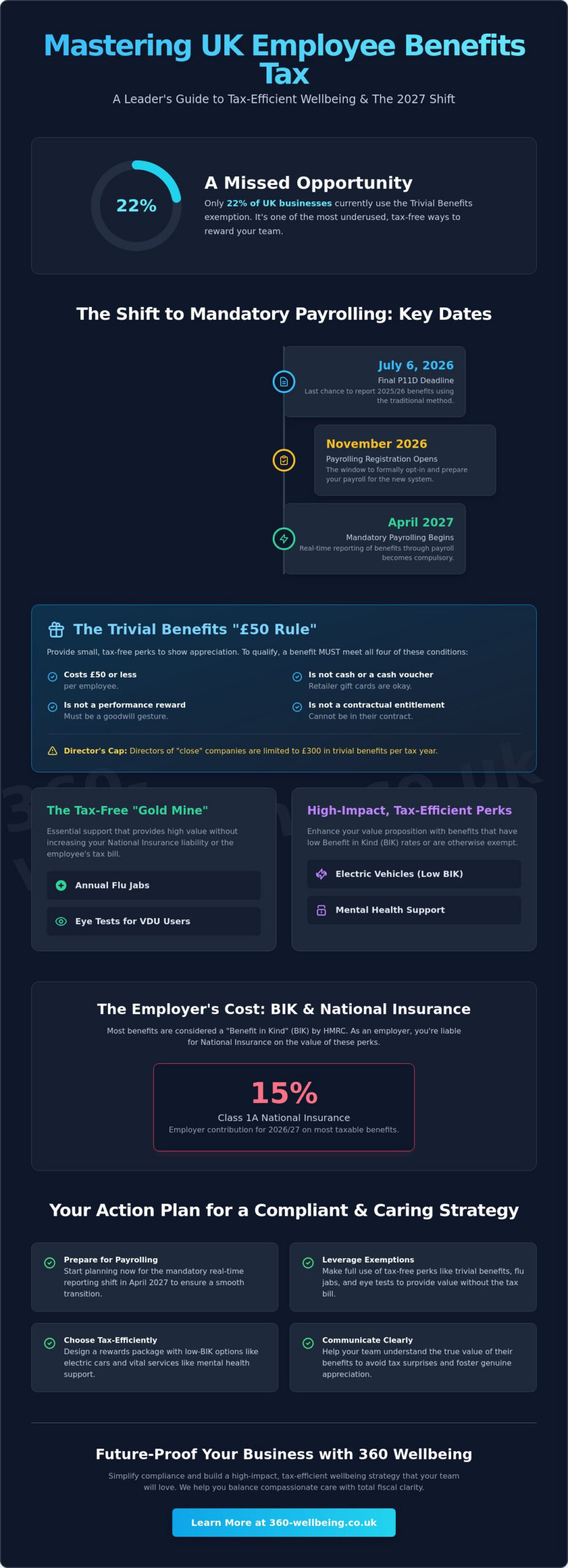
Did you know that only 22% of UK businesses currently take advantage of the trivial benefits exemption? It’s one of the most underused ways to reward staff without triggering a tax bill. Understanding the tax implications of employee benefits uk is no longer just a task for the finance department; it’s a vital part of a compassionate leadership strategy. When you get the balance right, you aren’t just ticking a compliance box for HMRC. You’re ensuring that the support you offer, from mental health resources to virtual GP access, reaches your team at its full value.
It’s natural to feel a sense of dread when P11D deadlines approach or to worry that a well-intended perk will be swallowed up by Benefit in Kind charges. We understand that you want to protect your staff’s take-home pay while providing the panoramic care they deserve. This guide will help you master these complexities so you can provide high-value support with total tax efficiency. We’ll explore the clear distinctions between taxable and tax-free benefits, simplify the 2026 reporting requirements, and show you how to build a wellbeing strategy that minimises friction for both your business and your people.
Key Takeaways
- Prepare for the pivotal shift from annual P11D filings to mandatory real-time payrolling to ensure your business remains compliant and ahead of the 2027 deadline.
- Identify the “gold mine” of tax-exempt perks, such as flu jabs and eye tests, which provide essential support without increasing your National Insurance liability.
- Master the tax implications of employee benefits uk to design a durable rewards package that balances high-impact wellbeing with fiscal efficiency.
- Discover how to leverage low BIK rates for electric vehicles and tax-efficient services like Mental Health Support to enhance your employee value proposition.
- Develop a clear communication strategy to help your team understand the value of their perks, ensuring they feel cared for while avoiding unexpected tax surprises.
Understanding Benefit in Kind (BIK) in the 2026 UK Landscape
Providing for your team’s wellbeing involves more than just a competitive salary. It’s about creating an environment where they feel protected, valued, and supported. Understanding Benefit in Kind (BIK) is the first step in this journey. These are non-cash perks provided to your staff, ranging from mental health support to company cars. While these benefits are designed to enhance lives, they are often treated as taxable income by HMRC, which can complicate your payroll and the employee’s take-home pay.
2026 has become a pivotal year for your benefit strategy. With the government announcing that mandatory payrolling of benefits will begin in April 2027, the window to prepare is closing. Registration for this new system opens in November 2026. Getting ahead of these changes now helps you avoid the administrative rush and protects your employees from the “double taxation” that can occur during a messy transition. When you understand the tax implications of employee benefits uk, you can make informed choices that strengthen your team’s loyalty without creating a financial headache for them.
The perceived value of a perk is deeply tied to what we call the “Fairness Factor.” If an employee receives a benefit but sees their take-home pay drop significantly due to tax, the positive impact of that gesture is lost. Clarity and foresight are your best tools here. By choosing tax-efficient options and mastering the tax implications of employee benefits uk, you ensure the support you provide feels like a genuine gift rather than a hidden cost.
The Core Principle: Why HMRC Taxes Perks
HMRC views most employee perks as “money’s worth.” This means that if a benefit has a clear value or saves the employee money they would otherwise have spent, it attracts tax. The amount an employee pays depends on their personal tax bracket. For example, a 40% taxpayer will feel the impact of a taxable benefit more than someone in the 20% bracket. As an employer, you are also responsible for Class 1A National Insurance Contributions on most of these perks. For the 2026/27 tax year, this rate is set at 15%, making it vital to calculate these costs into your annual budget to ensure your wellbeing strategy remains sustainable.
Trivial Benefits: The £50 Exemption Rule
Not every small gesture needs to be reported. The “trivial benefits” rule allows you to provide small perks tax-free, provided they cost £50 or less. To qualify, the benefit cannot be cash or a cash voucher, and it must not be a reward for performance or a requirement of the employee’s contract. It’s a wonderful way to celebrate a birthday or a personal milestone with a warm, human touch. However, be mindful that for directors of “close” companies, these tax-free gestures are capped at a total of £300 per year. Using this exemption wisely allows you to show appreciation frequently without adding to the tax burden.
Reporting and Calculating the Taxable Value of Benefits
Accurately reporting the value of perks is a cornerstone of responsible business management. It ensures your team isn’t hit with unexpected bills and protects your company from the stress of an HMRC audit. For the 2025/26 tax year, the deadline for submitting P11D forms is 6 July 2026. However, the landscape is shifting. From April 2027, almost all benefits must be payrolled in real-time. This means you’ll need to register for payrolling by November 2026 to stay ahead of the curve. Mastering the tax implications of employee benefits uk now allows you to refine your processes before they become mandatory.
HMRC generally requires you to value a benefit based on the “cost to the provider.” This isn’t always the market price a consumer would pay; it’s the actual expense your business incurs to provide the service. If you’re unsure about a specific perk, the official government guidance on expenses and benefits provides an exhaustive list of valuation rules. Using a centralized platform like 360 Wellbeing can help simplify this administration by providing clear data on the support your team is actually using, making the valuation process much smoother.
P11D vs. Payrolling: Choosing Your Method
Traditional P11D reporting happens after the tax year ends. While familiar, it often leads to “tax code lag,” where employees pay for last year’s benefits through this year’s salary. Payrolling benefits is a more modern, empathetic approach. It collects tax in real-time, which keeps employee cash flow steady and removes the need for annual forms. To make this work in 2026, your payroll software must be capable of handling Benefit in Kind (BIK) calculations dynamically. Transitioning early shows your team that you’re looking out for their long-term financial health.
Calculating the “Cash Equivalent” Value
A cash equivalent is the specific amount added to an employee’s earnings for tax purposes to reflect the value of a non-cash benefit. For company cars, this is determined by the vehicle’s list price and its CO2 emissions. In the 2026/27 tax year, fully electric vehicles attract a 4% BIK rate, while high-emission petrol cars can reach up to 37%. Other perks, like gym memberships or private health cover, are valued simply at the cost you pay to the provider. Beyond the tax for employees, don’t forget your own liability. Employers must pay Class 1A National Insurance on most taxable benefits at a rate of 15% for the 2026/27 tax year, with payments due by 22 July 2026 for electronic submissions.
Tax-Exempt Benefits: Maximising Value Without the Tax Bill
While the administrative side of taxable perks can feel heavy, there is a brighter side to your rewards strategy. Tax-exempt benefits are the “gold mine” of modern employee retention. These are the perks that allow you to provide deep, panoramic support to your team without triggering a tax bill for them or a National Insurance liability for you. It’s a win for everyone. By focusing on these exemptions, you can build a package that feels incredibly high-value but remains lean and efficient to manage. Understanding the tax implications of employee benefits uk is often about finding the paths that HMRC has left clear of obstacles.
A well-structured Employee Assistance Programme (EAP) is a cornerstone of this approach. It provides a safety net for your staff, offering everything from mental health support to legal advice, all without being classified as a taxable benefit. Similarly, investing in your team’s growth through work-related training or professional development is entirely non-taxable. This shows your people that you’re invested in their future, not just their current output. If you want to dive deeper into the full list of what is and isn’t covered, the Official GOV.UK guide to employee benefits is an invaluable resource for any employer looking to stay compliant while remaining generous.
Health and Wellbeing Exemptions
From 6 April 2026, the rules have become even more supportive of workplace health. Reimbursements for flu jabs and eye tests are now officially exempt from income tax. This is a significant step forward in recognizing that a healthy workforce is a professional necessity. Eye tests and corrective lenses are tax-free if they’re required specifically for VDU (Visual Display Unit) use. Additionally, welfare counselling and mental health support remain exempt, provided they’re available to all employees. These aren’t just perks. They are essential tools for maintaining vitality and harmony within your team.
Financial and Practical Support Exemptions
You can also provide practical financial foresight without adding to the tax burden. Employers can provide up to £500 worth of pension advice to an employee in a tax year without it being a taxable benefit. This helps your team plan for a durable future with confidence. Cycle to work schemes also remain a popular, tax-efficient way to encourage low-carbon commuting. Even the social side of work is protected. You can spend up to £150 per head on annual parties or similar functions, such as a Christmas dinner or a summer social, without triggering a Benefit in Kind charge. These moments of connection are vital for social health and don’t have to cost your employees a penny in tax.
Strategic Implementation: Balancing Compliance and Care
Creating a rewards strategy that truly resonates requires a blend of clinical precision and genuine compassion. You don’t want your team to feel like their benefits are a burden. Instead, aim for a “Tax-Smart” menu. This means prioritizing the tax-exempt gems discussed earlier while being transparent about taxable perks. When you master the tax implications of employee benefits uk, you can offer a diverse range of support that fits everyone from your newest apprentice to your longest-serving director. It’s about providing a panoramic view of care that remains fiscally responsible.
Regular benefit audits are essential as we move toward the 2027 reporting changes. A six-monthly review ensures your package remains compliant and continues to deliver the best possible value. It’s a proactive way to catch errors before they become costly penalties. To help streamline this process and ensure your team feels fully supported, you can learn more about our 360 Wellbeing solutions to see how we help businesses balance compliance with heartfelt care.
Communicating the Value Proposition
Transparency is the foundation of trust. If an employee’s tax code changes unexpectedly, it can lead to unnecessary anxiety. Avoid these “January surprises” by being upfront about Benefit in Kind (BIK) charges during your onboarding and annual reviews. Total Reward Statements are an excellent way to show the full picture. They highlight not just the gross salary, but the value of the perks and the tax contributions you make on their behalf. For those looking to go further, providing Financial Support for Employees can help your team manage their budgets with greater foresight and durability.
Salary Sacrifice in 2026
Salary sacrifice remains a powerful tool, but it’s one that requires careful handling under the current OpRA (Optional Remuneration Arrangements) rules. While many benefits no longer offer the same tax savings they once did, certain pillars remain strong. Pensions, childcare vouchers, and ultra-low emission vehicles (ULEVs) are still highly efficient ways to manage the tax implications of employee benefits uk. However, you must ensure that any sacrifice doesn’t push an employee’s hourly rate below the National Minimum Wage. This is a critical compliance check that protects both your business and your staff’s essential financial rights.
Future-Proofing Your Business with 360 Wellbeing
The journey toward a tax-efficient workplace doesn’t have to be a lonely one. As we look toward the 2027 reporting changes, the best way to protect your business is to move away from fragmented, manual systems. A centralized platform simplifies the administrative burden, allowing you to focus on the human side of leadership. By moving toward a unified platform, you gain a panoramic viewpoint of your rewards strategy. This makes it much simpler to manage the tax implications of employee benefits uk while providing a seamless experience for your staff. It’s about creating a culture where wellbeing is a professional necessity, not a complex administrative hurdle.
Our approach integrates physical, mental, and social health into a single narrative of total wellness. This isn’t just about compliance; it’s about the bottom line. Proactive care reduces absenteeism and boosts productivity by catching health concerns early. When your team feels truly supported, they are more engaged, more loyal, and more resilient. By prioritizing tax-efficient essentials like Mental Health Support and Physiotherapy, you’re building a business that is durable and ready for whatever the future holds.
The Virtual GP Advantage
Providing 24/7 Virtual GP access is one of the most impactful decisions you can make for your team. It’s a high-perceived-value perk that requires minimal administration compared to traditional health schemes. In a world where waiting for a medical appointment can take weeks, giving your staff instant access to clinical expertise is a game-changer. It significantly reduces the time taken off for routine appointments, keeping your business moving. Positioning digital health as a cornerstone of your culture shows your team that their vitality is a priority. It’s a modern, forward-thinking solution that feels deeply personal and supportive.
Comprehensive Support for SMEs
Small and medium-sized enterprises often face unique challenges in balancing costs with care. Our platform provides the same level of panoramic support used by large corporations, scaled for your specific needs. This includes essential tools like Legal Support, Financial Support & Debt Advice, and an Employee Assistance Programme (EAP). These services are often tax-exempt, allowing you to provide a safety net that respects your budget. Furthermore, our 360 Rewards marketplace offers a way to provide “trivial benefits” style value at scale, giving your team access to discounts and perks that enhance their daily lives. To see how this looks in practice, you can Explore how 360 Wellbeing can transform your benefits package and help you build a culture of lasting vitality and workplace harmony.
Building a Future of Sustainable Wellbeing
Mastering the tax implications of employee benefits uk is about more than just compliance; it’s a commitment to the long-term health and happiness of your workforce. By preparing for the 2027 payrolling shift now and prioritizing tax-exempt support like mental health resources and annual health checks, you create a package that values people over paperwork. This proactive approach ensures your team feels protected without the worry of unexpected tax burdens.
We’re here to help you navigate these complexities with a panoramic view of employee care. Our platform provides 24/7 UK-registered Virtual GP access, a comprehensive EAP, and thousands of offers through our 360 Rewards marketplace. This unified approach makes it easy to provide high-impact support that respects your business’s bottom line. Book a demo to see how our wellbeing platform supports your tax-efficient strategy and helps your business thrive. You’ve got the tools to build a workplace where everyone feels truly seen and supported. Let’s start that journey together.
Common Questions About Benefit Taxation
What is the most tax-efficient employee benefit in the UK for 2026?
Pensions and ultra-low emission vehicles remain highly efficient, but Employee Assistance Programmes (EAPs) are a standout choice because they are generally entirely tax-exempt. These programmes provide essential mental health and legal support without triggering Benefit in Kind charges. By focusing on these exemptions, you provide panoramic care that doesn’t impact your team’s take-home pay or your own National Insurance liabilities.
Do employees have to pay tax on a Virtual GP service?
Virtual GP services are typically treated as a taxable Benefit in Kind, valued at the cost your business pays to the provider. While there is a small tax implication for the employee, the perceived value of 24/7 medical access often far outweighs the minor cost. It’s a modern way to support vitality while minimizing the time your team spends away from work for routine appointments.
How does an Employee Assistance Programme (EAP) affect my company’s tax bill?
An Employee Assistance Programme (EAP) is generally a tax-exempt benefit, meaning it won’t increase your company’s Class 1A National Insurance bill. Because it doesn’t attract tax, every pound you invest goes directly into supporting your staff’s mental and social health. It’s a durable way to enhance your rewards strategy without the administrative friction of standard taxable perks.
What happens if I forget to report a taxable benefit to HMRC?
Failing to report a taxable benefit can lead to HMRC penalties and interest charges on the unpaid tax. If you discover an error, it’s best to take a proactive approach and notify HMRC as soon as possible to minimize potential fines. Maintaining clear records and using modern reporting software helps you stay compliant and avoid the stress of an unexpected audit.
Can I provide tax-free gym memberships to my employees?
Tax-free gym memberships are only possible if the facilities are provided on-site by the employer and are not available to the general public. For most businesses, providing a gym membership at a local club is a taxable benefit based on the cost of the subscription. You can still support physical health by offering these through a salary sacrifice scheme or by highlighting the corporate discounts available to your team.
Is private medical insurance always a taxable benefit in kind?
Private medical insurance is almost always considered a taxable Benefit in Kind in the UK. The employee pays income tax on the premium’s value, and you are responsible for Class 1A National Insurance. However, specific elements like annual health checks or eye tests can often be separated and provided tax-free, helping you manage the tax implications of employee benefits uk more effectively.
How do I calculate the National Insurance on employee benefits?
You calculate National Insurance on benefits by applying the Class 1A rate, which is 15% for the 2026/27 tax year, to the taxable value of the perk. This payment is due by 22 July each year for electronic payments. Keeping a steady rhythm of these calculations throughout the year ensures you have the necessary foresight to manage your budget without any end-of-year surprises.
What are the rules for “trivial benefits” in 2026?
Trivial benefits must cost £50 or less, cannot be cash or a cash voucher, and must not be a reward for work performance. These small gestures are a wonderful way to celebrate birthdays or personal milestones with a warm, human touch. Just remember that directors of close companies have an annual cap of £300 for these tax-free gifts.