
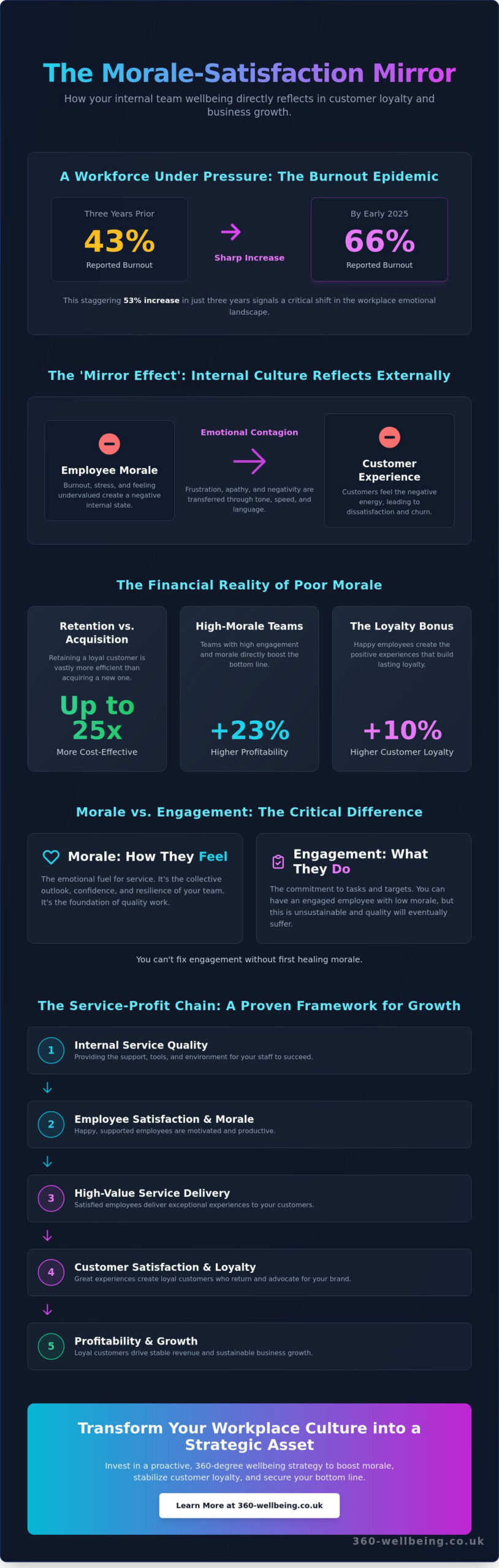
Did you know that by early 2025, 66% of employees reported feeling burned out, a sharp increase from 43% just three years prior? You might already feel this tension within your own teams, perhaps noticing that customer complaints regarding staff attitude are rising while your NPS scores begin to slide. It’s a difficult cycle to witness, especially when you pride yourself on service excellence. The impact of poor morale on customer satisfaction scores is no longer a theoretical concern; it’s a measurable business risk that directly erodes the loyalty you’ve worked so hard to build.
We understand that seeing your CSAT scores decline while turnover increases can feel overwhelming. However, your customer satisfaction is ultimately an external reflection of your internal culture, and you can’t fix the score without first healing the workplace spirit. In this article, you’ll discover how declining morale translates into service apathy and learn proactive strategies to restore harmony. We’ll provide a clear roadmap to link employee wellbeing to your ROI, offering practical ways to boost engagement and stabilise customer loyalty without requiring massive capital expenditure.
Key Takeaways
- Understand the ‘Mirror Effect’ and why your team’s internal emotional state acts as a direct reflection in every customer interaction.
- Identify how the impact of poor morale on customer satisfaction scores stems from emotional contagion, where staff apathy quickly translates into customer churn.
- Review the financial reality of disengagement, including why retaining a loyal customer is up to 25 times more cost-effective than the high price of new acquisition.
- Learn how to audit your workplace culture using anonymous insights to identify exactly where ‘life-stress’ is interfering with professional service delivery.
- Discover why a proactive, 360-degree wellbeing strategy transforms employee support from a corporate overhead into a strategic asset for service excellence.
Defining the Link Between Employee Morale and Customer Satisfaction
Employee morale is best understood as the collective outlook, confidence, and discipline of your team. It’s the quiet undercurrent that determines whether an employee approaches a task with genuine enthusiasm or weary obligation. In the modern UK workplace, particularly as we move through 2026, this internal temperature has become a critical predictor of commercial success. When morale is high, your team possesses the resilience to handle complex queries with grace. When it’s low, even the simplest customer interaction can feel like an insurmountable burden.
This leads to what psychologists often call the ‘Mirror Effect’. Customers are remarkably intuitive; they instinctively sense the emotional state of the person serving them. If an employee is struggling with burnout or feels undervalued, that frustration inevitably leaks into their tone of voice, response times, and problem-solving abilities. The negative impact of poor morale on customer satisfaction scores is often immediate and visible in your daily feedback loops. Research from 2024 and 2025 shows that business units with highly engaged, high-morale teams see 23% higher profitability and 10% higher customer loyalty. You simply cannot expect a customer to feel valued by an employee who doesn’t feel supported themselves.
Workplace culture in 2026 requires a more proactive approach than in previous decades. With 52% of employees expressing worry about the impact of AI on their roles and burnout rates reaching 66% in 2025, the emotional landscape has shifted. It’s no longer enough to offer a reactive solution. Businesses must actively cultivate a sense of security and purpose to maintain service standards. When leadership fails to address these internal stressors, the impact of poor morale on customer satisfaction scores becomes a recurring theme in monthly reports.
The Service-Profit Chain Explained
The Service-Profit Chain is a proven framework that demonstrates how internal wellbeing directly fuels external growth. It starts with internal service quality, which represents the support and tools you provide to your staff. This quality leads to employee satisfaction, which in turn drives productivity and value. When your team delivers high-value experiences, it creates the customer satisfaction and loyalty that stabilises your bottom line. It’s a linear progression where the health of your business is inextricably linked to the health of your people.
Morale vs. Engagement: Why Health Matters Most
While often used interchangeably, morale and engagement are distinct concepts. Engagement is what your employees do; it’s their commitment to their tasks and targets. Morale is how they feel while doing it. You can have an engaged employee who is technically productive but suffering from low morale, which eventually leads to a sharp decline in the quality of customer care. Physical health and mental resilience are the foundations of daily morale. Morale is the ’emotional fuel’ of customer service. Without it, even the most efficient processes will eventually fail to satisfy your clients.
How Low Morale Erodes Customer Satisfaction Scores (CSAT)
Emotional contagion isn’t just a psychological theory; it’s a daily reality in your service environment. When an employee is frustrated or feeling undervalued, their emotional state “infects” the customer experience. This happens through subtle cues: a sharp tone on a phone call, a lack of warmth in an email, or a visible sigh during a face-to-face interaction. The impact of poor morale on customer satisfaction scores is often most visible here, as customers react to the negative energy they encounter. They don’t just remember the service; they remember how the interaction made them feel.
This leads into the “Apathy Cycle,” a dangerous phase where staff stop caring about individual outcomes. In this state, employees do the bare minimum to get through their shift. They stop looking for creative solutions and start following the path of least resistance. When your team stops caring about whether a problem is truly solved, your customers stop caring about your brand. This apathy often manifests as “silo thinking,” where employees refuse to take ownership of a query if it falls slightly outside their remit. Instead of a seamless journey, the customer is bounced between departments, leading to a sharp drop in your CSAT data.
Burnout also plays a mechanical role in eroding your scores. By 2025, 66% of employees reported feeling burned out, which directly correlates with slower response times and a decline in first-contact resolution (FCR). A tired mind lacks the cognitive flexibility to resolve complex issues quickly. When morale is low, the mental energy required to be thorough simply isn’t there. Mistakes happen more frequently, and the attention to detail that usually defines your brand begins to slip away.
The Physicality of Poor Service
Low morale is often rooted in physical discomfort. Minor health issues, poor sleep, or persistent fatigue make it incredibly difficult for staff to remain patient in customer-facing roles. Irritability is frequently a symptom of underlying stress that hasn’t been addressed. Providing proactive support, such as access to a 24/7 Virtual GP, allows employees to manage these minor ailments quickly. This prevents physical discomfort from boiling over into a negative customer interaction. Recognising these signs of stress early is essential for maintaining a calm, professional service environment.
Erosion of Brand Reputation
Public reviews on platforms like Trustpilot or Google can be unforgiving. A single interaction with a low-morale employee can outweigh ten positive ones in the eyes of a frustrated customer. This negativity ripples through your social media sentiment and long-term Net Promoter Scores (NPS). In a competitive UK market, a reputation for “unhelpful staff” is difficult to shake. It’s much easier to maintain your scores by supporting your team’s wellbeing than it is to rebuild a damaged brand image after morale has collapsed.
The True Business Cost: Beyond the NPS and CSAT Metrics
While declining survey results are concerning, the financial reality of disengagement is far more tangible. The negative impact of poor morale on customer satisfaction scores often serves as an early warning for deeper financial erosion within your profit and loss statement. When a client encounters an apathetic or frustrated team member, they don’t just leave a poor review; they frequently take their business elsewhere. This direct customer churn represents a significant loss of lifetime value that many UK businesses fail to calculate accurately until the damage is already done.
The cost of replacing these lost clients is staggering. Research, including studies from Harvard Business Review, consistently shows that acquiring a new customer is between 5 and 25 times more expensive than retaining an existing one. In a competitive market, spending your marketing budget to replace customers you lost through poor service is an inefficient use of capital. You aren’t just losing a sale; you’re paying a premium to fill a leaky bucket that could be easily sealed by focusing on internal workplace harmony.
There is also the “Recruitment Tax” to consider. Low morale is a primary driver of staff turnover. When an experienced employee leaves, you face the direct costs of recruitment fees and the indirect costs of lost productivity during the onboarding of a new hire. In the UK, it can take weeks for a new starter to reach the same level of service excellence as a seasoned professional. During this transition, the risk of service errors increases, further straining your customer relationships and requiring expensive “customer recovery” measures such as refunds, discounts, and remedial management time.
Hidden Costs of Disengaged Service
Low morale often leads to a rise in administrative mistakes that quietly drain your resources. When staff are mentally checked out, the attention to detail required for accurate data entry or complex billing vanishes. This results in a “management drain,” where senior leaders spend hours resolving avoidable complaints rather than focusing on strategic growth. These lost hours represent a significant opportunity cost that never appears on a standard CSAT report but heavily impacts your bottom line.
Retention vs. Acquisition in 2026
As we move through 2026, customer loyalty has become the only sustainable shield against market volatility. A team that feels secure and valued is far more likely to provide the high-touch service that builds this loyalty. Providing financial support for employees is a powerful way to reduce the background anxiety that often erodes morale. When you address these fundamental stressors, you empower your team to focus entirely on the customer, turning your service department into a proactive engine for retention rather than a source of financial leakage.
Strategies to Boost Morale and Improve Satisfaction Scores
Restoring workplace harmony isn’t an overnight task, but it’s a strategic necessity to reverse the negative impact of poor morale on customer satisfaction scores. You can’t fix what you haven’t measured, and giving your team a safe space to voice their concerns is the foundation of trust. To move from a reactive stance to a proactive culture, consider following these steps:
- Audit your internal culture: Use anonymous wellbeing surveys to identify specific pain points without fear of reprisal.
- Implement proactive health support: Introduce benefits that address “life-stress” before it leaks into the customer experience.
- Foster recognition: Create a 360-degree culture that celebrates service wins across the entire business.
- Empower your team: Give staff the tools and autonomy to solve customer problems without unnecessary red tape.
- Monitor the data: Track the correlation between wellbeing uptake and improvements in your CSAT and NPS data.
This structured approach ensures that you aren’t just guessing what your team needs. When employees feel that their leaders are genuinely invested in their success, their commitment to the customer naturally deepens. This isn’t just about “perks”; it’s about building a foundation where excellence is the standard because the team has the emotional capacity to deliver it.
Proactive Health as a Service Strategy
In the UK, long NHS wait times can leave employees feeling anxious and physically unwell for weeks. By providing 24/7 virtual GP access, you remove this burden, allowing your team to get medical advice and prescriptions quickly. Mental health support is equally vital; it acts as a tool for emotional regulation, helping front-line staff stay calm during difficult calls. A healthy employee is a resilient employee. When your team isn’t distracted by physical pain or mental fatigue, they can focus entirely on delivering excellence. The impact of poor morale on customer satisfaction scores often lessens the moment staff feel their health is a priority for the business.
Communication and Transparency
Transparency from leadership is a powerful morale booster. When you close the feedback loop between customer complaints and staff training, you turn “failures” into learning opportunities rather than reasons for blame. Explain the “why” behind business decisions to build trust. When employees understand the bigger picture, they feel like partners in your success rather than just cogs in a machine. This sense of belonging is essential for maintaining long-term service standards and boosting your overall NPS.
If you’re ready to transform your workplace culture and protect your service standards, explore how our comprehensive employee assistance programmes can support your team’s vitality today.
The 360-Degree Approach to Sustainable Morale and Loyalty
Adopting a holistic benefits package is a strategic investment in your company’s future, not a mere administrative overhead. When you view employee health through a 360-degree lens, you recognise that mental, physical, and financial wellbeing are deeply interconnected. A team member worried about debt or struggling with a persistent physical ailment cannot bring their best self to a customer interaction. By integrating these support pillars into one accessible platform, you provide a comprehensive foundation for excellence. This unified approach ensures that your team feels supported in every aspect of their lives, which naturally translates into a more resilient and positive service environment.
For UK-based SMEs, this level of support is a powerful equaliser. It allows smaller businesses to compete with larger corporations not just for talent, but for service quality. When you offer a care-first culture, you attract high-calibre individuals who value their wellbeing as much as their career progression. The long-term ROI of this strategy is evident in reduced recruitment costs and stabilised customer loyalty. The impact of poor morale on customer satisfaction scores is a clear signal that your team needs more than just a standard benefits package; they need a partner invested in their total vitality.
A care-first corporate culture creates a virtuous cycle. As staff feel more secure, their capacity for empathy and problem-solving grows. This leads to the “Mirror Effect” mentioned earlier, where customers reflect the positivity they receive. Over time, this builds a brand reputation that is resilient to market volatility, as your clients become advocates for a business they trust and respect.
Building Resilience with 360 Wellbeing
Our 24/7 Virtual GP and Employee Assistance Programme (EAP) services create a vital safety net for your team. These tools allow staff to resolve health concerns or personal challenges before they escalate into workplace stress. Additionally, 360 Rewards provides daily motivation, offering tangible value that boosts morale on a consistent basis. As you look toward your strategy for the remainder of 2026, auditing your current benefits package is an essential next step. Identifying gaps in your support system now will prevent service dips in the future.
From Poor Morale to Service Excellence
The journey from low spirits to high CSAT scores begins with a commitment to your people. By addressing the root causes of disengagement, you transform your service department from a source of frustration into a primary driver of growth. You’ve seen how the impact of poor morale on customer satisfaction scores can erode your bottom line, but you also have the tools to reverse that trend. Prioritising wellbeing is the most effective way to ensure your brand remains a leader in service excellence.
Ready to see the difference a supported team can make? Explore how 360 Wellbeing can transform your team’s morale and help you reclaim your customer satisfaction goals.
Transforming Your Service Culture from the Inside Out
The connection between your team’s internal vitality and your brand’s external reputation is undeniable. We’ve explored how the Mirror Effect ensures that every ounce of employee frustration is felt by your clients, and how the apathy cycle can quietly erode years of hard-earned loyalty. Addressing the impact of poor morale on customer satisfaction scores isn’t just about damage control; it’s about building a resilient, high-performing culture that thrives in the competitive UK landscape of 2026.
By providing a safety net that includes 24/7 UK-registered Virtual GP access and comprehensive Mental Health and EAP support, you empower your staff to bring their best selves to every interaction. These tailored solutions for UK SMEs and sole traders turn wellbeing from a vague concept into a strategic asset. When your people feel cared for, they have the emotional capacity to care for your customers with the attention to detail they deserve.
Boost your team’s morale and your CSAT scores with 360 Wellbeing today. Your journey toward a more harmonious and profitable workplace starts with a single, proactive step.
Frequently Asked Questions
How exactly does employee morale affect customer satisfaction?
Employee morale acts as the primary emotional filter for every interaction your team has with a client. When staff feel undervalued or stressed, they often exhibit reduced empathy and slower response times, which customers perceive as a lack of care. This internal friction directly causes the negative impact of poor morale on customer satisfaction scores, as service quality is inextricably linked to the emotional state of the person delivering it.
Can you measure the ROI of employee wellbeing on customer scores?
You can measure ROI by correlating your wellbeing platform engagement rates with monthly CSAT or NPS data. Recent studies from 2024 indicate that companies with highly engaged employees see 10% higher customer loyalty and 23% higher profitability. By comparing the cost of your support programme against the reduction in customer churn and recruitment fees, you’ll see a clear financial return on your investment in workplace harmony.
What are the first signs of poor morale in a customer service team?
The earliest signs often include a decline in first-contact resolution (FCR) rates and a rise in “silo” thinking, where staff refuse to take ownership of queries. You might also notice a 78% increase in absenteeism among disengaged units, as reported in recent 2024 productivity benchmarks. When employees stop suggesting creative solutions for clients, it’s a signal that their emotional fuel is running low and burnout is likely setting in.
Does offering a Virtual GP service actually improve staff morale?
Offering a 24/7 Virtual GP service improves morale by removing the significant stress associated with long NHS wait times for primary care. When an employee can secure a consultation and prescription quickly, they feel physically better and emotionally supported by their employer. This reduction in health-related anxiety prevents irritability on the front line, ensuring that staff remain focused and resilient during difficult customer interactions.
How long does it take for morale improvements to show up in CSAT scores?
Most UK businesses begin to see a measurable shift in customer feedback within 90 to 180 days of implementing a structured wellbeing strategy. While internal sentiment can improve almost immediately after you announce new supports like an EAP, it takes time for this renewed energy to translate into consistent service excellence. Patience is vital as you move your culture from a state of burnout to one of proactive vitality.
What is the most cost-effective way to boost morale in a small business?
The most cost-effective method is implementing a comprehensive wellbeing platform that integrates mental health support and lifestyle rewards. For a small business, providing access to 360 Rewards or life coaching is often more sustainable than large salary increases. These benefits provide daily, tangible value that addresses the root causes of stress, making them a high-impact investment for SMEs looking to stabilise their workforce and service standards.
Is there a direct link between staff mental health and Net Promoter Scores?
There’s a verified correlation between staff mental resilience and Net Promoter Scores (NPS). By 2025, 66% of employees reported burnout, which directly impairs the cognitive flexibility needed to turn a neutral customer into a brand promoter. When mental health is prioritised through professional support, staff are better equipped to handle high-pressure situations with grace, leading to the positive interactions that drive higher NPS ratings over time.
Can poor morale cause long-term damage to brand reputation?
Poor morale causes long-term damage by creating a legacy of negative public reviews and social media sentiment that is difficult to erase. The impact of poor morale on customer satisfaction scores often ripples out into permanent brand erosion, as one low-morale interaction can outweigh ten positive ones in the eyes of a frustrated client. In a digital-first market, a reputation for apathetic staff is incredibly expensive to rectify once it takes hold.