
What if the biggest threat to your 2026 profit margins isn’t a market shift, but the silent withdrawal of your own team? Recent industry data suggests that the hidden costs of employee disengagement uk now account for a staggering 18% of annual salary costs for many firms. You’ve likely felt this pressure through the 25% increase in mental health-related absenteeism reported by UK HR directors over the last twelve months. It’s exhausting to watch talented people lose their spark while recruitment fees for replacement hires continue to climb in a tightening talent market.
We understand that maintaining a vibrant culture in a hybrid world is complex, yet your intuition that wellbeing is a strategic asset is backed by clinical evidence. This guide promises to reveal the invisible financial drains on your business and provide the concrete data you need to secure board-level buy-in for cultural change. We will walk you through the tangible ROI of a 360-degree engagement strategy and offer practical ways to re-energise your workforce, ensuring your people and your bottom line both thrive.
Key Takeaways
- Learn why a disengaged worker can cost your business 34% of their salary and how to identify the invisible financial drains within your organisation.
- Explore the hidden costs of employee disengagement uk employers face when external factors like the GP crisis and financial anxiety disrupt workplace focus.
- Discover how disengagement damages your brand reputation on platforms like Glassdoor, making recruitment significantly more difficult and expensive.
- Transition from a reactive mindset to a proactive 360-degree culture of care that treats employee vitality as a strategic asset rather than a business cost.
The UK Disengagement Crisis: Beyond the Headline Statistics
Employee disengagement in 2026 isn’t a loud rebellion; it’s a quiet, steady withdrawal of energy that erodes the foundation of UK businesses. Understanding the hidden costs of employee disengagement uk requires looking past surface-level productivity metrics. While a 2022 survey might have focused on simple output, the 2026 landscape focuses on holistic health and the 360-degree wellbeing of the individual. A paycheck is no longer a proxy for passion, and traditional perks like high-end coffee machines or office games rooms have lost their shine. Modern workers seek proactive support and a sense of purpose that transcends basic contractual obligations.
The shift toward a more compassionate workplace culture means employers must recognize that disengagement is often a symptom of unmet needs. When a team member feels their mental or social health is neglected, they naturally retreat. This lack of workplace enthusiasm isn’t just a HR metric; it’s a material risk to the resilience of the entire organization. Businesses that fail to adapt to this human-centric reality find themselves struggling with a workforce that is physically present but emotionally absent.
The Silent Rise of Quiet Quitting
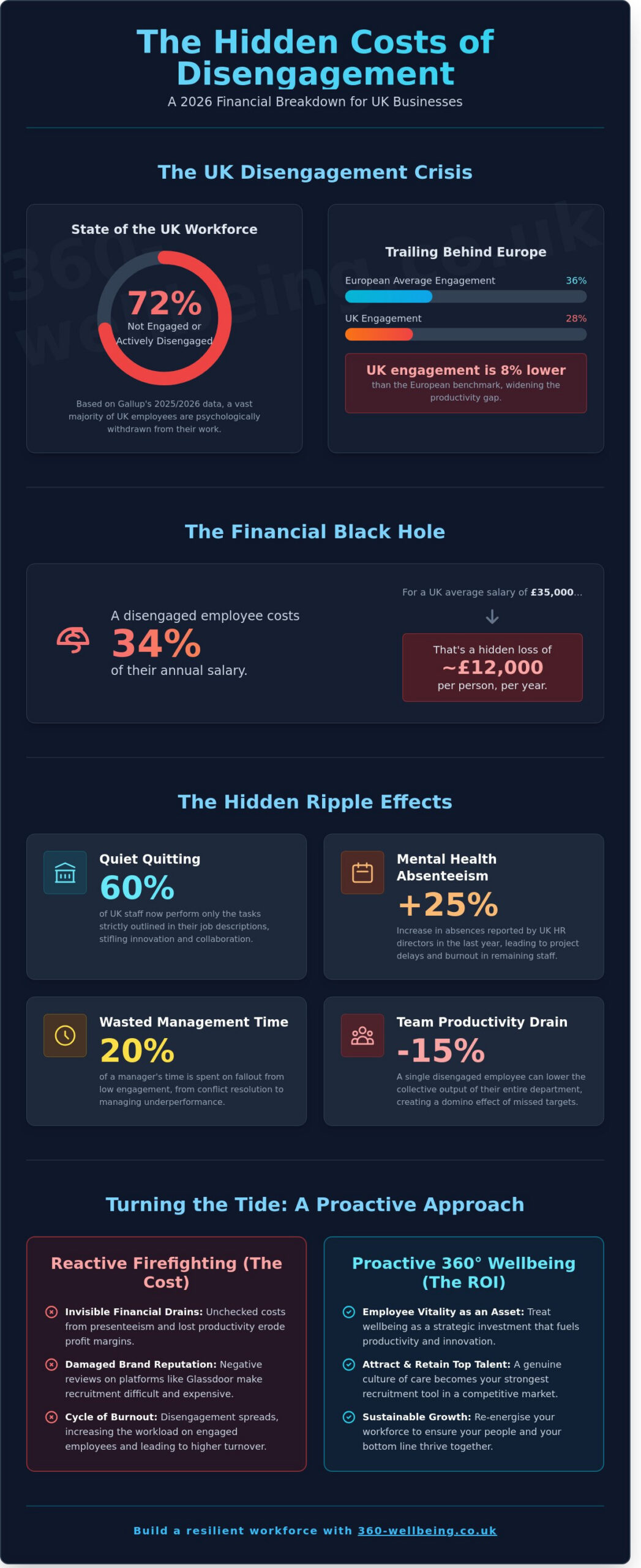
Quiet quitting has evolved from a social media trend into a structural reality. Current data shows 60% of UK staff now perform only the tasks strictly outlined in their job descriptions. You might notice a team member who was once vocal in brainstorming sessions suddenly becoming silent, or a department where the collaborative spark has faded into a series of transactional exchanges. This psychological shift, which accelerated after 2024, reflects a workforce prioritizing self-preservation over company growth. When one person disengages, the increased workload often falls on their peers, creating a ripple effect of burnout and resentment across the team.
The Gallup 2025/2026 Data for Europe
Gallup’s State of the Global Workplace report for 2025 and 2026 highlights a troubling trend for British industry. Currently, 72% of the UK workforce is classified as either not engaged or actively disengaged. This figure places the UK significantly behind its European counterparts, where engagement levels average 8% higher. Actively disengaged employees don’t just underperform; they can actively damage company culture by spreading negativity. Addressing the hidden costs of employee disengagement uk involves a tailored approach to wellbeing that restores trust and vitality. Without a comprehensive strategy, the gap between UK productivity and global benchmarks will continue to widen.
The Financial Black Hole: Calculating Absenteeism and Presenteeism Costs
Disengagement isn’t just a HR metric; it’s a silent drain on your bottom line that often evades traditional accounting. Industry data indicates that a disengaged worker costs their employer approximately 34% of their annual salary. For a UK business paying an average salary of £35,000, this equates to nearly £12,000 in lost value per person, every single year. Understanding the hidden costs of employee disengagement uk requires looking beyond the surface and examining how lost time and reduced focus erode your profit margins.
- The 34% Rule: This figure accounts for lost productivity, the cost of errors, and the negative impact on customer experience.
- Resource Redirection: Management spends roughly 20% of their time dealing with the fallout of low engagement, from conflict resolution to performance reviews.
- The Domino Effect: One disengaged team member can lower the collective output of a high-performing department by up to 15%.
By shifting your perspective to see wellbeing as a strategic asset, you can begin to close these financial gaps. These figures highlight why addressing the hidden costs of employee disengagement uk is a strategic necessity for 2026. Building a proactive wellbeing strategy helps identify these risks before they impact your bottom line.
The Direct Costs of Sick Leave
For SMEs, the absence of a single key staff member can stall entire projects. Beyond the £116.75 weekly Statutory Sick Pay (SSP) obligation, businesses face the secondary cost of “burnout tax” on the remaining team. When engaged employees are forced to cover extra workloads for extended periods, their own resilience drops. This often leads to a cycle of fatigue where project momentum is lost, and the cost of hiring temporary cover can exceed the original salary by 50% or more.
The Presenteeism Problem
Presenteeism represents the single greatest hidden cost in UK business. It occurs when staff show up to work while physically unwell or mentally distracted by financial anxiety and stress. Research from Deloitte suggests that mental disengagement leads to an 18% drop in individual productivity. This invisible drain is far more damaging than total absence because it is harder to track and resolve. In fact, presenteeism now costs UK employers approximately £28 billion annually, which is roughly 3.5 times the cost of actual sick days. When employees feel they must perform despite being unwell, the quality of work suffers, and the long-term recovery time increases significantly.
The Ripple Effect: How Disengaged Staff Damage Your Brand and Recruitment
Disengagement isn’t a quiet problem that stays confined to a single desk. It’s a visible signal that ripples through your entire organisation, affecting how the public perceives your brand. When your team feels disconnected, the hidden costs of employee disengagement uk businesses face become impossible to ignore. One disengaged leader can quickly derail an entire department, creating a contagion of low morale that stifles creativity. Innovation relies on discretionary effort. If your people don’t feel supported, they won’t offer the proactive ideas that drive growth.
Transparency is the default in 2026. Platforms like Glassdoor act as a digital window into your culture, and potential hires look through it before they ever submit a CV. A single negative review from a frustrated staff member can outweigh a dozen polished marketing campaigns. This damage to your external reputation makes it harder to attract the high-calibre talent you need to remain competitive. When engagement is low, your brand loses its most valuable asset: the authentic voices of its people.
Recruitment and Retention Friction
The financial burden of turnover is substantial. Replacing a single mid-level employee in the UK costs an average of £30,000 according to data from Oxford Economics. This figure includes recruitment fees, the logistics of onboarding, and the inevitable dip in productivity during the transition. High staff turnover rates are often a symptom of a culture that lacks a 360-degree approach to wellbeing. Top talent in 2026 prioritises resilience and workplace harmony. They won’t join a company where the internal engagement scores suggest a lack of support. Investing in retention is always more cost-effective than constant hiring.
Customer Experience and Brand Trust
Your front-line staff are the human face of your business. If they’re disengaged, your customers feel it instantly. There’s a direct, measurable correlation between employee happiness and Net Promoter Scores (NPS). Disengaged workers are less likely to go the extra mile, which alienates your most loyal customers and erodes brand trust. Protecting your reputation requires a comprehensive strategy that fosters internal advocates. When your team feels valued, they naturally provide the warm, human touch that keeps clients coming back. A tailored approach to staff vitality ensures your brand promise is delivered consistently at every touchpoint.
Identifying the Hidden Drivers: Health, Finance, and Legal Anxiety
Employee disengagement isn’t a personality trait. It’s frequently a response to the overwhelming weight of personal life admin and health concerns. When we examine the hidden costs of employee disengagement uk, we find that 17.1 million working days were lost due to work-related stress, depression, or anxiety in recent years according to HSE data. By 2026, the gap between public service capacity and employee needs has made employer intervention a strategic necessity rather than a perk.
Healthcare Accessibility as an Engagement Tool
The anxiety of waiting two weeks for a UK-registered GP appointment creates a persistent “cognitive load” that drains productivity. An employee isn’t focusing on their project if they’re refreshing a booking app at 8:00 AM every morning. Providing 24/7 virtual GP access changes this dynamic immediately. It returns an average of four hours of productive time per consultation by removing travel and waiting room delays.
Moving from reactive crisis management to proactive health screenings allows staff to address minor concerns before they become long-term absences. This holistic approach ensures that physical health doesn’t become a barrier to workplace presence. It’s about giving people back their time and their peace of mind, which are the two most essential ingredients for a focused workforce.
Social and Financial Security
Financial instability is a primary driver of cognitive distraction. With UK household debt levels remaining a significant concern for millions, the mental energy required to manage inflation and credit is immense. Employers who provide financial support for employees through debt advice and budgeting tools see a direct correlation in improved focus.
Legal anxieties, such as will-writing or property disputes, also contribute to the hidden costs of employee disengagement uk by creating a sense of instability. These issues often simmer in the background, slowly eroding an individual’s ability to commit to their professional goals. Offering legal helplines and life coaching builds long-term resilience. These services empower individuals to resolve personal complexities quickly. When a business provides a path to resolve these external pressures, it fosters a deep sense of loyalty and security.
- Virtual GP access reduces absenteeism by providing immediate clinical answers.
- Financial helplines mitigate the “presenteeism” caused by money worries.
- Life coaching transitions employees from a state of survival to a state of growth.
Learn how to protect your team’s future by exploring our comprehensive wellbeing solutions today.
Turning the Tide: A Proactive 360-Degree Approach to Vitality
By 2026, the UK workforce will demand more than a standard benefits package. Viewing health support as a simple cost center is a strategic error that deepens the hidden costs of employee disengagement uk businesses currently face. It’s time to shift the perspective. We see wellbeing as a strategic investment in human capital. A 2024 Deloitte report highlighted that employers receive an average return of £5.30 for every £1 spent on mental health support. This data proves that a culture of care isn’t just a moral choice; it’s a financial imperative.
Transitioning to a 360-degree philosophy means moving away from reactive “patch-up” care. Instead, it’s about building a resilient environment where every employee feels seen and supported. When you provide tools that address the whole person, you close the engagement gap that often leads to quiet quitting and high staff turnover.
The 360 Wellbeing Solution
Employees don’t live their lives in isolated compartments. Stress at home affects focus at the desk; physical discomfort impacts mental clarity. Our approach removes the friction that often prevents staff from seeking help. By providing a single, unified platform, we give your team immediate access to clinical and lifestyle experts. This includes 24/7 Virtual GPs, mental health counseling, and legal aid. It’s about providing a safety net that’s always there.
The ROI of 24/7 support is found in the days not lost to illness. When an employee can consult a GP via their phone during a lunch break, they don’t need to take a full day off for a local appointment. This accessibility builds a workforce that feels genuinely valued. It creates a sense of partnership between the employer and the individual, fostering the loyalty needed to thrive in a competitive 2026 market. We focus on proactive vitality, ensuring that small health concerns don’t escalate into long-term absences.
Next Steps for UK Employers
Reducing the hidden costs of employee disengagement uk requires a structured plan. You can’t fix what you haven’t measured. According to 2024 CIPD research, only 50% of organizations take a strategic approach to wellbeing, yet those that do report significantly higher engagement levels. Use these steps to begin your transformation:
- Audit your current engagement levels and identify where your health support is falling short.
- Consolidate your benefits into a single, comprehensive package that staff can actually navigate.
- Prioritize preventative care by offering 24/7 access to medical and mental health experts.
The goal for the coming year is to move beyond surface-level perks. It’s about creating an ecosystem of support that empowers your people to bring their best selves to work every day. If you’re ready to build a more resilient, engaged team, it’s time to take the first step. Transform your workplace with 360 Wellbeing and start your journey toward total organizational health.
Building a Resilient Workforce for 2026 and Beyond
Addressing the hidden costs of employee disengagement uk requires more than just reactive measures. Recent 2024 data from Deloitte highlights that poor mental health costs UK employers roughly £51 billion every year, a figure driven largely by presenteeism and lost productivity. When staff feel unsupported, the ripple effect reaches your recruitment pipeline and brand reputation, making it harder to attract top talent in a competitive market. Shifting to a proactive 360-degree strategy helps you move from managing crisis to fostering genuine vitality and workplace harmony.
At 360 Wellbeing, we partner with UK SMEs to create healthier, more engaged teams. Our platform provides your staff with 24/7 access to UK-registered GPs alongside comprehensive mental health and life coaching support. We’re already trusted by businesses across the country to bridge the gap between clinical expertise and human support. It’s time to protect your bottom line by investing in your people’s total wellness.
Book a demo to see how 360 Wellbeing can protect your business
Your team’s health is the foundation of your success; let’s build a brighter, more productive future together.
Frequently Asked Questions
What are the main causes of employee disengagement in the UK?
The primary causes include poor management, limited career progression, and a lack of support for mental health. Gallup’s 2023 State of the Global Workplace report found that 90% of UK workers feel disconnected from their roles. This often happens when there’s a 360-degree disconnect between an individual’s personal values and the company’s culture. Employers who don’t offer flexible working or robust wellbeing resources see these numbers rise.
How do you calculate the cost of a disengaged employee?
You calculate this cost by multiplying an employee’s annual salary by 34%, which is the productivity loss figure established by Gallup. For a UK worker earning the median salary of £34,963 in 2024, this equates to a loss of approximately £11,887 per year. These hidden costs of employee disengagement uk also include the price of recruitment and the 20% drop in team efficiency when morale dips.
What is the difference between absenteeism and presenteeism?
Absenteeism is when an employee is physically away from work, while presenteeism describes a worker who is physically present but mentally or physically unwell. Deloitte’s 2024 Mental Health Report shows that presenteeism costs UK employers about £28 billion annually. This is nearly four times the cost of absenteeism. While you can track absences easily, presenteeism is a silent productivity killer that requires a more empathetic, proactive approach to identify.
Can a wellbeing platform really improve employee engagement?
Yes, a comprehensive wellbeing platform increases engagement by providing employees with proactive tools that address their physical and mental health. Research from the CIPD in 2023 found that 67% of organisations using health platforms reported improved employee morale. By offering tailored support like 24/7 GP access or mental health counseling, you create a supportive environment where staff feel genuinely valued as individuals.
What are the first signs of disengagement I should look for in my team?
The first signs include a 15% drop in output, withdrawal from team discussions, and a noticeable increase in cynical behavior. You might notice an employee who previously met every deadline starting to miss them by 24 or 48 hours. Monitoring these subtle shifts allows for a compassionate intervention before the hidden costs of employee disengagement uk escalate into a resignation or a long-term health absence.
How much does disengagement cost the UK economy annually?
Employee disengagement costs the UK economy an estimated £340 billion every year according to 2023 industry data. This figure reflects lost tax revenue, decreased innovation, and the high price of healthcare for stress-related illnesses. It highlights why a 360-degree approach to workplace wellness isn’t just a perk. It’s a vital economic necessity for any business looking to build long-term resilience and stability.
Is employee disengagement reversible?
Disengagement is entirely reversible if you act quickly with a structured, empathetic recovery plan. Statistics from the 2024 Workplace Wellness Survey show that 72% of disengaged employees would stay if their employer improved their wellbeing strategy. By fostering open communication and providing tangible health resources, you can transform a disconnected worker into a proactive contributor. It’s about showing them that their health is a fundamental right, not a luxury.