
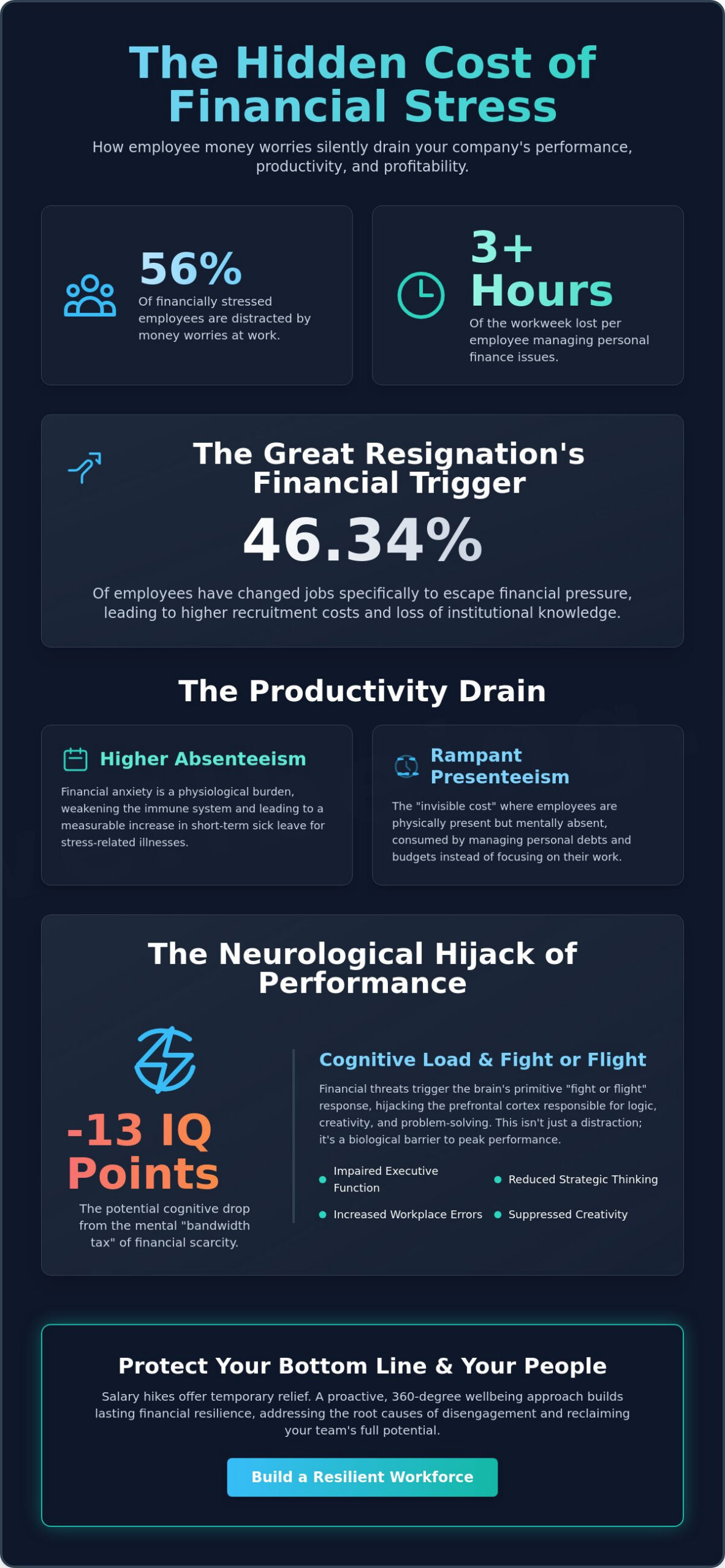
What if the most significant drain on your company’s productivity isn’t a lack of skill, but the silent weight of your team’s bank balances? In 2026, the impact of employee financial stress on business performance has become impossible to ignore, with 56% of financially burdened staff spending at least three hours of their workweek managing personal money worries. This cognitive load functions like a “hidden tax” on your operations, leading to high absenteeism and a rise in presenteeism where staff are physically present but mentally absent. You likely see this reflected in your turnover rates, as 46.34% of employees have already changed jobs specifically to escape financial pressure.
We understand that as a leader, you want to support your people without simply relying on unsustainable salary hikes. This guide promises to show you how to protect your bottom line by building a proactive, 360-degree support ecosystem. You’ll discover the clear ROI of financial wellness and learn actionable strategies to improve retention and engagement. We’ll explore how modern tools, from debt advice to integrated mental health support, create a resilient workforce that feels empowered to perform at their best every single day.
Key Takeaways
- Understand how the impact of employee financial stress on business performance translates into measurable costs through higher staff turnover and reduced operational efficiency.
- Learn why financial anxiety triggers a “fight or flight” response in the brain, effectively pausing the creativity and problem-solving skills your business relies on.
- Discover why salary increases often offer only short-term relief and how providing proactive money management tools creates lasting financial resilience.
- Explore how a 360-degree wellbeing approach, combining mental health support with practical debt advice, addresses the root causes of workplace disengagement.
- Gain a clear roadmap for auditing your company culture to ensure employees feel safe accessing support before a financial concern becomes a performance crisis.
The Hidden Cost: Quantifying the Business Impact of Financial Stress
By May 2026, financial stress has evolved from a private concern into a business-critical performance inhibitor. It acts as a silent drain on corporate energy, quietly eroding the foundations of productivity and growth. When your team members are preoccupied with rising interest rates or utility bills, they aren’t fully present for your clients or your strategy. The impact of employee financial stress on business performance is most visible in the widening gap between what your workforce can achieve and what they actually deliver. We define the Financial Stress Performance Gap as the measurable difference between an employee’s potential output and their actual performance when hindered by financial anxiety.
This gap isn’t just a conceptual problem; it’s an operational one. While absenteeism is easy to track on a spreadsheet, presenteeism remains the “invisible” cost. This occurs when staff are at their desks but are mentally managing debt or household budgets instead of working. Research in 2026 shows that 56% of financially stressed employees spend at least three hours of their workweek dealing with personal money issues. For a UK business, this represents a significant loss of billable time and creative focus that no amount of traditional management can recover.
The Absenteeism and Sick Leave Connection
Financial anxiety is a physiological burden as much as a psychological one. Chronic worry triggers a persistent “fight or flight” response, which floods the body with cortisol and eventually weakens the immune system. This biological wear and tear leads to an increase in short-term sick leave for physical ailments that have roots in mental strain. A foundational element of understanding occupational stress is recognizing that external pressures, like debt, don’t stay at the front door; they manifest as genuine illness.
In 2026, UK employers have seen a sharp rise in debt-related insomnia, which directly correlates with workplace errors and accidents. When employees don’t sleep because they’re worried about their bank balance, their reaction times and attention to detail suffer. This physical exhaustion is a leading reason why staff seek consultations through our Virtual GP service, often presenting with fatigue or recurring infections that stem from the underlying weight of financial insecurity.
Cognitive Load and the 13-Point IQ Drop
The mental “bandwidth” required to manage financial scarcity is immense. When an individual is trapped in a scarcity mindset, their executive function is impaired. It’s similar to a computer running heavy background processes; there’s less power available for the main task. Studies have shown that the cognitive load of poverty and debt can result in a drop of up to 13 IQ points, effectively lowering the collective intelligence of your workforce.
This cognitive drain is particularly damaging in high-pressure corporate roles where strategic thinking and complex decision-making are vital. A stressed brain prioritizes immediate survival over long-term planning. Consequently, your most talented managers might struggle to innovate or lead effectively because their mental resources are consumed by the immediate “threat” of their personal finances. Addressing this isn’t just about being a compassionate employer; it’s about reclaiming the full intellectual capacity of your team.
The Psychology of Money: Why Financial Anxiety Paralyses Performance
Money isn’t just math. It’s emotion. When the brain perceives a financial threat, such as an unexpected bill or a dwindling savings account, it triggers the amygdala. This is the same primitive region responsible for the “fight or flight” response. While this biological alarm system was useful for dodging predators, it’s disastrous for modern productivity. When the amygdala is hyper-active, the prefrontal cortex, which handles logic, creativity, and complex problem-solving, effectively shuts down. This neurological hijack is a primary reason why the impact of employee financial stress on business performance is so profound; your team isn’t just distracted, they’re biologically unable to do their best work.
This internal pressure often spills over into the wider team through a process called social contagion. Stress is rarely contained within a single cubicle. When one team member is visibly anxious or withdrawing due to debt, it lowers morale across the entire department. Despite its prevalence, the stigma of debt remains a powerful barrier. Many employees will hide their struggles until they reach a breaking point, fearing that admitting to money troubles might signal a lack of discipline or professional incompetence. This silence turns manageable issues into crises, making it a significant business concern that requires a proactive rather than reactive response.
Mental Health and Financial Interdependence
Debt and mental health exist in a relentless, cyclical relationship. Financial struggle is a leading driver of clinical depression and anxiety, which in turn makes it even harder for an individual to manage their budget or focus at work. Traditional Employee Assistance Programmes (EAPs) often miss the mark because they treat the symptom (anxiety) without addressing the cause (debt). Managers should look for early warning signs, such as uncharacteristic irritability, increased requests for overtime, or a sudden drop in engagement, as these often signal underlying financial distress. Integrating 360 Wellbeing’s Financial Support & Debt Advice into your strategy ensures you’re treating the whole person, not just the performance metric.
The Impact on Employee Retention and Loyalty
When an employee is under intense financial pressure, their loyalty to your company often becomes secondary to their survival. We see a recurring trend where talented staff leave secure roles for minor pay increases at rival firms, often just for an extra £100 or £200 per month. This “short-termism” is a direct result of financial desperation. However, the cost of recruiting a replacement, which can easily exceed £3,000 for even entry-level roles in the UK, far outweighs the investment in a financial support for employees programme. By providing tools that help staff manage what they already earn, you build a psychological contract based on genuine care, which is a far more powerful retention tool than a one-off bonus.
Beyond the Paycheck: Why Salary Increases Aren’t the Only Solution
When productivity dips, the traditional corporate reflex is to offer a salary increase. While competitive pay is vital, it often fails to resolve the underlying anxiety. This is due to the “Hedonic Treadmill,” a psychological phenomenon where individuals quickly adapt to a new income level, causing the initial relief of a pay rise to evaporate within months. If the root cause of an individual’s worry is poor money management or high debt, more cash simply fuels the same cycle. The impact of employee financial stress on business performance isn’t solved by liquidity alone; it requires a shift toward building long-term financial resilience and literacy.
Some leaders believe that personal finances are strictly outside an employer’s remit. However, when 59% of workers report being stressed about their finances in 2026, it becomes an operational priority. You aren’t just an employer; you’re a partner in their wellbeing. By providing a framework for financial health, you address the distraction at its source. This approach stretches the value of an existing salary through lifestyle benefits and professional guidance, creating a more stable and focused workforce without the constant pressure of unsustainable wage inflation.
The Limitations of the Annual Pay Review
Annual increments often struggle to keep pace with the rising cost of living, leaving many employees in a permanent deficit despite their hard work. In 2026, 58% of workers remain concerned that their salary isn’t keeping up with inflation. A 3% pay rise might look positive on a spreadsheet, but if household expenses have risen by 5%, the employee’s stress levels remain unchanged. This is where the “perceived value” of a benefits package becomes a strategic asset. By offering lifestyle benefits like 360 Rewards, you provide daily, tangible relief. Whether it’s a discount on the weekly food shop or reduced costs for family essentials, these savings provide a constant reminder that you’re looking out for their interests.
Empowering Staff Through Financial Education
True autonomy comes from knowledge. Shifting your strategy from “giving money” to “giving tools” empowers staff to take control of their own financial destiny. Providing access to professional Financial Support & Debt Advice or Life Coaching allows employees to restructure their outlook and manage credit more effectively. When a team member uses Complimentary Will Writing or Legal Support, they’re ticking off major life stressors that would otherwise consume their mental energy during office hours. A workforce that feels in control of their future is a workforce that can finally commit their full cognitive capacity to your business goals.
Strategic Intervention: Implementing a 360-Degree Financial Wellness Programme
Moving from understanding the problem to implementing a solution requires a shift in company culture. Before introducing new tools, you must audit whether your workplace feels safe for open dialogue. If employees fear that admitting to money worries will jeopardise their career progression, they’ll continue to hide their struggles. This silence masks the true impact of employee financial stress on business performance, leaving you to deal with the symptoms of absenteeism and low morale without ever reaching the root cause. A successful programme integrates support into the daily flow of work, making financial health as normalised as physical fitness.
Measuring the success of these interventions is essential for justifying the investment. We recommend tracking the correlation between benefit usage and your internal KPIs, such as a reduction in short-term sick leave or improved scores in quarterly engagement surveys. Since 56% of stressed workers spend work hours managing personal finances, a successful rollout should see a measurable return in focused “deep work” time. To achieve this, your support must be “always-on.” Financial emergencies don’t wait for office hours, so providing 24/7 access to resources ensures your team feels supported the moment a crisis occurs.
Immediate Support: Debt Helplines and Legal Advice
When an employee is in the middle of a financial crisis, they need a confidential safety net, not a generic pamphlet. Providing direct access to Financial Support & Debt Advice offers immediate relief from the “brain fog” that debt creates. This professional guidance helps individuals prioritise their outgoings and negotiate with creditors, which instantly lowers their cognitive load. Similarly, our Legal Support can prevent personal disputes or housing issues from escalating. By resolving these external pressures quickly, you ensure that personal legal complications don’t bleed into work hours or drain the employee’s mental energy.
Long-term Security: Will Writing and Life Planning
Financial wellness isn’t just about surviving the month; it’s about feeling secure in the future. Many employees carry significant “death in service” anxiety, worrying about how their dependents would cope without them. Offering Complimentary Will Writing is a high-value benefit that provides immense psychological relief by ticking off a major life task that many put off due to cost or complexity. This long-term perspective is further supported by Life Coaching, which helps staff align their professional growth with their personal financial aspirations. When employees see a clear path to security, their loyalty to your business deepens. You can view our full suite of financial wellness tools to see how these services integrate into a broader corporate strategy.
The 360 Wellbeing Approach: Building a Resilient Workforce
Addressing the impact of employee financial stress on business performance requires more than just a collection of disjointed tools. It demands a unified strategy that recognises how financial, mental, and physical health are deeply intertwined. At 360 Wellbeing, we provide a single ecosystem where these elements coexist. When an employee is struggling, they don’t need the added stress of navigating multiple providers or platforms. By centralising support, you ensure that help is always accessible, whether they need a 24/7 Virtual GP for a stress-related illness or expert debt advice to resolve the underlying cause of their anxiety.
The synergy between our services is where the real value lies for UK employers. For example, a team member suffering from insomnia due to money worries might first seek help from a GP. In a traditional setup, the medical consultation might end with a prescription. Within our 360-degree framework, that same employee is proactively guided toward financial helplines and mental health support. This joined-up approach directly reduces total absenteeism by treating the whole person rather than just the immediate symptom. A unified platform reduces administrative burden for HR while maximising employee engagement by centralising every support tool within a single, intuitive interface.
Holistic Health as a Strategic Asset
In the competitive UK market of 2026, wellbeing has moved from a “nice-to-have” perk to a fundamental pillar of business strategy. You shouldn’t view these services as a cost, but as an investment in your company’s operational resilience. Tools like 360 Rewards allow you to help staff manage the rising cost of living by providing significant discounts on daily essentials. This support effectively increases their disposable income without increasing your payroll tax or National Insurance contributions. The long-term ROI is clear: a workforce that feels financially secure is more loyal, more focused, and significantly more productive.
Getting Started with 360 Wellbeing
We’ve designed our onboarding process to be as seamless as possible, allowing even the busiest SMEs to scale their benefits quickly. You don’t need a massive HR department to offer “big corp” support. Our per-employee subscription model makes high-level benefits accessible to businesses of all sizes, ensuring your team stays protected as you grow. Every package is customisable, meaning you can tailor the support to meet the specific demographic needs of your staff, whether they’re Gen Z renters or older employees planning for retirement.
Your journey toward a more resilient workforce starts with a single proactive step. By choosing a partner who understands the clinical and emotional complexities of workplace health, you’re securing the future of your business. Discover how our platform supports your team’s financial health and start building a culture where every employee has the opportunity to thrive.
Securing the Future of Your Workforce
The evidence from 2026 is undeniable. Financial anxiety isn’t just a private struggle; it’s a significant cognitive drain that limits your team’s ability to innovate and perform. By moving beyond temporary salary fixes and embracing a 360-degree support ecosystem, you reclaim lost productivity and build a culture of genuine loyalty. Addressing the impact of employee financial stress on business performance is the most effective way to protect your bottom line while supporting the people who drive your success.
Our platform is already trusted by thousands of UK employees to navigate these modern challenges. We provide immediate relief through 24/7 Virtual GP access and comprehensive financial and debt support, ensuring your staff always has a place to turn. It’s time to transform your workplace into a hub of resilience and focus. Book a demo to see how 360 Wellbeing can transform your business performance. Together, we can create a healthier, more prosperous future for your entire organisation.
Frequently Asked Questions
How does financial stress specifically affect workplace productivity?
Financial stress creates a “scarcity mindset” that forces the brain to prioritise immediate survival over complex work tasks. This results in significant presenteeism, where staff spend their working hours mentally calculating bills or managing debt. The impact of employee financial stress on business performance is often seen in a rise in error rates and a slowdown in project completion times. Providing third-party support allows employees to offload this mental burden and refocus on their professional responsibilities.
Can an employer be held responsible for an employee’s financial wellbeing?
Employers aren’t legally liable for an individual’s personal debt, but they have a moral and operational duty of care to manage workplace stress. Under UK health and safety regulations, failing to address known stressors can lead to formal grievances or long-term sick leave. Investing in a wellness programme is a proactive way to meet these obligations while protecting the business from the high costs of staff burnout. It’s about creating an environment where people can thrive.
What are the most effective financial benefits for small businesses in 2026?
In 2026, the most effective benefits for UK SMEs include lifestyle discount platforms and professional debt advice. These tools provide immediate, tangible relief without the heavy tax burden of a direct salary increase. Offering services like Complimentary Will Writing or Legal Support also helps employees manage major life stressors that would otherwise distract them. These high-value, low-cost interventions allow smaller firms to compete with larger corporations for top talent while maintaining a lean budget.
How do I introduce a financial wellness programme without sounding intrusive?
The best approach is to frame financial support as one pillar of a broader, confidential wellbeing package. You don’t need to know the details of an employee’s bank balance to offer them help. By using a third-party platform like 360 Wellbeing, you ensure that all consultations remain private between the employee and the specialist. This removes the stigma of debt and encourages staff to seek help long before they reach a breaking point, fostering a culture of trust.
Is there a measurable ROI for financial wellbeing platforms?
The ROI is measured through a reduction in staff turnover and the recovery of lost productivity hours. With 46.34% of employees having changed jobs due to financial stress, the cost of replacing a single mid-level staff member can exceed £3,000 in recruitment and training costs. A comprehensive wellness programme pays for itself by retaining experienced talent and decreasing the number of working days lost to stress-related illness and financial distractions during the week.
What is the link between financial stress and physical health at work?
Financial stress triggers a persistent release of cortisol, which eventually weakens the immune system and leads to chronic exhaustion. This biological strain often manifests as recurring headaches, digestive issues, or debt-related insomnia. These physical symptoms are a primary driver for short-term absenteeism across the UK. By providing access to a 24/7 Virtual GP alongside financial advice, you address both the physical illness and the financial root cause simultaneously, ensuring a faster return to work.
How can lifestyle discounts help reduce employee financial anxiety?
Lifestyle discounts act as a “virtual pay rise” by lowering the cost of everyday essentials like groceries, fuel, and clothing. When employees save money on their weekly shop through 360 Rewards, their existing salary goes further, reducing the daily pressure of making ends meet. This immediate boost to their disposable income helps alleviate the low-level, constant anxiety that often leads to workplace disengagement and a “scarcity mindset” among your most valued team members.
What role does an EAP play in financial support?
A modern Employee Assistance Programme (EAP) acts as the first line of defence by providing a 360-degree support network. While traditional EAPs focused mainly on mental health counselling, today’s versions must include practical debt advice and legal support to be effective in 2026. This ensures that when an employee calls for help, they receive a holistic solution that covers their emotional state, their legal rights, and their practical financial challenges all in one place, creating a clear path forward.