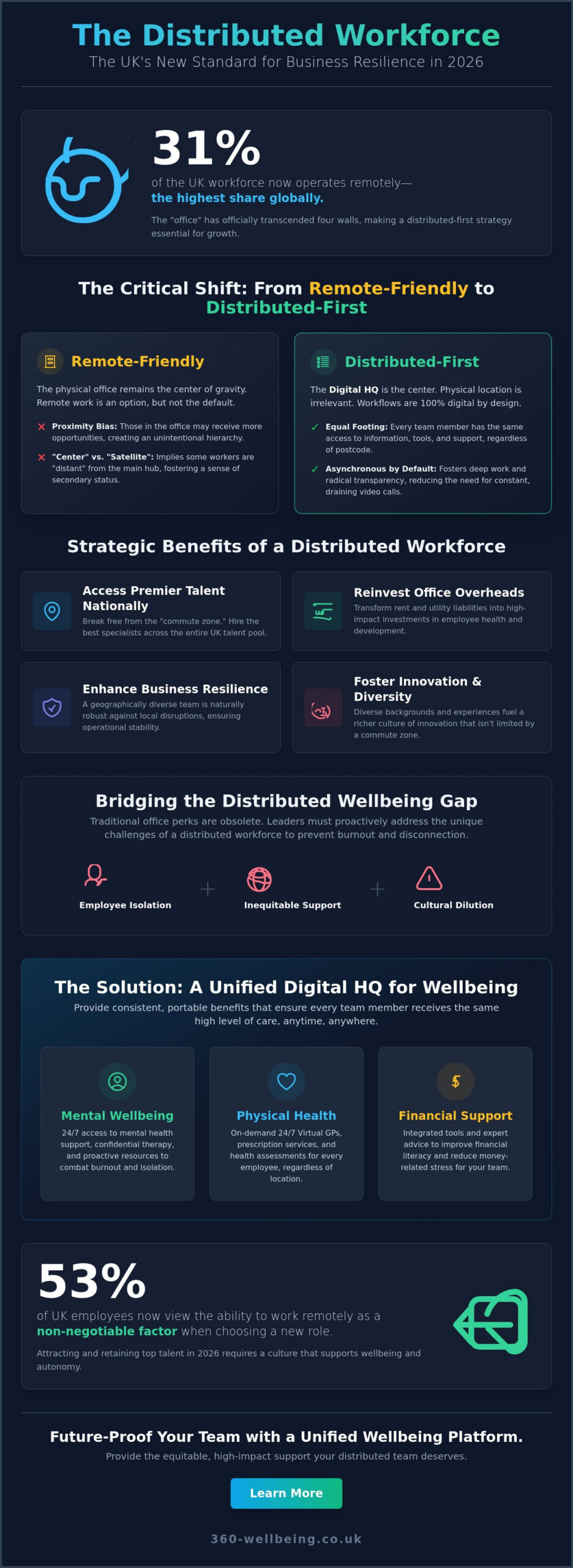
With 31% of the UK workforce now operating remotely, the highest share globally, the “office” has officially transcended four walls. Understanding the strategic benefits for a distributed team is no longer a luxury for forward-thinking leaders; it’s a fundamental requirement for staying competitive in 2026. You likely already know that managing a team across different postcodes brings unique challenges, from the quiet ache of employee isolation to the complexity of providing equitable support that feels as personal as an in-person conversation. It’s difficult to maintain a unified culture when your people don’t share a physical breakroom.
We promise to show you how to turn these geographical gaps into your greatest strengths, driving sustainable growth and deeper loyalty through a proactive, digital-first approach to care. This guide explores how to simplify your strategy by integrating mental, physical, and financial support into a single, panoramic vision of workplace harmony. We will look at how modern tools and a compassionate mindset allow you to access the best talent while ensuring every individual feels seen, supported, and empowered to thrive.
Key Takeaways
- Learn why transitioning from a “remote-friendly” culture to a truly distributed-first model is the new benchmark for UK business resilience in 2026.
- Explore the strategic benefits for a distributed team, including how to reallocate traditional office overheads into high-impact employee development and national talent acquisition.
- Discover how to bridge the “wellbeing gap” by replacing outdated office perks with essential digital health infrastructure like 24/7 Virtual GPs and mental health support.
- Understand the importance of portable benefits that ensure every team member receives the same level of care and professional support, regardless of their physical location.
- See how a unified wellbeing platform can serve as your “Digital HQ,” providing a consistent and simplified health strategy for your entire workforce.
What is a Distributed Team and Why is it the 2026 Standard?
By 2026, the concept of a “head office” has become a relic for many agile UK businesses. A truly distributed team operates with 100% digital workflows, where physical headquarters aren’t just empty; they often don’t exist at all. This evolution represents a shift from being “remote-friendly” to “distributed-first.” In the former, the office remains the sun around which everything orbits. In the latter, the digital infrastructure is the center. This model relies on radical transparency and asynchronous communication, ensuring that work happens effectively across different schedules and postcodes without the need for constant, draining video calls.
For many SMEs, the traditional head office has transitioned from an asset to a liability. It creates fixed overheads that don’t scale and limits your reach to a local talent pool. Embracing the benefits for a distributed team allows you to reinvest those saved rent costs into what truly matters: the health and professional growth of your people. It’s a move toward a more durable, flexible business structure that prioritizes results over presence.
Distributed vs. Remote: Understanding the Nuance
The term “remote” often carries a subtle, unintended weight. It implies there is a “center” or a “main hub” that a worker is distant from, which can inadvertently lead to a secondary status for those not in the room. This is where proximity bias takes root, where those physically closer to leadership receive more opportunities or support. A distributed model removes this hierarchy. Every staff member stands on equal footing regardless of their location. When you explore the foundational question of What is a virtual team?, you see that the goal is a unified digital organism where every individual has the same access to information and care.
The Drivers Behind the Distributed Revolution
Several factors have converged to make this the standard for 2026. Technological maturity is at the forefront. With 5G ubiquity and AI-driven collaboration tools, the digital workspace is now more reliable than the physical one. Employee expectations have also shifted permanently. Research shows that 53% of UK employees now view the ability to work remotely as a non-negotiable factor when choosing a new role. They aren’t just looking for a job; they’re looking for a lifestyle that supports their wellbeing and autonomy.
Economic foresight also plays a massive role. By removing geographic limits, you can hire the best talent across the UK, from the Highlands to the South Coast. This diversity of thought and experience is one of the primary benefits for a distributed team, fostering a culture of innovation that isn’t restricted by a commute zone. It’s a proactive strategy that balances business vitality with the personal needs of a modern workforce.
Strategic Business Benefits of a Geographically Distributed Workforce
Moving beyond the physical office isn’t just a logistical choice; it’s a strategic leap that redefines how a business creates value. One of the most immediate benefits for a distributed team is the radical expansion of your operational horizon. When you remove the requirement for a physical presence, you’re no longer managing a local company; you’re leading a national one with a far more resilient structure. This model allows for a level of agility that traditional setups simply cannot match, especially when navigating the shifting economic landscape of 2026.
The resilience of this model is often overlooked. A dispersed team is naturally more robust against local disruptions. Whether it’s a regional transport strike, a localized power outage, or extreme weather in one part of the country, your business operations remain steady. This geographic diversity acts as a natural insurance policy, ensuring that productivity doesn’t grind to a halt due to factors outside your control. It’s about building a business that is durable by design, moving away from the fragility of a single point of failure.
Accessing Premier Talent Nationally
The most significant constraint on growth for many SMEs is the “commute zone” cage. By embracing a distributed model, you unlock the entire UK talent pool. You can hire a specialist in Edinburgh, a creative lead in Bristol, and an analyst in Manchester, all working in a unified digital space. This doesn’t just fill roles faster; it brings a wealth of diverse perspectives that are often missing in localized teams. Widening your candidate net provides several clear advantages:
- Access to specialized skills that are rare in specific local markets.
- Increased diversity of thought by hiring from different regional backgrounds.
- A stronger employer brand that appeals to the 53% of UK workers who now prioritize remote flexibility.
Your employer brand receives a significant boost when you prioritize autonomy. It signals a culture of trust, which is a powerful motivator for high performers. Understanding the challenges and opportunities of remote work allows you to position your firm as a modern, forward-thinking partner in your employees’ professional journeys.
The ROI of the Dispersed Model
The financial argument for a distributed workforce is compelling. Fixed overheads like commercial rent, business rates, utilities, and office maintenance are often a company’s largest expenses after payroll. By reallocating these budgets, you can invest in high-impact tools that directly improve the lives of your staff. For example, the savings from a single mid-sized office can often fund a comprehensive digital wellbeing strategy for the entire workforce, providing a much higher return on investment through improved health and retention.
Distributed teams naturally reduce the hidden costs of presenteeism by shifting the focus from “hours at a desk” to tangible, high-quality outputs. This focus on results over presence is reflected in the data; 41% of UK employers report that productivity has actually increased with the move away from traditional office settings. It’s a more honest and effective way of working that respects the employee’s time while driving business growth.
Bridging the Distance: Addressing the Wellbeing Gap
While the benefits for a distributed team often focus on operational agility and cost savings, a significant gap remains in how we support the human at the other end of the screen. Digital isolation is a quiet but persistent risk. When an employee is no longer visible in a physical hallway, their struggles can become invisible too. This “Invisible Employee” syndrome isn’t just about loneliness; it’s a structural failure to provide the same level of care that an on-site first aider or HR manager would offer. In a dispersed environment, your duty of care must be even more intentional.
Traditional, office-centric Employee Assistance Programmes (EAPs) often fall short in 2026. They were designed for a world where support was a secondary thought to the physical office environment. Equitable care now means ensuring a staff member in a quiet rural village has the exact same 24/7 health access as someone in a central London hub. Without a physical headquarters, your digital safety net must be robust, reliable, and always available to provide the reassurance your team deserves.
Mental Health in a Digital Workspace
Losing those spontaneous “watercooler moments” is more than a social loss; it’s capable of triggering social anxiety and a sense of professional drift. Proactive mental health support is a professional necessity to prevent the quiet creep of burnout. Digital life coaching now fills the gap left by traditional in-person mentorship, offering a panoramic viewpoint on an employee’s personal and professional growth. This supportive framework ensures that isolation doesn’t become the default state for your people, fostering workplace harmony across any distance.
Physical Health and the Sedentary Remote Worker
Physical health challenges often hide in plain sight within a home office. Without the ergonomic oversight of a corporate facilities manager, sedentary habits can quickly lead to physical limitations and discomfort. Providing easy access to physiotherapy helps manage these risks before they escalate into long-term issues. Because there’s no longer a physical first-aid station, a virtual GP serves as the primary gateway to care, offering clinical expertise whenever it’s needed. Setting clear digital boundaries is equally vital to protect the social health of your team and prevent the exhaustion of an “always-on” culture.
Designing Equitable Employee Benefits for Distributed Teams
In 2026, the definition of a competitive benefits package has undergone a fundamental shift. We’ve moved past the era of office-bound perks like ping-pong tables or catered lunches. These have been replaced by a more durable form of support: health and lifestyle infrastructure. The most effective benefits for a distributed team are those that are entirely portable. They must follow the employee wherever they choose to work, ensuring that a staff member in a remote coastal village receives the same high standard of care as someone in a major city. This equity is the cornerstone of a modern, compassionate workplace.
Establishing a “Wellbeing Hub” serves as the digital heart of your company. It replaces the physical lobby with a space dedicated to the health and vitality of your people. When benefits are integrated into a single, accessible platform, they become a professional necessity rather than an afterthought. This panoramic approach to care ensures that your team feels valued and protected, which is essential for maintaining loyalty in a dispersed environment. It’s about creating a sense of safety and order that allows your workforce to focus on their best work without the distraction of unmet personal needs.
Health and Clinical Support
Clinical support should be immediate and reliable. Providing 24/7 Virtual GP access is a vital component of this infrastructure, allowing your team to bypass local NHS waiting times and speak with a professional at their convenience. This level of accessibility is especially important for distributed workers who may not have easy access to physical clinics during standard business hours. A structured Employee Assistance Programme (EAP) goes much further than a simple helpline. It offers a clear, methodical path toward mental and physical recovery, incorporating specialist mental health support and physiotherapy to address the unique challenges of sedentary, digital-first roles.
Financial Wellbeing and Legal Protection
Financial and legal security are often the most overlooked pillars of employee care. Offering robust financial support is a critical differentiator for employers who want to show genuine empathy for their team’s life outside of work. Debt advice and financial guidance provide a sense of reassurance that is essential for long-term mental health. By including complimentary will writing and legal support, you help remove the heavy burden of personal admin that can often lead to stress and reduced productivity.
The benefits for a distributed team should also include practical, everyday value. Integrating a platform like 360 Rewards helps employees manage the cost of living through a dedicated discount marketplace. This combination of clinical expertise and financial foresight creates a unified narrative of total wellness that is both scientifically grounded and deeply personal. You can view our full range of digital-first benefits to see how they can be tailored to your specific workforce requirements.
Future-Proofing Your Team with 360 Wellbeing
As we have explored, the transition to a distributed model requires more than just a change in location; it demands a change in how we anchor our people. In the absence of a physical office, the 360 Wellbeing platform acts as your “Digital HQ” for employee health. It provides a consistent, reliable space where every team member can find the clinical expertise and emotional support they need. This digital infrastructure ensures that the benefits for a distributed team are not just theoretical concepts but practical, daily realities that support the long-term durability of your business.
The beauty of this approach lies in its simplicity. We offer a single per-employee subscription that provides a global-standard package of care, removing the complexity of managing multiple providers or fragmented perks. This model is built to scale alongside your ambitions. Whether your team is a small collective of five specialists or a growing force of 500 spread across the country, the level of support remains uniform and high-quality. It allows you to grow with confidence, knowing your digital safety net is already in place.
Many UK SMEs are already using this strategy to out-compete larger rivals for premier talent. While big corporations often struggle with clunky, office-based legacy systems, smaller, more agile firms are offering a proactive and personal vision of wellness. By providing immediate access to essential services, these businesses are building a more productive and loyal workforce that feels genuinely seen and valued. It is a modern partnership that prioritizes the human element of the corporate strategy.
The All-in-One Wellbeing Solution
Our platform integrates 24/7 Virtual GP access, Mental Health Support, and the 360 Rewards marketplace into one seamless experience. This unification significantly reduces the administrative burden on your HR team, as there is only one system to manage and one point of contact. You also gain access to data-driven insights into your team’s collective wellbeing. These panoramic viewpoints allow you to identify trends and offer support where it’s needed most, all while maintaining the strict privacy and confidentiality your employees expect. It’s about being proactive rather than reactive, moving away from fear-based health management toward a positive culture of vitality.
Taking the Next Step
Transitioning from a collection of fragmented perks to a holistic wellbeing strategy doesn’t have to be overwhelming. We are here to guide you through this journey, helping you replace outdated office-based ideas with a modern, digital-first framework. The first step is a professional consultation where we can tailor the platform to the specific needs of your workforce, ensuring every individual has the tools to thrive in a distributed environment. This is your opportunity to move beyond the limitations of the traditional office and embrace a more balanced, supportive way of working. Empower your distributed team with 360 Wellbeing today.
Building a Resilient, Boundaryless Future
Embracing a distributed model is about more than just operational efficiency; it’s a commitment to a more inclusive and human-centric way of working. By shifting your focus from physical presence to portable, digital-first infrastructure, you ensure every team member feels valued regardless of their location. The strategic benefits for a distributed team range from accessing the UK’s premier talent pool to creating a more durable, agile business structure that thrives on results rather than desk time. It’s a proactive path forward.
Your duty of care is the foundation of this growth. Providing 24/7 access to UK-registered GPs, along with comprehensive Mental Health and Life Coaching support, creates a safety net that traditional office-based plans simply can’t match. When you include financial and legal helplines as standard, you remove the personal stressors that often hinder professional success. It’s time to replace outdated perks with a panoramic vision of total wellness that follows your people wherever they go. We invite you to protect and empower your distributed workforce with 360 Wellbeing and take the next step toward a more harmonious, high-performing future.
Frequently Asked Questions
What are the main benefits for a distributed team compared to a traditional office?
The primary benefits for a distributed team include accessing a wider talent pool and reducing fixed operational costs. By removing the need for a physical headquarters, you can hire the best talent from across the UK while reinvesting savings into digital health infrastructure. This model also enhances business continuity, as your operations aren’t tied to a single physical location that could be affected by local issues.
How do you maintain company culture in a distributed workforce?
Culture is maintained through intentional digital communication and equitable support systems rather than physical proximity. You can foster a sense of belonging by replacing office perks with shared digital experiences, such as a unified wellbeing hub. Consistent transparency and a focus on results over presence ensure every team member feels like an equal partner in the company’s success, regardless of where they log in.
Is a distributed team more productive than an office-based one?
Many UK employers report higher productivity levels in distributed settings due to reduced commuting stress and fewer office distractions. Data shows that 41% of employers believe productivity has improved with the shift to hybrid or remote work. By allowing staff to work in environments where they can focus on “deep work,” you unlock a more efficient workforce that is often more satisfied in their roles.
What are the best employee benefits for remote and distributed workers in the UK?
The most effective benefits for a distributed team are those that are portable and digital-first. Essential infrastructure includes 24/7 Virtual GP access, mental health support, and financial guidance. These services provide tangible value to employees regardless of where they live, ensuring that your support is equitable and accessible. Moving from office-bound perks to lifestyle infrastructure is the key differentiator for modern employers.
How can I provide health insurance or GP access to a distributed team?
You can provide clinical support through a digital-first wellbeing platform that offers 24/7 Virtual GP services. This bypasses local NHS waiting times and gives staff immediate access to UK-registered doctors from their own homes. It’s a simpler, more accessible path to care than traditional on-site services, ensuring that your team has professional medical advice whenever they need it, without the need for travel.
What are the legal requirements for supporting the wellbeing of remote staff?
UK employers have the same health and safety responsibilities for remote workers as they do for office staff. This includes conducting risk assessments for mental health, stress, and the home working environment. You’re legally required to provide a duty of care that covers both physical safety and psychological wellbeing, ensuring that your digital health strategy meets these essential statutory obligations for all staff.
How much does an employee wellbeing platform cost for a small distributed team?
Costs for a wellbeing platform are typically structured as a simple per-employee subscription, making it a predictable and scalable expense for your business. While the total depends on the specific services included, it’s often significantly lower than the cost of maintaining a physical office or traditional corporate insurance. For small teams, this approach provides a cost-effective way to offer a global-standard package of health and lifestyle support.
Can a distributed team work effectively across different time zones?
Distributed teams thrive across time zones by using asynchronous workflows and structured digital documentation. This approach reduces the need for real-time meetings and allows work to progress around the clock without causing burnout. By focusing on clear ownership and digital-first communication, you can turn geographic diversity into a strategic advantage that keeps your business moving forward at all hours of the day.