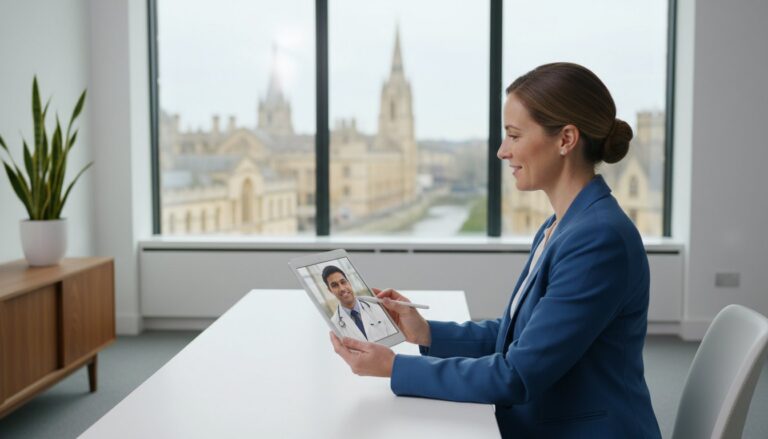
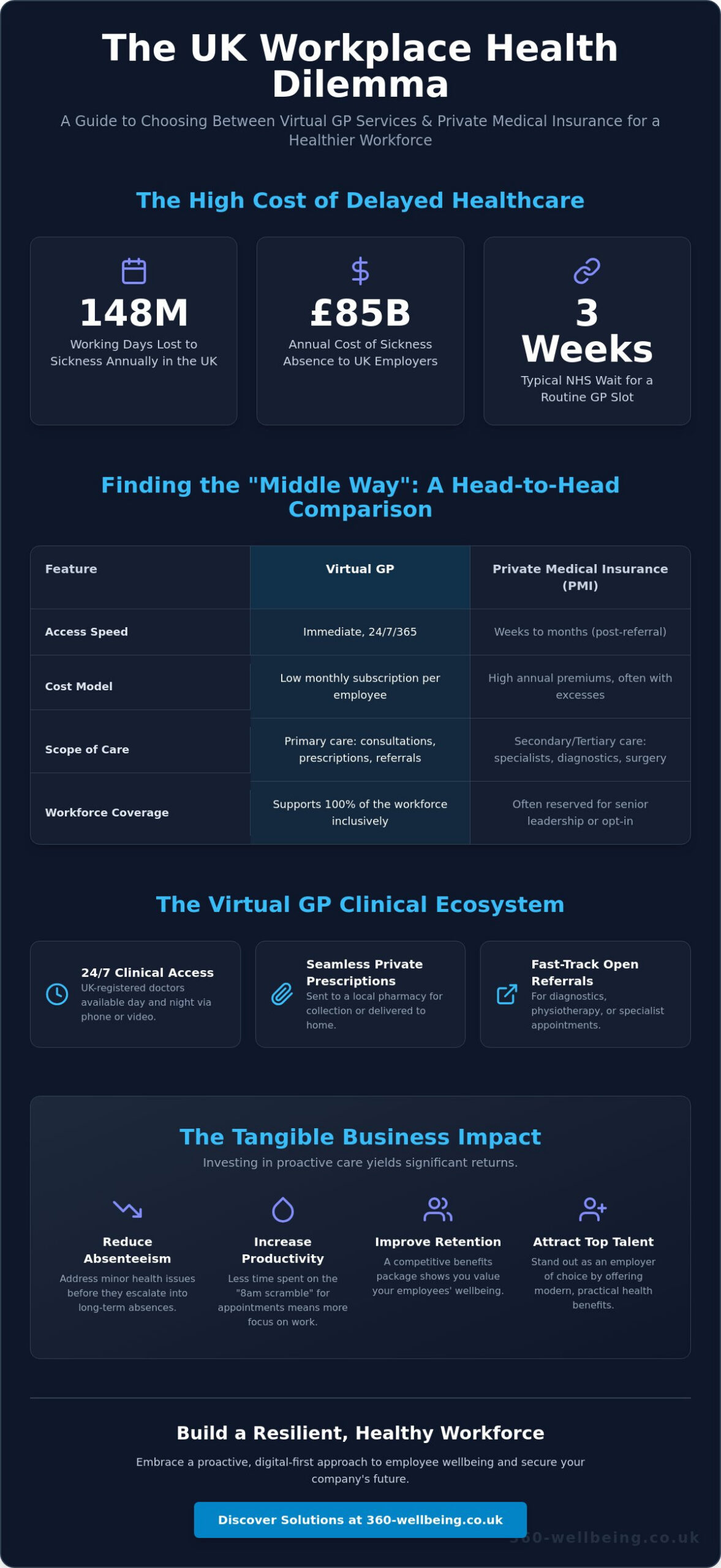
With 148 million working days lost to sickness absence annually in the UK, the pressure on your business and your people has never been higher. It’s a common struggle for employers who see staff taking entire days off just to secure a ten-minute GP slot, or watching minor health concerns spiral into long-term absences due to three-week NHS wait times. When you’re comparing a virtual gp vs private medical insurance uk, the decision often feels like a difficult choice between an overstretched public system and the soaring costs of traditional group premiums.
We understand that you want to be a supportive partner in your employees’ health journeys without overextending your budget. You can provide your team with 24/7 clinical access and immediate peace of mind, helping you build a resilient workforce and a competitive benefits package that aids recruitment. This guide explores how a digital-first “clinical front door” bridges the gap between basic care and full-scale insurance, ensuring your team stays healthy and productive while protecting your bottom line in 2026.
This guide examines the strategic shift in UK corporate wellness, focusing on how a virtual gp vs private medical insurance uk can address the current healthcare crunch. We explore the role of 24/7 clinical access in reducing the £85 billion annual cost of sickness absence, providing your team with immediate reassurance without the high premiums of traditional insurance. You’ll learn how fast-tracked private prescriptions and digital consultations fit seamlessly into busy work schedules, ensuring that minor health concerns don’t escalate into long-term issues.
We also delve into the holistic 360-degree approach, illustrating how mental health support and financial advice create a complete narrative of care. The article provides a practical implementation roadmap for SMEs, helping you assess workforce demographics and select scalable, subscription-based platforms. By moving toward a proactive vision of workplace harmony, you can enhance your recruitment and retention efforts while providing an essential human entitlement to health. This comparison ensures you have the foresight to build a durable, supportive environment where every employee can thrive.
Virtual GP for Employees: Solving the UK Healthcare Access Crisis
The 2026 healthcare landscape presents a unique challenge for UK business leaders. With NHS wait times for routine appointments now averaging one to three weeks, many employees find themselves stuck in the “8am scramble,” desperately calling their local surgery only to be met with busy tones. According to recent data, 38% of patients report that contacting their practice by phone is difficult. This “healthcare crunch” doesn’t just affect the individual; it ripples through your entire organisation. Sickness absence costs UK employers around £85 billion annually. When you’re evaluating virtual gp vs private medical insurance uk, it’s clear that the old model of reactive “sick care” is being replaced by proactive workplace wellbeing. Instead of waiting for a crisis, forward-thinking companies are providing a digital clinical lifeline that offers 24/7 access to UK-registered doctors via video or phone consultations.
The Evolution of Primary Care in the Workplace
Remote consultations have transitioned from a pandemic-era necessity to the gold standard for immediate primary care. This shift isn’t just about convenience; it’s about durability and foresight in how we manage health. A virtual GP service acts as a 24/7 clinical lifeline for modern staff, offering reassurance at the exact moment it’s needed. By resolving minor ailments or providing immediate referrals digitally, these services significantly reduce the burden on physical NHS surgeries. It allows local communities to focus on complex, in-person care while your employees get the fast-tracked support they deserve. Technology has bridged the gap, ensuring that health advice is an essential human entitlement that fits around the working day rather than disrupting it.
The “Middle Way” Between NHS and PMI
For many SMEs, traditional Private Medical Insurance (PMI) remains a significant financial commitment. While Private Healthcare in the UK offers exceptional benefits, the high premiums often mean it’s reserved for senior leadership or excluded from the budget entirely. This is where the comparison of virtual gp vs private medical insurance uk becomes vital for strategic planning. Standalone virtual GP services provide the speed and clinical excellence of private care at a fraction of the traditional insurance cost. It’s a panoramic approach to wellness that allows you to support 100% of your workforce. Every employee, regardless of their role or seniority, gains immediate clinical reassurance. This inclusivity fosters a sense of workplace harmony and ensures that no one is left behind in their health journey. Productivity stalls when care is delayed, but providing an immediate clinical front door keeps your team active and empowered.
Key Features of a Corporate Virtual GP Service
A modern virtual doctor service is far more than just a video call. It’s a sophisticated clinical ecosystem designed to provide immediate resolution for health concerns that would otherwise keep an employee away from their desk. When weighing up a virtual gp vs private medical insurance uk, it’s the speed of these integrated features that often defines the return on investment for an SME. Instead of waiting days for a local appointment, staff can access clinical support 24/7, 365 days a year. This flexibility is essential for shift workers or teams with demanding schedules who cannot easily step away during traditional surgery hours.
Beyond the Consultation: Prescriptions and Referrals
The journey doesn’t end when the video call finishes. If a doctor identifies a need for medication, the process is entirely seamless. Through a secure mobile app, employees receive private prescriptions that can be sent directly to a local pharmacy for collection or even delivered to their home. This level of efficiency is a hallmark of the UK’s digital health and care sector, which prioritises patient choice and rapid intervention.
Equally important are “open referrals.” If an employee needs diagnostic imaging or physiotherapy, a virtual GP can issue a referral letter that allows the patient to access secondary care quickly. This fast-tracking is vital; it prevents minor musculoskeletal issues or acute symptoms from escalating into long-term disabilities. By providing these integrated clinical support options, you ensure your team has a clear, supported path back to full health.
Clinical Safety and Care Quality Standards
Trust is the foundation of any healthcare partnership. Every clinician providing these services must be a UK-registered GP or an Advanced Clinical Practitioner (ACP) with extensive experience. These professionals are regulated by the General Medical Council (GMC) and the services are overseen by the Care Quality Commission (CQC). This ensures that the clinical advice your staff receives meets the same rigorous standards as an in-person NHS consultation.
Data privacy is another non-negotiable pillar. Corporate wellbeing platforms use encrypted technology to ensure medical confidentiality is maintained at all times. To ensure continuity of care, digital clinical notes can be shared with the employee’s regular NHS doctor with their consent. This integration means that the virtual GP isn’t a siloed service but a collaborative partner in the user’s long-term health journey. When considering a virtual gp vs private medical insurance uk, this focus on clinical safety and interoperability provides the reassurance that your team is in expert hands.
The Business Case: Reducing Absenteeism and Boosting Retention
The financial impact of ill health on a business extends far beyond the empty desk of an absent colleague. While sickness absence costs the UK economy around £85 billion each year, “presenteeism,” where staff work while unwell and unproductive, often carries an even higher hidden price tag. When you’re making a strategic choice between a virtual gp vs private medical insurance uk, the primary goal is to provide a safety net that catches health issues before they escalate. Early clinical intervention is the most effective way to prevent a minor acute ailment from becoming a chronic workplace absence. By offering immediate access to a doctor, you’re not just providing a perk; you’re building a durable framework for operational continuity.
This proactive approach creates a powerful synergy between physical health and mental clarity. Often, physical symptoms are exacerbated by external pressures, such as financial or legal worries. Providing Financial Support for Employees alongside clinical care ensures you’re addressing the root causes of stress that lead to long-term burnout. It’s a panoramic view of wellbeing that recognises health as a professional necessity, ensuring your team feels supported from every angle.
Calculating the ROI of Proactive Physical Health
The most immediate return on investment comes from the hours saved. Traditional GP appointments often require staff to take a half or full day of leave for travel and waiting room delays. In contrast, a digital consultation can be completed in fifteen minutes during a break. Providing 24/7 GP access can reduce health-related productivity loss by significantly reducing waiting times, as employees no longer need to wait the typical one to three weeks for an NHS routine appointment. This efficiency aligns with broader national shifts, such as Digitising the NHS frontline, which highlights the critical role of technology in modernising care. Beyond the data, the psychological benefit of immediate clinical reassurance cannot be overstated; knowing an expert is available at any hour significantly reduces the anxiety that often accompanies a new symptom.
Enhancing the Employee Value Proposition (EVP)
In the competitive talent market of 2026, employees prioritise holistic wellbeing benefits over minor salary increases. They’re looking for a partner who is invested in their long-term success rather than just a one-off service provider. Whether your team is remote, hybrid, or office-based, a virtual GP ensures that every individual has equal access to care regardless of their location. This inclusivity demonstrates a culture of empathy and expert care, positioning your brand as a forward-thinking employer. When you compare a virtual gp vs private medical insurance uk, the virtual GP model often wins on accessibility, ensuring that high-quality clinical support is an essential human entitlement for your entire workforce, not just a select few.
Implementation Guide: Integrating Virtual GP into Your SME
Moving from a theoretical interest to a practical rollout requires a structured approach. For many smaller organisations, the choice of virtual gp vs private medical insurance uk isn’t just about clinical features; it’s about administrative ease and budget durability. Unlike complex insurance schemes that require lengthy medical history declarations, a standalone virtual GP service can be integrated into your business in a few clear steps. This process ensures that your investment becomes a permanent, valued part of your workplace culture.
- Step 1: Assess Needs. Look at your workforce demographics and common health hurdles. Are your staff struggling with childcare-related health appointments or perhaps physical strain from manual roles? Identifying these pain points allows you to frame the service as a specific solution rather than a generic perk.
- Step 2: Prioritise Predictability. Select a subscription-based platform. This ensures cost predictability and ease of scale as your team grows, avoiding the volatile premium hikes often associated with traditional medical insurance.
- Step 3: The Launch. Drive initial engagement with a dedicated “Wellbeing Week.” Use this time to help staff download the app and understand that clinical support is now an essential human entitlement available to them 24/7.
- Step 4: Manager Empowerment. Train your line managers to refer staff to the virtual GP as a first point of contact for non-emergency issues. This proactive guidance helps reduce absenteeism before it starts.
- Step 5: Data Review. Regularly review anonymised usage data. Understanding which services are most used helps you refine your broader health strategy and ensure your investment remains targeted.
Choosing the Right Provider for Small Businesses
Sustainability is the cornerstone of any SME benefit. Per-employee monthly fees are often more manageable for smaller cash flows than fixed annual contracts. You should look for a partner that offers a “total wellness” approach rather than a fragmented service. A disjointed system that separates physical health from mental support can feel confusing for the user. A single, user-friendly app that provides a panoramic view of health ensures that your team feels cared for as whole individuals. This foresight in selection leads to a more durable benefit that staff actually use.
Driving Engagement and Internal Awareness
The biggest hurdle to adoption is often the “digital trust” gap. Employees need clear reassurance that their consultations are private and that their employer cannot access their medical records. Using internal champions to share positive experiences can bridge this gap effectively. Regular digital reminders keep the service top-of-mind, ensuring it isn’t forgotten until a crisis occurs. This clinical care works best when it complements other pillars of support, such as financial support, creating a unified package that addresses both physical symptoms and the stress that often causes them. To start building this supportive environment for your team, explore our corporate wellbeing solutions today.
Beyond the Consultation: The 360 Wellbeing Holistic Advantage
True wellness is rarely found in a single prescription or a one-off consultation. While the comparison of virtual gp vs private medical insurance uk often focuses on cost and clinical speed, the real differentiator for your business lies in the depth of support provided after the call ends. At 360 Wellbeing, we believe in a panoramic view of health that integrates physical, mental, and social wellness into a single, unified narrative. A headache might be a clinical symptom, but it can also be a physical manifestation of stress caused by debt or a complex legal worry. By addressing these root causes alongside the medical symptoms, we move beyond reactive care toward a proactive vision of workplace harmony.
Our philosophy treats wellbeing as a professional necessity and an essential human entitlement rather than a luxury. This means providing a seamless referral path from a GP consultation directly into mental health therapy, life coaching, or physiotherapy. When your employees feel supported in every aspect of their lives, they bring their best selves to work. This holistic approach ensures that your team doesn’t just recover from illness but thrives with long-term vitality. It’s about creating a culture where health is managed with foresight and care.
Total Wellness: The Synergy of Care
A GP consultation is often just the first step in a wider health journey. For example, a doctor might identify that an employee’s physical fatigue is linked to the anxiety of an unresolved legal issue. In our ecosystem, that same employee can access complimentary will writing or expert debt advice within the same platform. This synergy of care ensures that social and financial pressures don’t undermine clinical outcomes. It transforms the service from a simple “perk” into a durable safety net that protects your workforce from the complexities of modern life. By providing clinical support alongside financial and legal guidance, you offer a completeness of care that traditional insurance models often struggle to match.
Our Commitment to Your Team’s Success
Since 2019, we’ve been supporting UK organisations with modern health technology that remains deeply personal and approachable. We don’t see ourselves as just another software provider; we are your expert caregiver and a dedicated partner in your employees’ success. Our approach is scientifically grounded yet delivered with a warm, human touch that avoids the coldness of traditional medical services. We are invested in the long-term durability of your team’s health, providing the foresight needed to navigate the challenges of the 2026 workplace. Every interaction is designed to provide reassurance and reliability, ensuring your staff feel empowered to take control of their wellbeing.
It’s time to provide your team with the balance and clinical excellence they deserve. Explore our 24/7 Virtual GP and holistic wellbeing platform to see how we can help your business achieve total wellness and lasting workplace harmony.
Building a Resilient Workforce for 2026 and Beyond
Choosing between a virtual gp vs private medical insurance uk is about more than just managing costs; it’s about making health an essential human entitlement for every member of your team. By providing a digital clinical front door, you’re removing the barriers of the 8am phone scramble and three-week wait times. This proactive approach ensures minor ailments don’t escalate into long-term absences, keeping your business durable and your employees feeling truly valued.
A modern wellness strategy must look at the whole person. Our platform integrates physical health with mental health support and financial advice, addressing the root causes of stress that lead to burnout. We’ve designed this ecosystem specifically for SMEs and sole traders, ensuring that 24/7 UK-registered GP access is accessible and sustainable for your growing business. This foresight in care provides the clinical reassurance your staff need to thrive while protecting your bottom line.
Ready to transform your workplace culture? Book a demo of the 360 Wellbeing platform and 24/7 Virtual GP to see how we can support your team’s long-term vitality. Let’s build a healthier, more harmonious future for your organisation together.
Frequently Asked Questions
Is a virtual GP as effective as a traditional face-to-face appointment?
Virtual consultations are highly effective for approximately 70% of primary care concerns, including skin conditions, respiratory issues, and mental health support. While they don’t replace physical examinations for complex cases, the ability to share high-resolution photos and video allows for accurate clinical assessment in most routine scenarios. It’s a reliable first port of call that provides immediate reassurance without the travel time.
Can a virtual GP issue a sick note for an employee?
Yes, a virtual GP can issue a private fit note if they determine that an employee is clinically unfit for work. These notes are professionally recognised across the UK and can be sent directly to the employee’s smartphone or email. This bypasses the need for the employee to wait weeks for a physical appointment just to document their absence, helping you manage payroll and resources more effectively.
How much does a virtual GP service for employees typically cost in the UK?
When comparing a virtual gp vs private medical insurance uk, the cost structure is quite different. While individual private consultations in the UK typically range from £25 to £75, corporate packages are usually structured as a monthly subscription per employee. This model offers much greater cost predictability for SMEs than the fluctuating premiums and high entry costs of traditional medical insurance.
Can virtual GPs prescribe medication and how do employees collect it?
Virtual GPs can issue private prescriptions for most medications during a consultation. These are sent electronically to a pharmacy of the employee’s choice for local collection, or they can be delivered directly to their home address. This seamless integration ensures that treatment begins as quickly as possible, often on the same day the symptoms are first reported.
Are virtual GP services available 24/7, including weekends and bank holidays?
Most corporate virtual GP services are available 24 hours a day, 7 days a week, 365 days a year. This around-the-clock access is designed to fit around modern work schedules and varied shift patterns. It ensures that clinical support is available at the exact moment a health concern arises, providing peace of mind even when traditional surgeries are closed.
Is employee medical data kept confidential from the employer?
Employee medical data is strictly confidential and is never shared with the employer. Consultations are protected by the same patient-doctor confidentiality rules and GMC standards as any NHS surgery. Employers only receive high-level, anonymised usage data to help them understand the overall wellbeing of their workforce without ever identifying individual health records.
Can a virtual GP refer an employee to an NHS specialist?
A virtual GP can provide a private referral letter for specialist care or diagnostic tests. While they cannot directly book an appointment through the NHS internal system, the employee can present this letter to their regular NHS GP. This often helps speed up the process by providing a clear clinical recommendation for further investigation or secondary care.
What happens if an employee needs an urgent physical examination?
If a GP determines that a physical examination or urgent intervention is necessary, they’ll provide immediate guidance on the next steps. This might include advising the employee to visit their local NHS surgery or, in more serious cases, directing them to the nearest A&E or Urgent Care Centre. The GP stays on the call until the user understands the path forward and feels safe.