
With poor mental health costing UK employers an estimated £51 billion annually, it’s clear that workplace wellbeing has shifted from a luxury to a professional necessity. In 2023/24 alone, 22.1 million working days were lost to stress, depression, and anxiety, leaving many leaders feeling overwhelmed by their duty of care. You might be wondering how to build a safety net that actually works, starting with the fundamental question: what are the three main components of an eap?
We understand that the distinction between different types of support can feel confusing, especially when you’re trying to balance human empathy with business durability. You want to provide a reliable path forward for your staff without getting lost in complex jargon or reactive crisis management. It’s about finding a sense of balance and order that benefits everyone involved.
This guide will give you a clear framework to evaluate your wellbeing strategy by revealing the three foundational pillars of a modern Employee Assistance Programme. We’ll show you how clinical expertise, practical life support, and proactive organizational tools combine to protect your team and ensure your business thrives.
Key Takeaways
- Distinguish between an Emergency Action Plan and an Employee Assistance Programme to build your wellbeing strategy on a clear, reliable foundation.
- Learn how clinical mental health support serves as a vital safety net, providing your team with professional counselling and assessment when they need it most.
- Gain a panoramic view of workplace wellness by understanding what are the three main components of an eap, including clinical care, practical support, and management guidance.
- See how addressing the root causes of stress through financial and legal advice can foster a more focused, resilient, and proactive workforce.
- Discover how a scalable EAP framework helps you meet your duty of care while promoting long-term business durability and employee vitality.
What is an Employee Assistance Programme (EAP)?
In many industrial sectors, the acronym EAP refers to an Emergency Action Plan, a vital protocol for fire safety and evacuations. However, for HR directors and business owners, an Employee Assistance Program (EAP) represents something entirely different; it’s a confidential, workplace-funded intervention programme designed to support the mental, physical, and financial health of your workforce. It’s a structured way to offer help before personal challenges begin to impact professional performance.
Early iterations of these programmes often functioned as simple crisis hotlines, used only when an individual reached a breaking point. Today, the model has evolved into a proactive, holistic wellbeing platform. UK businesses are increasingly turning to these systems to combat the rising tide of absenteeism and turnover. By providing early support, employers can address issues before they lead to long-term sickness or resignations. This foresight helps maintain a stable, resilient team while showing staff that their health is an entitlement, not a luxury.
As we explore what are the three main components of an eap, it’s helpful to view the system as a bridge between a person’s private struggles and their professional vitality. It provides a structured path forward when life feels unmanageable.
The Core Purpose of a Modern EAP
The primary objective is to provide professional support for any issue that might impact job performance or overall wellbeing. A modern programme balances clinical expertise with a warm, human-centric approach. It creates a reliable safety net that covers both personal challenges, such as family disputes, and professional hurdles, like workplace stress. This panoramic approach ensures that employees feel seen as whole individuals. It’s about empowering people to regain their balance and return to their best selves through accessible, expert care.
EAP vs. Traditional Health Insurance
It’s helpful to distinguish an EAP from traditional private medical insurance models. While insurance often focuses on long-term clinical treatment or hospital stays, an EAP is built around short-term, solution-focused therapy. It acts as a first-line defence, catching problems early through low-barrier access. Because these programmes often offer 24/7 availability, staff can reach out for support the moment a challenge arises rather than waiting for a medical referral. This immediacy is essential for maintaining workplace harmony and long-term durability, providing a level of support that feels both scientifically grounded and deeply personal.
Component 1: Clinical & Mental Health Support
The clinical pillar is the heartbeat of any effective programme. It’s often referred to as the “bread and butter” of the framework because it provides the direct intervention employees need when life feels heavy. By offering short-term, solution-focused counselling, you give your team a dedicated space to process challenges like grief, anxiety, or workplace pressure. This support isn’t just about fixing a problem; it’s about providing the tools for long-term emotional durability.
Beyond standard sessions, a robust EAP includes professional assessment and referral services. Not every issue can be resolved in a handful of sessions. Some employees may require specialized care for complex mental health needs. In these instances, the EAP acts as a knowledgeable guide, ensuring the individual is directed to the right clinical pathway. This foresight ensures that the employee’s health and the company’s productivity are protected through a structured path forward.
24/7 crisis support lines provide immediate emotional reassurance that can be life-changing. Whether it’s 2 PM or 2 AM, having a professional at the end of the phone creates a profound sense of safety. This is a core part of understanding what are the three main components of an eap, as it addresses the unpredictability of human emotions with a steady, reliable presence.
Counselling and Therapy Models
Modern programmes often utilize Cognitive Behavioural Therapy (CBT). This evidence-based approach is highly effective for workplace recovery because it focuses on practical tools and reframing thought patterns. It’s vital that these services are delivered by BACP-accredited professionals to ensure clinical safety and expertise. We also see a positive shift toward Life Coaching, which moves the conversation from reactive healing to proactive personal growth and vitality.
Digital Access and Virtual Care
Accessibility is key to reducing the stigma often associated with seeking help. Smartphone apps allow staff to engage with support privately and at their own pace, making mental health feel like a manageable part of daily life. A significant addition to the modern EAP is the integration of Virtual GP services. Since physical symptoms like fatigue or tension often mirror mental distress, having 24/7 access to a doctor provides a complete, panoramic view of an employee’s health. This digital-first approach maintains strict confidentiality while making expert care feel personal and immediate.
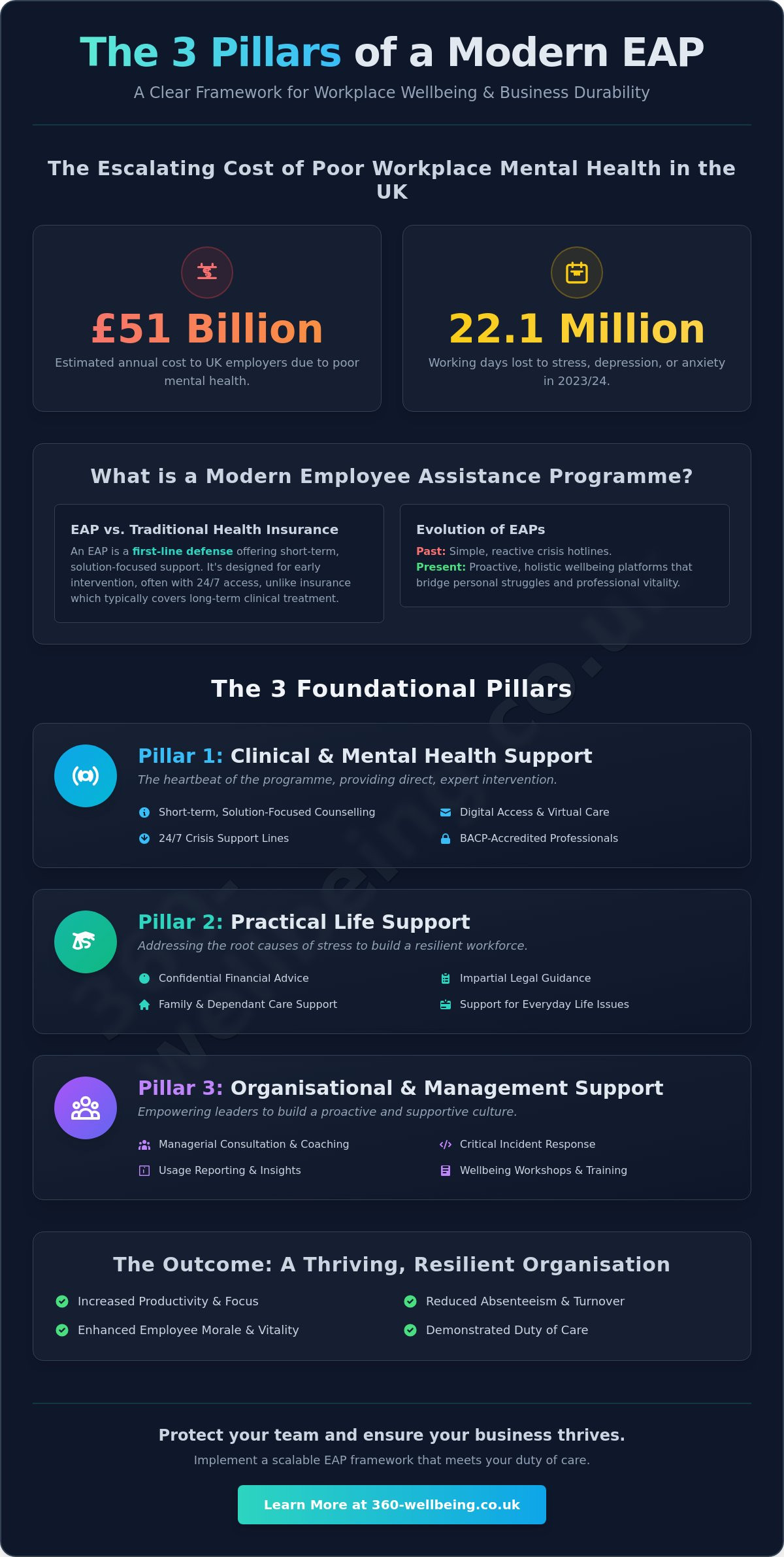
Component 2: Practical Life Support (Financial & Legal)
While mental health support is often the most visible element of a programme, practical life support is equally critical to a panoramic wellbeing strategy. If you’re asking what are the three main components of an eap, this second pillar focuses on the external stressors that weigh heavily on a person’s mind before they even step through the office door. It’s about recognizing that an employee’s professional vitality is deeply connected to their stability at home.
Practical support provides a safety net for the logistical and administrative burdens that often lead to burnout. This includes guidance on complex life events like finding suitable childcare or navigating eldercare resources for aging relatives. By offering these services, you reduce the cognitive load on your staff, allowing them to bring their full focus back to their roles. It’s a compassionate way to show that you’re looking out for their long-term interests as a partner in their success.
Understanding what are the three main components of an eap helps employers see that wellbeing isn’t just about clinical therapy; it’s about solving the real-world problems that cause distress in the first place. Providing these tools creates a sense of order and security that is essential for a harmonious workplace.
Financial Wellness and Debt Advice
Financial stress is frequently cited as a leading cause of employee distraction and anxiety in the UK. Integrating robust financial support into your core benefit package provides a proactive solution to this challenge. This support goes beyond simple advice; it provides access to debt helplines and budgeting tools that empower individuals to manage their finances with foresight and durability. A highly valued feature in modern programmes is complimentary will writing. This service offers staff immense peace of mind, ensuring their family’s future is secure and reducing a significant source of long-term worry.
Legal and Administrative Guidance
Legal disputes, whether they involve personal contracts or family law, can feel overwhelming and inaccessible. A modern EAP provides direct access to legal professionals who can offer clarity on non-employment related issues. This expert navigation helps employees resolve personal disputes efficiently, preventing them from escalating into crises that require time away from work. When a business provides this level of specialized care, it builds deep employee loyalty. It transforms the workplace from just a place of employment into a supportive environment where human entitlements are respected and protected through a unified narrative of total wellness.
Component 3: Organisational & Management Support
The final pillar of a robust programme shifts the focus from the individual to the collective workplace environment. While clinical and practical support provide essential care for the employee, organisational and management support ensures the business itself remains resilient. This is the third answer to the question of what are the three main components of an eap. It acts as a bridge between high-level HR strategy and the daily reality of team leadership.
Management consultation is a cornerstone of this component. Leaders often find themselves in difficult positions when a staff member’s personal life begins to affect their performance. An EAP provides a professional sounding board for managers, helping them handle sensitive staff situations with empathy and clinical foresight. Whether it’s navigating a complex disciplinary case or supporting a team through a period of intense change, this support ensures that leaders don’t have to carry the emotional burden alone.
Beyond daily management, this pillar includes critical incident stress management. In the event of workplace trauma or a sudden loss, an EAP provider can offer immediate, structured intervention to help the entire team process the event. This proactive approach to health promotion, often delivered through wellness workshops, transforms the programme from a reactive service into a proactive vision of workplace harmony. To see how these pillars can be integrated into your business, you can explore our Employee Assistance Programme options.
Empowering Managers and Leaders
Managers are often the first to notice when something is wrong, but they aren’t always equipped to respond. Training leaders to spot the physical symptoms of stress, such as chronic fatigue or irritability, allows for earlier intervention. A modern EAP establishes a partnership with the leadership team, providing them with the expertise needed to manage difficult conversations without overstepping professional boundaries. This creates a sense of safety and order within the management structure, allowing leaders to focus on growth while knowing their team’s wellbeing is supported by experts.
Data-Driven Wellbeing Strategy
One of the most powerful tools for HR professionals is the anonymised reporting provided by an EAP. By reviewing usage statistics, you can identify organisational stress trends without compromising individual confidentiality. If a specific department shows a high demand for financial support or stress counselling, you can implement targeted interventions to address the root cause. This data-driven approach is how businesses justify the ROI of an EAP. With UK employers seeing an average return of £10.85 for every £1 spent, these insights are essential for building a strategy that is both scientifically grounded and deeply personal. Understanding what are the three main components of an eap allows you to move beyond guesswork and toward a panoramic view of your company’s health.
Implementing a Modern EAP with 360 Wellbeing
Transitioning from understanding the theory to launching a practical programme is a significant step for any business. While we’ve detailed what are the three main components of an eap, the true value lies in how these pillars are integrated into a single, unified narrative of care. A modern wellbeing platform shouldn’t feel like a collection of disjointed services. Instead, it should offer a panoramic view of health that feels both scientifically grounded and deeply personal for every member of your team.
For many UK employers, especially small businesses and sole traders, the challenge has historically been accessibility. There’s often a misconception that comprehensive support is only for large corporations with massive budgets. However, the shift toward scalable, digital-first solutions means that professional-grade care is now available to organisations of all sizes. By choosing a platform that grows with you, you ensure that wellbeing remains a professional necessity and an essential human entitlement rather than a luxury that feels out of reach.
Understanding what are the three main components of an eap is just the beginning. The goal is to move away from reactive crisis management and toward a proactive vision of workplace vitality. This requires a partner who looks out for your long-term interests, providing a structured path forward that balances clinical expertise with a warm, human touch.
The 360 Wellbeing Advantage
Our approach centers on the seamless integration of physical, mental, and social health. By combining 24/7 Virtual GP access with our core Employee Assistance Programme, we provide a level of foresight that traditional models lack. If an employee is struggling with a physical ailment, they can speak to a doctor immediately; if that ailment is linked to workplace stress, they have a direct path to mental health support and life coaching. We maintain a supportive and empowering tone in every interaction, ensuring your staff feels supported by an expert caregiver who is genuinely invested in their success. This balance of clinical expertise and empathy is what builds true organisational durability.
Getting Started: A Methodical Path Forward
Launching your programme doesn’t have to be overwhelming. The process begins with a calm, methodical evaluation of your current benefits gap and the specific needs of your workforce. Once you’ve identified where support is most needed, the onboarding process introduces these tools as a vital part of your company culture. This isn’t just about meeting a statutory duty of care. It’s about establishing a partnership that protects your business and empowers your people to thrive. If you’re ready to take the next step toward a healthier, more resilient workplace, you can explore our Employee Wellbeing Platform to find a solution that fits your unique needs.
Building a Resilient Future for Your Workforce
Developing a workplace culture that prioritizes health as an essential human entitlement creates a foundation for long-term durability. By exploring what are the three main components of an eap, you’ve seen how clinical care, practical life support, and management guidance combine to form a complete safety net. This panoramic approach doesn’t just address symptoms; it fosters a proactive environment where every individual can thrive with a sense of safety and order.
A modern programme provides the foresight needed to catch challenges before they escalate into crises. With 24/7 UK-registered Virtual GP access, comprehensive mental health therapy sessions, and complimentary will writing included, you can offer your staff a unified narrative of total wellness. These tools provide the balance necessary to handle the complexities of modern work life with confidence and compassion, ensuring your business remains a supportive place to grow.
Investing in your team’s vitality is a professional necessity that yields lasting rewards for both your people and your business success. Discover how 360 Wellbeing can transform your team’s health and help you establish a partnership built on expert care and genuine support. Your journey toward a more harmonious and productive workplace starts with this methodical step forward.
Frequently Asked Questions
What are the three main components of an EAP in a wellbeing context?
The three core pillars are clinical mental health support, practical life support covering financial and legal issues, and organisational management assistance. Understanding what are the three main components of an eap helps businesses create a balanced safety net that addresses the whole person. This structured approach ensures that both an employee’s personal vitality and a company’s operational durability are protected through expert intervention.
How much does a standard EAP cost per employee in the UK?
According to research from May 2026, the average cost of an EAP in the UK is £14 per employee, per year. Small and medium-sized enterprises typically pay between £15 and £80 per head, while larger organisations with over 2,000 staff may see costs as low as £3.50 for basic telephone-only services. These industry averages help employers budget effectively while fulfilling their duty of care.
Is an Employee Assistance Programme confidential for staff?
Yes, strict confidentiality is a fundamental human entitlement within any professional programme. All counselling sessions and advice calls are private between the individual and the clinical provider. Employers only receive anonymised, high-level reporting that identifies broad organisational trends without naming individuals, which helps maintain a sense of safety and trust across the workforce.
Can an EAP help with financial problems and debt?
Absolutely. Practical life support is one of the answers to what are the three main components of an eap, specifically addressing the root causes of stress. These services provide debt advice, budgeting tools, and even complimentary will writing. By addressing these external pressures, the programme helps staff regain their focus and professional vitality during difficult periods.
What is the difference between an EAP and an Emergency Action Plan?
A wellbeing EAP is a clinical and practical support system for employees’ mental, social, and physical health. Conversely, an Emergency Action Plan is a health and safety protocol focused on physical safety during immediate crises like fires or building evacuations. While both are essential for workplace harmony, they serve entirely different operational and supportive purposes.
Does an EAP provide 24/7 access to a UK-registered GP?
Many modern, all-encompassing platforms like 360 Wellbeing integrate 24/7 Virtual GP access as a core feature. This allows staff to consult with a UK-registered doctor via video or phone at any time of day or night. It bridges the gap between physical symptoms and mental distress, providing a panoramic view of an individual’s health journey.
How do employees typically access EAP services?
Staff usually access support through dedicated smartphone apps, secure online portals, or 24/7 telephone helplines. This digital-first approach removes traditional barriers to care and allows employees to seek help privately at their own pace. It makes complex wellbeing topics feel manageable and accessible, whether they’re working from home or in the office.
What are the benefits of an EAP for small business owners?
Small business owners benefit from a significant return on investment, with UK employers seeing an average return of £10.85 for every £1 spent on an EAP in 2022-23. It helps reduce the 22.1 million working days lost annually to stress and anxiety in the UK. Providing these services also ensures that SMEs meet their statutory duty of care while supporting long-term staff retention.