
Life, both in and out of the office, can present challenges that feel overwhelming. Whether you’re an employee navigating personal difficulties, or an employer seeking meaningful ways to support your team’s mental and financial wellbeing, finding the right help can feel like a maze of confusing jargon and uncertainty. You may have heard the term mentioned, but what is an EAP, really? It’s far more than just another employee benefit; it’s a confidential lifeline designed to provide proactive, expert support when it’s needed most.
This complete guide for 2026 is here to provide the clarity you deserve. We will walk you through exactly what an Employee Assistance Programme is, the comprehensive range of services it includes-from counselling to legal advice-and how it serves as a cornerstone for a thriving workplace. We will also address the crucial question of confidentiality, giving you the confidence to use or champion this service. By the end, you’ll understand the true value of an EAP as a strategic asset for building a healthier, more resilient workforce across the UK.
Key Takeaways
- At its core, understanding what is an eap means recognising it as a confidential, employer-funded support system for both personal and professional challenges.
- Discover how a comprehensive EAP provides a 360-degree support system, covering everything from counselling to practical legal and financial guidance.
- For UK businesses, an EAP is a proactive investment in employee resilience and productivity, leading to reduced absenteeism and a stronger workplace culture.
- Learn why modern EAPs are evolving into integrated wellbeing platforms to overcome low engagement and provide truly accessible support for your teams.
What is an Employee Assistance Programme (EAP)?
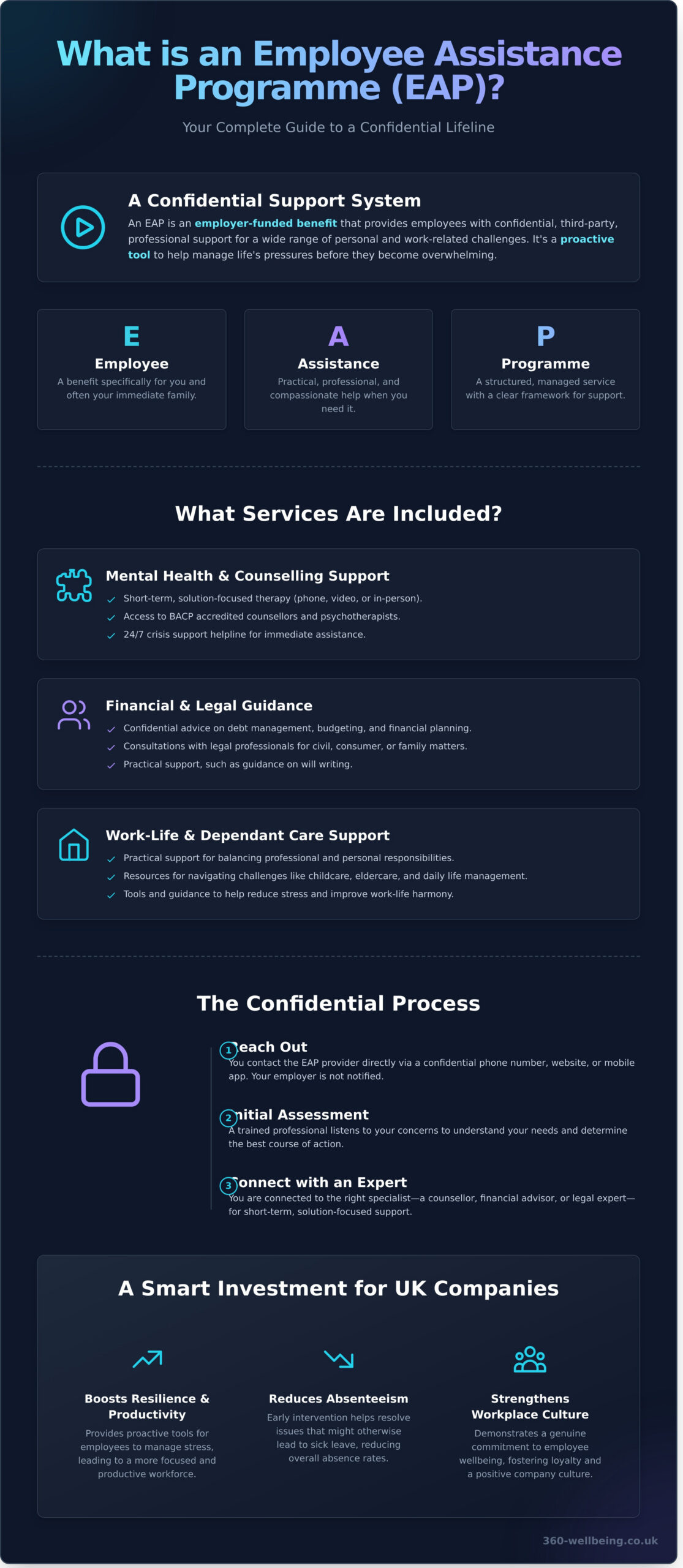
At its core, an Employee Assistance Programme (EAP) is a confidential, employer-funded benefit designed to support you with a wide range of personal and work-related challenges. Think of it as a comprehensive support system, provided at no cost to you, that helps you navigate life’s complexities and enhance your overall wellbeing. The primary goal of an EAP is to provide professional, impartial assistance to help you resolve issues that could be affecting your health, happiness, or performance at work.
Crucially, this service is delivered by an independent, third-party provider, ensuring complete confidentiality between you and the support professional. It is not simply a service for when things go wrong; it is a proactive tool you can use to build resilience and manage everyday pressures before they become overwhelming. An EAP provides a confidential lifeline for employees navigating life’s challenges, from mental health to financial stress. Understanding what is an EAP is the first step toward unlocking a powerful resource for your personal and professional life.
What does EAP stand for?
The acronym EAP stands for Employee Assistance Programme. Let’s break that down:
- Employee: This benefit is specifically for you, the employee. It recognises that your wellbeing is a vital asset.
- Assistance: It offers practical, professional, and compassionate help across various areas, including counselling, legal advice, and financial guidance.
- Programme: It is a structured, managed service with a clear framework for accessing support. These services have evolved significantly from their origins in the mid-20th century, as detailed in the history of the Employee Assistance Program.
Who is an EAP for?
An EAP is a truly inclusive benefit, available to every employee within the organisation, regardless of your role, seniority, or length of service. It’s a universal resource built on the principle that everyone deserves access to support when they need it. In many cases, this valuable support extends beyond the employee to include immediate family members, such as a partner or dependent children living in the same household. However, the specifics can vary, so it is always a good idea to check your company’s EAP policy to confirm exactly who is covered.
What Services Are Typically Included in a UK EAP?
When asking what is an EAP, the answer lies in its comprehensive, multi-faceted support system. While the exact services offered can vary between providers, most modern UK programmes are built on several core pillars of support designed to help you navigate life’s personal and professional challenges. Think of it as a confidential toolkit for your total wellbeing.
Here are the three main areas of support you can typically expect from your Employee Assistance Programme.
Mental Health and Counselling Support
This is often the most well-known component of an EAP, providing a safe and confidential space to discuss issues like stress, anxiety, depression, or bereavement. You can typically access:
- Short-term, solution-focused therapy: A set number of sessions with a qualified counsellor, delivered conveniently via phone, video call, or in-person appointments.
- Accredited professionals: Direct access to a network of BACP (British Association for Counselling and Psychotherapy) accredited counsellors and psychotherapists.
- 24/7 crisis support: An immediate helpline for when you need to speak to someone urgently. This rapid access is a crucial support mechanism that can complement long NHS waiting times for mental health services.
Financial and Legal Guidance
Life’s practical pressures can significantly impact your wellbeing. An EAP offers impartial, expert guidance to help you regain a sense of control over complex situations. This includes:
- Financial wellbeing support: Confidential advice on topics like debt management, budgeting, and financial planning. This support often directs you to resources similar to those offered by respected UK charities.
- Legal consultations: Access to qualified legal professionals for initial advice on civil, consumer, or family law matters. It is important to note this service does not cover legal disputes against your employer. Practical support, such as will writing, may also be included.
Work-Life and Dependant Care Support
Balancing professional responsibilities with personal life is a common source of stress in today’s world. This pillar provides proactive, practical support to help you manage your commitments, offering resources for:
- Dependant care: Specialist help with finding and vetting local childcare, eldercare services, or support for dependants with specific needs.
- Major life events: Guidance on navigating relationship issues, parenting challenges, moving house, or preparing for retirement.
- Daily life management: Tools and information to help you improve your work-life balance and manage everyday pressures more effectively, building your personal resilience.
How Do Employees Access an EAP? The Confidential Process
Taking the first step to seek support can feel daunting, and a common concern is privacy. Let us put your mind at ease. The entire EAP process is designed to be completely confidential, independent, and straightforward. The most pressing question we hear is, “Will my boss know I called?” The answer is a clear and simple No. Your employer will never know you have accessed the service unless you choose to tell them.
Here is a simple, step-by-step guide to how the process works from your perspective.
Step 1: Making First Contact
Your journey begins by reaching out directly to the EAP provider, not your HR department. Your employer will have provided you with the contact details, which are typically a dedicated freephone number, a secure website portal, or a mobile app. When you make contact, you will speak with a trained EAP case manager or counsellor. This initial conversation is a secure, private interaction where no personal details are ever shared back to your employer.
Step 2: Triage and Assessment
The initial call is a supportive conversation known as a triage or assessment. The specialist will listen carefully to understand the challenges you are facing. This is not an interrogation; it is a collaborative discussion to determine the most effective support pathway for your unique situation. Based on this, you will be matched with the right expert, whether that is a counsellor, a financial advisor, or a legal professional. The number of prepaid sessions available to you, often up to six or eight, is usually confirmed at this stage.
Step 3: Receiving Support
Once your tailored support plan is agreed, appointments will be scheduled at a time and in a format that works for you. This flexibility is a core part of the service. Understanding what is an EAP means recognising its adaptability to your needs. Support is typically offered in several ways:
- By telephone: Convenient and easy to fit around your schedule.
- Via video call: A secure and personal way to connect from home.
- Face-to-face: At a private, neutral location near you.
Throughout this journey, every conversation you have and all notes taken by your specialist are held in the strictest confidence, protected by professional codes of conduct and data protection laws.
The Business Case: Why EAPs Are a Smart Investment for UK Companies
While the immediate benefits of an Employee Assistance Programme are felt by your team, the strategic value it delivers to your business is profound. An EAP is far more than a reactive employee perk; it is a proactive tool for building a resilient, engaged, and productive workforce. For leaders and HR managers, understanding what is an EAP in business terms means seeing it as a cornerstone of a successful corporate wellbeing strategy.
In a landscape where the Health and Safety Executive (HSE) reports that 17 million working days were lost due to work-related stress, depression, or anxiety in 2022/23, taking a preventative approach is not just compassionate-it’s commercially essential.
Reducing Absenteeism and Presenteeism
Proactive support is the key to mitigating workforce disruption. An EAP provides a confidential outlet for employees to address challenges like stress, financial worries, or personal issues before they escalate into long-term absence. It also tackles the hidden cost of ‘presenteeism’-when employees are physically at work but mentally disengaged and unproductive due to unresolved stress. By giving your team the tools to manage their wellbeing, you cultivate a focused, present, and more effective workforce.
Boosting Employee Morale and Retention
Investing in an EAP sends a powerful message: you care about your people as individuals. This single act can significantly enhance morale, foster loyalty, and build a positive company culture. In a competitive talent market, a comprehensive benefits package that includes robust mental health support is a key differentiator. Happy, supported employees are not only more productive but are also far more likely to remain with your company long-term, reducing costly turnover and recruitment cycles.
Fulfilling Duty of Care and Mitigating Risk
As a UK employer, you have a legal ‘duty of care’ to protect the health, safety, and welfare of your employees. Implementing an EAP is a clear, demonstrable step towards fulfilling this crucial responsibility. It provides a structured framework to support mental and emotional health, helping to mitigate the risk of workplace stress claims and tribunals. It shows you are not just aware of your obligations but are actively investing in a healthy, safe, and supportive environment for everyone. This foundational support is central to any modern business that values its people. See how an EAP can form the foundation of your wellbeing strategy.
Beyond the Basics: The Evolution of EAPs into Integrated Wellbeing Platforms
While traditional Employee Assistance Programmes have provided a vital safety net for decades, their potential has often been limited. Typically offered as a standalone service, many employees remain unaware of their EAP until a crisis hits, leading to low engagement and a perception that it’s only for emergencies. This reactive model is now evolving into something far more powerful and proactive.
The modern answer to the question, “what is an EAP?” is no longer just a confidential helpline. It is the cornerstone of a complete ecosystem of care, seamlessly integrated into a single, accessible digital platform that supports employees every day, not just on their worst days.
From Reactive Support to Proactive Wellbeing
The most significant shift is from a reactive to a proactive model of care. Instead of waiting for a problem to become overwhelming, modern platforms encourage daily engagement with tools that build resilience and promote positive habits. This can include guided meditations, on-demand fitness classes, financial planning tools, and nutritional advice. By making wellbeing resources a part of the daily routine, this approach normalises seeking support and powerfully reduces the stigma around mental and physical health.
The 360 Wellbeing Approach
At 360 Wellbeing, we believe that true support means treating the whole person. Our platform redefines what is an EAP by fully integrating it with a suite of essential health services. We’ve broken down the barriers that prevent employees from getting the right help at the right time, creating a single point of access for total health.
With one simple login, your team can access a comprehensive range of support:
- Confidential EAP Counselling: Immediate access to mental health professionals for emotional and psychological support.
- 24/7 Virtual GP Access: Speak to a UK-based GP anytime, anywhere, for medical advice and prescriptions.
- Expert Physiotherapy: Digital and in-person assessments to manage musculoskeletal pain and prevent injury.
- Financial and Legal Guidance: Impartial advice to navigate life’s complexities with confidence.
This holistic approach ensures that whether an employee is facing stress, a physical ailment, or a financial worry, the solution is always just a few clicks away. By connecting every aspect of health, we empower your team to build a balanced, resilient, and healthier life. Discover how our integrated wellbeing solution can transform your workplace culture.
Beyond the EAP: Partnering for Proactive, Total Wellbeing
As we’ve explored, understanding what is an EAP is the first step towards building a more resilient and supportive workplace. At their core, these programmes offer a confidential lifeline, providing critical support for a range of life’s challenges while representing a strategic investment in the health of your people and the productivity of your business.
But the modern UK workplace demands more than a reactive solution. The future of employee support lies in proactive, integrated platforms that nurture every aspect of an individual’s health. Trusted by hundreds of UK businesses, the next generation of wellbeing provides comprehensive mental, physical, and financial support, including vital 24/7 access to UK-registered GPs.
By choosing a partner dedicated to this 360-degree vision, you are not just offering a benefit; you are fostering a culture of genuine care and vitality. Discover how our integrated platform can support your team’s total wellbeing.
Your EAP Questions Answered
Is an Employee Assistance Programme (EAP) completely confidential?
Yes, your use of the EAP is strictly confidential. EAP providers are independent of your employer and bound by professional codes of conduct and privacy laws. Your personal details and the content of your conversations are never shared with your manager or HR. Your employer only receives anonymised, high-level reports on usage trends (e.g., the percentage of employees seeking financial advice) to help them better support the entire workforce.
Is an EAP free for employees to use?
Absolutely. The EAP is a fully funded employee benefit, meaning your employer covers the entire cost. There are no charges or fees for you to access the support services available, whether it’s a counselling session, legal guidance, or financial information. It is a proactive investment your company makes in your health and wellbeing, available for you to use whenever you need it without any financial concern.
How many counselling sessions can I get through an EAP?
The number of sessions depends on your employer’s specific plan, but a typical EAP in the UK provides access to a structured course of short-term counselling, usually between six and eight sessions per issue. This model is designed to provide effective, solution-focused support to help you manage challenges. If you require longer-term care, your EAP counsellor can provide guidance on accessing further support through the NHS or other specialist services.
Will using an EAP affect my career or performance review?
No, not at all. Because the service is confidential, your employer will not know you have used it. In fact, seeking support is a sign of strength and self-awareness. Taking proactive steps to manage your wellbeing and build resilience can positively impact your focus and engagement at work. Your organisation provides this resource to support you, not to monitor you, ensuring you can thrive both personally and professionally.
Does my manager know if I contact the EAP?
Your manager will not be informed that you have contacted the EAP. Your privacy is the highest priority. All communication is directly between you and the EAP provider. The only exception to this strict confidentiality is in very rare circumstances where there is a serious risk of harm to yourself or others, which is a legal and ethical duty of care for all clinical professionals.
Can my family members use the EAP as well?
Many comprehensive EAP schemes extend their services to your immediate family members living in the same household. This is a significant benefit, as challenges affecting your family can also impact your own wellbeing. We recommend checking the specific details of your company’s EAP policy or welcome materials to confirm who is eligible to access this valuable, tailored support.
What kind of issues are not covered by an EAP?
When considering what is an EAP, it’s helpful to know its scope. It is designed for short-term support, not for treating severe, long-term mental health conditions that may require specialist psychiatric care or hospitalisation. It also doesn’t provide specific, regulated financial advice (like recommending investments) or legal representation in court, but it can offer invaluable guidance, information, and signposting for all of these areas to set you on the right path.
Is an EAP the same as private medical insurance (PMI)?
No, they are two different but complementary benefits. An EAP provides immediate, confidential support for a wide spectrum of life’s issues, focusing on short-term counselling and advice for mental, financial, and legal matters. In contrast, PMI is a health insurance policy that covers the costs of private diagnosis and treatment for acute medical conditions, often following a GP referral. An EAP is a proactive wellbeing tool, while PMI is for medical treatment.