
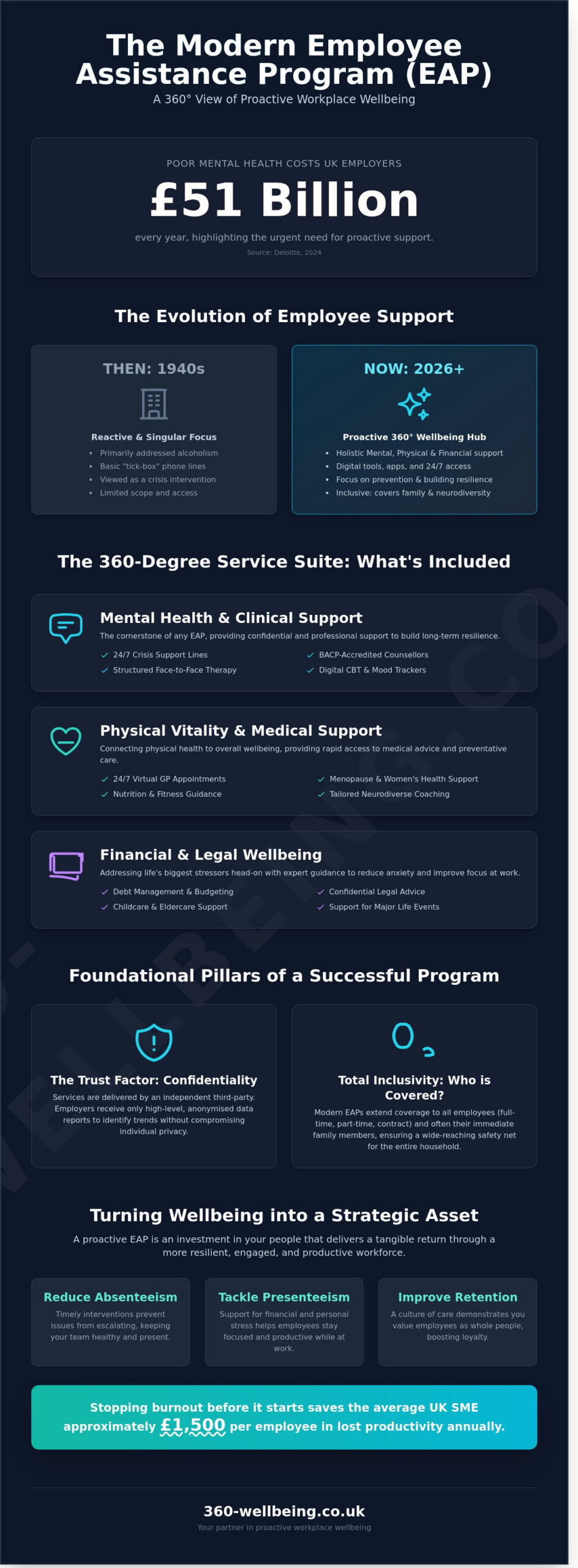
In 2024, research from Deloitte revealed that poor mental health costs UK employers £51 billion every year. This isn’t just a distant statistic; it’s the quiet weight of burnout and high staff turnover felt in workplaces across the country. As we look toward 2026, many leaders are rightly asking, what is an employee assistance program eap, and can it really bridge the gap between reactive care and true workplace harmony? We believe that every employee deserves a proactive safety net that treats wellbeing as a strategic asset rather than a luxury.
You likely agree that supporting your team’s health is a fundamental right, yet the complexity of managing these needs often feels overwhelming for smaller teams. This guide will help you discover how a modern EAP provides a proactive, 360-degree support system that bolsters mental, financial, and physical health while driving business resilience. We’ll break down the core components of these programmes and give you a structured framework to evaluate providers, ensuring your investment leads to a more resilient and productive workforce.
Key Takeaways
- Gain a clear understanding of what is an employee assistance program eap and how it has evolved from a basic intervention into a proactive, 360-degree wellbeing hub.
- Explore the comprehensive service suite, from 24/7 mental health crisis lines to virtual GP access, designed to support your team’s total health and vitality.
- Learn how robust confidentiality frameworks protect employee privacy, building the essential trust required for a successful and supportive workplace culture.
- Discover how to turn wellbeing into a strategic asset by reducing absenteeism and tackling presenteeism through timely, clinically-backed interventions.
- Follow a structured path to selecting and implementing the right provider, ensuring the solution is perfectly tailored to your organisation’s specific demographics.
What is an Employee Assistance Program (EAP)?
An Employee Assistance Programme (EAP) is a confidential, work-based intervention service designed to support the mental, physical, and financial health of your workforce. When asking what is an employee assistance program eap, it helps to view it as a strategic bridge. It connects employees with professional support while maintaining a vital layer of anonymity from their employer. The historical roots of the Employee assistance program (Wikipedia) date back to the 1940s, where they primarily addressed occupational alcoholism. Today, the landscape has shifted entirely. By 2026, these services have matured into 360-degree wellbeing hubs that address everything from menopause support to neurodiverse coaching.
Modern EAPs function through a third-party model. This means the employer pays for the service, but the provider remains independent. This separation is crucial. It ensures that when a staff member calls a crisis line at 3:00 AM, their manager never receives a transcript of the conversation. Instead, the organisation receives anonymised, high-level data. This allows leadership to identify trends, such as a 12% rise in anxiety within a specific department, without compromising individual privacy. Understanding what is an employee assistance program eap is essential for any modern business owner looking to foster a resilient culture.
There is a sharp distinction between basic and comprehensive platforms. A basic EAP often provides little more than a “tick-box” phone line with limited counselling sessions. In contrast, 88% of UK firms now prioritise comprehensive platforms that offer face-to-face therapy, legal advice, and debt management. These holistic systems integrate with daily life, providing tools for vitality rather than just a safety net for crises. They move beyond the reactive to provide a total wellness narrative.
The Core Purpose of Modern Workplace Support
The 2026 priority for UK businesses is moving from reactive “firefighting” to proactive care. An Employee Assistance Programme (EAP) is a confidential, employer-funded intervention service designed to proactively mitigate UK workplace stress while supporting the mental and emotional resilience of every staff member. Stopping burnout before it starts saves the average UK SME approximately £1,500 per employee in lost productivity annually. We focus on the “whole person” because a parent struggling with childcare or an individual facing financial debt cannot leave those burdens at the office door. Supporting these personal challenges directly improves long-term retention and workplace harmony.
Who is Eligible for EAP Services?
Inclusivity is the hallmark of modern standards. Coverage typically extends to all employees, whether they are full-time, part-time, or on fixed-term contracts. A significant 2026 trend is the extension of benefits to immediate family members living in the same household. This recognises that an employee’s wellbeing is intrinsically linked to the health of their partner or children. Scalable digital platforms now allow even sole traders and small startups to access the same level of clinical expertise once reserved for global corporations. New standards also require tailored support for neurodivergent individuals. This ensures that the 1 in 7 people in the UK who are neurodiverse receive support that respects their unique cognitive profiles and communication styles.
The 360-Degree Service Suite: What is Included in an EAP?
To truly understand what is an employee assistance program eap, one must look beyond the outdated image of a simple emergency telephone line. Modern EAPs function as a comprehensive ecosystem designed to support the person as a whole. This 360-degree approach ensures that every facet of an individual’s life, from their physical vitality to their financial security, is nurtured through a single, accessible platform. It’s about moving from reactive crisis management to a proactive culture of health.
Mental Health and Clinical Support
At the heart of any robust programme lies clinical excellence. Employees gain direct access to BACP-accredited counsellors who provide structured therapy sessions tailored to specific needs. This isn’t just about managing stress; it’s about building long-term resilience. Digital mental health tools, such as mood trackers and CBT-based modules, allow staff to manage their wellbeing proactively. These tools provide a sense of agency, allowing users to identify triggers before they escalate into significant health challenges.
The integration of “Doctor at Hand” services has transformed how UK businesses handle health. By offering virtual GP appointments 24/7, employees can receive medical reassurance without the typical four-hour window often required for a traditional in-person visit. Data from the UK EAPA indicates that such immediate access significantly reduces workplace absence. This clinical speed ensures that health concerns are addressed early, maintaining both individual health and collective productivity. When a parent can speak to a doctor about a sick child at 10:00 PM on a Tuesday, the relief provided is immeasurable.
Financial, Legal, and Life Management
Workplace anxiety often stems from factors outside the office walls. As we look toward the economic climate of 2026, where inflation and housing costs continue to pressure household budgets, financial guidance has become a vital pillar of the EAP. Debt counselling and professional financial planning provide employees with a clear, structured path forward. These services alleviate the “quiet stress” that often hinders professional focus, allowing staff to feel in control of their future.
Legal support within an EAP offers practical peace of mind during difficult transitions. Whether it’s complimentary will writing or expert advice on family law and consumer rights, having a legal expert a click away removes the barrier of high hourly fees. This is complemented by life coaching services. Unlike therapy, life coaching focuses on personal growth and goal attainment. It empowers individuals to align their personal aspirations with their professional life, creating a sense of balance and purpose that benefits the entire organisation.
Physical health is never treated in isolation within a 360-degree model. Many modern programmes now include virtual physiotherapy, allowing staff to address musculoskeletal issues before they result in long-term sick leave. Lifestyle benefits, including discount marketplaces and rewards for healthy habits, make wellness feel rewarding rather than like a chore. This unified narrative of health makes it easier for employees to thrive in every area of their lives. If you’re looking to implement such a holistic strategy, you can explore tailored wellness solutions that fit your team’s specific requirements. By treating wellbeing as a strategic asset, businesses create an environment where everyone can perform at their peak.
The Trust Factor: Confidentiality and Data Privacy
“Will my boss find out I called?” This is the primary hurdle for 31% of UK workers who hesitate to seek mental health support, according to 2023 workplace wellness surveys. At 360 Wellbeing, we understand that trust isn’t just a preference; it’s a clinical necessity. A robust “Chinese Wall” exists between the EAP provider and your HR department. This ensures that while your company pays for the service, they have no visibility into who uses it or why. When people ask what is an employee assistance program eap, the first thing they need to understand is its total independence from the employer’s management structure.
To truly grasp what is an employee assistance program eap, you have to view it as a confidential bridge. UK EAP providers operate under the strict ethical frameworks of the British Association for Counselling and Psychotherapy (BACP) and the Employee Assistance Professionals Association (EAPA) UK. These standards, combined with rigorous GDPR compliance, mean your personal data is handled with the same level of security as a private medical record. It’s a space where your privacy isn’t just a legal tick-box; it’s a foundational promise that protects your career and your peace of mind.
Employers receive quarterly reports to help them shape their broader wellbeing strategies, but these documents only contain high-level, anonymised data. For example, a report might show that 12% of the workforce accessed support for financial anxiety or that 8% sought help for childcare issues. This allows the business to offer proactive workshops or targeted resources without ever knowing which specific employees were struggling. It’s about identifying trends to improve the workplace for everyone while keeping individual identities completely shielded.
We view wellbeing through a 360-degree lens. This means protecting the social and professional integrity of the individual while supporting the health of the entire organisation. The data firewall is absolute. Even if an HR manager calls to ask if a specific team member has checked in, the EAP provider cannot confirm or deny their participation. This level of security is what makes the programme a strategic asset for building long-term resilience and a safe company culture.
How Confidentiality Works in Practice
Counsellors follow rigid protocols that prioritise your privacy at every stage. The only exceptions occur if there’s a serious risk of harm to yourself or others, or if a court order is issued; in these rare cases, the focus remains on immediate safety. EAP providers never share the names of individuals who access the service with their employers. This separation ensures that seeking help won’t affect your career progression or performance reviews.
Building a Culture of Trust
High engagement relies on transparent communication. When leadership teams openly discuss the EAP, they remove the “secret” stigma. Appointing Mental Health Champions, a role now present in 45% of UK firms, helps bridge the gap between policy and people. These champions guide colleagues toward the right resources without acting as therapists themselves. Clear, accessible privacy policies ensure everyone knows their rights from day one, making the EAP a fundamental right rather than a hidden luxury.
Why UK Businesses Invest in EAPs: ROI and Productivity
Investing in workplace health isn’t just a moral choice; it’s a strategic necessity for the modern British economy. When directors ask what is an employee assistance program eap, they’re often looking for a solution to the rising costs of lost productivity. Deloitte’s 2024 Mental Health Report highlights that for every £1 spent on wellbeing interventions, employers see an average return of £4.70. This return on investment stems from a proactive approach that stops small issues from becoming major organisational disruptions. It’s a clear financial argument for preventative care.
These savings manifest in several key areas that impact the bottom line:
- Lower recruitment costs through improved staff retention.
- Reduced management time spent on disciplinary or grievance issues.
- Fewer workplace accidents caused by fatigue or distraction.
- Decreased insurance premiums for healthcare and disability cover.
Reducing absenteeism is the first major win. Early intervention prevents long-term sick leave by giving staff a safe space to address stress before it leads to a total breakdown. Statistics from the Employee Assistance Professionals Association (EAPA) show that EAP usage can reduce disability claim costs by up to 20%. It’s about keeping your people healthy and at their desks. By providing immediate access to counselling, you’re shortening the recovery time for those struggling with personal or professional challenges.
Tackling presenteeism is perhaps even more vital. This hidden drain on resources occurs when employees are physically present but mentally disengaged due to personal struggles. Presenteeism costs UK businesses approximately £28 billion annually. By providing immediate mental health support, an EAP ensures staff are focused, engaged, and capable of performing at their peak. It turns a distracted workforce into a resilient one. When people feel supported, they’re more likely to contribute their best work every day.
The business case for 2026 is already clear. As we move toward a more competitive talent market, recruitment and retention are shifting. 75% of Gen Z and Millennial workers now state they would leave an employer that doesn’t prioritise their mental health. An EAP is no longer a “nice to have” perk; it’s a fundamental requirement for any business that wants to attract top-tier talent over the next three years. Companies that fail to adapt will likely face higher recruitment costs and lower staff engagement as the workforce demographic changes.
Impact on Workplace Culture and Morale
An EAP serves as a tangible demonstration that an employer genuinely cares about staff vitality. It builds a foundation of trust. When employees feel supported, their loyalty increases. The link between financial security and performance is undeniable. By offering EAP debt and financial advice, businesses see a reduction in workplace errors. Using anonymised EAP data also allows leadership to spot trends and refine their long-term corporate wellbeing strategies without compromising individual privacy. It’s about creating a culture where everyone can thrive.
Legal and Compliance Benefits
Meeting the “Duty of Care” requirements under the UK Health and Safety at Work Act 1974 is a legal obligation. An EAP provides a robust framework for managing these responsibilities. It’s particularly useful during periods of significant change, such as redundancies or mergers, where stress levels naturally spike. Understanding what is an employee assistance program eap helps HR directors navigate complex legal landscapes. Adopting the ISO 45003 standard for managing psychosocial risks becomes much simpler when an EAP is already in place. It ensures your business remains compliant while protecting its most valuable asset: its people.
Discover how to protect your team and improve your bottom line with a tailored EAP solution from 360 Wellbeing.
Choosing and Implementing the Right EAP for Your Team
Selecting the right partner for your business is a strategic decision that goes beyond simply ticking a box for HR compliance. It’s an investment in the long-term resilience of your workforce. To fully understand what is an employee assistance program eap in a practical sense, you must view it as a proactive tool rather than a reactive safety net. The implementation process requires a structured approach to ensure the service actually gets used by those who need it most.
- Step 1: Assess your workforce demographics. A legal firm in London with a high percentage of Gen Z employees will have different requirements than a manufacturing plant in the North East. Analyse your absence data and staff surveys. If 30% of your staff are struggling with musculoskeletal issues or cost-of-living stress, your EAP must prioritise physical health and financial signposting.
- Step 2: Compare clinical standards and technology. Don’t settle for “black box” providers where you don’t know who is answering the phone. Demand transparency regarding clinical qualifications and the technology used to deliver care.
- Step 3: Launch with a multi-channel communication plan. Statistics from the CIPD 2023 Health and Wellbeing at Work report suggest that while many firms offer support, only a fraction of employees feel confident using it. Use webinars, physical posters in breakrooms, and direct emails to normalise the service.
- Step 4: Monitor and evolve. Review usage reports quarterly. If engagement is low in specific departments, investigate why. A successful programme adapts to the changing pressures of the UK market, such as shifting hybrid work patterns or seasonal health trends.
What to Look for in a Provider
Accessibility is the bridge between having a benefit and actually helping someone. Clunky, phone-only systems often create a barrier for younger employees or those in open-plan offices who can’t speak freely. Look for providers offering encrypted, user-friendly apps that allow for discreet booking. It’s vital to ensure all therapists are BACP or UKCP accredited, and medical professionals are UK-registered. A 360-degree approach that blends mental health support with lifestyle rewards and virtual GP access ensures the platform feels like a daily benefit, not just a crisis line.
The 360 Wellbeing Advantage
Our platform is designed to remove the friction often found in traditional corporate benefits. We simplify the experience for SMEs and large organisations by consolidating essential services into one intuitive interface. By integrating 24/7 Virtual GP services with traditional EAP counselling, we provide a unified narrative of care. This means an employee can discuss their anxiety and book a medical consultation in the same afternoon, all through the same trusted partner. It’s about creating a culture where health is a fundamental right, not a luxury. We help you move away from fragmented services toward a cohesive strategy that protects your most valuable asset.
Ready to transform your workplace culture? Organise a demo of the 360 Wellbeing platform today and discover what is an employee assistance program eap capable of when it’s built around your people.
Future-proofing Your Workplace Culture
Understanding what is an employee assistance program eap marks the first step toward creating a thriving, resilient workforce. By 2026, proactive health strategies aren’t just an optional perk; they’re a strategic necessity for UK businesses aiming to boost productivity and retain top talent. Research indicates that every £1 invested in comprehensive wellness support can generate a return of up to £5 by reducing absenteeism and presenteeism. A truly effective programme balances clinical precision with a warm, human touch, ensuring your staff feel supported at every turn.
360 Wellbeing provides this essential 360-degree perspective. Our members gain 24/7 access to UK-registered GPs and confidential, BACP-accredited mental health support. We also provide comprehensive legal and financial helplines to address the social factors that impact workplace harmony. It’s about more than just managing crises; it’s about fostering a culture where every individual has the tools to flourish. You don’t have to navigate these complexities alone. We’re here to act as your dedicated partner in health.
Discover how 360 Wellbeing can transform your workplace health
Let’s work together to build a brighter, more balanced future for your team.
Frequently Asked Questions
How much does an EAP cost per employee in the UK in 2026?
In 2026, a comprehensive EAP in the UK typically costs between £10 and £25 per employee per year for a standard 360-degree service. This price point reflects a 12% increase in mental health investment seen across the corporate sector since 2023. Smaller firms with fewer than 50 staff might pay a slightly higher rate per head, while large corporations benefit from economies of scale that can bring the cost down to under £8 per person.
Is an EAP the same as Private Medical Insurance (PMI)?
No, an EAP isn’t the same as Private Medical Insurance, as it focuses on immediate, short-term support and prevention rather than long-term medical treatment. While PMI covers 100% of the costs for surgeries or chronic illness consultations, an EAP provides rapid access to counselling and practical advice for daily challenges. It’s a proactive tool that sits alongside insurance to ensure your team’s mental and social health is supported before a crisis occurs.
Can an EAP help with legal issues like divorce or debt?
Yes, a standard EAP provides expert guidance on legal and financial matters including divorce proceedings and debt management. Data shows that 40% of employees use these services for practical life issues rather than just mental health support. You’ll gain access to qualified legal professionals and debt advisors who provide structured pathways to resolve these stressors, ensuring personal worries don’t impact your performance or health at work.
How do employees access the EAP services?
Employees access EAP services through a confidential 24/7 helpline or a dedicated digital wellbeing portal. When you’re wondering what is an employee assistance program eap, it’s helpful to know it’s designed for total anonymity. Most providers offer a response time of under 30 seconds for phone calls. You can also book sessions through an app, giving you a direct line to a counsellor or advisor whenever you need support.
What happens if an employee needs long-term therapy beyond the EAP limit?
If an employee requires support beyond the standard six to eight sessions provided by the EAP, the service will facilitate a clinical handover to the NHS or your private medical insurer. This ensures a seamless transition so you aren’t left without care. The EAP acts as a primary triage point, identifying the 15% of cases that need specialist long-term intervention and helping you navigate the next steps in your recovery journey.
Is an EAP worth it for a small business with under 10 staff?
Yes, an EAP is highly valuable for small businesses because the cost of a single staff member being absent for 20 days far outweighs the annual £250 investment for the whole team. For a micro-business with 8 staff, the EAP provides a professional HR and wellbeing infrastructure that you couldn’t otherwise afford. It protects your most vital asset and demonstrates a genuine commitment to a healthy, resilient workplace culture from the very beginning.
What is the difference between an EAP and a wellbeing platform?
An EAP provides direct human intervention and clinical support, whereas a wellbeing platform is primarily a self-serve library of digital content and trackers. To understand what is an employee assistance program eap, you should view it as a reactive safety net with 1-to-1 counselling. A wellbeing platform is a proactive tool for daily habits. Combining both creates a 360-degree strategy that covers everything from step-counts to crisis management.
Can managers use the EAP for support with difficult staff situations?
Managers can definitely use the EAP for dedicated support sessions to navigate sensitive staff issues like performance reviews or workplace conflict. This service provides a confidential space to discuss the 25% of management tasks that involve high emotional complexity. You’ll receive structured advice on how to support a struggling team member while maintaining your own resilience, ensuring you lead with both empathy and professional clarity.