
If poor mental health is costing UK employers an estimated £51 billion annually according to 2024 Deloitte data, why do so many wellbeing strategies still feel like an afterthought? You’ve likely seen the impact of rising absence rates firsthand, especially as the lines between home and office life continue to blur for your team. Understanding exactly what is included in an eap is no longer just about meeting a legal duty of care. It’s about building a resilient culture where every individual feels seen, valued, and supported.
We understand that you want to provide the best for your people without overstretching your budget or getting lost in clinical jargon. You deserve a partner who views health through a 360-degree lens, balancing human empathy with modern digital efficiency. In this guide, we’ll outline the must-have features for 2026, from 24/7 virtual GP access to proactive stress management tools. You’ll discover how a tailored EAP reduces absenteeism and provides the holistic, 360-degree care your workforce needs to thrive in a changing world.
Key Takeaways
- Understand how EAPs have evolved from reactive crisis lines into proactive platforms that offer clinical mental health support, including CBT and trauma management.
- Discover exactly what is included in an eap in 2026, from essential 24/7 Virtual GP access to tailored life coaching and nutritional advice.
- Learn how to integrate financial wellness tools and retail rewards to provide meaningful support that helps your employees’ salaries go further in the current UK economy.
- Identify the strategic steps to conduct a wellbeing needs assessment, ensuring your investment delivers high engagement rather than unused “shelfware” features.
- Explore how a holistic, 360-degree approach to health creates a resilient workforce by unifying physical, mental, and social wellbeing into one manageable strategy.
What is an Employee Assistance Programme (EAP) in 2026?
An Employee Assistance Programme (EAP) is a confidential workplace benefit that serves as a vital safety net for your most valuable asset: your people. By 2026, the definition of these programmes has expanded significantly. It’s no longer just a phone number tucked away in an employee handbook for emergencies. Instead, it’s a holistic ecosystem designed to support mental, physical, and financial health in a unified way. We’ve seen a definitive shift in the UK market from reactive “crisis lines” to proactive wellbeing platforms. These modern systems identify risks early, offering a 360-degree perspective that balances high-level clinical expertise with practical, everyday lifestyle support. Understanding exactly what is included in an eap is the first step toward building a thriving, high-performance culture.
The Legal and Strategic Purpose of an EAP
The introduction of the Employment Rights Act 2025 has transformed EAPs from a “nice-to-have” perk into a strategic necessity for UK businesses. This legislation clarified the employer’s statutory duty of care, making it essential to have robust systems in place to manage workplace stress and mental health. From a financial perspective, the stakes are high. Recent data from 2024 indicates that workforce absences cost the UK economy approximately £85 billion annually. A modern EAP addresses this by acting as a “single entry point” for all staff health needs. It simplifies the path to recovery through early intervention, ensuring that minor issues don’t escalate into long-term sick leave. This structured approach provides a clear path forward for both the individual and the organisation.
Who is Included? Coverage for Families and Dependants
When evaluating what is included in an eap, coverage for the “whole person” is a hallmark of the 2026 standard. Most comprehensive packages now extend support to an employee’s immediate household members and dependants. We know that personal and professional lives are deeply intertwined. If a partner is facing financial instability or a child is struggling with mental health, the impact on the employee’s focus and productivity is immediate. By providing support to the family unit, you foster a sense of security and loyalty.
Confidentiality remains the cornerstone of these services. To ensure employees feel safe using the support, strict protocols are in place:
- Total anonymity: Employers receive high-level usage data but never individual names.
- Clinical independence: The service is managed by external professionals, not HR.
- Secure access: Encrypted platforms ensure that personal health journeys stay private.
This commitment to privacy ensures that your team can seek help early, without the fear of judgement or professional repercussions, creating a culture of trust and genuine care.
The Four Core Pillars: Standard EAP Inclusions Explained
Understanding what is included in an eap helps you build a more resilient workforce that feels truly seen and supported. A modern programme isn’t just a phone number tucked away in an employee handbook; it’s a 360-degree safety net. According to the 2024 CIPD Health and Wellbeing at Work report, 76% of UK organisations now provide an EAP, yet many employers don’t fully realise the breadth of these services. A comprehensive EAP covers mental, financial, legal, and physical health to ensure no member of your team has to face life’s challenges alone.
Mental Health and Counselling Services
The cornerstone of any EAP is immediate, expert mental health support. This starts with 24/7 confidential helplines staffed by BACP-accredited counsellors. These professionals provide confidential counselling and advice at the moment of crisis. There’s a vital difference between this initial telephone support and structured therapy. Most high-quality plans include a set number of face-to-face or video sessions for deeper issues. This often includes Cognitive Behavioural Therapy (CBT), which is highly effective for managing anxiety and depression. For more severe situations, such as a workplace accident or the loss of a colleague, Critical Incident Stress Management (CISM) provides specialized trauma support to help teams process and recover together.
Financial and Legal Support Inclusions
Financial stress is a significant driver of workplace absence, with many UK workers citing money worries as their primary source of anxiety. Modern EAPs move beyond reactive help by offering proactive financial support for employees. This includes access to debt management specialists and financial resilience coaching to help staff navigate the rising cost of living. Legal support is equally robust. Employees can access helplines that offer guidance on domestic issues, tenancy disputes, and consumer rights. A particularly high-value inclusion in many 2026 plans is complimentary will writing. This provides long-term peace of mind for staff and serves as a tangible example of how your business cares for their future.
Physical health remains the final essential pillar. EAPs frequently include physiotherapy assessments to address musculoskeletal problems before they lead to long-term sick leave. This is paired with preventative health advice on topics like sleep hygiene and nutrition. By integrating these four pillars, you create a culture where wellbeing is treated as a strategic asset rather than an afterthought. If you’re looking to refine your benefits, a tailored wellness strategy can help you determine exactly what is included in an eap for your specific team requirements.
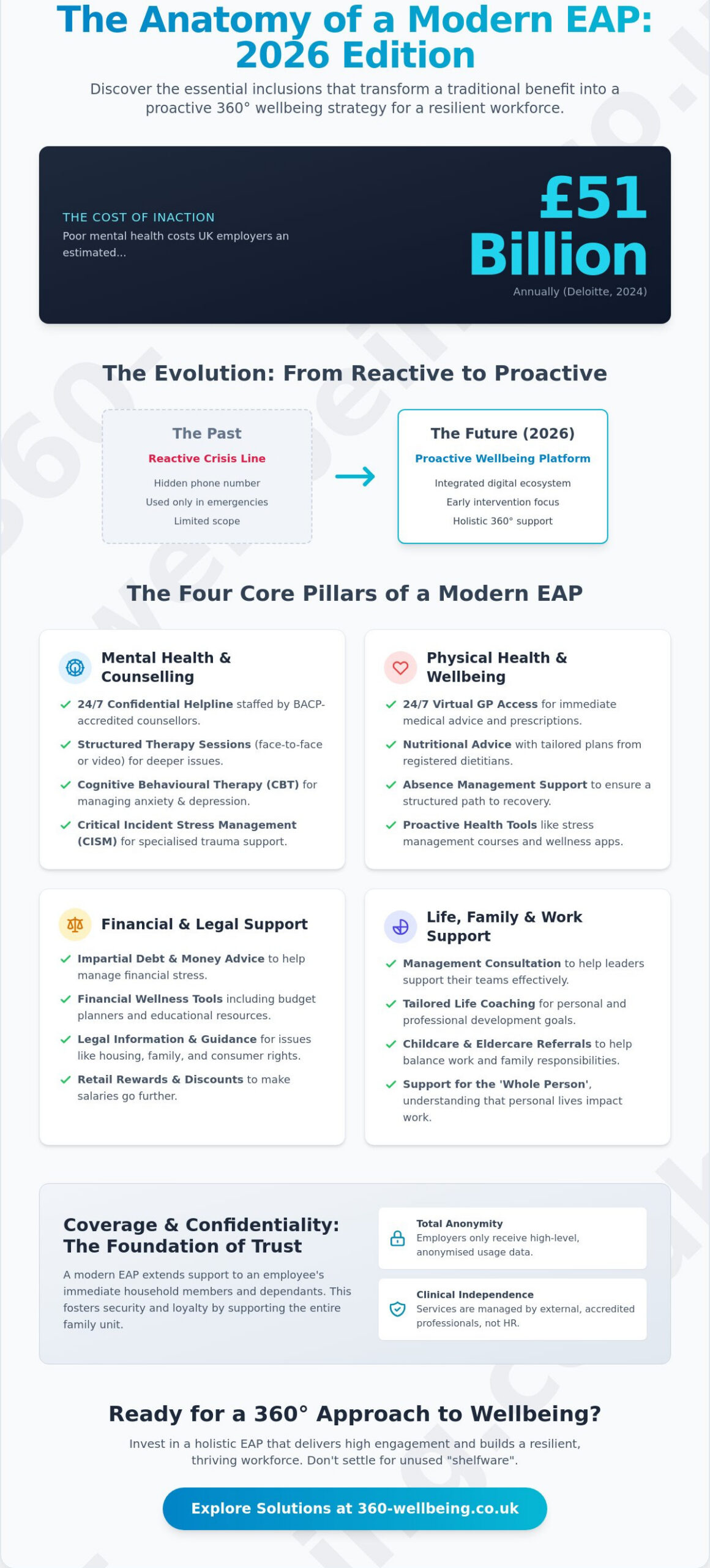
The Evolution of EAPs: Modern Digital Health & Lifestyle Support
The traditional model of workplace support has undergone a radical transformation. When considering what is included in an eap in 2026, the focus has shifted from reactive crisis management to proactive, daily health optimization. Employees now expect their benefits to reflect their digital-first lifestyles, moving beyond the standard phone line toward a comprehensive ecosystem of physical and mental care. This transition ensures that your team feels supported in every aspect of their lives, from their physical fitness to their long-term career aspirations.
Virtual GP: The New Standard in Employee Care
Wait times for routine NHS appointments often exceed 15 days in many UK regions, leading to prolonged periods of employee ill-health. By including 24/7 Virtual GP access, you’re giving your team the ability to speak with a UK-registered doctor within minutes via a mobile app. These services offer more than just advice; they provide private prescriptions sent to local pharmacies and specialist referral letters that bypass traditional bottlenecks. Virtual GP access serves as the vital link between physical symptoms and psychological wellbeing by providing immediate medical reassurance that reduces health-related anxiety.
Life Coaching and Proactive Personal Development
While traditional counselling addresses mental health struggles or past trauma, life coaching looks toward the future. It’s a proactive tool designed to build resilience and help employees reach their personal and professional milestones. This support is particularly effective during major life events such as moving house, starting a family, or navigating a career transition. By investing in an employee’s personal growth, businesses see a direct correlation with retention. Data suggests that 68% of employees feel more loyal to companies that provide tools for personal development that extend beyond their specific job role.
Holistic Health: MSK and Nutritional Support
The rise of hybrid working has led to a surge in musculoskeletal (MSK) issues. The Health and Safety Executive (HSE) reported that 473,000 workers suffered from work-related MSK disorders in 2022/23, a figure that remains high as home office ergonomics vary. Modern EAPs now include digital physiotherapy assessments and tailored exercise plans to combat “tech neck” and lower back pain. To complement this, nutritional advice and digital marketplaces offering “Rewards” help drive daily platform engagement. These perks turn the EAP into a lifestyle companion rather than an emergency tool, ensuring that what is included in an eap delivers value every single day of the year.
Assessing Value: How to Determine Which EAP Inclusions Your Team Needs
Selecting a wellness partner is a vital commitment to your team’s future. Many UK businesses fall into the trap of paying for “shelfware,” which refers to digital tools that remain unused by staff. To ensure you invest wisely, start with a comprehensive wellbeing needs assessment. This process identifies the specific pressures your team faces, whether that’s the cost-of-living crisis or burnout from high-growth targets. When you understand what is included in an eap, you can align those features with the actual needs of your workforce rather than buying a generic package.
The financial model you choose impacts both accessibility and your bottom line. Traditional insurance-linked EAPs often serve as a reactive “bolt-on” and frequently see usage rates as low as 3%. Modern “Per-Employee” subscription models drive much higher engagement because they’re designed for proactive use. According to Deloitte’s 2024 analysis, UK employers receive an average return of £4.70 for every £1 spent on mental health interventions. This value is largely found in the reduction of “presenteeism,” where employees are at their desks but unable to function effectively. Proactive support can reduce long-term sick leave by approximately 25%, making the right EAP a strategic asset rather than a simple cost centre.
Small and medium-sized enterprises (SMEs) often find that consolidated platforms offer better value than enterprise-level suites. Evaluating what is included in an eap helps you filter out unnecessary features that don’t serve your specific industry. A single, unified hub reduces the administrative burden on HR teams and provides a more cohesive experience. It’s about creating a sense of safety through a 360-degree approach to health.
Evaluating Platform Engagement and Accessibility
Accessibility is the foundation of trust. If a colleague faces a personal crisis at 11 pm, a service that only operates during “office hours” fails them. Ensure your EAP provides 24/7 clinical support through a user-friendly mobile app. This puts professional guidance directly into their hands. Use anonymous data reporting to monitor workforce stressors. If reports show a 15% spike in financial wellness searches, you can proactively offer targeted workshops to support your team before the issue escalates into absenteeism.
Implementation and Onboarding Strategies
A successful EAP requires more than a link in a welcome email. You must launch the service with a clear, supportive narrative. Appointing “Wellbeing Champions” within your departments creates a peer-to-peer support network. These advocates help de-stigmatise seeking help and ensure staff feel empowered to use the tools available. Avoid hidden costs by choosing providers with transparent SaaS pricing. This clarity allows you to focus on your team’s vitality without worrying about unexpected fee hikes during the onboarding process.
Support your team’s long-term health and resilience by exploring our tailored EAP solutions.
The 360 Wellbeing Advantage: A Holistic EAP for UK Businesses
360 Wellbeing transforms the standard definition of what is included in an eap by moving beyond reactive crisis management. Our platform integrates high-demand services like 24/7 Virtual GP access, professional mental health counseling, and expert financial guidance into one intuitive interface. This holistic approach ensures your team receives support before a small worry becomes a major leave of absence. By combining physical, mental, and financial health, we address the root causes of workplace stress rather than just treating the symptoms.
Beyond clinical care, we recognize the impact of the cost-of-living crisis on employee morale. Our “360 Rewards” program provides access to thousands of discounts on everyday essentials, travel, and leisure. It’s a practical way to make your employees’ salaries go further. This tangible benefit shows your staff that you care about their quality of life outside of office hours, which is a key driver for retention in the current UK job market.
We believe every worker deserves a safety net. While large corporations have long enjoyed these perks, 360 Wellbeing makes professional-grade benefits accessible for UK SMEs and sole traders. We provide the same level of care and resilience-building tools to a team of three as we do to a workforce of three hundred. Making wellbeing a strategic asset isn’t just for the FTSE 100; it’s a vital move for any business looking to build a sustainable, loyal team.
Consolidating Your Benefits Strategy
Managing multiple vendors for GP services, legal advice, and counseling is an administrative headache. By partnering with 360 Wellbeing, you consolidate these essential services into a single, managed subscription. This reduces the burden on your HR team and ensures employees have one clear point of contact for all their needs. When considering what is included in an eap, simplicity for the end-user is just as important as the services themselves. 360 Wellbeing provides a reliable safety net for both the employer and the employee, fostering a culture of mutual trust and security.
Ready to Transform Your Workplace?
Transitioning to a proactive wellbeing model is simpler than you might think. We work with you to build a tailored package that fits your specific industry needs. Our onboarding process is designed for speed, moving from the initial sign-up to full staff access in just a few days. You don’t have to wait months for a healthier workplace. See how 360 Wellbeing can support your team with a comprehensive EAP and start making vitality your business’s greatest strength.
Future-Proofing Your Workplace Wellbeing Strategy
Understanding what is included in an eap is no longer just a box-ticking exercise for HR departments. It’s a strategic investment in your company’s long-term resilience. By 2026, the most effective programmes have evolved far beyond basic telephone helplines to offer a complete 360-degree support system. You’re now looking for a blend of clinical expertise and digital convenience that addresses the physical, mental, and social pillars of health simultaneously.
Modern solutions provide immediate, 24/7 access to UK-registered Virtual GPs and BACP-accredited mental health counselling, alongside essential financial and legal guidance. This proactive approach is vital for supporting the 875,000 workers currently affected by work-related stress, depression, or anxiety according to 2022/23 HSE statistics. It’s about creating a sustainable culture where every team member feels genuinely cared for and empowered to thrive. Empower your workforce with a 360-degree Employee Assistance Programme today. We’re here to help you build a healthier, more harmonious workplace for the years ahead.
Frequently Asked Questions
Is an EAP a legal requirement for UK employers?
No, there’s no specific statutory law that mandates the provision of an EAP. However, it’s a vital tool for meeting your legal duty of care under the Health and Safety at Work etc. Act 1974. The HSE reports that work-related stress, depression, or anxiety accounted for 49% of all work-related ill health in 2023/24. An EAP helps you manage these risks proactively to protect your staff and your business reputation.
How much does an EAP typically cost per employee?
Most modern EAPs in 2026 follow a SaaS-based subscription model that scales with your headcount. While prices vary based on clinical depth, the Employee Assistance Professionals Association (EAPA) suggests that the average cost for a comprehensive EAP can be as low as £5 to £15 per employee annually for larger firms. For SMEs, this small investment provides a 360-degree support system that includes 24/7 counselling and digital health tools to build long-term resilience.
Can an EAP help with the 2025/2026 employment law changes?
Yes, an EAP is essential for navigating the removal of the Lower Earnings Limit and changes to Statutory Sick Pay (SSP) introduced in 2025. These reforms mean employers face higher costs for short-term absences. By using early intervention strategies, you can reduce the 18.5 million working days lost annually to musculoskeletal problems in the UK. This proactive care keeps your workforce healthy and minimises the financial impact of new legislative requirements.
Are EAP services completely confidential for my staff?
Yes, confidentiality is a non-negotiable standard for every reputable provider. Your staff can access mental health support or financial advice without any fear that their details will be shared with management. You’ll receive high-level, anonymous data reports that show usage trends across the organisation. This allows you to understand what is included in an eap and how it benefits your team’s resilience without ever identifying an individual user.
Does an EAP include support for physical injuries?
Many modern EAPs now provide comprehensive support for physical health alongside mental wellbeing. This often includes physiotherapy assessments and musculoskeletal (MSK) advice to help staff manage pain. Since MSK issues are a leading cause of workplace absence in the UK, having these services integrated into your plan is vital. It’s a tailored approach that ensures remote and office-based workers stay mobile and productive through expert clinical guidance and preventative care.
What is the difference between an EAP and Private Medical Insurance (PMI)?
The main difference is that an EAP focuses on proactive, immediate intervention while PMI covers the cost of clinical treatment for specific conditions. You can think of an EAP as a 24/7 gateway to support that addresses issues before they escalate into serious medical problems. When considering what is included in an eap, you’ll find it offers a broader range of daily lifestyle support, such as legal advice and GP consultations, which aren’t always available through traditional insurance.