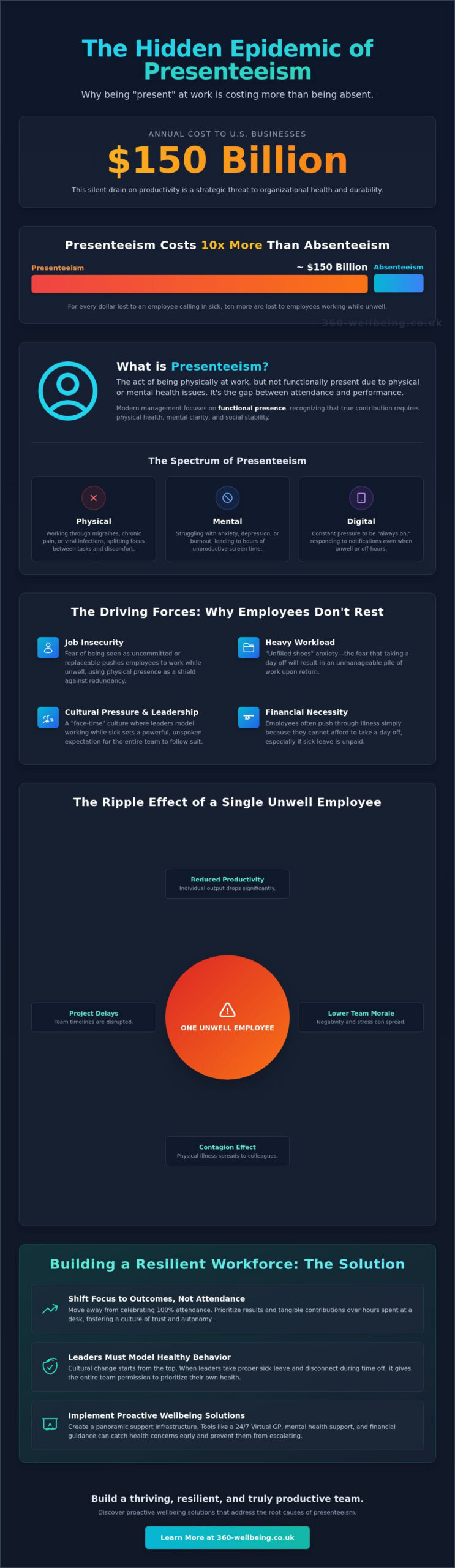
U.S. businesses lose up to $150 billion annually to presenteeism, a figure that’s ten times higher than the cost of staff actually calling in sick. You might see your team logged on and “present,” yet the actual work isn’t moving forward as it should. Understanding what is presenteeism and how to manage it is no longer just a human resources task; it’s a vital strategic move for any organization that values durability and genuine employee health. When people feel they must show up despite being physically or mentally unwell, the hidden drain on your culture and bottom line becomes immense.
We understand how frustrating it is to watch burnout rates climb while productivity figures stay stubbornly flat. You want a team that’s truly engaged and healthy, not just physically occupying a desk. This guide provides the clarity you need to spot the subtle signs of a struggling workforce before they lead to long-term absence. We will explore the hidden drivers behind why staff stay at their desks when they should be resting and offer a proactive framework for restoration. You’ll gain actionable steps to improve staff wellbeing and build a resilient, high-performing environment where everyone can thrive.
Key Takeaways
- Learn to distinguish between physical attendance and functional presence to identify the subtle productivity losses that don’t appear on a standard attendance record.
- Discover what is presenteeism and how to manage it by uncovering the psychological drivers, such as job insecurity and workload anxiety, that keep unwell staff at their desks.
- Quantify the hidden costs of working while sick and understand how the “contagion effect” can cause a single employee’s illness to impact the performance of an entire department.
- Gain actionable strategies for leadership to model healthy behaviors, shifting the focus toward outcome-based productivity instead of simple attendance.
- Explore how a panoramic wellbeing infrastructure, featuring tools like a 24/7 Virtual GP, can catch health concerns early and support long-term organizational durability.
Defining Presenteeism: Why It Is More Than Just Working While Sick
Presenteeism is often the ghost in the machine of modern business. It’s the silent drain on resources that occurs when a team member is physically at their workstation but is unable to perform at their full capacity. When researching What is presenteeism, it’s clear that the term describes a state where an employee is physically at their desk but essentially absent in terms of output. In the 2026 workplace, we’ve moved beyond simply tracking who is in the office. We now focus on functional presence. This shift recognizes that a person’s ability to contribute is influenced by a complex mix of physical health, mental clarity, and social stability. Understanding what is presenteeism and how to manage it requires a panoramic view of the individual, seeing them as a whole person rather than just a name on a payroll.
This isn’t just an isolated HR issue; it’s a holistic challenge affecting the entire UK workforce. When an employee isn’t functioning fully, the impact ripples through the team, slowing down projects and lowering the collective morale. By taking a proactive and empathetic approach, you can identify these hidden productivity losses and create a culture where health is prioritized over a simple headcount.
The Spectrum of Presenteeism
The challenges your team faces aren’t always visible. Presenteeism exists on a broad spectrum, and it’s rarely just about a seasonal flu. It involves several layers that require different types of support:
- Physical presenteeism: This is the most recognizable form. It involves staff working through migraines, chronic back pain, or viral infections. They are there, but their focus is split between their tasks and their physical discomfort.
- Mental presenteeism: This is often harder to spot. It occurs when employees struggle with anxiety, depression, or the heavy fog of burnout. They might spend hours staring at a screen without completing a single meaningful task.
- Digital presenteeism: In our hyper-connected world, there’s a constant pressure to respond to notifications immediately. Even when they’re technically “off” or feeling unwell, employees may stay logged in to prove their commitment.
Why Traditional Attendance Metrics Fail
For decades, managers celebrated 100% attendance as a gold standard. However, in a modern context, perfect attendance can actually be a red flag. It often masks a “hero complex” where employees feel they are the only ones who can do their job. This mindset is dangerous because it leads to total exhaustion and long-term illness. When people don’t feel safe enough to step away, the quality of work suffers across the board. Sometimes, the drive to stay at work is rooted in necessity. Employees often push through because they can’t afford a day off, masking a deep-seated need for financial support. By only measuring hours spent at a desk, you miss the underlying stressors that erode your team’s durability and long-term health.
The Psychological and Physical Drivers of Presenteeism
Understanding what is presenteeism and how to manage it requires us to look deep into the psychological landscape of the modern office. It’s rarely a simple choice made by a stubborn employee. Most people don’t show up unwell because they want to; they do it because they feel they have no other option. Job insecurity remains a primary driver. When people fear they are replaceable, they view their physical presence as a shield against redundancy. This is especially common in competitive sectors where “showing face” is still incorrectly seen as a proxy for commitment.
The definition of presenteeism often focuses on the resulting productivity dip, but the root cause is frequently a heavy workload. This “unfilled shoes” anxiety is the fear that if an employee takes a sick day, their tasks will simply pile up, creating an even more stressful situation upon their return. When leaders model this behavior by sending emails while they are clearly unwell, it sets a silent but firm expectation for the rest of the team. Our digital culture only makes this worse. Smartphones and remote access mean that even when a person is in bed, they feel the magnetic pull of the “always-on” workplace.
The Fear Factor: Job Insecurity and Culture
Workplace culture plays a massive role in how health is perceived. In environments that prize a “tough it out” attitude, employees link their attendance directly to their perceived value. This leads to a phenomenon known as leavism. Leavism is the habit of using holiday time to recover from illness or working during scheduled leave to keep up with demands. It’s a clear signal that the boundaries between health and work have dissolved, leading to long-term durability issues for the business. Shifting this requires a panoramic view of how we reward loyalty and performance.
External Stressors: Beyond the Office Walls
Life doesn’t stop at the office door. Financial anxiety is a significant driver of presenteeism, as many staff cannot afford the potential pay cuts associated with absence. For those feeling the weight of economic pressure, accessing Financial Support & Debt Advice can be a vital first step in restoring their peace of mind. Family emergencies or legal troubles also occupy significant mental bandwidth, leaving an employee physically present but cognitively drained. Providing tools like a 24/7 Virtual GP helps address “time-poverty,” allowing staff to seek medical advice without the stress of missing a full day of work for an appointment. When you address these underlying factors, you begin to truly master what is presenteeism and how to manage it in a way that protects both the person and the profit.
The Hidden Business Impact: Why Presenteeism Costs More Than Absence
While the empty chair of an absent employee is easy to spot on a spreadsheet, the person sitting at their desk while unwell represents a much larger, hidden financial drain. Research indicates that presenteeism costs U.S. businesses up to $150 billion annually, which is ten times more than the cost of absenteeism. On a global scale, the combination of low engagement and presenteeism drains approximately $10 trillion from the economy each year. When we look at what is presenteeism and how to manage it, we must recognize that the damage isn’t just about lost minutes. Employees lose an average of 57.5 days of productivity each year by working while impaired, leading to a massive erosion of quality across the board.
The impact isn’t limited to the individual. There is a real public health hazard of presenteeism within the workplace, known as the contagion effect. One person struggling through a viral infection can quickly lower the health of an entire department. Beyond physical illness, a culture that encourages working through pain creates a ripple effect where team morale dips. If employees see their colleagues visibly struggling without support, they begin to question the organization’s commitment to their own durability. This eventually damages your employer brand, making it harder to attract and retain the high-level talent your business needs to grow.
Calculating the Productivity Gap
When an employee is working at half-capacity, the “multiplier effect” kicks in. Projects take longer, and the need for “re-work” increases as mistakes slip through the cracks. This is particularly dangerous in high-stakes environments where errors carry legal or safety risks. Beyond the basics, innovation suffers. Creative problem-solving requires a level of mental energy that a sick or burned-out brain simply cannot provide. You aren’t just losing time; you’re losing the competitive edge that comes from a fully functional, visionary workforce.
The Burnout Pipeline
Chronic presenteeism is rarely a sustainable state; it’s usually the precursor to a total collapse. By ignoring the signs, businesses inadvertently create a burnout pipeline that leads directly to long-term sickness absence. Shifting the perspective to see wellbeing as a professional necessity, rather than a luxury, is essential for organizational health. When you understand what is presenteeism and how to manage it from a panoramic viewpoint, you move from reacting to crises to building a culture of sustained vitality.
Strategic Management: How to Reduce Presenteeism in Your Team
Managing presenteeism starts at the very top of your organization. If senior leaders send emails from a hospital bed or brag about never taking a sick day, they inadvertently build a culture of fear and unrealistic expectations. Employees need to see their managers taking visible time to recover when they are unwell. This simple act of leadership gives the rest of the team permission to prioritize their own health without feeling guilt or a sense of failure. It’s about moving away from the “hero complex” and toward a model of sustainable performance.
We must also redefine what productivity looks like in a modern, durable organization. Success should be measured by outcomes and the quality of work, rather than the number of hours someone is physically logged in or sitting at a desk. Shifting to this outcome-based model reduces the pressure on staff to perform while impaired. When we talk about what is presenteeism and how to manage it, we’re really talking about creating a results-oriented environment where recovery is respected as a vital part of the professional process. Policies should explicitly encourage recovery time, making it clear that staying home to get well is a responsible choice that prevents the contagion effect from spreading through the office.
Wellness Action Plans are another powerful tool for your strategy. These collaborative documents allow employees and managers to discuss health needs before a crisis hits. They facilitate open, calm conversations about what support looks like for each individual, ensuring that when health challenges arise, a clear path forward already exists.
The Manager’s Toolkit for Early Detection
Managers are the first line of defense in spotting the subtle signs of a struggling team member. You might notice a normally punctual person missing deadlines, a social team member becoming uncharacteristically withdrawn, or sudden shifts in mood and irritability. Conducting regular, empathetic check-ins is essential to catch these changes early. These conversations shouldn’t feel like an interrogation; instead, they should be a supportive partnership focused on wellbeing. Training managers to recognize the physical symptoms of stress allows them to intervene with compassion, offering resources before a minor issue turns into a chronic struggle.
Creating a Culture of Psychological Safety
Psychological safety means employees feel safe to be honest about their mental health without fear of judgment. Actively promoting your Employee Assistance Programme (EAP) ensures they know exactly where to turn for confidential support. To combat the digital drain, many forward-thinking companies are now implementing “no-contact” hours, where there is no expectation to respond to communications outside of work. True flexibility in the workplace reduces the urge to work while sick because it empowers employees to adjust their schedules and manage their recovery without the anxiety of falling behind. To build a truly resilient workforce, explore our full range of Mental Health Support services designed to empower and protect your team.
Implementing a Proactive Wellbeing Solution with 360 Wellbeing
Creating a workplace where employees feel truly empowered to prioritize their health requires more than just a policy change; it requires a panoramic infrastructure of support. The 360 Wellbeing platform is designed as a comprehensive solution that bridges the gap between physical presence and functional excellence. By integrating a suite of proactive tools, we help you address the complex question of what is presenteeism and how to manage it through early intervention and sustained care. Our approach moves away from reactive management and toward a model of organizational durability where every team member has the resources they need to thrive.
At the heart of this solution is our 24/7 Virtual GP. This service acts as a vital tool for catching physical health issues before they escalate into chronic conditions that fuel presenteeism. When employees can consult a doctor at any time of the day or night, they’re much more likely to seek help early. This foresight prevents the “tough it out” mentality that often leads to a contagion effect within the office. Beyond physical health, our Mental Health Support and Life Coaching services address the deep-seated root causes of mental presenteeism. These resources provide a safe space for staff to navigate anxiety, stress, or personal blocks, ensuring they can return to their roles with clarity and renewed focus.
Total wellness also encompasses the social and economic factors that weigh on an employee’s mind. Our Financial Support & Debt Advice, along with Legal Support, serve as essential pillars of stability. When a person isn’t distracted by external pressures, their cognitive bandwidth is freed up for innovation and high-quality output. This unified narrative of wellness ensures that your strategy covers every angle of the human experience.
Removing the Barriers to Care
Traditional healthcare often comes with “appointment anxiety,” where the stress of finding time for a GP visit keeps people working while unwell. By providing 24/7 access, we remove this barrier entirely. Employees don’t have to choose between their duties and their health. Similarly, providing immediate access to mental health therapy sessions is a game-changer for preventing burnout. This platform is more than just a list of services; it’s a benefit that empowers your staff to put their health first, knowing they have a dedicated partner looking out for their long-term interests.
A Partnership for Long-Term Vitality
Our Employee Assistance Programme (EAP) is a cornerstone for achieving total workplace harmony. It provides a steady, methodical path forward for employees facing sensitive challenges, creating a sense of safety and order. To further boost morale and daily engagement, our 360 Rewards and lifestyle perks offer a positive vision of workplace vitality that goes beyond the clinical. This combination of expert care and lifestyle support transforms your culture into one of genuine appreciation and durability. Discover how 360 Wellbeing can transform your workplace culture and help you build a healthier, more engaged workforce for the future.
Building a Culture of Sustainable Vitality
Mastering the balance between attendance and actual performance is the cornerstone of a resilient 2026 workforce. By shifting your focus from desk hours to meaningful outcomes, you protect your team from the burnout pipeline and the hidden drain of the contagion effect. We’ve explored the complex drivers behind this issue, but the most important step is moving from awareness to action. Understanding what is presenteeism and how to manage it is just the beginning of your journey toward a truly durable and panoramic culture of health.
True workplace harmony requires a partner that looks out for the long-term success of your people. With 24/7 access to UK-registered GPs, comprehensive Mental Health Support, Life Coaching, and included Financial and Legal support, you can remove the barriers that keep unwell employees at their desks. Empower your team with 360 Wellbeing’s all-in-one platform to ensure every individual feels supported in their journey toward total wellness. Together, we can build a future where health is a professional necessity and every employee has the opportunity to thrive with vitality and purpose.
Frequently Asked Questions
What is the simplest definition of presenteeism?
Presenteeism is the act of being physically present at your workstation while your productivity is significantly impaired by physical or mental health issues. It’s essentially the opposite of absenteeism; instead of being away, the employee is “there” but unable to contribute their full cognitive or physical capacity. This creates a hidden productivity gap that often goes unnoticed by traditional attendance tracking systems.
How can I tell if an employee is struggling with presenteeism?
You can identify presenteeism by watching for subtle changes in an employee’s typical behavior or output. Look for signs like uncharacteristic irritability, frequent mistakes on routine tasks, or a noticeable withdrawal from team collaborations. If a high performer suddenly starts missing deadlines or appears physically exhausted while at their desk, it’s a strong indicator that they are struggling to maintain their functional presence.
Is presenteeism worse for a business than absenteeism?
Presenteeism is often more damaging than absenteeism because it costs businesses up to ten times more in lost productivity and error rates. When an unwell employee stays at work, they risk spreading illness to others and making critical mistakes that require expensive re-work. Understanding what is presenteeism and how to manage it helps you prevent these compounding costs before they impact your bottom line.
Can remote working increase the risk of presenteeism?
Remote work can significantly increase the risk of digital presenteeism due to the blurred boundaries between home and office life. Employees often feel a heightened pressure to prove they are working by responding to messages instantly, even when they are unwell. Without the physical cues of an office, it’s easier for staff to “power through” illness in bed rather than taking the necessary time to fully recover.
What are the primary causes of presenteeism in UK workplaces?
The primary causes in the UK often include job insecurity, heavy workloads, and a corporate culture that prizes “resilience” over genuine wellbeing. Financial anxiety also plays a huge role, as many employees feel they cannot afford to take unpaid leave or fear being viewed as less committed if they are absent. These pressures create a cycle where staff feel forced to choose work over their own recovery.
How does an Employee Assistance Programme (EAP) help manage presenteeism?
An Employee Assistance Programme (EAP) provides a confidential safety net that addresses the mental and emotional root causes of presenteeism. By offering immediate access to professional counseling and mental health therapy, an EAP helps employees manage stress or anxiety before it leads to a total productivity collapse. It creates a supportive environment where seeking help is viewed as a proactive professional choice rather than a weakness.
What can managers do to lead by example in reducing presenteeism?
Managers must lead by example by visibly taking time off when they are unwell and prioritizing their own recovery. When leaders openly discuss the importance of rest and focus on project outcomes rather than hours spent logged in, they give their team permission to do the same. This top-down approach is essential for anyone learning what is presenteeism and how to manage it within a modern, empathetic organization.
Does offering a Virtual GP service actually reduce presenteeism?
Offering a Virtual GP service reduces presenteeism by removing the “appointment anxiety” and time-poverty that often keep people at work while sick. With 24/7 access to medical advice, employees can address health concerns immediately without the stress of missing a full day of work for a traditional appointment. This foresight catches physical issues early, preventing them from becoming long-term drains on individual and team performance.