
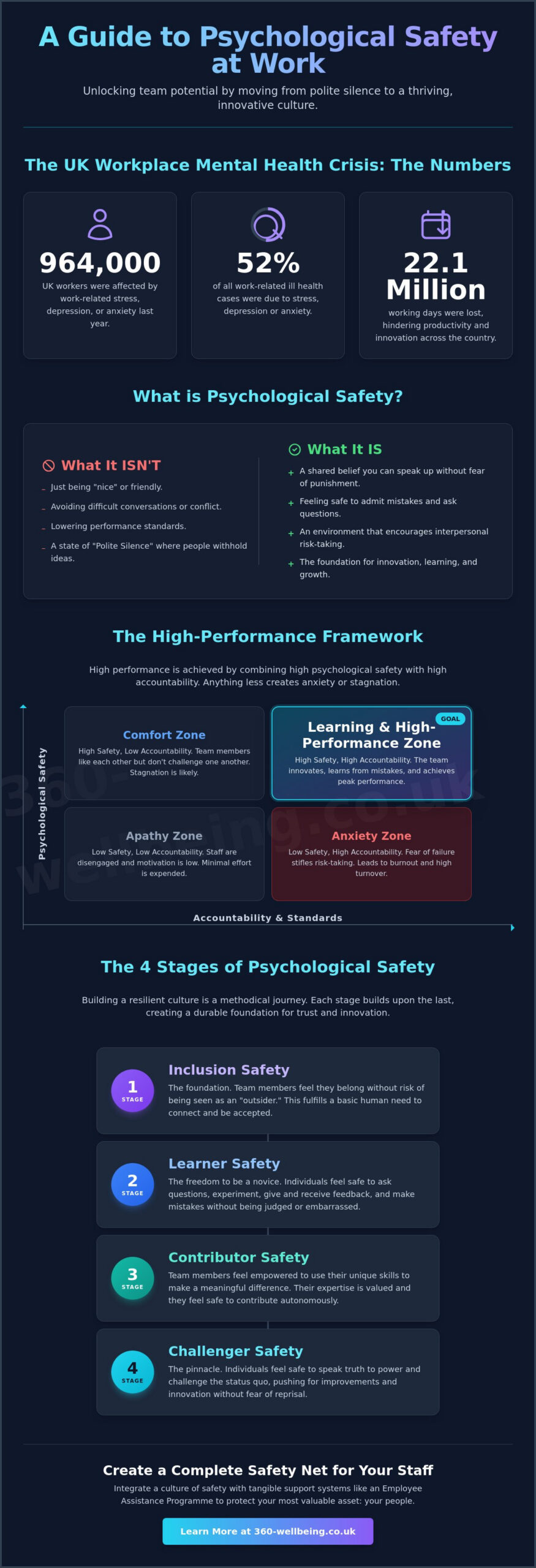
Last year, 964,000 UK workers were affected by work-related stress, depression, or anxiety, accounting for a staggering 52% of all work-related ill health cases. With the HSE conducting 14,000 proactive inspections this year focused on mental health, the question of what is psychological safety at work has shifted from a boardroom discussion to a core safety priority. You might already feel the strain of high staff turnover or the frustrating silence in meetings where innovation should be happening. It’s exhausting to manage a team that’s too afraid of making mistakes to actually move forward, especially when those fears contribute to 22.1 million lost working days across the country.
We believe that your people are your most valuable asset, and protecting their mental wellbeing is both a professional necessity and an essential human entitlement. This 2026 guide offers a definitive framework to help you foster a sense of completeness and balance within your teams. You’ll discover a clear roadmap to improve engagement, reduce absences, and create an environment where every individual feels safe to speak, risk, and thrive. By moving toward a proactive vision of workplace harmony, you can transform polite silence into a strategic advantage for your business.
Key Takeaways
- Learn to distinguish between “polite silence” and true psychological safety to unlock your team’s hidden potential and drive innovation.
- Explore the four-stage roadmap for team development that ensures your cultural improvements are durable and deep-rooted.
- Discover exactly what is psychological safety at work and why it’s the most effective tool for boosting retention and reducing absenteeism.
- Master practical leadership techniques, such as acknowledging fallibility, to frame daily tasks as shared learning experiences.
- See how to integrate cultural shifts with tangible support systems, like an Employee Assistance Programme, to create a complete safety net for your staff.
Defining Psychological Safety: More Than Just “Being Nice”
At its heart, understanding what is psychological safety at work involves looking past simple friendliness. It isn’t about being “nice” or avoiding difficult conversations. In fact, true safety is the exact opposite. It’s the shared belief that you can speak up, ask questions, or admit to a mistake without the fear of being humiliated or punished by your peers or leaders. When a culture lacks this foundation, it often retreats into “polite silence.” This is a dangerous state where team members withhold vital ideas to avoid conflict, effectively prioritising social comfort over collective progress.
This concept isn’t an individual personality trait; you aren’t simply born with the courage to speak up. Instead, Psychological safety is a collective property of the team. It’s the invisible “mesh” that connects colleagues, allowing for interpersonal risk-taking. This risk-taking is the primary engine of innovation. Without it, your most talented employees will keep their best ideas to themselves, fearing that a single “failed” suggestion might damage their professional reputation or lead to a negative performance review.
The Core Concept: Amy Edmondson’s Framework
Harvard Professor Amy Edmondson first brought this dynamic to light, and her research remains the gold standard for UK employers. She makes a vital distinction: feeling safe is not the same as having low standards. In high-performance environments, we aim for the “Learning Zone.” This is where high psychological safety meets high accountability. If you have accountability without safety, you create an “Anxiety Zone” where fear stifles productivity. By building a durable culture of trust, you ensure that high expectations lead to growth rather than burnout.
Why It’s a Basic Human Need in the Modern Workplace
Psychological safety is deeply rooted in our biology. When we feel socially threatened, our brains trigger a “fight or flight” response that prioritises survival over creativity. In Maslow’s Hierarchy of Needs, this sense of belonging and safety is a prerequisite for self-actualisation. Today’s hybrid and remote work models have made this even more complex. Without the nuance of face-to-face interaction, a blunt message or a silent video call can easily feel like a threat. Understanding what is psychological safety at work in 2026 requires a panoramic view of how your digital and physical spaces interact to support or hinder human connection.
The Four Stages of Psychological Safety in the Workplace
Creating a truly resilient culture isn’t an overnight achievement. It’s a methodical journey of team development. To truly understand what is psychological safety at work, we must view it as a ladder. You can’t expect a team to challenge the status quo if they don’t yet feel they belong. Skipping stages leads to a fragile culture where trust is superficial and easily broken. Each step requires a specific emotional shift from leadership, moving from a protective stance to one of active facilitation and empowerment.
From Inclusion to Innovation: The Progression
Durable cultural change happens in four distinct phases. Each phase builds on the last to create a sense of completeness and balance within the group:
- Stage 1: Inclusion Safety. This is the foundation where every member feels a basic human right to belong. It’s the absence of “outsider” feelings and cliques.
- Stage 2: Learner Safety. Here, individuals feel safe to ask questions, give or receive feedback, and experiment without fear of being judged. It’s about the freedom to be a novice.
- Stage 3: Contributor Safety. At this level, team members feel they can use their unique skills to make a tangible difference. They feel valued for their specific expertise.
- Stage 4: Challenger Safety. This is the pinnacle. It’s the safety to speak truth to power and challenge the status quo when they see an opportunity for improvement or a potential risk.
As a leader, your role is to guide your team through these phases with foresight and compassion. This methodical approach ensures that your team’s growth is both durable and sustainable. If you’re looking for ways to support your managers through this transition, offering tailored mental health support can provide the necessary tools for these complex interpersonal shifts.
Identifying Where Your Team Stands Today
Identifying your current position is the first step toward a proactive vision of workplace harmony. In a Stage 1 team, you might notice high anxiety, frequent “huddling” in small cliques, or a general reluctance to speak in group settings. Conversely, a Stage 4 team thrives on healthy debate. You’ll see rapid iteration and a high level of trust where ideas are critiqued, but individuals are always supported.
To get a clearer picture of what is psychological safety at work for your specific department, try asking these questions in your next 1-to-1 session:
- “On a scale of 1 to 10, how comfortable do you feel admitting to a mistake in our team meetings?”
- “Do you feel you have the space to ask ‘why’ when we start a new project?”
- “What is one thing I could do to make it easier for you to share a dissenting opinion?”
These conversations move the topic from an abstract HR concept to a practical, daily reality. They establish an immediate partnership between you and your staff, making complex cultural topics feel manageable and grounded in human support.
The Business Case: Why Psychological Safety Matters for UK SMEs
UK small and medium enterprises are currently facing a “War for Talent” that demands more than just competitive salaries. In an era where 964,000 workers are suffering from work-related stress, depression, or anxiety, the ability to retain skilled staff is directly tied to the emotional environment you provide. Understanding what is psychological safety at work is no longer just a soft skill; it’s a financial imperative. When employees feel safe, they stay. When they feel threatened, they check out, leading to a rise in both absenteeism and the equally damaging “presenteeism,” where staff are physically present but mentally disengaged.
In 2024/2025, 22.1 million working days were lost due to work-related stress and anxiety. This staggering figure represents more than half of all work-related ill health cases in the UK. Beyond the human cost, the economic impact of these absences is profound. By fostering a culture of safety, you reduce the risk of “groupthink,” a phenomenon where teams make poor decisions because no one is willing to challenge the majority. A safe team is an agile team, capable of pivoting quickly without the weight of internal fear holding them back.
Boosting Productivity and Meeting ISO 45003 Standards
As the UK’s Health and Safety Executive (HSE) intensifies its focus on psychological health, the introduction of ISO 45003 has provided the first international standard for managing psychosocial risks. This framework helps businesses move away from reactive fixes toward a proactive vision of vitality. By implementing these standards, you reduce the “cognitive load” your employees carry when they worry about office politics or potential humiliation. Research into high-performance cultures suggests that teams with high levels of psychological safety are able to recover from errors 40% faster than those operating in a culture of blame.
The Link Between Safety, Equity, and Inclusion
True diversity and inclusion cannot exist without a foundation of safety. Microaggressions and subtle biases often erode the confidence of minority groups, making those with “different” perspectives the least likely to speak up in a meeting. This silence is a lost opportunity for your business. Inclusive safety goes beyond tokenism by ensuring that every voice is not only invited to the table but is also protected once it gets there. By creating a panoramic viewpoint that values every individual’s contribution, you ensure that your EDI initiatives are durable and lead to genuine workplace harmony.
How to Foster Psychological Safety: A Manager’s Action Plan
Knowing the theory is one thing; putting it into practice is where the real work begins. It requires a shift in mindset from being a traditional “commander” to becoming a facilitator of growth. To truly embed what is psychological safety at work within your team, you need a structured action plan that moves beyond abstract concepts into daily habits. This approach builds the durability your business needs to thrive in a high-pressure environment.
Embedding these habits starts with five core steps designed to transform your team’s internal narrative:
- Step 1: Frame work as a learning problem. Move away from a pure execution focus. Acknowledge that because the landscape is complex and full of uncertainty, you need everyone’s brain in the game to succeed.
- Step 2: Acknowledge your own fallibility. Use simple phrases like, “I may miss something, so I need your eyes on this.” This gives others permission to speak up.
- Step 3: Model curiosity. Ask more questions than you give answers. Instead of directing, try asking, “What are we missing here?” or “What’s another way to look at this?”
- Step 4: Destigmatise failure. Distinguish between “intelligent mistakes” that happen during experimentation and preventable errors. Celebrate the lessons learned from the former.
- Step 5: Monitor your response to bad news. Don’t shoot the messenger. If someone brings you a problem, thank them for their honesty before you start looking for a solution.
Practising Situational Humility and Active Listening
Situational humility is the ability to admit you don’t have all the answers. It’s a professional necessity that builds immediate partnership with your staff. When you’re in a meeting, practice active listening by focusing entirely on the speaker rather than preparing your rebuttal. You can use a specific script to invite feedback: “What is one thing I could do to make it easier for you to speak up?” This question is powerful because it assumes there is already a barrier and asks for your help in removing it. It turns the abstract understanding of what is psychological safety at work into a tangible, daily practice.
Responding to Mistakes with Curiosity, Not Blame
When something goes wrong, your first instinct might be to ask, “Who did this?” However, this immediately triggers a defensive “fight or flight” response in your team. Instead, try a “Blameless Post-Mortem” approach. Ask, “How did this happen and what can we learn?” This shifts the focus from individual blame to systemic improvement. It builds foresight and allows your team to recover from errors much faster. If your managers feel overwhelmed by these cultural shifts, our professional Life Coaching can help them develop the emotional intelligence required for this new era of leadership.
Building a Safety Net: Integrating Safety with Holistic Wellbeing
Cultural shifts and leadership training are essential components, but they can’t stand alone. To truly answer what is psychological safety at work, we have to look beyond meeting room dynamics and consider the structural safety net you provide for your staff. When an employee is struggling with a personal health crisis or a financial burden, their capacity for interpersonal risk-taking often vanishes. A culture of trust is only durable when it’s backed by tangible, accessible support systems that address the whole person.
We advocate for a 360 Wellbeing approach. This methodology doesn’t just look at productivity; it integrates physical, mental, and social health into a single, unified narrative. By providing proactive resources, you signal that your commitment to your team’s vitality is genuine. It moves the conversation from a one-off HR initiative to a professional necessity and an essential human entitlement. This creates a sense of order and safety, which is essential when discussing sensitive topics like mental health or workplace stress.
The Role of Mental Health Support and Virtual GPs
The stress of “waiting and worrying” is a significant drain on cognitive resources. When an employee has 24/7 access to a Virtual GP, they gain immediate reassurance that their health concerns are being managed. This reduces base-level anxiety and allows them to focus on their contributions. Similarly, dedicated Mental Health Support and an Employee Assistance Programme (EAP) shouldn’t be viewed as reactive tools for when things go wrong. Instead, they’re proactive layers of protection that build individual resilience. Providing these services establishes an immediate partnership between the provider and the user, making complex health topics feel manageable and accessible.
Connecting Financial Security to Psychological Peace
It’s difficult for anyone to feel safe at work when they’re facing debt or financial uncertainty at home. These external pressures directly erode a person’s sense of security, often leading to the absenteeism and stress cases we’ve seen rise to record highs in 2026. Employers can play a pivotal role by offering Financial Support and Debt Advice as part of a panoramic wellbeing strategy. You can explore our Financial Support for Employees guide to see how these benefits create a foundation of stability.
Even services like complimentary will writing or legal support contribute to this sense of completeness. They remove the “background noise” of life’s legal and financial complications. When your team knows these essentials are covered, they have the mental space required to innovate, challenge, and thrive. This is the ultimate goal of understanding what is psychological safety at work: creating a space where the human spirit is free to do its best work because the basic needs of the human being are securely met.
Cultivating a Culture of Lasting Vitality
Transitioning your organisation toward a culture of trust is a journey that requires both leadership courage and structural support. You’ve seen that understanding what is psychological safety at work involves far more than just avoiding conflict; it’s about creating a space where team members move through the stages of inclusion and learning to reach a level of high-performance challenge. By framing work as a shared learning experience and acknowledging leadership fallibility, you empower your people to innovate without fear.
This cultural work is most effective when it’s grounded in tangible care. Providing a comprehensive safety net ensures that your team has the resilience to navigate both professional and personal hurdles. Discover how our wellbeing platform builds a safer, healthier workplace through 24/7 UK-registered Virtual GP access, a comprehensive EAP featuring mental health therapy, and integrated financial and legal support. This all-encompassing approach provides the panoramic security your employees need to truly thrive. Together, we can build a workplace where every individual feels valued, protected, and empowered to reach their full potential.
Frequently Asked Questions
Is psychological safety the same as trust?
No, they are distinct concepts. Trust focuses on the relationship between two people, while psychological safety is a shared belief held by the entire team. It describes the group dynamic and whether the collective environment feels safe for risk-taking. While you might trust a specific colleague, you may still feel unsafe speaking up in a large meeting if the team culture is punitive.
How do I measure psychological safety in my UK business?
You can measure this through anonymous pulse surveys that ask employees to rate their comfort level with admitting mistakes. Another practical metric is the “silence-to-contribution ratio” in your team meetings. In the UK, many businesses now integrate these questions into their mandatory stress risk assessments. This data provides a methodical way to identify which departments need more support and helps in understanding what is psychological safety at work for your specific context.
Can you have too much psychological safety at work?
It’s impossible to have too much safety, but it’s possible to have too little accountability. When safety is high but expectations are low, teams fall into a “Comfort Zone” where productivity might stall. The goal is the “Learning Zone,” where people feel completely safe to be honest while remaining deeply committed to high-performance standards and personal growth.
What is the first step for a manager to build psychological safety?
The first step is for a manager to demonstrate situational humility by admitting they don’t have all the answers. When a leader says, “I might have missed something, I need your eyes on this,” it gives the rest of the team explicit permission to speak up. This small act of vulnerability breaks the “expert” facade and invites an immediate partnership between the manager and their staff.
How does psychological safety affect remote or hybrid teams?
Remote and hybrid work can increase the risk of isolation and misunderstanding. Without physical body language, a short email or a silent video call can be interpreted as a threat. Building safety in these environments requires more intentionality. Managers should use dedicated “non-work” digital spaces and explicit invitations for dissenting opinions during virtual meetings to ensure everyone feels included.
Does psychological safety mean lowering performance standards?
Absolutely not. In fact, understanding what is psychological safety at work is the key to maintaining elite standards. When standards are high but safety is low, employees often hide errors to protect themselves. High safety ensures that problems are surfaced early, allowing the team to address them before they become expensive or dangerous failures. It supports a culture of durability and foresight.
What role does an Employee Assistance Programme (EAP) play in safety?
An EAP serves as a vital structural safety net that backs up your cultural work. Knowing that professional mental health support, legal advice, or financial guidance is just a phone call away reduces the “base-level” anxiety an employee carries. This external support allows them to bring their best, most creative selves to work because they feel their basic human needs are securely met.
How long does it take to build a psychologically safe culture?
Building a durable culture is a methodical process rather than a one-off project. While you can see shifts in meeting engagement within a few months, creating a truly resilient environment often takes a year or more of consistent effort. It requires foresight and a commitment to maintaining these standards even when the business is under significant pressure. Consistency is the key to long-term workplace harmony.