
Did you know that replacing a single mid-level team member in the UK can cost your business upwards of £30,614 in recruitment fees and lost productivity? You likely already feel the weight of these rising costs, especially when a departure triggers a domino effect of low morale and a drain on institutional knowledge. It’s frustrating to watch your best talent leave for a competitor when you’ve invested so much in their professional growth. We understand that behind every resignation letter is often a person seeking more balance, support, or purpose.
We believe that a thriving business starts with a healthy, supported workforce. By implementing modern employee retention strategies uk organisations can use to foster genuine loyalty, you’ll move from reactive hiring to proactive care. This guide reveals ten effective ways to reduce turnover and build a resilient team for 2026. We’ll show you how a 360-degree approach to mental, physical, and social health creates a workplace where people don’t just stay, they truly flourish. Our roadmap covers everything from tailored wellbeing packages to career development paths that make your employer brand irresistible.
Key Takeaways
- Understand the hidden financial impact of staff turnover, from recruitment fees to lost momentum, and why a proactive approach is essential for UK businesses.
- Discover modern employee retention strategies uk managers can implement that move beyond salary alone to focus on holistic mental and physical health security.
- Learn how to distinguish between superficial perks and high-impact support systems, such as 24/7 GP access, that provide genuine peace of mind for your team.
- Master a practical five-step framework for auditing your current benefits and conducting “stay interviews” to align your culture with the real-world needs of your workforce.
- Explore how a 360-degree wellbeing strategy simplifies complex benefits, making comprehensive care both manageable and affordable for growing organisations.
The True Cost of Staff Turnover for UK Organisations in 2026
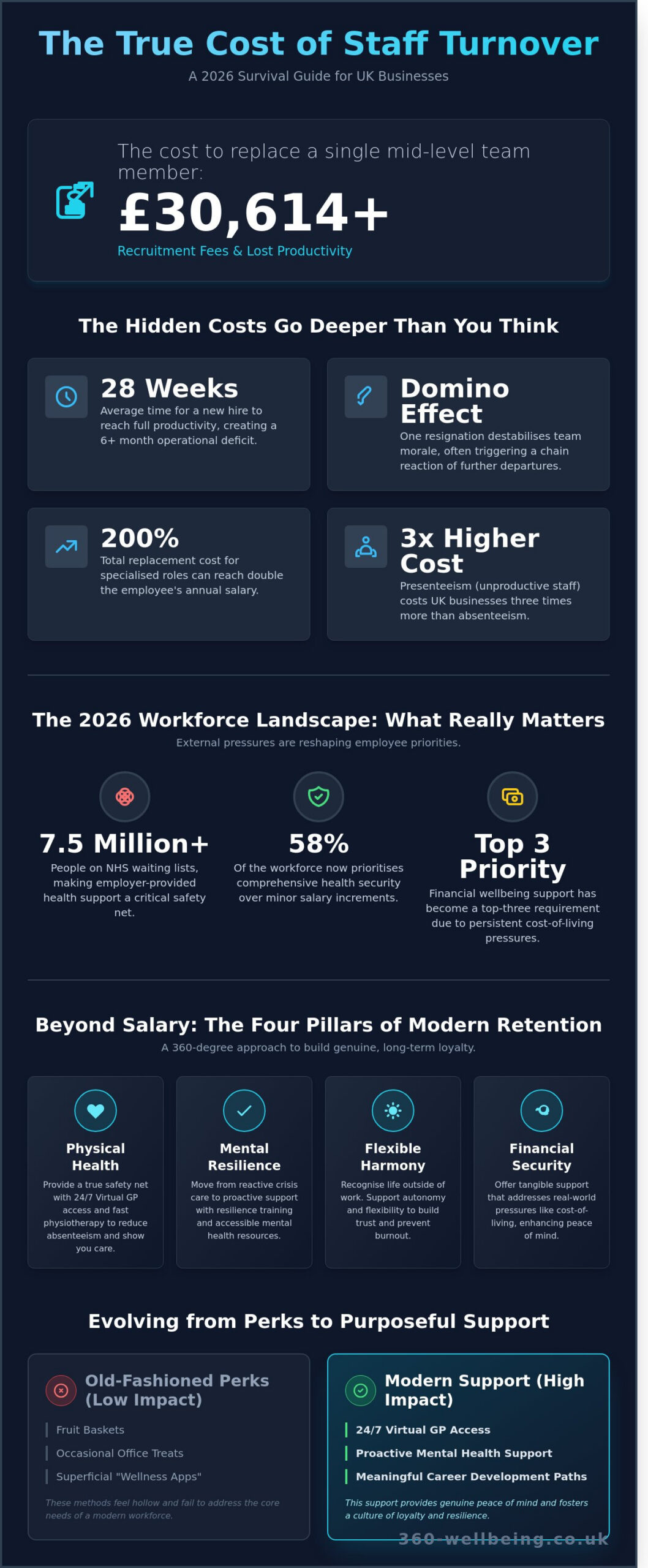
In the 2026 UK labour market, employee retention has shifted from a basic HR target to a core pillar of organisational resilience. It’s about more than just keeping seats filled; it’s a proactive promise to support the whole person. Understanding The True Cost of Staff Turnover means looking at the hidden ripples that follow a resignation. When a valued colleague leaves, they take specific expertise and emotional stability with them. This loss often leaves the remaining team feeling exposed and exhausted. Old-fashioned employee retention strategies uk firms used to use, like fruit baskets or occasional office treats, feel hollow in a world where workers value health security and flexible autonomy above all else. Modern retention requires a tailored approach that recognises the human behind the job title.
The hidden costs of losing a team member extend far beyond a recruitment fee. There is a profound loss of momentum that occurs when a project lead or specialist departs. It takes an average of 28 weeks for a new hire to reach full productivity in a professional role, meaning your business operates at a deficit for over half a year. This transition period puts immense pressure on the remaining staff, often triggering a cycle of burnout that is difficult to break. Traditional methods are failing because they don’t account for the “whole-life” needs of employees who now view work as a component of their wellbeing rather than their entire identity.
Calculating the Financial Impact on Your SME
Replacing a skilled professional in 2026 represents a significant capital loss. For roles requiring specialised expertise, the total replacement cost frequently reaches 200% of the employee’s annual salary once recruitment fees, onboarding, and training periods are factored in. While the cost of a vacancy is clear, the cost of presenteeism, where staff are present but unproductive due to stress or illness, is often three times higher for the average UK business. The Domino Effect in UK workplace culture is a phenomenon where one resignation destabilises the confidence of the remaining team, leading to a rapid succession of further departures as colleagues begin to question their own loyalty.
The 2026 Landscape: NHS Strain and Cost of Living
External factors now weigh heavily on a person’s decision to stay with your company. With NHS waiting lists remaining a primary concern for over 7.5 million people in early 2026, employees are looking for employers who provide a genuine safety net. Health security has replaced minor salary increments as a top priority for 58% of the workforce. People need to know they can access care without waiting months for a consultation. Financial wellbeing support is now a top-three requirement, as UK staff seek proactive help with the persistent costs of daily life. Effective employee retention strategies uk must now offer a comprehensive 360-degree approach that addresses these real-world pressures directly to foster long-term commitment.
Beyond Salary: The Four Pillars of Modern Staff Retention Ideas
Salary is a foundation, but it’s rarely the reason people stay long-term. A 360-degree approach to employee loyalty recognises that your team members are individuals with complex lives outside the office. To build a robust employee retention strategies uk framework, you must look at the person as a whole. This means moving beyond the payslip to support four distinct pillars: physical health, mental resilience, flexible harmony, and financial security. When these pillars are strong, you create an environment where staff feel truly seen and valued.
Health as a Strategic Retention Asset
Health support is no longer just a “nice-to-have” perk; it’s a critical business tool. Access to 24/7 Virtual GPs allows employees to book appointments around their shifts, significantly reducing absenteeism. According to Deloitte’s 2024 Mental Health Report, poor mental health costs UK employers approximately £51 billion per year. Moving from reactive crisis care to proactive resilience training helps your team manage stress before it leads to long-term sick leave. For those in physical roles, fast access to physiotherapy is vital. With over 30 million working days lost annually in the UK to musculoskeletal issues, providing immediate support keeps your workforce active and reduces the strain on the NHS. You can learn more about optimising your health benefits to meet these specific needs.
Culture, Recognition, and Professional Growth
Creating a “caregiver” corporate personality helps build deep trust. Employees stay when they feel their employer genuinely cares about their future. This involves moving away from one-size-fits-all rewards and toward personalised recognition that honours individual life stages. Life coaching and mentorship are excellent tools here, as they help staff visualise a long-term career path within your organisation. Managers should implement proactive, ongoing strategies to ensure that career development conversations happen regularly, rather than being confined to just an annual review.
- Tailored Rewards: Swap generic vouchers for benefits that matter, such as extra leave for a child’s first day at school or a subscription to a wellness app.
- Financial Wellness: Offer legal support or debt counselling to reduce the “financial noise” that often distracts employees during the working day.
- Proactive Support: Use data to identify when a team member might be struggling and offer support before they feel the need to resign.
Implementing these employee retention strategies uk requires a shift in mindset. It’s about seeing your staff as partners in success. By providing a safety net of health, flexibility, and growth, you don’t just retain staff; you build a resilient, loyal community that’s equipped to thrive even in challenging economic climates.
Comparing Traditional Benefits vs. Holistic Wellbeing Platforms
For many UK SMEs, standard Private Medical Insurance (PMI) feels like a heavy financial commitment that rarely addresses everyday health. While PMI is excellent for major surgeries, it often ignores the smaller, persistent issues that lead to burnout. A shift is happening. Businesses are moving away from “perks” like cinema discounts, which only 15% of staff regularly use, toward comprehensive support systems. Real value lies in providing 24/7 GP access or mental health counselling. These are the foundations of effective employee retention strategies uk businesses need to survive.
The cost difference is stark. Replacing a mid-level employee costs an average of £30,614 when accounting for recruitment fees and lost productivity. A holistic wellbeing platform typically costs between £5 and £15 per employee per month. Investing in a proactive platform pays for itself if it prevents just one resignation every two years. It’s about moving from a reactive “break-fix” model to a proactive culture of care. Consider the difference between these two approaches:
- Traditional Perks: Gym discounts, cinema vouchers, and high-street coupons that often go unused.
- Holistic Support: 24/7 virtual GPs, mental health counselling, and legal or financial aid that provide genuine peace of mind.
The Problem with Fragmented Benefit Packages
Managing five different logins for five different providers creates a massive administrative burden for HR teams. When benefits are scattered, uptake drops by up to 40% because employees simply forget they exist. A unified platform like 360 Wellbeing creates a single point of care. It removes the friction between a staff member feeling unwell and getting the help they deserve. This 360-degree approach ensures that physical and mental health support are always within reach, rather than buried in an old HR email or a dusty handbook.
Virtual GP Services: The Ultimate Retention Tool
Waiting weeks for a local surgery appointment causes unnecessary stress for working parents and busy professionals. Digital-first care, such as “Doctor at Hand” services, allows staff to speak with a clinician in minutes. Data shows that virtual GP access can save an employee 3 hours of travel and waiting time per instance. This proactive care is one of the most effective employee retention strategies uk companies can implement to reduce absenteeism. Looking ahead to 2026 surveys, health access is projected to be the most requested benefit above traditional salary increases. By providing this now, you’re building long-term resilience and showing your team that their time and health are genuinely valued.
How to Improve Employee Retention: A 5-Step Strategy for UK Managers
Retaining your best people in 2026 requires a shift from reactive fixes to proactive care. When you implement comprehensive employee retention strategies uk businesses often see a direct correlation between staff wellbeing and long-term loyalty. Managers who prioritise a holistic view of their team’s health create a culture where people feel seen, heard, and valued. This five-step framework provides a structured path to building that resilience within your workforce.
- Step 1: Conduct a “Stay Interview” to understand current team sentiment before frustration turns into a resignation letter.
- Step 2: Audit your current benefits against the 2026 cost-of-living needs, ensuring your package provides genuine financial relief.
- Step 3: Implement a proactive wellbeing platform that offers 24/7 support, giving staff immediate access to clinical and mental health experts.
- Step 4: Train managers to recognise the physical symptoms of stress, such as persistent fatigue or tension-related absences, to intervene early.
- Step 5: Regularly communicate and celebrate the support available so that every team member knows exactly where to turn during difficult times.
Conducting Effective Stay Interviews
Stay interviews are a powerful tool for uncovering hidden frustrations. You should ask specific questions like: “What do you look forward to most when you start your day?” or “If you could change one aspect of your current role, what would it be?”. Use this feedback to organise better internal support structures, such as adjusting workloads or providing new training opportunities. Stay interviews allow you to fix the roof while the sun is shining, whereas exit interviews are merely an autopsy of why the talent has already left.
Integrating Financial and Legal Support
Financial anxiety is a leading cause of workplace stress in the UK. By offering complimentary will writing as a high-value, low-cost benefit, you provide employees with peace of mind that their families are protected. Additionally, providing debt advice helplines can significantly reduce the mental load on staff struggling with rising costs. You can learn more about these essential tools in our Financial Support for Employees pillar. These employee retention strategies uk managers use help bridge the gap between professional performance and personal stability.
Creating a supportive environment isn’t just about the occasional perk; it’s about a consistent commitment to your team’s total health. We can help you build a bespoke strategy that protects your most valuable assets. Discover our comprehensive wellbeing solutions today.
The 360-Degree Solution: Making Retention Manageable and Affordable
Managing employee benefits often feels like a fragmented puzzle. For many UK businesses, the administrative burden of juggling multiple providers prevents them from implementing truly effective employee retention strategies uk. 360 Wellbeing changes this by consolidating physical, mental, and social support into a single, intuitive platform. We don’t just provide a service; we act as a clinical partner that simplifies the complex world of corporate wellness.
The heart of this approach is the Employee Assistance Programme (EAP). In an era where 1 in 4 people in the UK experience a mental health problem each year, a robust EAP is no longer a luxury. It’s a fundamental safety net. By offering 24/7 access to British Association for Counselling and Psychotherapy (BACP) accredited counsellors, you provide your team with immediate support. This proactive care prevents minor stressors from escalating into long-term sick leave, ensuring your workforce remains stable and productive.
Positioning your company as an “Employer of Choice” requires more than a competitive salary. It demands a culture of genuine care. When staff see that their health is a priority, loyalty follows naturally. You’re not just hiring talent; you’re building a community that feels protected and valued.
A Scalable Model for Small Businesses and Sole Traders
Size shouldn’t dictate the quality of care you offer. While large corporations have historically dominated the benefits space, our model makes these tools accessible to the 5.5 million SMEs operating across Britain. We provide a transparent, monthly per-employee fee starting from just a few pounds. This predictable cost allows even the smallest teams to access the same clinical expertise as a FTSE 100 company. Onboarding is swift and digital, removing the traditional barriers of heavy paperwork and long lead times.
Success Stories: Resilience in Action
The impact of these services is visible in the data. Businesses using our Virtual GP service report that staff can secure consultations within 24 hours, compared to the weeks often required for standard appointments. This speed reduces absenteeism and demonstrates a commitment to employee time. According to a 2022 Deloitte report, employers see an average return of £5.30 for every £1 invested in mental health support. This ROI manifests in a healthy, supported, and loyal workforce that chooses to stay for the long term. See how our platform can transform your retention strategy and help you build a team that thrives.
By integrating these 360-degree solutions, you move beyond temporary fixes. You create a sustainable environment where people feel empowered to do their best work. It’s time to build a workforce that doesn’t just work for you, but wants to grow with you.
Future-Proof Your Workforce for 2026
Building a resilient team in 2026 requires looking beyond the monthly payslip. Research indicates the cost of replacing a single staff member can exceed £30,000 once recruitment fees and lost productivity are tallied. To protect your bottom line, it’s vital to transition from reactive perks to proactive, holistic care. Modern employee retention strategies uk focus on providing 360-degree support that treats physical, mental, and financial health as a unified strategic asset rather than a luxury.
Professionals today seek more than just a salary; they want a partnership that values their long-term vitality. Our platform simplifies this by providing 24/7 access to UK-registered GPs, a comprehensive EAP with mental health and legal support, and thousands of lifestyle discounts via 360 Rewards. It’s a manageable and affordable way to show your staff they truly matter while fostering a culture of genuine workplace harmony. Take the first step toward a more stable and empowered workforce. Book a demo of the 360 Wellbeing platform today and start building a future where your people can truly thrive.
Frequently Asked Questions
What are the most effective employee retention strategies for UK SMEs in 2026?
The most effective employee retention strategies uk SMEs can adopt in 2026 focus on hyper-personalisation and proactive health support. By 2026, 73% of the UK workforce will expect hybrid working as standard, making flexible schedules a non-negotiable foundation for any business. You should also implement tailored career development paths and integrated health benefits that address physical and mental needs before they become issues, ensuring your team feels truly seen and supported.
How much does it actually cost to replace an employee in the UK?
Replacing an employee in the UK costs an average of £30,614 per person according to research by Oxford Economics. This figure accounts for the £5,433 spent on recruitment and the £25,181 lost in productivity during the 28 weeks it typically takes for a new hire to reach full efficiency. For senior roles, these costs often exceed £45,000 when you factor in specialised training and agency fees, making retention a vital financial priority.
Can a virtual GP service really improve staff retention?
A virtual GP service significantly improves staff retention by providing immediate access to healthcare, reducing the average NHS wait time of 10 days to just a few hours. When employees feel their health is a genuine priority, they’re 60% more likely to stay with their current employer for the long term. This 360-degree approach to care shows you value their time and wellbeing, which builds deep-seated loyalty and reduces absenteeism across the board.
What is the difference between an EAP and a wellbeing platform?
An Employee Assistance Programme (EAP) is typically a reactive service focused on crisis management, whereas a wellbeing platform is a proactive tool designed for daily health maintenance. While 75% of UK companies offer an EAP, engagement is often as low as 5% because it’s only used when problems arise. A modern wellbeing platform integrates with an EAP but adds preventative features like fitness tracking and nutritional advice to keep your team healthy every day.
How do I talk to my employees about their mental health and wellbeing?
You should approach mental health conversations with a “listen first” mindset, using open-ended questions like “How are you managing your current workload?” in a private, safe setting. Research from Mind shows that 60% of employees would feel more motivated if their manager took an active interest in their wellbeing. It’s best to follow a structured framework that offers support and reassurance without attempting to diagnose medical conditions yourself, acting as a compassionate guide instead.
Is financial support a legal requirement for UK employers?
Financial support beyond Statutory Sick Pay (SSP) of £116.75 per week and mandatory pension contributions isn’t a legal requirement for UK employers. However, since 25% of UK workers report that financial stress affects their performance, many businesses now provide discretionary support as a strategic asset. This includes salary sacrifice schemes or financial education tools to help staff manage the cost of living more effectively, which fosters a sense of security and partnership.
How can I improve employee engagement on a tight budget?
You can improve employee engagement on a tight budget by implementing a formal peer-to-peer recognition programme, which costs nothing but increases morale by up to 14%. Focus on transparent communication and regular feedback loops, as 80% of UK employees feel more engaged when they understand the company’s long-term goals. These low-cost employee retention strategies uk businesses use create a sense of belonging and purpose that salary alone can’t buy for your team.
What are the best employee benefits for improving work-life balance?
The best benefits for work-life balance include flexible working hours, “work from anywhere” weeks, and enhanced annual leave policies that go beyond the statutory 28 days. Implementing a “4-day work week” trial or “Summer Fridays” can boost productivity by 20% while drastically reducing burnout. Providing access to a virtual GP also helps, as it allows staff to manage family health appointments without taking a full day of unpaid leave or disrupting their schedule.