
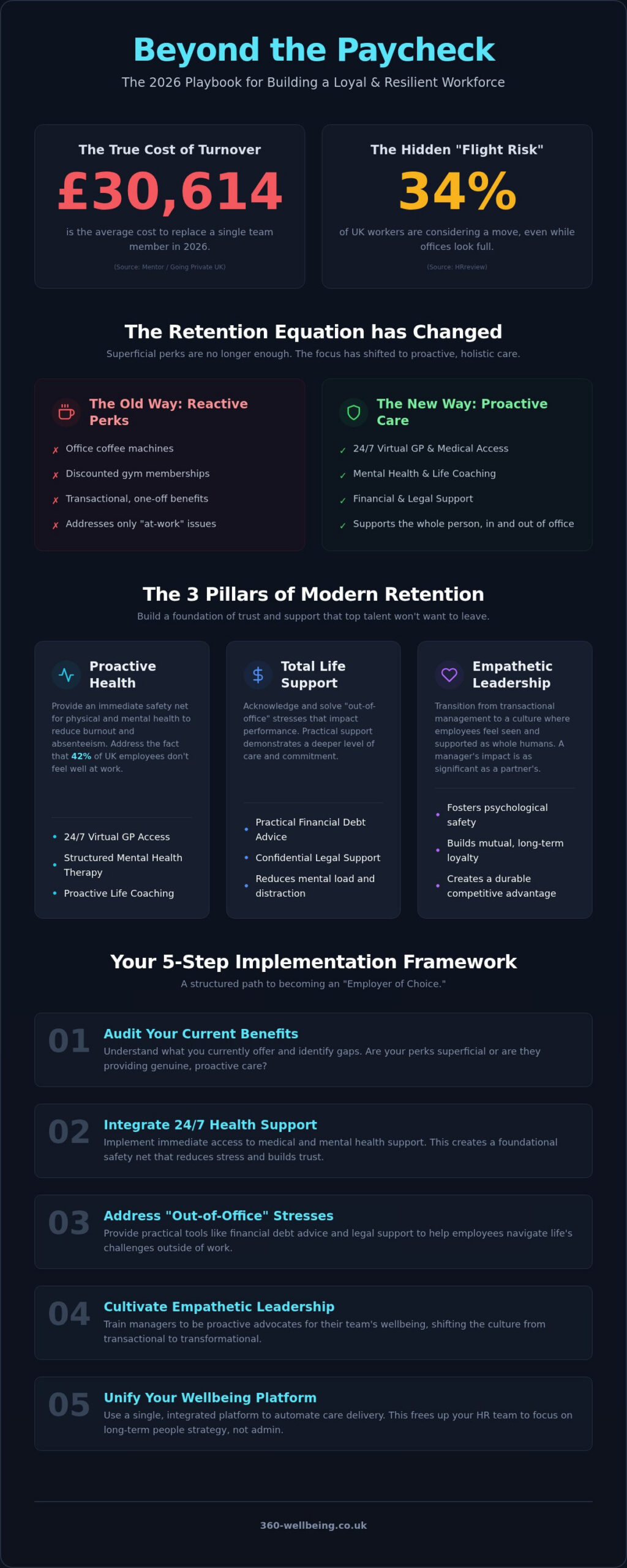
Did you know that replacing a single member of your team in 2026 now costs an average of £30,614? While the “Big Stay” might make your office look full, research shows that 34% of UK workers are still considering a move. Many stay because they feel they have to, not because they want to. This hidden disengagement is a quiet threat to your productivity and morale. To protect your business, you need employee retention strategies that look beyond the salary slip and address the whole person.
We understand the pressure of managing rising turnover while trying to maintain a high-performing culture. It’s frustrating to lose senior staff and the vital institutional knowledge they carry. This guide promises to help you build a resilient, loyal workforce by integrating holistic health, financial wellness, and empathetic leadership into your core strategy. We’ll examine how providing proactive care, such as 24/7 virtual GP access and mental health therapy, can turn your company into an “Employer of Choice” where people don’t just stay, but truly flourish.
Key Takeaways
- Understand why superficial perks are no longer enough to secure top talent in the competitive 2026 UK landscape.
- Learn how providing immediate, 24/7 access to medical and mental health support creates a foundation of trust and reduces burnout.
- Discover the impact of solving “out-of-office” stresses through practical financial debt advice and legal support.
- Follow a structured 5-step framework to audit your current benefits and build more robust employee retention strategies.
- Explore how a single, unified wellbeing platform can automate care and free your HR team to focus on long-term people strategy.
The 2026 Retention Landscape: Why Traditional Perks Aren’t Enough
At its core, Employee retention represents the strategic effort by an organisation to maintain a stable, high-performing workforce. In 2026, this isn’t just an HR metric; it’s a vital sign for business health. We’re currently seeing a significant “talent crunch” where skilled professionals aren’t just looking for a job. They’re looking for a partnership. With 34% of UK workers considering a move this year, according to HRreview, the power has shifted firmly into the hands of the employee. They are more selective than ever, choosing employers who offer foresight and durability over those offering superficial benefits.
Traditional perks like office coffee machines or discounted gym memberships are no longer the anchors they once were. Modern employee retention strategies must pivot toward proactive care. This means moving away from reactive “perks” and toward a panoramic view of wellbeing that includes 24/7 Virtual GP access and mental health support. When you invest in a unified wellbeing platform, the ROI becomes clear: you’re trading the massive expense of constant hiring for a predictable, preventative safety net that keeps your team focused and present.
The High Cost of High Turnover
Losing a staff member creates a ripple effect that touches every part of your operation. Direct expenses like recruitment fees, advertising, and the hours spent interviewing are just the beginning. You also face indirect burdens, such as the “knowledge drain” that occurs when a senior specialist departs, taking years of institutional wisdom with them. This often leads to lowered team morale and a temporary dip in productivity for those left behind. According to Mentor and Going Private UK, the average cost to replace a single UK employee in 2026 has reached £30,614.
From Transactional to Empathetic Leadership
Employees in 2026 stay where they feel seen and supported as whole humans, not just as units of production. The transition from transactional management to empathetic leadership involves becoming a proactive advocate for your team’s health. This isn’t about being “soft”; it’s about being strategic. When a manager understands that their impact on an employee’s mental health is as significant as that of a partner, as suggested by Great Place To Work 2026, empathy becomes a durable competitive advantage. By offering tools like life coaching and financial support, you demonstrate a commitment to their long-term success, fostering a culture of mutual loyalty that is difficult for competitors to replicate.
The Health Pillar: Integrating Physical and Mental Support
Physical vitality and mental clarity are the invisible engines of employee engagement. When an individual is distracted by a persistent ache or weighed down by anxiety, they cannot bring their best self to their role. Research indicates that 42% of UK employees report not feeling physically or mentally well at work. This isn’t just a personal issue; it’s a structural risk for any business. Modern employee retention strategies must move beyond basic health warnings toward a proactive vision of total wellness.
By providing immediate medical access, you solve the “waiting game” that often fuels workplace anxiety. Our approach to “Panoramic Wellbeing” ensures that support isn’t fragmented. Instead, it covers the employee from the moment they feel unwell through to their full recovery. This seamless integration of physical, mental, and social health creates a sense of safety that is essential for long-term loyalty. As the UK government on retaining staff highlights, the value proposition you offer must be robust enough to compete in a tightening labour market.
24/7 Virtual GP: The Modern Safety Net
Digital health access has become a cornerstone of the modern workplace. By offering a 24/7 Virtual GP, you provide a vital safety net for staff working non-traditional or flexible hours. This instant reassurance reduces absenteeism, as employees can address health concerns without the stress of securing a daytime appointment. It’s about positioning medical access as a professional necessity, ensuring your team remains healthy, focused, and capable of meeting their goals. Providing such a reliable resource is a simple way to invest in your team’s long-term health and stability.
Mental Health and Life Coaching
Traditional Employee Assistance Programmes often fall short because they offer reactive, one-off support. To truly retain top talent, you need to provide structured Mental Health Support and Life Coaching. This helps employees navigate personal transitions, such as returning from parental leave or managing family changes, keeping them mentally present at work. We aim to create a culture where seeking help is viewed as a proactive strength rather than a weakness. When you destigmatise mental health through professional therapy access, you build a workplace where everyone feels empowered to thrive.
Beyond the Office: Financial and Legal Wellness as Retention Anchors
While physical and mental health are foundational, the weight of personal financial anxiety and legal burdens often acts as a silent anchor, pulling down even your most talented staff. It’s a hidden driver of turnover that many organisations overlook. When an employee is worried about rising debt or an unresolved legal dispute, they are physically present but mentally absent, a phenomenon known as presenteeism. To build a truly resilient workforce, employee retention strategies must look beyond the office walls to solve these life stresses before they lead to burnout.
Providing a panoramic view of support means acknowledging that an individual’s sense of security is tied to their financial and legal stability. A retention in public services report highlights how extrinsic factors like financial stability are inextricably linked to workforce morale and long-term commitment. By offering tools that address these concerns, you’re not just providing a benefit; you’re offering a professional necessity that allows your team to stay focused on their goals. For a deeper dive into these strategies, see our Financial Support for Employees: A Comprehensive Guide.
The Impact of Financial Stress on Productivity
Financial anxiety is a major distractor in the modern UK workplace. Only 10% of UK employees are fully engaged at work, according to MOL Learn, and personal finance issues are often at the root of this disengagement. By offering a dedicated debt helpline and financial support, you demonstrate a compassionate, long-term commitment to your staff’s welfare. It’s a proactive way to reduce the mental load on your team, ensuring they have the headspace to be creative and productive. Integrating these services into your standard package transforms your business into a sanctuary of stability.
Legal Support and Complimentary Will Writing
Legal benefits provide the ultimate peace of mind for employees navigating complex life events. Whether it’s a housing dispute or family matter, having access to legal support reduces the administrative and emotional burden on the individual. We’ve found that high-perceived-value benefits, such as complimentary will writing, offer a unique sense of psychological security. It shows that you care about their legacy and their family’s future. This level of foresight builds a deep bond of trust, making it far less likely that your senior staff will seek opportunities elsewhere during sensitive periods of their lives.
How to Implement an Effective Retention Strategy: A 5-Step Framework
Building a culture where people choose to stay requires a transition from reactive fixes to a methodical, proactive framework. Effective employee retention strategies are not assembled overnight; they are the result of steady, calm consultation with your workforce. By following a structured path, you can move away from guesswork and toward a strategy that feels both scientifically grounded and deeply personal to your team’s needs.
- Step 1: Conduct “Stay Interviews.” Don’t wait for an exit interview to learn why people are unhappy. Ask your current staff what keeps them engaged and what challenges they face in their daily lives.
- Step 2: Audit existing benefits. Review your current offerings for actual usage. If a benefit has low engagement, it’s likely not meeting a genuine need.
- Step 3: Identify gaps in holistic care. Use a panoramic viewpoint to see if you’re covering all four pillars: physical, mental, financial, and legal health.
- Step 4: Roll out a unified platform. Fragmented services lead to low engagement. A single SaaS platform like 360 Wellbeing ensures ease of access and makes the “expert caregiver” role manageable for HR.
- Step 5: Measure and refine. Use anonymous feedback loops and retention data to adjust your approach. Success is a continuous journey of improvement.
Auditing Your Current Wellbeing Culture
It’s vital to differentiate between “fluff” perks and foundational benefits. While office social events might provide temporary morale boosts, they don’t solve the underlying stress of a health concern or financial burden. Use employee surveys to pinpoint specific areas of pressure. This data allows you to evaluate the “durability” of your efforts. For example, replacing a generic gym discount with 24/7 Virtual GP access shifts your culture from offering a luxury to providing a professional necessity.
Measuring ROI and Engagement
To ensure your strategy remains sustainable, you must track key metrics like turnover rates and absenteeism. Industry data indicates that when employees don’t feel recognised or supported, their motivation drops significantly. Use your internal engagement data to refine your employee retention strategies over time, ensuring your investment always maps to the actual wellbeing of your staff. When you clearly communicate the value of these benefits back to your team, you foster a sense of being truly “seen” and supported. To see how a consolidated approach can simplify this process for your HR team, explore our unified wellbeing platform today.
Scaling Your Strategy with a Unified Wellbeing Platform
Managing fragmented benefits packages often leads to administrative burnout for HR teams. When you’re juggling separate contracts for a GP service, a legal helpline, and mental health support, the complexity can overshadow the care you’re trying to provide. A unified SaaS platform simplifies this “expert caregiver” role by automating the delivery of support, allowing leadership to focus on long-term strategy rather than managing multiple vendors. For SMEs, this approach is particularly vital. It provides an affordable way to offer the same level of panoramic care as corporate giants, ensuring your employee retention strategies are as robust as those of any global competitor.
The transition to a single platform creates a sense of order and safety for both the employer and the employee. Instead of a confusing list of disparate perks, staff have a single point of access for their physical, mental, and social health needs. This clarity increases engagement, as employees are far more likely to use a service that is easy to find and simple to navigate. By consolidating your efforts, you ensure that your investment in wellbeing isn’t just a line item on a spreadsheet, but a functional, durable part of your company culture.
The 360 Wellbeing Advantage
The 360 Wellbeing platform integrates vital services like 24/7 Virtual GP access, Mental Health Support, and Legal Support into a single dashboard. This all-encompassing nature is our signature, reflecting a commitment to total wellness that feels both scientifically grounded and deeply personal. We’ve designed the onboarding process to be steady and methodical, allowing you to get your entire team protected in days rather than months. By providing a 24/7 safety net that includes life coaching and debt advice, you address the flexible needs of a modern workforce, ensuring support is always accessible when it’s needed most.
Securing Your Talent for the Future
As we look toward the landscape of 2026, the link between comprehensive care and long-term loyalty is undeniable. Employees stay where they feel their wellbeing is treated as a professional necessity and an essential human entitlement rather than a luxury. Don’t wait for staff to leave before you examine the durability of your support systems. Taking a proactive step today ensures your workforce feels valued, secure, and healthy enough to drive your business forward. It’s time to protect your team and improve retention with 360 Wellbeing and build a culture that truly flourishes.
Building a Future-Proof Workplace Culture
The landscape of 2026 demands a shift from superficial perks toward a panoramic vision of care. By following a structured 5-step framework and auditing your current benefits, you can move beyond reactive fixes. True loyalty is built when staff feel supported in every aspect of their lives, from their physical health to their financial security. Implementing modern employee retention strategies isn’t just about reducing turnover; it’s about creating a sanctuary where your team can truly thrive.
Our platform is designed specifically to help UK SMEs compete for top talent by offering comprehensive mental, physical, and financial support in one place. With 24/7 access to UK-registered GPs and a suite of tools including debt advice and life coaching, you provide a safety net that is both professional and deeply personal. It’s an investment in the durability of your workforce that pays dividends in productivity and morale. Book a demo to see how 360 Wellbeing can transform your staff retention and start your journey toward a more resilient, harmonious workplace today. You have the power to turn your business into an employer of choice.
Frequently Asked Questions
What are the three most important employee retention strategies for 2026?
The most effective strategies for the current landscape involve providing 24/7 medical access, offering integrated financial and legal guidance, and fostering a culture of empathetic leadership. By moving beyond superficial office perks, you address the foundational life stresses that often lead to disengagement. Providing a panoramic safety net ensures that your team feels valued as whole individuals, which is the most durable way to secure long-term loyalty in a competitive market.
How much does it cost to implement an employee retention programme in the UK?
While costs vary depending on the size of your workforce, most modern programmes operate on a predictable per-employee subscription model. This makes high-level support affordable even for smaller businesses. When you consider that the average cost of replacing a single staff member in 2026 has reached £30,614, the investment in a unified wellbeing platform represents a significant saving. It shifts your budget from the high cost of reactive recruitment to the sustainable value of proactive care.
Can a Virtual GP service really help with staff retention?
Yes, providing a Virtual GP service is a powerful way to demonstrate that you prioritise your team’s health as a professional necessity. It removes the stress and time-loss associated with securing traditional daytime appointments, allowing staff to receive UK-registered medical advice 24/7. This immediate reassurance reduces health-related anxiety and absenteeism. When employees know their health is supported without barriers, they are far more likely to stay with an employer who provides such essential security.
What is the difference between an EAP and a holistic wellbeing platform?
A traditional Employee Assistance Programme (EAP) is typically reactive, offering a phone line for crises. In contrast, a holistic wellbeing platform provides a unified, proactive dashboard that integrates physical, mental, and social health. While an EAP might be a standalone service, a platform like 360 Wellbeing includes everything from physiotherapy and mental health therapy to legal aid and debt advice. This all-encompassing approach ensures that support is a constant presence, not just an emergency measure.
How do I measure the success of my new retention strategy?
Success is best measured through a combination of quantitative metrics and qualitative employee feedback. Focus on tracking your voluntary turnover rates and the frequency of health-related absenteeism over a six-month period. Additionally, monitoring platform usage data allows you to see which specific benefits, like mental health support or debt advice, are resonating most with your team. This evidence-based approach helps you refine your employee retention strategies based on actual staff needs rather than assumptions.
Why is financial support becoming a key retention factor for UK businesses?
Financial anxiety acts as a silent driver of turnover, often leading to burnout and a lack of focus. By providing a debt helpline and financial support, you help remove the mental load that many workers carry outside of the office. This proactive care reduces presenteeism and shows a deep, empathetic commitment to your team’s overall stability. When a business helps solve real-world burdens like financial stress, it builds a level of trust that salary increases alone cannot achieve.
What is a “Stay Interview” and how do I conduct one?
A stay interview is a structured, informal conversation designed to understand why an employee chooses to remain with your organisation and what might tempt them to leave. Unlike an exit interview, it allows you to make positive changes in real-time. Conduct these by asking open-ended questions about their career aspirations, their daily work-life balance, and their experience with your current benefits. This steady, methodical approach to communication ensures that your employee retention strategies are always aligned with the human needs of your workforce.