
Did you know that 43% of “sandwich carers” in the UK are currently considering leaving their roles because the pressure of balancing children and aging parents has become too much? It’s a sobering figure that highlights why standard employee benefits for working parents must evolve beyond simple compliance. You’ve likely felt the sting of losing a brilliant manager after their parental leave or struggled to manage the schedule gaps when family health issues arise. It’s frustrating to see your best people stretched thin, especially when you want to support them but face the reality of tight commercial budgets.
We understand that you want to be a family-friendly employer who offers more than just the bare minimum. You deserve a loyal, engaged workforce, and your team deserves the peace of mind that comes from a truly supportive workplace. This 2026 guide will show you how to navigate the latest statutory requirements, including the April 2026 day-one rights for paternity leave, while introducing innovative perks like 24/7 virtual GP access and financial wellbeing tools. We’ll walk through the essential legislative updates and the practical, empathetic strategies you can use to reduce recruitment costs and build a culture where parents can truly thrive.
Key Takeaways
- Stay ahead of the 2026 Employment Rights Act by understanding new day-one entitlements for paternity and unpaid parental leave.
- Shift your strategy from basic compliance to “whole-person” support to stop the drain of experienced staff after they return from leave.
- Learn how to integrate immediate medical support into your employee benefits for working parents to minimize absenteeism caused by family health issues.
- Ensure your workplace is truly inclusive by extending support to all family structures, including those balancing childcare with elder-care duties.
- Discover how financial wellbeing tools like legal advice and discount marketplaces can alleviate the daily stressors that impact your team’s focus.
The Evolving Landscape of Parental Support in the UK Workplace
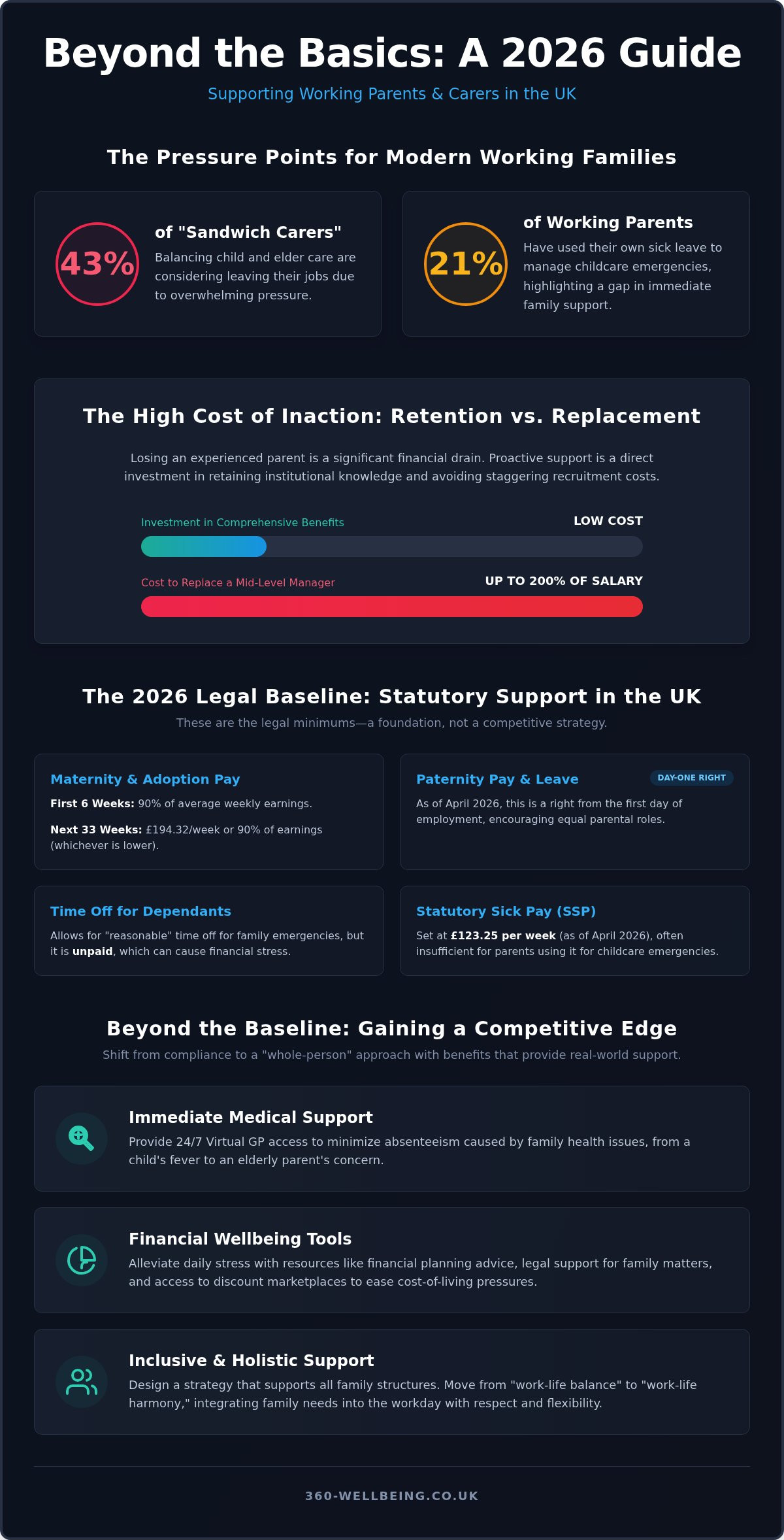
By 2026, the definition of a supportive employer has shifted significantly. It’s no longer enough to offer the legal minimums. The modern UK workforce expects a “whole-person” approach to wellbeing, where their roles as caregivers are seen as a professional asset rather than a scheduling conflict. While traditional maternity and paternity leave provide a necessary foundation, they’re often insufficient for long-term talent retention. Parents returning to work today face a unique set of pressures, from the rising cost of living to the “GP crisis,” where 21% of working parents have had to use their own sick leave just to manage childcare emergencies, according to the 2026 Modern Families Index.
True employee benefits for working parents now extend far beyond statutory pay. They encompass daily lifestyle support that addresses the mental, physical, and financial health of the entire family unit. This is particularly vital for the “sandwich generation,” those employees who are simultaneously raising children and caring for aging parents. With 43% of these carers considering quitting their jobs due to the sheer weight of their responsibilities, providing a panoramic support system has become a commercial imperative for any business looking to maintain a stable, experienced team.
Why Retention Starts with Family Support
Losing a trained, experienced employee after they become a parent is a significant financial blow to any SME. Between recruitment fees, training time, and lost productivity, the cost of replacing a mid-level manager can be staggering. In contrast, integrating a comprehensive benefits platform offers a proactive way to reduce “quiet quitting” and burnout. When parents feel their employer genuinely cares about their family’s health, their loyalty increases. For UK SMEs, the ROI of parental benefits is realized through the preservation of institutional knowledge and the avoidance of recruitment costs that can often reach up to double an employee’s annual salary.
2026 Trends in Work-Life Harmony
The conversation has moved from “work-life balance” to “work-life harmony.” Balance implies a strict separation that is often impossible in a hybrid or remote world; harmony suggests an integration where family needs are respected within the workday. Parents now place a premium on benefits that offer immediate, practical help, such as digital health tools and flexible legal support. We’re also seeing a sharp rise in the demand for male-inclusive support. As paternity rights become a “day-one” entitlement in 2026, fathers are looking for workplaces that actively encourage them to take an equal role in family life without fear of career stagnation.
Essential vs. Competitive: Navigating Statutory and Enhanced Benefits
Understanding the difference between legal compliance and a competitive talent strategy is the first step in building a resilient workforce. While the law provides a safety net, it’s rarely enough to foster the deep loyalty that keeps experienced parents from looking elsewhere. In 2026, the “Benefit Gap” has widened. Employees no longer view statutory minimums as a perk; they see them as a baseline. To truly stand out, you need to look at how your employee benefits for working parents bridge the gap between what’s required and what’s actually needed to sustain a family’s wellbeing.
Statutory Minimums: A Baseline, Not a Strategy
For the 2026/27 tax year, Statutory Maternity Pay (SMP) and Statutory Adoption Pay (SAP) remain structured around a 39 week payment period. For the first six weeks, employees receive 90% of their average weekly earnings. For the subsequent 33 weeks, this drops to £194.32 per week or 90% of their earnings, whichever is lower. It’s a similar story for Statutory Paternity Pay and Leave, which, as of April 6, 2026, has become a day-one right for all new employees. While these payments provide essential support, the drop in income after the initial six weeks can create significant financial stress for modern families.
Beyond pay, you’re legally obligated to manage “Time Off for Dependants.” This allows for reasonable, unpaid time off to deal with emergencies. However, relying solely on unpaid leave can lead to burnout and “quiet quitting.” With Statutory Sick Pay (SSP) set at £123.25 per week as of April 2026, parents who are forced to use sick leave for childcare emergencies often find themselves in a precarious financial position. This is where a proactive strategy becomes a professional necessity rather than a luxury.
Enhanced Offerings That Win Talent
Competitive employers are increasingly moving toward “Enhanced Parental Leave” to secure their best people. This might include offering full pay for the first 13 or even 26 weeks of leave. While this sounds like a heavy investment for an SME, it’s often more cost-effective than the price of a mid-level recruitment drive. Other impactful enhancements include:
- Phased return-to-work programmes that allow parents to gradually increase their hours over several weeks.
- Active use of “Keep In Touch” (KIT) days, paid at the employee’s full daily rate to maintain professional confidence.
- Formalised flexible working policies that go beyond the day-one right to request, making “flex by default” a core part of the culture.
Building a culture of trust starts with these legal foundations, but it’s often the extra layers of care, such as accessible mental health support and legal advice, that truly make an employer stand out in a crowded market. By integrating these tools, you show your team that you’re invested in their long-term success, not just their immediate output.
Beyond Leave: Holistic Wellbeing for the Modern Working Family
Most discussions about employee benefits for working parents stop at maternity or paternity leave. However, the real challenge begins when the routine of the working day meets the unpredictable nature of family life. According to the 2026 Modern Families Index, 29% of working parents report experiencing very high levels of stress. Health concerns and financial instability are the two biggest factors that lead to this burnout. By addressing these daily stressors, you move from being just a workplace to becoming a vital partner in your employee’s long-term success.
24/7 Virtual GP: The Ultimate Parent Perk
The current “GP Crisis” in the UK has made it increasingly difficult for parents to secure timely appointments for their children. It’s frustrating for an employee to take a full day of leave just for a ten-minute consultation. Offering a 24/7 Virtual GP acts as a clinical lifeline. Parents can speak with UK-registered doctors from home at any hour, which significantly reduces absenteeism and provides immediate peace of mind. With digital prescriptions sent directly to local pharmacies and private referrals handled swiftly, family health management becomes a manageable part of the day rather than a source of panic.
Mental Health and Life Coaching for Parents
The transition into parenthood involves a massive identity shift that can often lead to feelings of isolation, anxiety, or postnatal depression. Traditional NHS waitlists for therapy are often too long for someone in immediate need of support. Providing direct access to Mental Health Support and Life Coaching allows parents to process these changes in a safe, professional environment. This support is equally critical for parents of children with additional needs, who often require specialized counseling and methodical guidance to manage their unique pressures without sacrificing their professional vitality.
Financial and Legal Safeguards
Financial wellness is a cornerstone of a stable home, yet it’s often the most overlooked aspect of corporate care. Providing financial support, including debt advice, helps families navigate the rising costs of childcare and household essentials. Beyond the monthly budget, new parents often overlook long-term security. Complimentary Will Writing and Legal Support offer the protection families need for the future, ensuring their children’s interests are always prioritized. When combined with a 360 Rewards marketplace offering thousands of discounts, these employee benefits for working parents help stretch the family budget further, creating a sense of completeness and balance in their lives.
Designing an Inclusive Benefits Strategy for Parents and Carers
To build a truly supportive workplace, your strategy must reflect the diversity of the modern UK family. It’s common for SMEs to feel they can’t compete with “big-corp” perks, but inclusivity is often about thoughtful design rather than just massive budgets. Moving away from “maternity-only” language to a broader “parental support” framework is a powerful first step. This ensures that non-biological parents, those going through the adoption process, and LGBTQ+ families feel seen and valued from their first day of employment.
Single parents also require specific consideration. They often face the highest levels of pressure when managing family health issues or school emergencies alone. By ensuring your employee benefits for working parents are accessible to all family structures, you create a culture of belonging that directly impacts your retention rates. This inclusivity should also extend to “sandwich carers.” As we’ve seen, 43% of these individuals are considering leaving the workforce due to the dual pressure of childcare and elder-care. Providing them with the same health and legal tools you offer to new parents shows a panoramic commitment to your entire team’s wellbeing.
Implementing a Low-Friction Digital Solution
A fragmented list of perks hidden in an employee handbook is rarely effective. Parents in a crisis don’t have time to hunt for a phone number or a policy document. A single-platform SaaS app provides a low-friction way for your team to access 24/7 Virtual GP services or mental health support instantly. This digital approach is particularly effective for SMEs because it’s scalable and provides clear data on which benefits are actually being used. You can measure success through engagement rates and by tracking how many parents return to and stay in their roles after leave.
Communicating for Recruitment and Retention
Communication is the final piece of the puzzle. Highlighting your family-friendly culture during the recruitment process can be a decisive factor for top talent. Don’t wait for an interview to mention your support systems; include them in your job descriptions to establish your reputation as a modern, compassionate employer. If you’re ready to modernize your approach, you can explore how our all-in-one platform supports diverse family needs. By using feedback and retention data to refine your offerings, you ensure your benefits remain a professional necessity rather than a static expense.
Empowering Working Parents with 360 Wellbeing
At the heart of a resilient workplace is the understanding that an employee’s professional vitality is inseparable from their family’s health. 360 Wellbeing acts as a comprehensive safety net, bridging the gap between statutory requirements and the daily realities of family life. By providing a single point of access for health and financial support, we help UK SMEs transform their employee benefits for working parents from a simple checklist into a genuine competitive advantage. It’s about more than just perks; it’s about providing the durability and foresight families need to thrive in a modern economy.
Our 24/7 Virtual GP service serves as a clinical lifeline for parents who find themselves awake at 2 am with a feverish child. Instead of waiting days for a local appointment or spending hours in a congested waiting room, your team can access UK-registered doctors instantly. This reliability is paired with the practical power of 360 Rewards. With thousands of offers available in our marketplace, parents can stretch the household budget further on everyday essentials, from groceries to school supplies, mitigating the ongoing pressures of the cost of living. Because our platform is designed for household use, these benefits extend to the employee’s partner and children, ensuring the whole family feels the impact of your care.
A Proactive Approach to Family Health
Our platform is built on the philosophy of all-encompassing care. We don’t just treat symptoms; we support the entire parental journey by combining physical, mental, and financial health into one accessible subscription. Whether it’s a session with a life coach to navigate the identity shift of returning to work or mental health therapy to address burnout, our expert caregivers are there to guide your team. This unified narrative of wellness ensures that support is always manageable and never overwhelming. Family health is a professional necessity, and we provide the tools to treat it as such.
Next Steps for Your Business
Boosting your Employee Value Proposition (EVP) doesn’t require the complex infrastructure of a multinational corporation. Implementing 360 Wellbeing is a methodical and straightforward process designed specifically for the needs of UK firms. To begin, we recommend assessing your current employee benefits for working parents against the 2026 standards we’ve discussed in this guide. If you’re ready to see how a modern health platform can reduce absenteeism and improve retention, you can book a demo to see our digital solution in action. Creating a culture where parents feel empowered to use these tools is the final step in building a workplace that is scientifically grounded and deeply personal.
Building a Future-Ready Workplace for Families
The landscape of 2026 demands a shift from simple compliance to a panoramic vision of care. By moving beyond statutory minimums and embracing holistic support, you create a culture where parents don’t just survive; they thrive. We’ve explored how integrating digital health tools can reduce absenteeism, while inclusive strategies and financial safeguards build the deep loyalty necessary to retain your best talent. A modern approach to employee benefits for working parents is no longer a luxury; it’s a professional necessity that ensures the long-term vitality of your team.
As an award-winning UK wellbeing platform, 360 Wellbeing provides a seamless safety net for your workforce. From 24/7 Virtual GP access for all staff to expert legal and financial guidance, we help you deliver the all-encompassing support your team deserves. It’s time to move toward a proactive vision of workplace harmony that values the whole person. Book a demo to see how 360 Wellbeing supports your working parents and discover how our tailored solutions empower your business to lead with compassion and foresight. Your team is your greatest asset; let’s protect their future together.
Frequently Asked Questions
What are the best employee benefits for working parents in small businesses?
The most effective employee benefits for working parents in small businesses are those that provide immediate, practical support without the high overhead of traditional medical insurance. A digital platform offering 24/7 Virtual GP access and an Employee Assistance Programme (EAP) allows SMEs to compete with larger firms. These tools help parents manage family health crises efficiently, ensuring they feel supported while minimizing the impact on business productivity and reducing recruitment costs.
Is enhanced maternity pay mandatory for UK employers in 2026?
Enhanced maternity pay is not mandatory for UK employers in 2026. While you must pay Statutory Maternity Pay (SMP) to eligible employees at the 2026/27 rates, any amount above this is at your discretion. However, many competitive firms offer enhanced pay to attract top talent. It’s a strategic choice rather than a legal obligation, though providing it can significantly improve your reputation as a family-friendly employer and increase long-term staff retention.
How can a Virtual GP service help reduce employee absenteeism?
A Virtual GP service reduces absenteeism by providing parents with instant access to UK-registered doctors, eliminating the need to take a full day off for minor child health concerns. Instead of waiting for local surgery appointments, employees can secure a consultation from home at any hour. This proactive approach ensures that family health issues are managed swiftly, allowing parents to return to work with peace of mind and minimal disruption to their professional schedules.
What financial support can employers offer to help with childcare costs?
Beyond government schemes like Tax-Free Childcare, employers can provide practical financial relief through discount marketplaces and debt advice services. Tools like 360 Rewards offer thousands of offers on household essentials and childcare-related purchases, helping to stretch the family budget further. Offering complimentary will writing and financial support sessions also provides long-term security, addressing the broader economic pressures that modern working families face during the current cost-of-living challenges.
Do employee benefits for parents have to be inclusive of fathers and partners?
Yes, employee benefits for working parents must be inclusive of all family structures to be truly effective and legally compliant. As of April 6, 2026, paternity leave and unpaid parental leave have become day-one rights for all employees. Modern benefits packages should use gender-neutral language and offer support to adoptive parents, LGBTQ+ families, and single parents. This inclusivity ensures that every caregiver feels valued, fostering a more harmonious and loyal workforce.
What is the ‘sandwich generation’ and how can employers support them?
The “sandwich generation” refers to employees who are simultaneously caring for young children and aging parents. This group faces unique pressures, with 43% of sandwich carers considering leaving their jobs due to caring responsibilities according to 2026 data. Employers can support them by providing flexible working arrangements and holistic benefits that include legal advice and mental health support. Addressing the needs of these dual caregivers is essential for retaining experienced staff who possess valuable institutional knowledge.
How does a mental health EAP support parents returning from leave?
A mental health Employee Assistance Programme (EAP) provides a safe, professional space for parents to navigate the complex emotional transition of returning to work. It offers direct access to therapy and life coaching, which is vital for addressing postnatal depression or the anxiety associated with leaving a child for the first time. By providing these resources outside of traditional waitlists, you offer immediate reassurance and empower your employees to regain their professional confidence and vitality.
Can a benefits platform really help with employee retention?
A dedicated benefits platform significantly improves retention by reducing the daily friction of family life. When employees have a single, accessible app for health, finance, and legal support, they feel a deeper partnership with their employer. This sense of being valued as a “whole person” reduces the likelihood of “quiet quitting” and prevents the high costs associated with replacing experienced staff who might otherwise leave for a more supportive or flexible environment.