
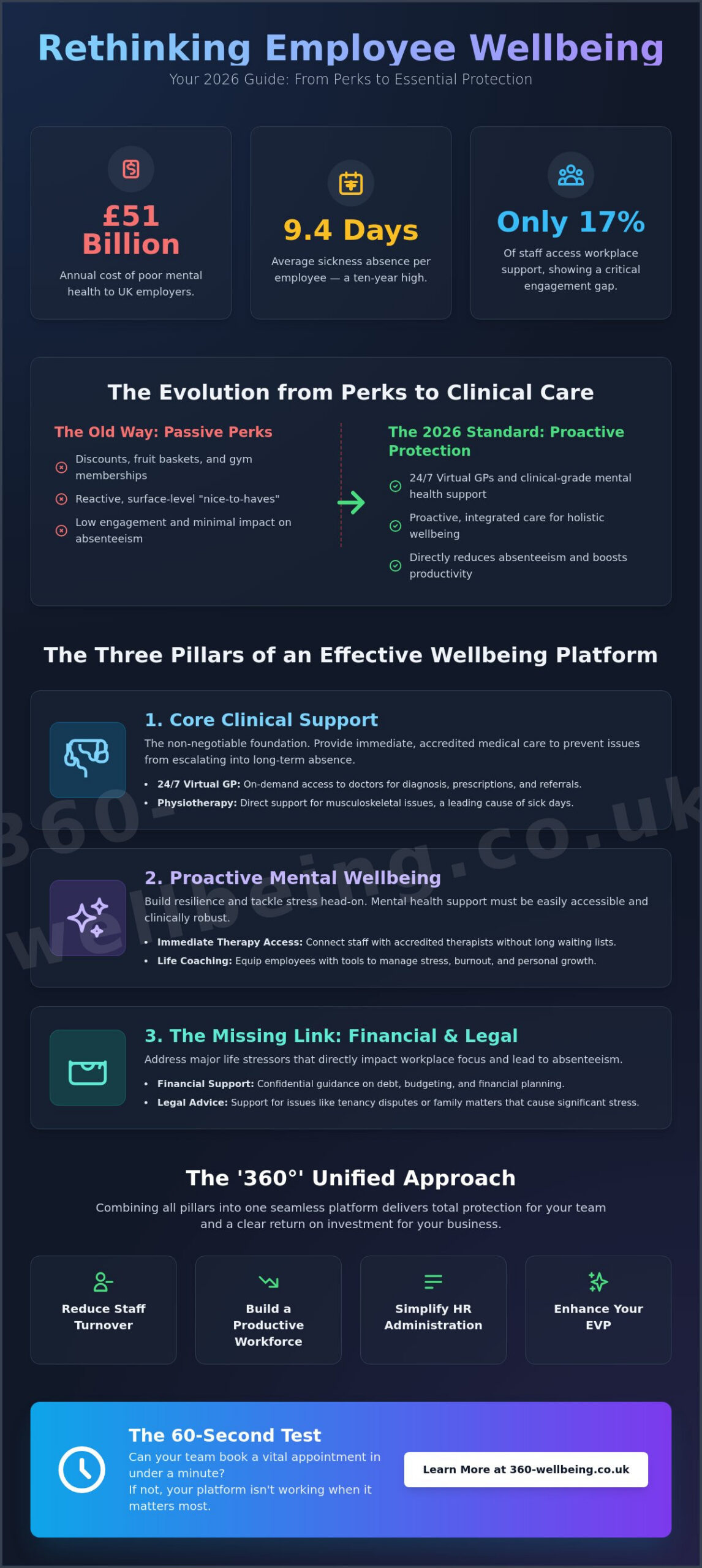
Poor mental health costs UK employers an estimated £51 billion per year, yet only 17% of staff actually access the workplace support offered to them. If you feel like your current “perk” platform is gathering digital dust while sick days continue to climb, you aren’t alone. Knowing what to look for in an employee wellbeing platform has become a critical business priority for 2026, especially as average sickness absence hits a ten-year high of 9.4 days per person.
You need a solution that goes beyond surface-level rewards to address the root causes of absenteeism and low engagement. This guide outlines the essential features and clinical standards required to choose a platform that delivers a real return on your investment. We’ll explore how a unified approach, combining 24/7 Virtual GPs with mental health and financial support, can help you reduce staff turnover and build a more resilient, productive workforce.
- Understand why 24/7 Virtual GP access and clinical-grade mental health support are the non-negotiable cornerstones of a modern wellbeing strategy.
- Learn exactly what to look for in an employee wellbeing platform to ensure your team has immediate access to therapy and life coaching when they need it most.
- Discover the “missing link” of financial and legal support, and how addressing debt or legal worries can directly reduce workplace stress and absenteeism.
- Gain a clear evaluation framework to test platform usability, ensuring your staff can book vital appointments in under 60 seconds.
- See how a unified “360” approach to health provides total protection for your team while simplifying administration for your business.
What is an Employee Wellbeing Platform in 2026?
In 2026, an employee wellbeing platform is no longer a collection of nice-to-have discounts. It has evolved into a sophisticated digital ecosystem that provides 24/7 access to clinical, mental, and lifestyle support. As poor mental health costs UK employers an estimated £51 billion every year, these platforms have shifted from “discounts only” to clinical-grade intervention. Businesses now view this technology as essential infrastructure. It’s the primary tool for reducing the record-high sickness absence of 9.4 days per employee. Understanding what to look for in an employee wellbeing platform means looking for a partner that offers genuine medical and psychological safety nets rather than just a list of retail vouchers.
Workplace wellness has moved from the periphery of HR to the very heart of corporate strategy. It isn’t just about feeling good; it’s about staying functional. Modern platforms provide a panoramic view of an employee’s health journey, integrating everything from 24/7 Virtual GPs to financial coaching. This proactive approach ensures that support is available the moment a challenge arises, rather than weeks later when it has already impacted productivity. It creates a sense of reliability and reassurance for staff who are navigating an increasingly complex world.
This investment also aligns with emerging standards like the new BSI healthy working lifecycle guidelines. Employers are recognizing that a “one-stop-shop” approach is the most effective way to drive engagement. By offering a comprehensive suite of tools, including Life Coaching, Financial Support, and Legal Support, you create a culture of durability and foresight. It shows your team that you’re invested in their long-term success, not just their immediate output. This creates an immediate partnership between the provider and the user, making health feel manageable and positive.
The Evolution from Perks to Holistic Care
Fruit baskets and gym discounts aren’t enough for a workforce facing modern pressures. Teams now expect a unified dashboard where physical, mental, and financial health coexist. A robust platform uses proactive data to spot signs of burnout before they lead to a crisis. It moves beyond passive perks to active clinical-grade intervention, offering services like Physiotherapy and Mental Health Support that are accessible with a single tap. This shift ensures that care is personalized and durable.
Why UK Employers Are Investing Now
UK businesses are investing to bridge the gap in clinical care. Providing private access to a 24/7 Virtual GP is a powerful way to address current GP waiting times. When researching what to look for in an employee wellbeing platform, employers prioritize features that improve their Employee Value Proposition (EVP). In a market where talent is scarce, showing that wellbeing is as vital as a salary helps attract and keep the best people. It’s a professional necessity that rewards loyalty with genuine care.
Core Clinical Features: Priority One for 2026
While many platforms focus on surface-level rewards, the most vital element of a modern wellbeing strategy is clinical depth. In 2026, the gap between “perks” and “care” has widened. When evaluating what to look for in an employee wellbeing platform, your priority should be immediate access to accredited medical professionals. This ensures that health issues are managed before they escalate into long-term absence. 24/7 Virtual GP access is the primary feature for reducing absenteeism because it eliminates the need for employees to wait days for a local appointment, allowing for immediate diagnosis and treatment. By providing this level of care, you’re not just offering a benefit; you’re building a safety net that protects both your staff and your business operations.
Beyond the GP, a comprehensive platform must address the physical and mental pillars of health with clinical precision. This includes direct access to Physiotherapy to manage musculoskeletal issues, which remain a leading cause of UK absenteeism. It’s also essential that all medical professionals on the platform are UK-registered and fully accredited. This clinical-grade approach mirrors the most effective strategies to improve employees’ health and well-being by focusing on proactive intervention rather than reactive fixes. If you’re looking to integrate these services, exploring Corporate Virtual GP Services: The Ultimate Guide can help you understand the logistical benefits for your firm.
Virtual GP: The ‘Doctor at Hand’ Necessity
The ability to secure a prescription or a specialist referral within minutes is a game-changer for productivity. 24/7 access is particularly crucial for shift workers and parents who often struggle to find medical support outside of standard office hours. It provides a sense of reassurance that help is always available, regardless of the time. This “doctor at hand” approach reduces the stress of navigating the traditional healthcare system, allowing employees to focus on their recovery and return to work sooner. For a deeper look at how this works in practice, you might consider how integrated clinical services can streamline your internal health processes.
Mental Health Beyond Mindfulness Apps
In 2026, a simple breathing app isn’t enough to support a modern workforce. Employees need clinical-grade mental health support that includes 1-to-1 therapy and professional life coaching. Providing a safe, confidential space for staff to seek help without stigma is a professional necessity. Rapid-response support is vital during crisis situations, ensuring that an employee never feels alone during their most challenging moments. This panoramic approach to mental health focuses on long-term durability and emotional balance, helping your team stay resilient in the face of workplace stress.
The Missing Link: Financial and Legal Wellbeing
Employee health doesn’t exist in a vacuum. A person’s physical vitality and mental resilience are often tied directly to their financial security and legal peace of mind. When you’re considering what to look for in an employee wellbeing platform, it’s vital to look beyond medical charts and mindfulness timers. You need to address the “life admin” that causes silent, corrosive stress. Financial anxiety is a massive driver of poor performance in the UK, often acting as the underlying cause of the burnout and absenteeism mentioned earlier. Providing expert debt advice and financial planning tools within your platform helps lift that heavy cognitive burden, allowing your team to bring their full selves to work.
Integrating these supports creates a panoramic viewpoint of care that feels both scientifically grounded and deeply personal. It moves the conversation from reactive crisis management to a proactive vision of workplace harmony. By offering Financial Support and Debt Advice alongside clinical services, you recognize that a legal worry or a mounting bill can be just as debilitating as a physical injury. This all-encompassing approach is a hallmark of modern corporate wellness, where health is seen as a professional necessity and an essential human entitlement. It builds a sense of safety and order that is essential for a productive environment.
Addressing the Cost-of-Living with Financial Support
Debt helplines and financial planning tools provide a clear, structured path forward for employees feeling overwhelmed by economic pressures. These services reduce the mental load on stressed staff, helping them regain control over their personal lives. For a deeper look at implementing these tools, you can explore our Financial Support for Employees: A Comprehensive Guide. Additionally, features like 360 Rewards help stretch a monthly salary further, providing a tangible, daily benefit that reinforces the partnership between employer and user.
Legal Peace of Mind as a Productivity Tool
Legal worries such as divorce, probate, or tenancy disputes are major drivers of presenteeism, where staff are physically present but mentally distant. A robust platform should offer Legal Support through a dedicated helpline to resolve these personal issues before they impact professional output. High-value, low-friction benefits like Complimentary Will Writing offer long-term security and reassurance for families. When you understand what to look for in an employee wellbeing platform, you’ll see that these legal safeguards are not luxuries. They’re essential tools for maintaining a focused, resilient, and loyal workforce.
Evaluation Framework: How to Choose the Right Platform
Selecting a partner for your team’s health is a significant decision that impacts the daily lives of every individual in your care. It requires a methodical framework that balances technical capability with human empathy. When you are determining what to look for in an employee wellbeing platform, you must look beyond the feature list and focus on how that technology serves the user during a moment of need. The single most critical factor in platform adoption and long-term success is a seamless, intuitive user experience. If a service feels like a chore or a technical hurdle to access, it will remain unused, regardless of its clinical quality.
A truly supportive platform scales with your ambition. It should offer the same panoramic viewpoint of care to a sole trader as it does to a firm with 500 employees. It needs to be a durable part of your infrastructure, integrating smoothly with existing HR systems or your current Employee Assistance Programme (EAP). This ensures that wellbeing is framed as an essential human entitlement rather than a fragmented add-on. By creating this immediate partnership between the provider and the user, you foster a sense of safety and order that is essential for a productive, harmonious workplace.
User Experience and Accessibility
In 2026, a mobile-first approach is non-negotiable for a modern workforce. You should test the platform’s speed: can an employee book a 24/7 Virtual GP appointment in under 60 seconds? If the barrier to care is too high, the platform won’t deliver the results you need. True accessibility also means 24/7 availability across all services, from Physiotherapy to Mental Health Support, not just a library of pre-recorded digital content. Using Single Sign-On (SSO) further reduces “app fatigue,” making it simple for staff to find professional help the moment they need it.
Measuring Success and ROI
To ensure your investment is effective, you need access to clear, anonymised data and reporting. This allows you to track engagement rates against real clinical outcomes, such as the number of GP appointments or Life Coaching sessions used by your team. These insights help you identify departmental burnout risks before they lead to long-term sick leave or high staff turnover. By comparing the platform subscription fee to the “cost of doing nothing”—the £51 billion annual loss to UK businesses due to poor mental health—the return on investment becomes clear. Ready to see how a unified platform can transform your team’s health? Explore our comprehensive wellbeing solutions today.
The 360 Wellbeing Approach: Total Protection for UK Teams
Choosing a partner for your staff’s health is about more than just checking boxes. It’s about creating a culture where every individual feels seen, supported, and valued. When you evaluate what to look for in an employee wellbeing platform, the ultimate goal is a unified narrative of care. 360 Wellbeing provides this by seamlessly integrating medical, mental, and financial support into a single, cohesive ecosystem. This approach ensures that no part of an employee’s health is left to chance, providing total protection for your workforce through a single, manageable fee.
This model is specifically designed to meet the unique needs of the UK market. It includes non-negotiable features like 24/7 Virtual GPs and professional life coaching, which are often siloed in traditional health plans. For small businesses and sole traders, these tools offer a level of protection previously reserved for large corporations. By providing these services under one roof, you remove the friction of navigating multiple providers. It’s about durability and foresight; we help you look out for the long-term interests of your team, ensuring they remain resilient in both their personal and professional lives.
Beyond clinical intervention, the platform supports the daily lifestyle of your staff through the 360 Rewards marketplace. This feature allows employees to save on everyday costs, providing a tangible benefit that supports their financial health in a very practical way. It’s part of a panoramic viewpoint that sees health as an essential human entitlement. By combining medical expertise with lifestyle rewards, the platform becomes a daily companion for your team, reinforcing the partnership between employer and employee.
Why 360 Wellbeing is Built for the UK Market
Our commitment to excellence is rooted in the use of UK-registered clinicians, ensuring that every consultation meets the highest standards of care. We understand the specific pressures of the UK workplace, from GP waiting times to the cost-of-living crisis. The platform provides a seamless path from physical symptoms to mental health support, acknowledging that one often impacts the other. Our personality is that of an expert caregiver, offering proactive support that feels genuinely human rather than cold or corporate.
Getting Started: From Onboarding to Impact
Implementing a new health strategy doesn’t have to be complex. Our onboarding process is designed to be simple and methodical, whether you are a micro-business or a growing SME. Success depends on clear communication, so we provide the tools you need to introduce these benefits to your team effectively. High uptake is essential for seeing a real impact on productivity and retention. To take the first step toward a healthier workplace, book a demo or see our pricing to protect your team today.
Building a Resilient Workforce for the Future
The landscape of workplace health is shifting from passive perks to active, clinical interventions. By prioritizing immediate access to medical professionals and addressing the silent stresses of financial or legal life admin, you’re doing more than just ticking an HR box. You’re establishing a foundation of durability and foresight. When you understand exactly what to look for in an employee wellbeing platform, you transition from merely managing sickness to fostering genuine vitality within your team.
Our approach provides 24/7 access to UK-registered GPs, along with mental health therapy, life coaching, and essential financial and legal support as standard. This unified model ensures that every employee has a clear, structured path to support, whether they’re facing a physical health challenge or a personal life admin hurdle. It’s time to move toward a future where wellbeing is an essential human entitlement and a professional necessity. Discover how 360 Wellbeing can protect your team today. Your team’s health is your greatest asset; let’s look after it together.
Frequently Asked Questions
What is the difference between an EAP and a wellbeing platform?
An Employee Assistance Programme (EAP) is typically a reactive service focused on short-term crisis management, whereas a wellbeing platform is a proactive, all-encompassing ecosystem. While an EAP might provide a telephone helpline, a platform integrates 24/7 Virtual GPs, Physiotherapy, and Life Coaching into a single digital dashboard. This shift toward a panoramic viewpoint ensures that health is managed daily rather than just during a crisis, focusing on long-term durability rather than just a quick fix.
How much does an employee wellbeing platform typically cost in the UK?
Market rates for these services vary depending on the depth of clinical support and the number of employees covered. Most providers operate on a tiered membership model, charging a fee per employee per month to ensure the service is scalable for different business sizes. When researching what to look for in an employee wellbeing platform, it’s essential to consider the total value of integrated services like Legal Support and Complimentary Will Writing, which can offset the cost of hiring separate professional providers.
Can a wellbeing platform really reduce staff absenteeism?
Providing immediate clinical access can significantly lower sickness rates by addressing health issues before they escalate. By offering a 24/7 Virtual GP, you remove the primary barrier of long waiting times for medical advice, which is a major driver of the UK’s high sickness absence rates. This proactive approach helps combat the national average of 9.4 sick days per employee, ensuring your team remains functional, resilient, and supported throughout their working lifecycle.
Is the medical data on these platforms confidential from the employer?
Clinical data is entirely confidential and is never shared with the employer in a way that identifies an individual. All medical and mental health services are bound by strict clinical confidentiality standards and GDPR regulations to ensure user safety. Employers only receive anonymised, high-level reporting on usage trends, which provides the foresight needed to address general workplace stress without compromising the personal privacy of any staff member.
Do these platforms work for small businesses with only a few employees?
Modern wellbeing platforms are highly scalable and are often specifically designed to support small businesses, SMEs, and micro-firms. For an SME, an integrated platform provides the same level of clinical and legal protection that was once only available to large corporations with massive budgets. It levels the playing field, making professional Mental Health Support and Financial Support accessible and manageable for teams of any size.
What are the most used features of an employee wellbeing platform?
The most utilized features typically include 24/7 Virtual GP access and 1-to-1 mental health therapy or life coaching. Financial Support and Debt Advice are also seeing high engagement in 2026 as employees seek help with the cognitive load of “life admin” and cost-of-living pressures. These core services provide the immediate, practical relief that modern workers prioritize over passive perks like retail vouchers or fruit baskets.
How do I measure the ROI of a wellbeing platform for my business?
You can measure ROI by tracking reductions in staff absenteeism and improvements in employee retention rates over a set period. Comparing the cost of your subscription against the estimated £51 billion annual cost of poor mental health to UK employers provides a clear financial perspective. Engagement data within the platform also helps identify which supports are most valued, allowing you to refine your strategy based on real-world usage.
Can sole traders access employee wellbeing platforms?
Sole traders can absolutely access these platforms to protect their own health and business continuity. For a person working alone, having 24/7 access to a GP and legal support is a professional necessity rather than a luxury. It provides a vital safety net, ensuring that personal health challenges don’t lead to a total loss of income or business momentum, while offering the same clinical-grade care available to larger firms.
Similar Posts
Complimentary Will Writing: The Essential Guide to This Vital Employee Benefit
Did you know that as of 2023, a staggering 59% of UK adults still don’t have a will, leaving their loved ones exposed to potential disputes and…
Corporate Wellbeing in 2026: The Definitive Guide to Employee Vitality
According to the UK’s Health and Safety Executive, a staggering 17.1 million working days were lost to work-related stress, depression, or anxiety in…
Life Coaching in 2026: The Proactive Strategy for Employee Growth and Resilience
In 2023, low employee engagement cost the UK economy an estimated £257 billion, a figure projected to climb as we head into 2026. You’ve likely felt…
Absenteeism in the Workplace: A Comprehensive Guide for UK Employers in 2026
Did you know that by 2026, the cost of employee absence is projected to exceed £850 per employee for UK businesses? That’s a staggering figure,…
Virtual GP Services for Business: The 2026 Guide to Employee Healthcare
Is the cycle of long NHS waiting times and rising absenteeism impacting your team’s productivity and morale? For many UK businesses, the prohibitive…
Employee Assistance Programme (EAP) UK: The Complete 2026 Guide for Employers
Is the rising tide of staff burnout and mental health-related absence putting a strain on your business? Juggling the complex and diverse needs of…