
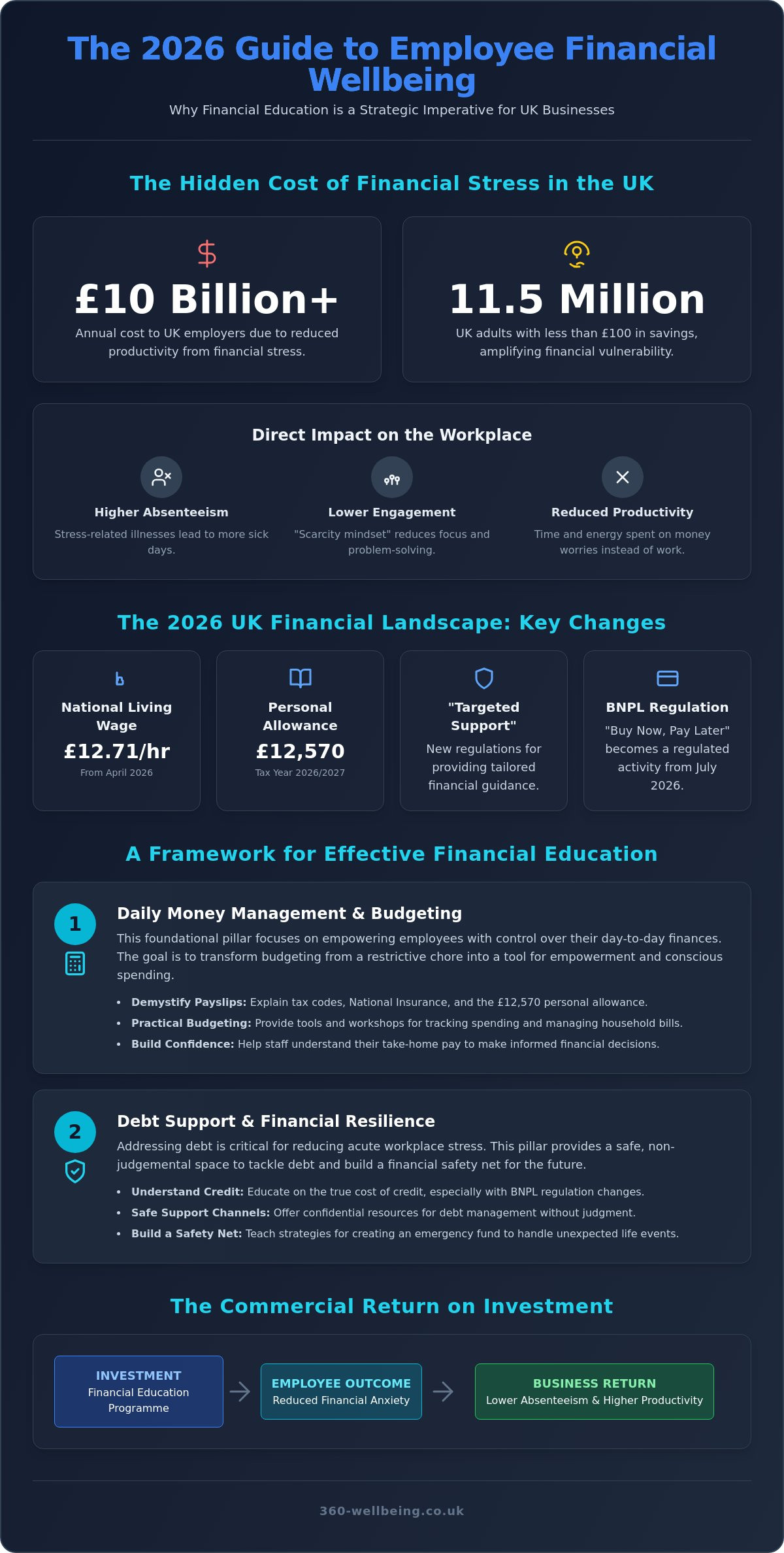
Did you know that financial stress is estimated to cost UK employers over £10 billion a year in reduced productivity? With approximately 11.5 million people across the UK holding less than £100 in savings, the weight of money worries often follows your team into the office, leading to higher absenteeism and lower engagement. It’s understandable if you feel stuck between wanting to help and facing requests for pay rises that the budget can’t meet. Implementing a structured programme of financial education for employees isn’t just a nice gesture; it’s a strategic partnership that supports their mental health and your business’s stability.
We agree that your people are your most valuable asset, and their financial vitality is central to a harmonious workplace. This 2026 guide promises to demystify the process of supporting your staff, showing you how to reduce stress-related mental health issues while boosting the uptake of existing benefits like pensions. We’ll walk you through the latest April 2026 regulatory changes regarding “Targeted Support,” the new National Living Wage rates, and how to build a durable wellbeing strategy that empowers every individual on your team to thrive.
Key Takeaways
- Understand why proactive financial support has evolved from an optional perk into a professional necessity for maintaining a resilient and focused 2026 workforce.
- Discover a structured four-pillar framework for implementing financial education for employees that serves every team member, regardless of their salary band or current life stage.
- Learn to calculate the commercial return on investment by linking reduced financial anxiety to lower absenteeism and higher levels of workplace productivity.
- Follow a practical five-step roadmap to launch your programme effectively, ensuring it remains accessible and manageable for both the business and your staff.
- Explore how to integrate financial guidance into a panoramic wellbeing strategy that views mental, physical, and social health as a single, unified narrative.
What is Financial Education for Employees and Why Does it Matter Now?
Workplace wellbeing has evolved far beyond the occasional yoga session or a basket of fruit in the breakroom. In 2026, the most forward-thinking organisations recognise that true vitality starts with a sense of security. Providing financial education for employees is no longer just a “nice-to-have” perk; it’s a proactive support system designed to protect your team’s mental and physical health. While Financial literacy provides the foundation, workplace education builds the practical bridge between knowing and doing. Financial education is the process of empowering staff with the knowledge to manage daily finances and plan for future security.
This shift from an optional benefit to a commercial necessity is driven by the stark reality of the modern UK economy. When an individual is preoccupied with debt or the rising cost of essentials, their brain enters a state of “scarcity mindset.” This isn’t just a feeling; it’s a physiological response that reduces cognitive bandwidth, making it harder to solve complex problems or maintain focus. By offering structured guidance, you aren’t just helping with money; you’re restoring your team’s capacity to perform at their best. It’s a partnership that acknowledges the human side of professional life.
The Connection Between Money and Mental Health
The link between bank balances and brain health is profound and undeniable. Financial worries are a leading cause of workplace stress, often triggering a vicious cycle where money anxiety leads to poor mental health, which then makes it even harder to manage finances effectively. This downward spiral frequently results in burnout and long-term absence. We view financial resilience as a vital shield. By teaching employees how to build a safety net, you’re helping them develop the durability needed to handle life’s unexpected turns without it impacting their professional vitality or personal peace of mind.
The 2026 Cost-of-Living Context
UK workers continue to face a complex economic environment. Even with the National Living Wage rising to £12.71 per hour in April 2026, many find that housing costs and inflation outpace their earnings. Traditional salary increases, while helpful, often fail to solve deep-seated financial stress if the underlying knowledge of how to navigate high-interest environments or tax bands is missing. For example, understanding the 2026/2027 personal allowance of £12,570 or the nuances of the “Targeted Support” regulations can be life-changing. As an employer, you occupy a position of trust. By becoming a reliable source of guidance rather than just a paymaster, you create a workplace culture rooted in foresight and genuine care.
The Four Pillars of an Effective Financial Education Programme
Implementing financial education for employees shouldn’t feel like a daunting administrative hurdle. To be truly effective, support needs to be broken down into manageable, human-sized pieces that resonate with everyone in your organisation. We use a structured four-pillar framework that ensures no one is left behind, whether they’re an apprentice earning the 2026 rate of £8.00 per hour or a senior executive navigating higher tax bands. This approach builds long-term staff durability by replacing quiet anxiety with a clear, actionable path forward.
Daily Money Management and Budgeting
The first pillar focuses on the “here and now.” Many people feel a sense of unease when looking at their payslips simply because they don’t fully understand the deductions. Education should demystify tax codes, the £12,570 personal allowance, and National Insurance contributions. When staff understand how their take-home pay is calculated, they can track spending and manage household bills with much greater precision. We encourage a proactive mindset where employees view budgeting not as a restriction, but as a tool for personal empowerment and spending control.
Debt Support and Financial Resilience
Addressing debt is often the most sensitive part of any wellbeing strategy, yet it’s perhaps the most critical for reducing workplace stress. With “deferred payment credit” (Buy-Now-Pay-Later) becoming a regulated activity in July 2026, helping your team understand the true cost of credit is vital. We believe in providing a safe, non-judgemental space where staff can access professional financial support and debt advice without stigma. Resilience is built when an individual moves from a cycle of debt to creating an emergency fund, providing a vital buffer that absorbs financial shocks before they impact mental health.
Future Planning: Pensions and Savings
The final pillars involve looking toward the horizon with foresight and confidence. Pensions are often shrouded in complex jargon that leads to disengagement, particularly among younger staff. By simplifying concepts like compound interest and explaining the 2026/2027 annual allowance of £60,000, you help employees see their pension as a tangible asset rather than a distant deduction. Encouraging early engagement with retirement goals gives your workforce a sense of durability and purpose, knowing their future self is being cared for through their current professional efforts. This panoramic view of wealth ensures that every team member feels supported at every stage of their life journey.
Calculating the ROI: Why Financial Wellbeing is a Commercial Imperative
Investing in your team’s financial health isn’t just a compassionate choice; it’s a sound business decision that strengthens your bottom line. When we look at the panoramic view of organisational health, the data is clear. Financial stress is estimated to cost UK employers over £10 billion a year in reduced productivity. This isn’t just about people being away from their desks. It’s about the cognitive drain that occurs when a team member is physically present but mentally elsewhere, worrying about a missed payment or a rising interest rate. By providing financial education for employees, you’re directly reclaiming that lost focus and turning it back into professional vitality.
The commercial impact of money worries manifests in two primary ways: absenteeism and presenteeism. While the former is easy to track through missed shifts, the latter is a silent drain on your resources. Presenteeism occurs when employees are at work but their efficiency is compromised by the emotional weight of financial insecurity. A focused workforce is a productive one. Helping your staff navigate the complexities of 2026 finances ensures they have the mental capacity to innovate and contribute fully to your business goals.
Retention and Attracting Top Talent
In a competitive UK job market, your benefits package is a statement of your values. Becoming an “Employer of Choice” requires more than just a competitive salary. It requires a commitment to the whole person. Candidates in 2026 are increasingly looking for durability and support. A robust programme of financial education for employees acts as a powerful differentiator for your brand. When people feel their employer is genuinely invested in their long-term security, they’re far less likely to leave for a marginal pay increase elsewhere. This reduction in staff turnover saves your business significant costs in recruitment, onboarding, and lost institutional knowledge.
Reducing the Burden on HR and Managers
A proactive approach to financial literacy shifts your culture from reactive crisis management to one of foresight. HR departments often spend valuable time processing “emergency loan” requests or dealing with the fallout of staff burnout. Education empowers your team to handle their own finances with confidence, which naturally reduces these administrative burdens. Additionally, training your managers to spot the subtle signs of financial distress allows for earlier, more empathetic intervention. Instead of waiting for a performance issue to arise, your leadership can guide staff toward existing support services like your Employee Assistance Programme (EAP) or debt advice, maintaining workplace harmony and operational efficiency.
How to Implement Financial Education in Your UK Business
Launching a programme of financial education for employees shouldn’t be a source of stress for leadership. Even for smaller businesses with limited budgets, a structured rollout ensures that support feels like a natural extension of your company culture. Taking a methodical approach allows you to build trust and ensure the long-term durability of the initiative. By following a clear roadmap, you can move from reactive crisis management to a proactive culture of foresight.
We recommend a five-step process for a successful launch:
- Listen: Use anonymous surveys to identify the specific financial pressures your team is facing.
- Segment: Tailor your content to different life stages, from first-time buyers to those nearing retirement.
- Select: Decide between internal resources for policy guidance and external partners for specialist advice.
- Integrate: House all tools within a single, accessible hub to encourage regular engagement.
- Review: Monitor uptake and feedback to ensure the support remains relevant as economic conditions shift.
Choosing between internal resources and external partners is a pivotal decision. While internal teams understand your company culture, external experts provide a necessary layer of confidentiality. Employees are often more comfortable discussing sensitive topics like debt or savings with a neutral third party. This clinical distance ensures that data privacy is maintained, which is the foundation of employee trust. When staff feel safe, they’re more likely to engage deeply with the support offered.
Assessing Your Workforce Needs
Successful implementation starts with understanding. Don’t assume you know what your team needs; instead, use anonymous surveys to pinpoint the most urgent pain points. You might discover that your apprentices are struggling with the 2026 National Minimum Wage rates, while mid-career professionals are confused by the 2026/2027 tax bands. Identifying gaps in your current benefit uptake, such as low pension engagement, allows you to customise your education for maximum impact. This panoramic view of your workforce ensures that every individual feels seen and supported.
Choosing the Right Delivery Methods
The way you deliver information is just as important as the content itself. Digital platforms and webinars offer excellent scalability, while one-to-one coaching provides the human touch needed for complex debt advice. Many organisations find success by offering a “discount marketplace” to help salaries go further on daily essentials. Integrating these financial tools into an existing employee wellbeing platform ensures that financial health is treated as a core component of total wellness. If you’re ready to build a more resilient workforce, explore our Financial Support & Debt Advice services to see how we can partner with your business.
Integrating Financial Support into a Holistic Wellbeing Strategy
True vitality isn’t found in isolation. When we view a team member’s health through a panoramic lens, it becomes clear that money, mind, and body are deeply interconnected. Providing financial education for employees is a critical piece of the “Total Wellness” puzzle, but it shouldn’t stand alone. At 360 Wellbeing, we believe that a truly durable strategy seamlessly integrates financial guidance with mental health support and physical care. This unified narrative ensures that when a worker faces a challenge, they have a single, trusted pathway to resolution rather than a confusing array of siloed tools.
A comprehensive approach includes pillars that extend beyond simple budgeting. For example, offering Legal Support and Complimentary Will Writing provides a profound sense of security that goes beyond the monthly payslip. These services address the long-term anxieties that often weigh on staff, such as protecting their family’s future or navigating complex legal hurdles. By addressing these needs proactively, you help your team achieve a state of completeness and balance. This sense of order is essential for sustained workplace harmony and professional focus.
The Role of EAPs in Financial Support
An Employee Assistance Programme (EAP) often serves as the frontline for individuals facing financial distress. It’s a safe, clinical gateway where staff can access immediate debt and legal advice without fear of judgement. However, the real power of an EAP lies in its ability to link these services to 24/7 mental health therapy sessions. Because financial anxiety so often triggers physical symptoms or emotional exhaustion, having a system that can address the root cause and the psychological fallout simultaneously is invaluable. This foresight prevents a temporary money worry from spiralling into a long-term health crisis, maintaining the individual’s professional vitality.
Next Steps for Your Organisation
We encourage leaders to move away from viewing wellness as a luxury or a seasonal campaign. In the 2026 economic landscape, holistic support is an essential human entitlement and a professional necessity. By taking the first step today, you’re not just implementing a programme; you’re establishing a partnership with your people that looks out for their long-term interests. Whether your team needs Life Coaching to set new goals or Mental Health Support to navigate stress, we provide the expert care needed to help them thrive.
Achieving panoramic wellbeing for your workforce is a methodical journey, but you don’t have to walk it alone. We invite you to explore how a tailored package can transform your company culture into one of proactive vitality and resilience. See how 360 Wellbeing can support your staff and help you build a more focused, productive, and empowered workforce for the years ahead.
Cultivating a Resilient and Focused Future for Your Team
We’ve explored how the quiet weight of money worries directly impacts your bottom line and how a methodical roadmap can transform your company culture. By prioritising financial education for employees, you’re investing in the long-term vitality of both your business and your people. This strategic partnership moves your organisation beyond reactive support, creating a foundation of foresight that allows every team member to focus on their professional contributions with a clear mind and a sense of security.
Our holistic platform is designed to bridge the gaps between financial, mental, and physical health, ensuring your staff feels supported from every angle. We provide a single, unified narrative of care that includes 24/7 Virtual GP access alongside complimentary will writing and professional debt advice. By integrating these essential pillars, you ensure that your workforce has the durability to handle life’s unexpected turns without losing their professional focus. It’s time to embrace wellbeing as an essential human entitlement that drives collective success and workplace harmony.
Empower your team with 360 Wellbeing’s financial and health support to begin your journey toward panoramic workplace wellness. We’re here to help you build a more resilient, focused, and empowered team for the years ahead. Your commitment today creates a brighter, more stable tomorrow for everyone in your organisation.
Frequently Asked Questions
Is financial education for employees a legal requirement in the UK?
As of July 2026, it’s not a legal requirement for UK employers to provide financial education to their staff. However, there is a growing movement calling for mandatory support within larger organisations of 250 plus employees. While not mandated by law, many forward thinking businesses view it as a professional necessity to maintain workplace harmony and support the essential human entitlement to wellbeing.
How much does it cost to implement a financial education programme?
The investment required to launch a programme varies based on your workforce size and the delivery methods you choose. Options range from accessible digital platforms and webinars to more personalised one to one coaching sessions. Many organisations find that integrating these services into a broader Employee Assistance Programme provides a cost effective way to offer panoramic support without overwhelming the business’s budget.
Can financial education help reduce staff absenteeism?
Implementing financial education for employees can significantly lower absenteeism by addressing one of the primary drivers of workplace stress. When individuals possess the tools to manage their money effectively, they experience fewer stress related mental health issues that often lead to time off. This proactive approach helps maintain professional vitality and ensures your team remains focused and present in their roles.
What is the difference between financial education and financial advice?
Financial education provides general knowledge and tools to help staff manage their finances, while financial advice offers specific recommendations tailored to an individual’s unique situation. New regulations for “Targeted Support” introduced in April 2026 make it easier for firms to provide guidance without it becoming formal advice. Education empowers employees to understand concepts like tax bands and compound interest so they can make informed decisions.
How do I talk to an employee about their financial stress without being intrusive?
Approaching this sensitive topic requires a deeply empathetic and non judgemental touch. Instead of asking direct questions about their personal bank balance, focus on observing changes in their engagement or workplace performance. Frame the conversation around the supportive resources your business already provides, such as debt advice or life coaching. This positions you as a supportive partner looking out for their long term interests.
What are the most common topics covered in workplace financial education?
Most programmes focus on building long term durability through practical, daily money management. Common topics include understanding payslips, navigating the £12,570 personal allowance, and effective budgeting strategies. Many organisations also prioritise debt management and future planning, such as simplifying pension jargon or explaining the 2026/2027 annual allowance of £60,000. These subjects ensure that every team member feels supported regardless of their current life stage.
Is financial education suitable for small businesses and sole traders?
Financial education is highly beneficial for organisations of all sizes, including small businesses where every team member’s productivity is vital. Smaller firms often see a significant impact on workplace harmony when staff feel financially resilient and secure. Modern digital tools and third party partnerships make these programmes accessible and manageable, allowing even the smallest teams to benefit from a proactive and positive vision of wellness.
How do I measure the success of a financial wellbeing programme?
Success can be measured by tracking the uptake of existing benefits, such as pension contributions or the use of debt advice services. You can also use anonymous surveys to gauge whether employees feel more confident and less anxious about their money. Over time, improvements in workplace productivity and a reduction in stress related absenteeism serve as clear indicators that your strategy is fostering a more focused and resilient workforce.