
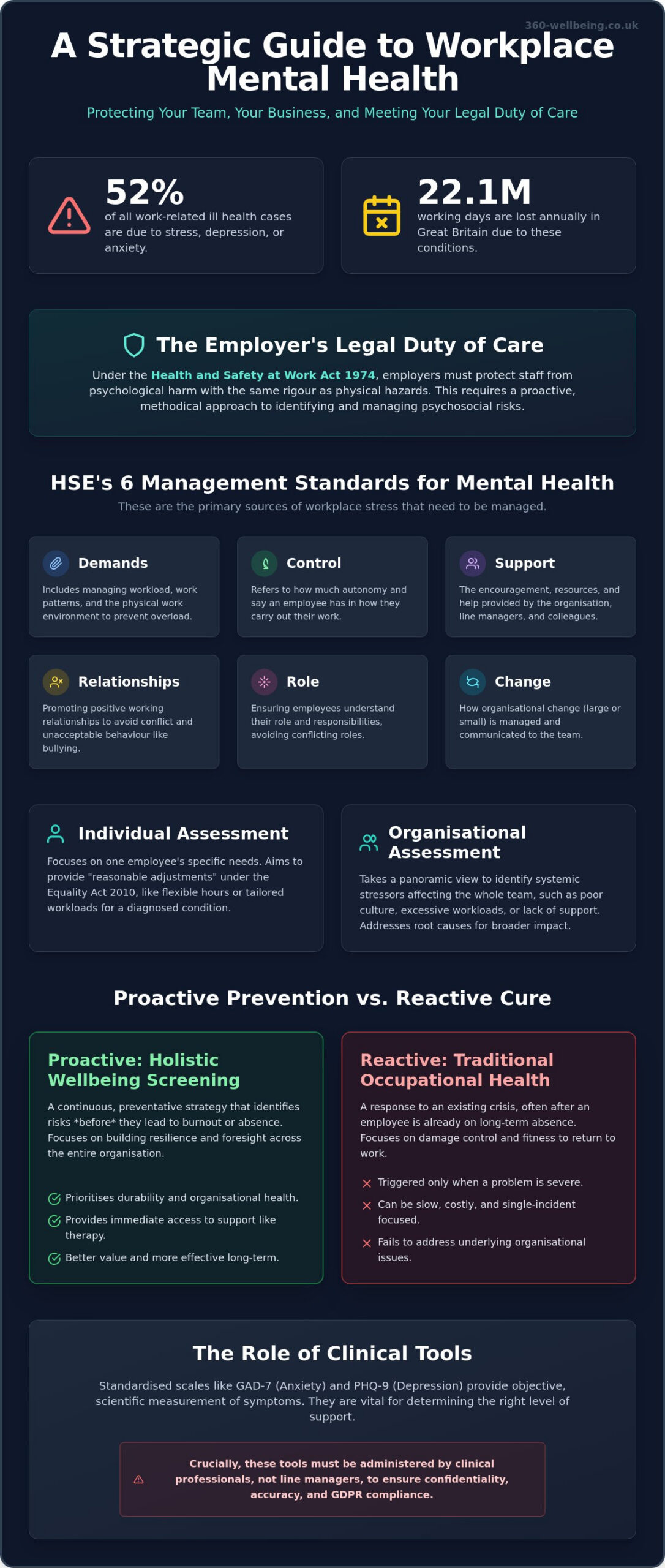
Did you know that work-related stress, depression, or anxiety now accounts for 52% of all work-related ill health cases in Great Britain? With 22.1 million working days lost annually, a proactive workplace mental health assessment isn’t just a “nice-to-have” wellbeing initiative; it’s a vital tool for business survival and legal compliance. We understand that many UK employers feel stuck between the pressure of high staff turnover and the fear of saying the wrong thing to a struggling employee. It’s often confusing to distinguish between a clinical occupational health review and your statutory duty under the Management of Health and Safety at Work Regulations 1999.
You want to protect your team, but you also need to protect your business from risk. This guide will show you how to effectively assess, manage, and support your team’s mental health while meeting your legal duty of care. We’ll provide a clear framework for identifying psychosocial risks, ensuring you stay compliant with the HSE and the Equality Act 2010 while building a more resilient, productive workforce that feels truly seen and supported.
Key Takeaways
- Learn how to meet your legal duty of care by following HSE Management Standards and ISO 45003 guidelines for psychological safety.
- Discover a practical 5-step framework to implement a workplace mental health assessment that identifies organizational risks before they lead to burnout.
- Understand why modern, holistic wellbeing platforms often provide better value and more immediate support than traditional, one-off occupational health referrals.
- Identify how to transition from simply gathering data to providing immediate professional help through integrated therapy and Virtual GP services.
- Explore the role of Mental Health Champions in bridging the gap between your statutory obligations and a supportive company culture.
What is a Workplace Mental Health Assessment?
A workplace mental health assessment is a strategic process designed to evaluate the psychological wellbeing of your workforce and the environmental factors that influence it. It isn’t merely a reactive response to a crisis. Instead, it serves as a panoramic tool that allows you to identify potential stressors before they lead to burnout or long term absence. Under UK law, specifically the Health and Safety at Work Act 1974, you have a clear duty of care to protect your team from work-related stress. Meeting this obligation requires more than just an open door policy; it requires a methodical and empathetic approach to understanding your employees’ needs.
We’ve seen a significant shift in how the UK handles health at work. The transition from traditional “sick notes” to “fit notes” highlights a move toward focusing on what employees *can* do with the right support. A comprehensive assessment facilitates this by providing the data needed to make meaningful adjustments, helping people stay in work or return more quickly after a period of ill health. Proactive screening is far more effective than reactive occupational health referrals because it prioritises durability and foresight over damage control.
Individual vs. Organisational Assessments
A workplace mental health assessment is a proactive tool for identifying psychological hazards. To be truly effective, it must operate on two distinct levels. Individual assessments focus on the specific needs of a single employee, often looking at “reasonable adjustments” required under the Equality Act 2010. These might include flexible hours or tailored workloads for someone managing a diagnosed condition.
Organisational assessments, however, take a broader view. They identify systemic stressors like poor workplace culture, excessive workloads, or lack of support. This approach draws heavily from the field of Occupational health psychology, which examines how organisational structures impact an individual’s mental state. By addressing these root causes, you don’t just help one person; you improve the vitality of the entire team.
The Clinical Component: GAD7 and PHQ9
When an assessment moves into the clinical realm, professionals often use standardised tools like the GAD7 (Generalised Anxiety Disorder-7) and PHQ9 (Patient Health Questionnaire-9). These scales provide a scientifically grounded way to measure the severity of anxiety and depression symptoms. They offer a clear, objective snapshot of an individual’s current mental health status, which is essential for determining the right level of support.
It’s vital that these tools are administered by clinical professionals rather than line managers. Managers are expert guides in their own fields, but they aren’t trained to interpret clinical data or handle the sensitive nuances of a mental health diagnosis. Keeping these assessments professional ensures total confidentiality and compliance with GDPR. When employees know their data is handled with clinical integrity, they’re much more likely to be honest about their struggles, creating a partnership of trust between the employer and the individual.
The Employer’s Legal Duty: HSE Standards and ISO 45003
The Health and Safety at Work Act 1974 makes it clear that employers have a duty to ensure the health, safety, and welfare of their employees. This isn’t limited to physical safety; it encompasses psychological wellbeing too. Understanding the Employer’s Legal Duty involves recognising that mental health hazards must be identified and managed with the same rigour as a trip hazard or faulty machinery. A robust workplace mental health assessment is the primary mechanism for meeting these legal standards and protecting your team’s vitality.
To help businesses manage this, the HSE outlines six Management Standards. These are the primary areas that, if not managed properly, lead to poor health and reduced productivity:
- Demands: Addressing workload, work patterns, and the work environment.
- Control: How much say a person has in the way they do their work.
- Support: The encouragement and resources provided by the organisation and managers.
- Relationships: Promoting positive working to avoid conflict and dealing with unacceptable behaviour.
- Role: Ensuring people understand their jobs and how they fit into the team.
- Change: How organisational change is managed and communicated.
For those looking for a global benchmark, ISO 45003 provides the first international standard for managing psychosocial risks at work. It’s an excellent framework for businesses aiming for excellence beyond basic compliance. If you have five or more employees, you’re legally required to record the significant findings of your risk assessment, ensuring your commitment to mental health is documented and durable.
The Equality Act 2010 and Reasonable Adjustments
Under the Equality Act 2010, a mental health condition is considered a disability if it has a long-term, substantial adverse effect on an employee’s ability to carry out normal activities. In these cases, you’re legally obligated to make reasonable adjustments. This might involve offering flexible hours, providing quiet spaces for focused work, or temporarily altering duties to reduce pressure. Ignoring these duties isn’t just a failure of care; it carries the risk of costly employment tribunals and lasting reputational damage.
Conducting a Stress Risk Assessment
Conducting a stress risk assessment is the foundation of a healthy workplace. You begin by identifying potential hazards, such as unrealistic deadlines or poor communication. Next, decide who might be harmed and evaluate the risks. You can use the HSE template to ensure your process is structured and thorough. Mental health risk assessments are a legal requirement, not an optional perk. Integrating a regular workplace mental health assessment into your operations ensures you stay ahead of potential issues. If you need clinical support to back up your findings, our Mental Health Support services provide the next step in your care strategy.
Occupational Health vs. Holistic Wellbeing Screening
Traditionally, employers relied on Occupational Health (OH) services only when an employee reached a breaking point. While OH remains a valuable clinical resource, it often functions as a reactive “fix” rather than a preventative strategy. Modern businesses are moving toward digital wellbeing platforms that offer a panoramic view of health. This shift aligns with NHS Employers guidance on mental health, which encourages an integrated approach to supporting staff. By incorporating a regular workplace mental health assessment into a digital framework, you catch the first flickers of stress before they ignite into full-blown burnout.
Speed of access is perhaps the most critical differentiator. Waiting weeks for a traditional referral can exacerbate anxiety or depression, whereas modern platforms offer immediate support. This creates a sense of safety and order for the employee. It’s about moving away from “crisis management” and toward a proactive vision of vitality where help is available the moment it’s needed.
The Limitations of Traditional Occupational Health
Traditional OH services often come with high per-referral costs that can be prohibitive for UK SMEs and sole traders. Beyond the financial burden, there’s often an “us vs them” perception. Employees might view a formal clinical referral as a disciplinary precursor or a step toward being managed out of the business. This clinical coldness can stifle honest communication. Because OH is typically triggered by long-term absence, it frequently misses the “pre-crisis” stage. It’s a tool for managing illness, not necessarily for fostering durability and workplace harmony.
The Rise of the Wellbeing Platform
Modern wellbeing platforms solve the accessibility problem through 24/7 Virtual GP access and integrated Employee Assistance Programmes (EAPs). This instant connection provides a reassuring first point of contact. A holistic approach recognises that mental health is often tied to external pressures. Providing financial support for employees, for instance, serves as a powerful preventative measure. Money worries are a primary driver of workplace stress, so assessing and addressing these needs is a logical next step in any comprehensive workplace mental health assessment.
Subscription-based models empower the individual by providing self-assessment tools. These allow employees to monitor their own wellbeing in a confidential, low-pressure environment. This builds autonomy and trust. Instead of waiting for a manager to notice they’re struggling, the employee has the foresight to seek help early. It transforms mental health from a professional hurdle into a shared journey of total wellness that feels both scientifically grounded and deeply personal.
5 Steps to Implementing an Effective Assessment Framework
Implementing a workplace mental health assessment requires a methodical and compassionate approach. It’s not a tick-box exercise but a journey toward a more resilient organisational culture. By following a structured path, you ensure that your efforts are both legally compliant and deeply supportive of your team’s individual needs. This process transforms abstract wellbeing goals into a practical, durable strategy for workplace harmony.
1. Preparation: Begin with foresight by reviewing your existing data. High staff turnover, frequent short term absences, or a dip in productivity often signal underlying stress. This initial audit provides the context needed for a focused assessment.
2. Consultation: Engagement is a partnership. Speak with your staff and involve “Mental Health Champions” to identify specific departmental pressures. This step ensures that employees feel heard and valued from the very start.
3. Implementation: Use a mix of anonymous surveys and private 1-to-1 meetings to gather qualitative data. This is where you’ll find the human stories behind the statistics, allowing for a truly panoramic view of your team’s health.
4. Action Planning: An assessment is only as good as the response it triggers. Create a transparent strategy to address identified stressors, such as clarifying job roles or adjusting workloads. Clarity here builds immense trust.
5. Review: Set specific dates to measure the impact of your adjustments. Mental health is dynamic, so your framework must be, too. Regular reviews ensure your support remains relevant and effective over the long term.
How to Start the Conversation
Initiating a workplace mental health assessment can feel daunting for managers. The key is to frame the conversation as support rather than a performance review. Training your managers to spot the physical symptoms of stress, such as fatigue or increased irritability, allows for earlier, gentler interventions. A “Wellness Action Plan” (WAP) is an excellent collaborative tool here. It’s a living document where the manager and employee agree on what support looks like, ensuring the individual feels empowered rather than managed. This approach moves away from fear and toward a proactive vision of health.
Measuring Success and ROI
While absenteeism is easy to track, “presenteeism”—where employees are at work but unable to function effectively—is often the bigger challenge. Regular pulse surveys provide a panoramic view of company culture and help you catch these subtle shifts in morale. When you see improvements, share these wins with the team. It reinforces the idea that their wellbeing is a professional necessity and a human entitlement. If you’re ready to move from assessment to action, you can view our Employee Assistance Programme (EAP) solutions to see how we provide the professional help your team deserves.
Beyond the Assessment: Turning Data into Support
Data is a powerful starting point, but it’s just a collection of numbers and narratives until you act. A workplace mental health assessment provides the map, but your team still needs the vehicle to reach their destination. If you identify that a department is struggling with burnout but offer no immediate professional help, you risk creating a culture of “all talk and no action.” This can lead to a breakdown in trust, as employees might feel their vulnerabilities have been exposed without any genuine intent to support them.
Integrating Mental Health Support and therapy sessions directly into the daily workflow is the most effective way to turn data into durability. By providing an Employee Assistance Programme (EAP) that offers 24/7 crisis cover, you ensure that help is always available. This bridges the gap between identifying a problem and solving it, moving your business from a state of reactive concern to one of proactive care. It’s about ensuring the support is as accessible as the assessment itself.
The 360 Wellbeing Approach to Total Wellness
We believe that corporate-level support shouldn’t be reserved for the biggest companies with the deepest pockets. Our SaaS platform combines 24/7 Virtual GP access, Life Coaching, and Mental Health therapy into a single, accessible hub. This reduces the friction that often stops people from seeking help. There’s no more waiting weeks for a referral or paying for expensive, one-off clinical reviews. Small businesses can access this panoramic support for a fixed monthly fee, providing their team with a sense of safety and order that is essential for long-term productivity.
Building a Resilient Workforce for 2026
As we look toward 2026, the businesses that thrive will be those that embrace a culture of foresight. Moving beyond a one-off workplace mental health assessment means committing to a narrative of total wellness. This includes offering holistic support like legal and financial advice, acknowledging that an employee’s mental state is rarely influenced by work factors alone. When you provide tools that address the whole person, you build a workforce characterized by durability and vitality. It’s time to move past basic compliance and start viewing wellbeing as an essential human entitlement. Empower your team with 360 Wellbeing and turn your commitment to mental health into a strategic advantage.
Empowering Your Team for a Healthier Future
Building a resilient organisation starts with the courage to look closer at your team’s needs. We’ve explored how a robust workplace mental health assessment serves as both a legal safeguard and a foundation for a thriving culture. By moving away from reactive “crisis fixes” and toward a proactive vision of vitality, you’re not just ticking a compliance box. You’re investing in the long term durability and happiness of your most valuable asset: your people.
Real change happens when you bridge the gap between identifying a challenge and providing a solution. Whether it’s through our 24/7 UK-registered Virtual GP, professional Mental Health Therapy, Life Coaching, or comprehensive EAP and financial support, the right tools make total wellness feel manageable. You don’t have to navigate these complex health topics alone. It’s time to transform your workplace into a space where every individual feels seen, supported, and empowered to succeed.
Discover how 360 Wellbeing supports your team’s mental health and take the next step toward a more harmonious, productive future for your business.
Frequently Asked Questions
Is a workplace mental health assessment a legal requirement in the UK?
Yes, conducting a risk assessment for work-related stress is a statutory duty under the Management of Health and Safety at Work Regulations 1999. Employers with five or more employees must also record the significant findings of this workplace mental health assessment in writing. Failing to identify and manage these psychological hazards is treated with the same seriousness by the HSE as failing to manage physical safety risks.
What is the difference between a stress risk assessment and an occupational health assessment?
A stress risk assessment is a broad, organisational tool used to identify systemic hazards that affect the whole team, such as workload or workplace culture. In contrast, an occupational health assessment is a clinical, individual review focused on a specific employee’s health and their fitness for work. While the first prevents issues from arising, the second usually addresses a problem that has already manifested.
Can an employee refuse a mental health assessment?
Yes, an employee generally has the right to refuse a clinical assessment, as these require informed consent. However, it’s helpful to explain that the process is designed to support them and identify reasonable adjustments. If an individual chooses not to participate, it may limit your ability as an employer to provide tailored support or fulfill your duty of care effectively under the Equality Act 2010.
How much does a workplace mental health assessment cost for a small business?
Costs vary depending on the depth of the review and the size of your workforce. While basic organisational risk assessments can often be managed internally using free government templates, more comprehensive clinical screenings involve external professional fees. Many small businesses now find that subscription-based wellbeing platforms offer a more predictable and affordable way to access ongoing support compared to one-off private referrals.
What are reasonable adjustments for mental health under the Equality Act?
Reasonable adjustments are practical changes to help an employee perform their role effectively while managing a mental health condition. Common examples include offering flexible start and finish times, providing a quiet workspace to aid concentration, or allowing for a phased return to work after an absence. These adjustments are essential for fostering a culture of durability and ensuring that mental health is treated as a professional necessity.
How often should a business conduct an organisational mental health assessment?
We recommend conducting a workplace mental health assessment at least once a year to capture a panoramic view of your company culture. It’s also vital to review your findings whenever there is a significant change in the business, such as a restructure, high staff turnover, or a shift to remote working. Regular check-ins ensure your support strategies remain relevant and effective as your team evolves.
What should be included in a mental health risk assessment report?
Your report should clearly document the potential hazards identified, such as unrealistic deadlines or poor communication channels. It must also state who might be harmed and how, the control measures you already have in place, and what further actions you intend to take. This document serves as a vital record of your commitment to psychological safety and is a legal requirement for businesses with five or more staff.
Does my business need a mental health policy before conducting assessments?
You don’t legally need a formal policy in place before starting, but having one provides a helpful framework for the process. A clear policy outlines your commitment to wellbeing and explains how data from assessments will be used to support the team. It creates a sense of safety and order, ensuring that employees understand that the assessment is a supportive initiative rather than a disciplinary measure.