
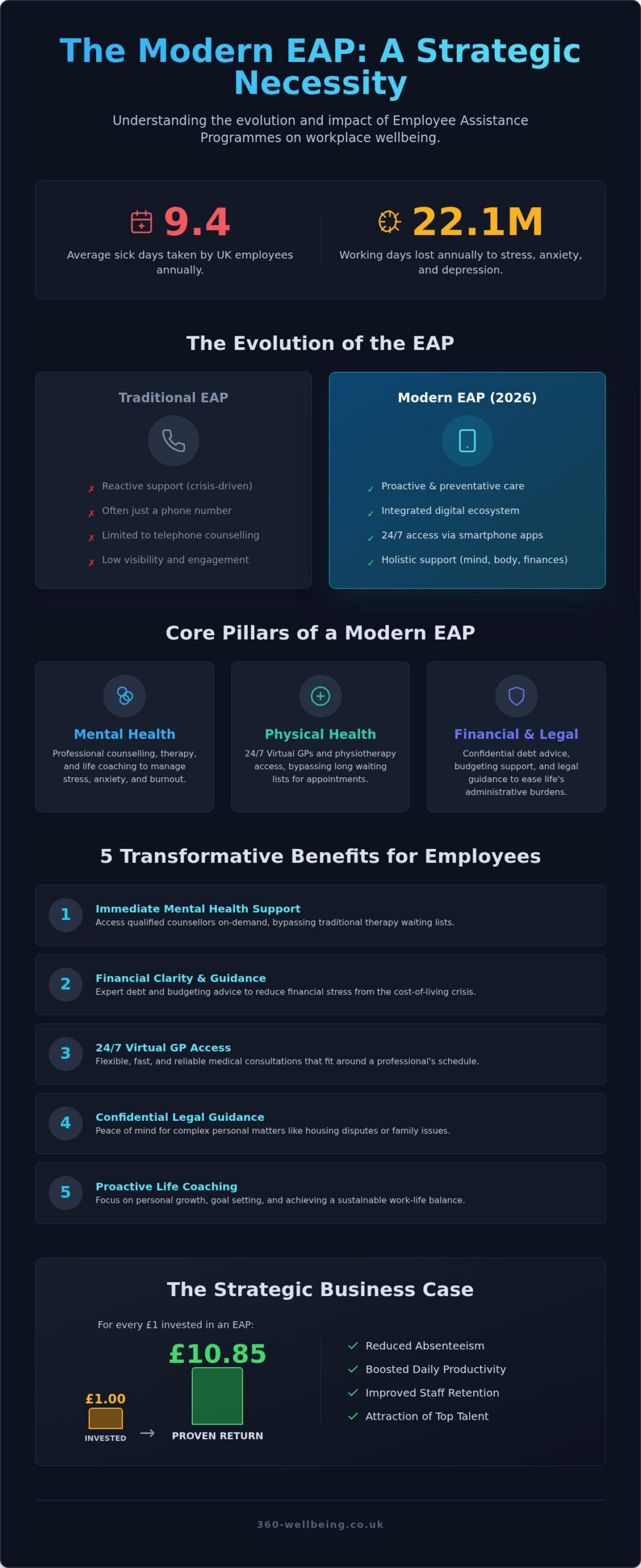
Did you know that UK employees now take an average of 9.4 sick days every year? This figure has climbed significantly, often driven by the 22.1 million working days lost annually to stress, anxiety, and depression. You’ve likely felt this shift within your own teams as burnout and the ongoing cost-of-living crisis take their toll on morale. Understanding the core benefits of an eap for employees is no longer just a box-ticking exercise; it’s a vital step toward protecting your most valuable asset. When you provide a safety net that catches people before they fall, you create a workplace where everyone can truly flourish.
We agree that it’s overwhelming for managers to juggle their own targets while supporting staff through complex personal issues. This guide promises to show you how a modern, holistic EAP lightens that burden by providing professional pathways for mental, physical, and financial health. We’ll explore how integrating 24/7 Virtual GPs, debt advice, and life coaching works to reduce absenteeism and boost daily productivity. You’ll discover how a proactive wellbeing strategy secures a proven return of £10.85 for every pound invested, ensuring your business remains resilient and attractive to top talent throughout 2026.
Key Takeaways
- Discover how modern Employee Assistance Programmes have evolved into comprehensive digital platforms that offer a panoramic view of health.
- Understand the core benefits of an eap for employees, including immediate mental health support and expert financial guidance that bypasses traditional waiting lists.
- Learn why it’s a strategic necessity to use proactive wellbeing tools to reduce absenteeism and improve staff retention.
- Find out how to bridge the engagement gap by fostering leadership buy-in and moving beyond basic onboarding communications.
- See how integrating 24/7 Virtual GPs and physical health support creates a unified narrative of total wellness for your workforce.
What is a Modern Employee Assistance Programme (EAP)?
An Employee Assistance Programme, often abbreviated to EAP, is a confidential workplace benefit designed to help staff manage personal and professional challenges that might affect their performance or wellbeing. While the basic concept has existed for decades, the question of What is a Modern Employee Assistance Programme (EAP)? looks very different in 2026. It’s no longer just a phone number on a poster in the breakroom. Instead, it’s an integrated digital ecosystem that offers proactive care before a person reaches a crisis point.
Traditional services were often reactive and limited to telephone counselling. Today, the benefits of an eap for employees include 24/7 access to a suite of tools via smartphone apps. This shift is critical because the 2026 landscape is demanding. With NHS waiting lists remaining a significant hurdle and the cost-of-living crisis squeezing household budgets, employees need immediate, expert support. A modern EAP acts as a vital safety net, providing a firewall of confidentiality. Employers receive high-level usage data to help them understand workplace trends, but they never see individual details. This ensures staff feel safe seeking help without fear of professional repercussions.
The Core Pillars of a 2026 EAP
A comprehensive programme now covers much more than just a chat about problems. It addresses the whole person through three main avenues of care:
- Mental Health: Professional counselling, therapy sessions, and life coaching to manage stress, anxiety, or burnout.
- Physical Health: Integration of 24/7 Virtual GPs and physiotherapy, allowing employees to address health concerns without waiting weeks for a local appointment.
- Financial & Legal: Practical support including debt advice, budgeting help, and even complimentary will writing to ease the mental load of life’s admin.
EAP vs. Traditional HR: Understanding the Difference
It’s a common mistake to expect HR managers to be the primary source of emotional or medical support. While HR professionals are essential for workplace structure, they aren’t trained clinicians or financial advisors. Attempting to play those roles can lead to blurred boundaries and manager burnout. An EAP provides third-party expertise that keeps professional relationships intact. By outsourcing this support, businesses can focus on building a positive workplace culture while knowing their team has access to specialist care. When leaders understand the benefits of an eap for employees, they stop seeing it as a luxury and start seeing it as a professional necessity. This partnership ensures that wellbeing is treated as a foundational human entitlement, not just a reactive HR task.
5 Transformative Benefits of an EAP for Employees
Many people mistakenly view an EAP as a ‘break glass in case of emergency’ service. In reality, the benefits of an eap for employees extend far beyond simple crisis management. By providing a holistic support system, these programmes address the subtle, daily pressures that can accumulate into major health issues if left unchecked. In 2026, where the boundary between home and work is often fluid, having a single point of access for mental, physical, and financial support is a game-changer for the modern professional.
- Immediate Mental Health Support: Long waiting lists for traditional therapy can exacerbate mental health struggles. An EAP offers immediate access to qualified counsellors, ensuring help is available the moment it’s needed.
- Financial Clarity: With the cost-of-living crisis impacting many households, expert debt and budgeting advice reduces the mental load that employees carry into their working day.
- 24/7 Virtual GP Access: For a busy professional, finding time for a traditional 9-to-5 doctor’s appointment is often impossible. Virtual GPs offer flexibility, speed, and reliability.
- Legal Guidance: Whether it’s a housing dispute or a complex family matter, having a dedicated legal helpline provides immense peace of mind and reduces external stress.
- Proactive Life Coaching: This isn’t just about fixing problems; it’s about personal growth. Life coaching helps employees set meaningful goals and maintain a sustainable work-life balance.
Mental Resilience and Stress Management
Early intervention is the most effective tool against long-term burnout. By providing 24/7 support, an EAP offers a safety net for those late-night worries or out-of-hours crises that don’t wait for Monday morning. This constant availability helps normalise the conversation around mental health, making it a standard part of professional life rather than a taboo subject. The Business Case: Why EAPs are a Strategic Necessity highlights how this proactive approach fulfills an employer’s duty of care while fostering a resilient workforce. When staff feel supported, they’re more likely to remain engaged and productive, even during challenging periods.
Physical Health and Virtual Healthcare
Presenteeism occurs when employees are physically present but mentally distant due to lingering health concerns. Waiting days for a GP callback often leads to unnecessary stress and lost productivity for the business. A UK-registered Virtual GP can provide prescriptions and referrals instantly, allowing staff to manage their health without the traditional wait. This immediate care, combined with physiotherapy support, addresses the physical toll of both sedentary office work and more active roles. If you’re looking to implement these features, exploring a comprehensive Employee Assistance Programme is a logical next step for your team’s long-term vitality. Understanding the multifaceted benefits of an eap for employees ensures that your wellbeing strategy is both scientifically grounded and deeply personal.
The Business Case: Why EAPs are a Strategic Necessity
Investing in staff wellbeing is often viewed as a moral obligation, yet the commercial case for doing so has never been stronger. In 2026, a high-impact EAP serves as a proactive health engine rather than a reactive safety net. When you consider that poor mental health costs UK employers an estimated £51 billion annually, according to 2024 Deloitte data, the strategic necessity of these programmes becomes undeniable. By addressing issues at the source, businesses can move away from the high costs of crisis management toward a model of sustainable productivity.
One of the most significant benefits of an eap for employees is the ability to foster long-term loyalty. When a company cares for the ‘whole person’ by providing support for mental, physical, and financial health, staff are far more likely to stay. Replacing a skilled employee often costs significantly more than the annual subscription for a comprehensive wellbeing platform. This fiscal reality, combined with independent research from 2026 showing a proven ROI of £10.85 for every £1 invested, makes a modern EAP one of the most efficient tools in a leader’s arsenal. In a job market where candidates prioritise holistic care, these programmes offer a distinct competitive advantage for recruitment.
Reducing the Cost of Absenteeism
Untreated stress and physical ailments are leading drivers of workplace disruption. By linking absenteeism directly to a lack of early intervention, we see why proactive health checks are so vital. These checks can catch potential issues before they escalate into long-term sick leave, keeping your team functional and focused. As noted in this Institute of Directors EAP factsheet, providing these services is a practical way to fulfill your legal duty of care while gaining anonymous insights into the health trends of your workforce. Catching the first signs of burnout is a commercial priority that protects your bottom line.
Financial Wellness as a Productivity Driver
Financial anxiety is a silent productivity killer. When an employee is worried about debt or housing, their cognitive function and ability to focus on complex tasks diminish. Offering financial support through debt helplines and budgeting advice directly restores that focus by removing the mental load of external stressors. High-perceived-value benefits, such as complimentary will writing, provide a sense of security and durability that extends beyond the office walls. This holistic approach ensures that the benefits of an eap for employees translate directly into a more resilient workforce, where people feel empowered to bring their best selves to work every day.
Overcoming the Engagement Gap: How to Drive EAP Usage
A frequent challenge for UK business leaders is the ‘engagement gap.’ While over 24 million workers in the UK have access to an EAP, the average annual utilisation rate sits at just 10.4%, according to 2024 EAPA UK data. This suggests that while the safety net is there, many employees don’t feel empowered or informed enough to use it. Closing this gap requires a shift in how the service is positioned. Instead of a ‘break glass in case of emergency’ resource, it should be framed as a daily wellness companion. Helping your team understand the full benefits of an eap for employees transforms the service from a reactive crisis line into a proactive health engine.
Leadership buy-in is the most effective way to build trust. When managers openly mention using the Virtual GP for a quick prescription or the 360 Rewards portal for their weekly shop, it normalises the platform. It’s about moving beyond the standard ‘onboarding email’ and integrating wellbeing into regular team highlights. Anonymised usage reports are also invaluable here. They allow you to see which services are most popular, helping you tailor future wellbeing initiatives to the actual needs of your workforce without ever compromising individual privacy.
Making the EAP a Daily Habit
Consistency is key to driving engagement. By promoting features like the rewards and discounts section, you encourage staff to log in regularly for positive reasons. This makes the platform a familiar space, so when they do face a challenge, they already know where to go. Integrating Virtual GP access as the first point of contact for health queries also builds this habit. For those who aren’t in a crisis but want to grow, life coaching offers a powerful incentive to engage with the programme. To see how these features work together, you can learn more about our integrated approach to workplace health.
Training Managers to be EAP Champions
Managers are the frontline of your wellbeing strategy. They don’t need to be therapists, but they do need to know how to spot the early signs of stress, such as changes in communication or unusual absenteeism. Training them to understand the full suite of legal and financial tools ensures they can offer practical solutions during difficult conversations. When a staff member discloses a personal struggle, the manager’s role is to listen with empathy and then provide a clear, step-by-step referral to the confidential EAP portal for professional specialist guidance. Communicating the diverse benefits of an eap for employees in these moments ensures that support is always within reach before a problem escalates.
Choosing the Right EAP: Why 360 Wellbeing is Different
Selecting a provider is a significant decision that shapes your company’s culture for years to come. At 360 Wellbeing, we believe in a ‘Panoramic View’ of health. We’ve moved away from the fragmented model where employees must navigate different providers for a GP appointment, a counselling session, or legal advice. Instead, our platform integrates physical, mental, and financial health into a single, intuitive app. This panoramic viewpoint ensures that no matter where an employee’s health journey starts, they have a steady, methodical path forward. When you consider the benefits of an eap for employees, the ease of access is just as important as the quality of the care itself.
Our digital-first approach is specifically tailored for the flexibility of modern workforces. Whether your team is in the office, working remotely, or on the move, they have 24/7 access to UK-registered GPs and mental health therapy. We’ve also prioritised affordability for SMEs, ensuring that smaller teams can access the same high-calibre corporate benefits usually reserved for large enterprises. To keep engagement high between health needs, the 360 Rewards Marketplace provides thousands of daily offers, from grocery discounts to leisure deals, making the platform a valuable part of every employee’s lifestyle.
A Holistic Approach to Total Wellness
Managing separate subscriptions for virtual doctors, life coaches, and legal helplines is an administrative burden for HR teams. A unified platform simplifies this into a single, durable model that reduces management overhead while providing a more cohesive experience for staff. This integration is essential for effectively supporting mental health and wellbeing in the workplace. By combining mental health support with physical healthcare and financial debt advice, we address the underlying factors of stress rather than just treating the symptoms. This completeness is what defines a modern wellbeing strategy in 2026.
Ready to Transform Your Workplace?
Onboarding with 360 Wellbeing is a clear and structured process designed to fit businesses of all sizes. We don’t believe in high-pressure tactics; instead, we act as a partner invested in your long-term success. You can provide your workforce with a safety net that feels scientifically grounded and deeply personal. It’s time to move toward a proactive vision of workplace harmony where the benefits of an eap for employees are felt every single day. Book a demo of the 360 Wellbeing platform today to see how we can support your team’s vitality.
Securing Your Workforce’s Vitality for 2026 and Beyond
Transitioning from a reactive health strategy to a proactive wellbeing culture is one of the most impactful decisions a leader can make. We’ve seen how modern programmes move beyond simple helplines to offer a panoramic approach that addresses the whole person. By integrating clinical expertise with tangible daily rewards, you can transform the workplace into a hub of resilience and harmony. Understanding the full scope of the benefits of an eap for employees is the first step toward building a business that truly values its people as a foundational entitlement rather than a luxury.
You don’t have to navigate these complexities alone. With 24/7 UK-registered Virtual GP access, FCA-regulated financial guidance, and BACP-accredited mental health support, your team receives expert care at every turn. It’s about providing a safety net that is both scientifically grounded and deeply personal, ensuring your staff feel seen and supported. Empower your team with 360 Wellbeing’s all-in-one EAP platform and take the first step toward a more vibrant, durable future. We look forward to partnering with you on this journey toward total wellness.
Frequently Asked Questions
Is an EAP completely confidential for employees?
Confidentiality is a cornerstone of the service. A strict firewall exists between the provider and your employer; they only receive high-level, anonymised data about usage trends. This ensures you can seek support for sensitive issues without any fear that your personal details will be shared with management. It’s a professional necessity that allows staff to feel safe when addressing mental health or personal limitations.
Can family members use the Employee Assistance Programme?
Yes, coverage often extends to immediate family members. Many programmes allow partners and children living in the same household to access helplines and support services at no additional cost. This holistic approach recognises that an employee’s wellbeing is deeply linked to the health and happiness of their loved ones. Providing this panoramic support ensures that the whole family unit feels more resilient and balanced.
What is the difference between an EAP and Private Medical Insurance (PMI)?
An EAP focuses on proactive, preventative support while Private Medical Insurance (PMI) is typically reactive. While PMI covers hospital treatments and specialist surgeries, an EAP provides immediate access to mental health support, 24/7 Virtual GPs, and financial advice. It’s designed to manage the daily pressures that occur before clinical intervention is needed. This makes it a more accessible and manageable solution for many corporate clients.
How much does a modern EAP cost per employee in the UK?
Industry data shows the average UK cost for an EAP is approximately £14 per employee per year. For small and medium-sized enterprises, the cost typically ranges between £15 and £80 per person annually. Large enterprises with over 2,000 staff may see rates as low as £3.50 for basic telephone-only services. These figures reflect industry averages and can vary based on the level of clinical expertise and digital tools included.
What kind of issues can an employee discuss with an EAP counsellor?
You can discuss a wide range of personal and professional challenges. This includes work-related stress and burnout, bereavement, relationship difficulties, and anxiety. The goal is to provide a safe space where you can address these underlying factors with a qualified professional before they impact your health or performance. It provides a structured path forward for those struggling with the complexities of modern life.
How quickly can an employee see a Virtual GP through the platform?
Access is available 24/7 through our digital platform. You can typically book an appointment with a UK-registered GP at a time that suits your schedule, bypassing the traditional wait times often found at local surgeries. This speed is one of the key benefits of an eap for employees who need reliable medical advice without disrupting their workday. It ensures that healthcare feels like an essential entitlement rather than a luxury.
Does an EAP help with financial problems like debt or mortgage issues?
Yes, modern programmes provide expert financial guidance for debt and budgeting. This includes access to debt helplines and legal support for housing or mortgage concerns. Reducing financial anxiety is a major factor in restoring cognitive focus and improving overall workplace productivity. By addressing these social health factors, the platform helps create a unified narrative of total wellness that supports employees during the cost-of-living crisis.
Can an EAP help reduce staff turnover in small businesses?
Absolutely. Small businesses often find that an EAP acts as a powerful retention tool by demonstrating a genuine commitment to staff welfare. When employees feel supported by a safety net during personal crises, they’re more likely to stay loyal to their employer. This helps reduce the high costs associated with recruitment and training, making it a strategic necessity for SMEs looking to build a durable workforce.