
Did you know that poor mental health alone costs UK employers a staggering £56 billion every year through absenteeism and lost productivity? It’s a heavy burden for any business to carry, especially when you’re already juggling high staff turnover and the rising costs of recruitment. You likely recognize that your team is your most valuable asset, yet calculating the roi of employee wellbeing programs can feel complex when you’re under pressure to deliver results on a tight budget. It’s frustrating to watch talented people struggle with “presenteeism” when you know that proactive, panoramic support could make all the difference to your company’s vitality.
We understand the desire to provide meaningful care without the prohibitive expense of traditional medical insurance. This guide is designed to help you unlock a 470% return on investment by implementing a strategy that treats health as a professional necessity rather than a luxury. We’ll provide a clear framework for measuring success, showing how accessible tools like virtual GP services and mental health support can slash sick leave and improve staff retention. By the end of this article, you’ll have a structured path forward to build a more resilient, productive, and harmonious workplace for 2026 and beyond.
Key Takeaways
- Understand how absenteeism and presenteeism contribute to the £56 billion annual cost to UK businesses and why addressing these issues is a professional necessity.
- Discover the data-driven framework behind the 470% roi of employee wellbeing programs, where every £1 invested yields £4.70 in measurable productivity gains.
- Learn how to implement a panoramic health strategy that integrates 24/7 virtual GP access, mental health support, and financial guidance into one unified platform.
- Gain a step-by-step approach to conducting a wellbeing audit and securing leadership buy-in by presenting a solid financial business case for your organisation.
- See how democratising access to elite health benefits ensures long-term organisational durability and helps you retain top talent in a competitive market.
The Economic Reality of Workplace Wellbeing in 2026
ROI is no longer just a financial metric; it’s a measure of organisational durability. In 2026, the roi of employee wellbeing programs represents the clear difference between a business that merely survives and one that flourishes. It’s about foresight. We’re moving away from reactive, one-off fixes toward a panoramic strategy that protects your team before a crisis occurs. This shift acknowledges that health is a professional necessity, not a corporate luxury. When you invest in the vitality of your people, you’re securing the long-term stability of your entire company.
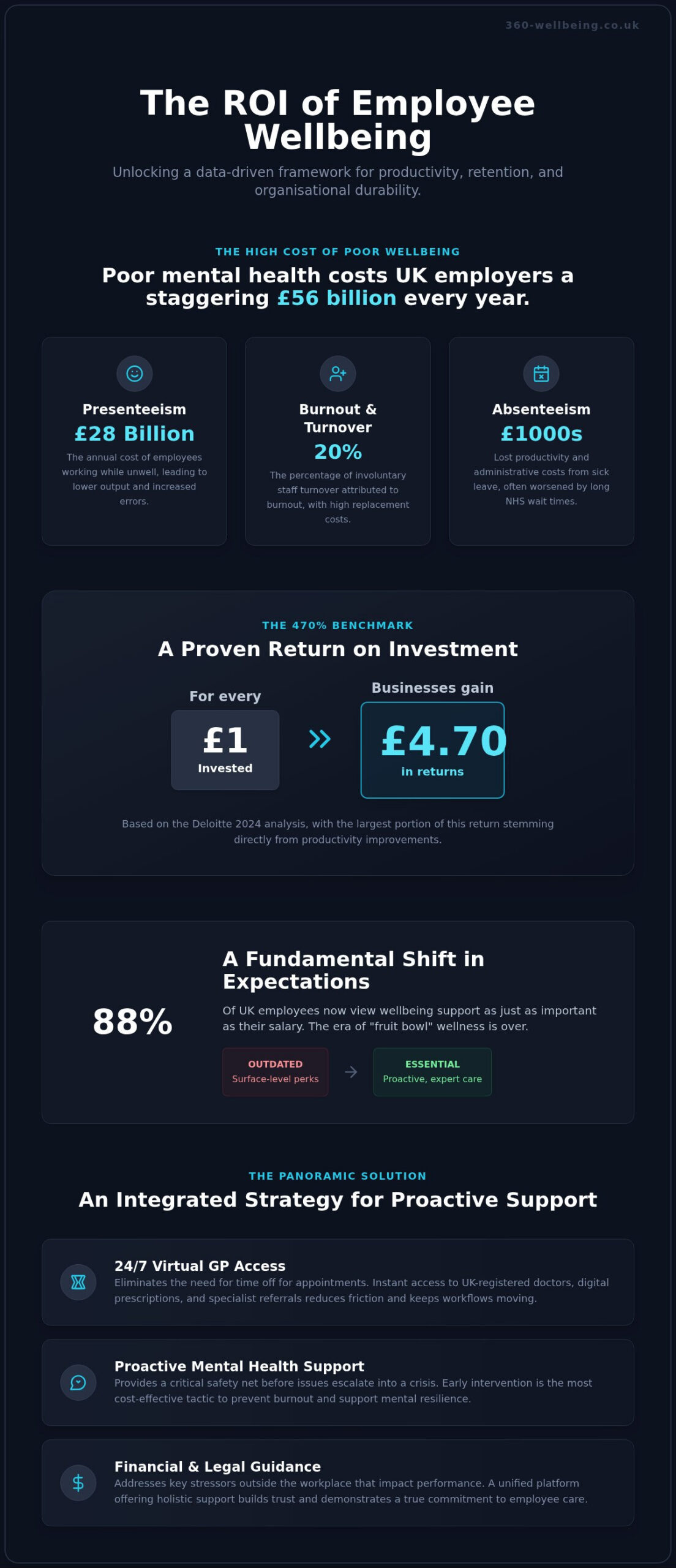
Poor mental health currently costs UK employers approximately £56 billion every year. This staggering figure isn’t just about people being off sick. It’s about the silent drain on productivity that happens when your team isn’t at their best. Workplace wellness programs have evolved to address these specific economic pressures, turning a compassionate choice into a vital business strategy. By focusing on durability, you can transform these potential losses into a proactive vision of workplace harmony.
The Hidden Cost of Unwell Employees
Presenteeism, the act of working while unwell, is a quiet thief. It costs UK businesses between £24 billion and £28 billion annually. When employees struggle through the day, their output drops and errors rise. It’s a lose-lose situation for everyone involved. Burnout is another critical factor, now accounting for up to 20% of involuntary staff turnover. It’s a high price to pay for talent you’ve worked hard to recruit. With NHS wait times often stretching for months, employees are left in a state of limbo. They’re unable to access the clinical or mental support they need to return to full strength, creating a ripple effect of stress across your entire organisation. This gap in care is where many businesses lose their competitive edge.
Wellbeing as an Essential Human Entitlement
The days of “fruit bowl” wellness are over. In 2026, health support is seen as a core part of the employment contract. A significant 88% of UK employees now view wellbeing as just as important as their salary. They aren’t looking for surface-level perks. They’re looking for a partnership with an expert caregiver who understands their needs. They want a system that offers clinical reassurance and mental resilience as a right, not a luxury. By providing a panoramic support structure, you’re not just offering a benefit. You’re establishing a foundation of trust. This partnership ensures your workforce remains durable, loyal, and ready to meet the challenges of the modern market.
Measuring the ROI of Employee Wellbeing Programs: The 470% Benchmark
The Deloitte 2024 analysis offers a compelling target for UK business leaders: an average return of £4.70 for every £1 spent on health initiatives. This 470% benchmark isn’t just a theoretical number; it’s a practical reality for those who master the roi of employee wellbeing programs. While reduced sick pay and lower administration costs play a part, the largest portion of this return stems directly from productivity improvements. It’s the difference between a team that’s simply “there” and a team that’s truly vital and engaged.
Early intervention is the most cost-effective tactic you can employ. Waiting for an employee to reach a breaking point is expensive, both in human and financial terms. Replacing a single staff member often costs a business thousands of pounds when you factor in recruitment fees, onboarding, and the loss of institutional memory. By providing support before a crisis hits, you protect your most valuable assets and ensure organisational durability. It’s a methodical approach to care that prioritises the long-term interests of both the individual and the company.
Productivity Gains from Rapid Clinical Access
Traditional GP appointments often force employees to take half a day off, creating a significant ripple effect of missed deadlines and increased pressure on colleagues. 24/7 Virtual GP services eliminate this friction by providing instant access to clinical expertise at any hour. Employees can consult with a UK-registered doctor at a time that suits them, often receiving digital prescriptions or specialist referrals within the same hour. This speed of care keeps workflows moving and reduces the stress of managing health around a busy schedule. Clinical foresight prevents minor health issues from becoming chronic, ensuring that small physical concerns don’t escalate into long-term absence.
Mental Health Intervention and Long-Term Savings
Mental health support is a cornerstone of the 470% return. Providing access to therapy and life coaching helps employees manage stress, anxiety, or personal challenges before they impact their professional performance. This proactive care prevents the spiral into long-term sick leave, which is far more costly to manage than a few sessions of professional support. Following the principles in the NHS England wellbeing guide, you can create a culture where mental health is discussed openly. When the taboo is removed, employees seek help sooner, leading to faster recoveries and higher retention rates.
Building this infrastructure doesn’t have to be complex or prohibitively expensive for your business. You can see how a unified platform supports these goals by exploring our panoramic wellbeing services.
The Panoramic ROI Framework: Clinical, Mental, and Financial Gains
To achieve a truly sustainable return, you must look beyond isolated health perks. A panoramic framework integrates clinical, mental, and financial health into a single, unified narrative. This approach ensures that no part of an employee’s wellbeing is left to chance. When these three pillars work in harmony, they create a foundation for organisational durability that generic programs simply cannot match. It’s a common mistake to view these areas as separate departments. In reality, they’re deeply interconnected. A physical ailment often leads to mental stress, which can be exacerbated by financial worries. By treating them as a whole, the roi of employee wellbeing programs becomes much clearer and more impactful.
The framework is built on three essential pillars. First, physical resilience is maintained through instant clinical access and physiotherapy, ensuring minor aches don’t become long-term absences. Second, mental resilience is fostered via Employee Assistance Programmes (EAPs), therapy, and life coaching. These tools empower your team to navigate personal and professional hurdles with expert guidance. Finally, financial security provides the anchor. By offering debt advice and legal support, you address the external pressures that often bleed into the working day. This completeness is what defines a modern, forward-thinking strategy.
Financial Wellness as a Productivity Driver
Financial anxiety is one of the most significant yet overlooked drivers of workplace distraction. When an employee is worried about debt or legal complications, they aren’t fully present at their desk. Providing financial support for employees is a strategic ROI move that addresses the root cause of many workplace distractions. Tools like debt helplines and complimentary will writing offer more than just practical help; they provide peace of mind. This reduces the “hidden” stress that often leads to burnout and presenteeism, allowing your team to focus their energy on their roles. It’s a proactive way to show you’re invested in their long-term success.
Offsetting the Cost of Living with Reward Marketplaces
In 2026, many UK workers are feeling the squeeze of rising costs. According to recent reports, 58% of Britons are either just about keeping up or falling behind financially. Reward marketplaces, such as 360 Rewards, allow you to provide a tangible “pay rise” through lifestyle discounts without increasing your payroll tax burden. These retail rewards drive daily engagement with your wellbeing platform, making health support a regular part of the employee experience. For UK SMEs, these financial perks are a powerful tool for talent attraction. They show a level of care and foresight that helps you compete with larger corporations, proving that you value your team’s quality of life both inside and outside the office.
Strategic Implementation: How to Ensure Your Wellbeing Program Pays Off
Implementing a wellbeing strategy that delivers measurable results requires a methodical, step-by-step approach. It’s about moving from a collection of disconnected perks to a unified system of care that supports every aspect of your team’s life. To ensure the roi of employee wellbeing programs is fully realised, you must start with a panoramic audit. This isn’t just a survey; it’s a deep dive into the specific pain points within your workforce, whether they’re clinical, mental, or financial. Once you have this data, securing senior leadership buy-in becomes much easier. You can present a clear business case based on organisational durability and the proven financial returns of proactive care.
Choosing a scalable digital platform is the next vital move. In 2026, digital-first health access is the modern standard for ROI. It centralises support, making it easy for employees to find virtual GP access or mental health therapy in one place. When you launch, focus heavily on confidentiality and the clinical expertise of the providers. Employees must feel safe using these services, knowing they’re receiving professional, expert care. Finally, don’t just “set and forget”. Use usage data to measure engagement and refine your strategy over time. This ensures your investment continues to meet the evolving needs of your team and provides the best possible foresight for future challenges.
Building a Culture of Expert Care
Managers play a pivotal role in this journey. They should be trained to act as empathetic partners rather than just supervisors. When leadership normalises the use of health benefits through clear, warm communication, it removes the stigma often associated with seeking help. Aligning your organisational values with the holistic health of the team creates a sense of workplace harmony. This environment encourages employees to use the tools provided, ensuring your investment leads to a healthier, more productive workforce.
Scaling Wellbeing for SMEs and Sole Traders
You don’t need a large HR department to manage a complex suite of benefits. A per-employee subscription model allows for precise budget control, making elite health support accessible for UK SMEs and even sole traders. This approach is particularly effective for modern remote and hybrid workforces, providing a consistent level of care regardless of where your team is located. It ensures that every individual has an expert caregiver looking out for their long-term interests. This democratised access to health benefits is a hallmark of a modern, compassionate employer.
To begin your journey toward a more resilient workforce, book a consultation with our expert team today.
Future-Proofing Your Workforce with 360 Wellbeing
The landscape of workplace health has shifted from a series of fragmented perks to a unified system of care. For many UK businesses, the challenge isn’t just about offering support; it’s about ensuring that support is accessible, relevant, and used. 360 Wellbeing democratises access to elite health benefits, ensuring that every member of your team, regardless of their seniority, has an expert caregiver in their corner. By treating health as a professional necessity, you move away from the “benefit fatigue” that often occurs when employees are overwhelmed by too many disconnected apps. The true roi of employee wellbeing programs is found when clinical, mental, and financial support are centralised into a single, panoramic platform.
Positioning your organisation as a modern, compassionate employer of choice requires more than just words. It requires a commitment to organisational durability. When you provide tools that address the human necessity of wellness, you’re building a culture of trust and vitality. This foresight allows your business to remain resilient in a competitive market, attracting and retaining the best talent by showing you’re invested in their long-term interests. It’s a partnership that values the person behind the professional, creating a sense of safety and order that is essential for a harmonious workplace.
The Virtual GP: The Cornerstone of 2026 Benefits
Busy professionals often delay seeking medical advice because of the friction involved in booking and attending traditional appointments. Having a UK-registered doctor at hand at any hour removes these barriers, allowing your team to prioritise their health without disrupting their workflow. The peace of mind provided by rapid referrals and digital prescriptions cannot be overstated. It reduces the mental load on employees, allowing them to focus on their roles with clinical reassurance. The immediate ROI of employee wellbeing programs is never clearer than when a staff member resolves a pressing health concern in minutes via the app, returning to their day with clinical reassurance instead of lingering worry.
A Panoramic View of Organisational Durability
360 Wellbeing automates the administration of holistic support, taking the pressure off your HR team or office managers. Whether it’s managing 360 Rewards to offset the cost of living or providing access to physiotherapy and life coaching, the platform handles the complexity for you. This closes the gap between your corporate strategy and the daily reality of your workforce. By integrating physical, mental, and social health into a single narrative, you ensure that your wellbeing initiatives are both scientifically grounded and deeply personal.
Explore how 360 Wellbeing can transform your workplace culture and provide the panoramic support your team deserves.
Securing Your Organisation’s Future through Panoramic Care
The transition from reactive perks to a proactive, panoramic health strategy is no longer optional for UK businesses. By embracing the roi of employee wellbeing programs, you’re not just protecting your bottom line; you’re investing in the long-term durability of your most valuable assets. The evidence is clear: every £1 invested can yield a return of £4.70 by reducing absenteeism and eliminating the silent drain of presenteeism. It’s about creating a culture where expert care is accessible to everyone.
With 24/7 Virtual GP access, professional mental health support, and a marketplace for financial and legal advice, you can provide the reassurance your team needs to thrive. This integrated approach ensures that clinical, mental, and social health are treated as a unified driver of productivity. You have the power to transform your workplace into a sanctuary of vitality and harmony. Explore how 360 Wellbeing can transform your workplace culture and take the first step toward a more resilient future today. We’re here to partner with you on this journey toward total wellness.
Frequently Asked Questions
What is the average ROI of employee wellbeing programs in the UK?
The average return is approximately £4.70 for every £1 spent, according to Deloitte’s 2024 analysis. This figure highlights the positive impact of the roi of employee wellbeing programs on organisational durability. Most of this return is driven by improvements in productivity and a reduction in staff turnover. By investing in the health of your team, you’re securing a more resilient workforce that’s better equipped to handle modern professional challenges.
How does a Virtual GP service specifically improve workplace ROI?
A Virtual GP service improves ROI by drastically reducing the time employees spend away from their desks for medical appointments. Instead of taking a half-day for a traditional visit, staff can consult a UK-registered doctor in minutes via an app. This rapid access leads to faster diagnoses and digital prescriptions. It ensures that minor health concerns are resolved before they escalate into long-term sick leave, maintaining steady workflow.
Can small businesses realistically achieve a high ROI on wellbeing programs?
Small businesses can achieve a high return by using scalable, per-employee subscription models. These platforms democratise access to elite health benefits that were once only available to large corporations. For an SME, the cost of losing a single key staff member is disproportionately high. Implementing targeted support like mental health therapy or physiotherapy protects your talent and ensures your organisation remains durable without the need for a massive budget.
What are the biggest drivers of “presenteeism” in the modern workplace?
Presenteeism is often driven by a combination of high workloads, a culture that rewards “soldiering on,” and underlying financial anxiety. Employees often feel a sense of guilt about letting their colleagues down, leading them to work while unwell. This results in lower quality output and a higher risk of long-term burnout. Addressing these drivers requires a panoramic approach that provides clinical and mental support, reassuring staff that their health is a priority.
Is financial support for staff considered part of a wellbeing program?
Financial support is a critical component of a modern wellbeing strategy. In 2026, 58% of Britons report they’re either falling behind or just about keeping up with living costs. Providing tools like debt advice, legal support, and complimentary will writing addresses the “hidden” stress that often distracts employees from their work. By helping staff manage their external pressures, you’re directly supporting their mental resilience and their ability to stay focused.
How do I measure the ROI of mental health support for my team?
You can measure the roi of employee wellbeing programs regarding mental health by tracking specific metrics like reduced sick leave and improved retention rates. Use anonymous engagement surveys to gauge the stress levels of your team before and after implementing support. When you provide access to therapy and life coaching, you’ll likely see a decrease in long-term absences, which translates directly into saved recruitment costs and maintained organisational stability.
What is the difference between an EAP and a holistic wellbeing platform?
An Employee Assistance Programme (EAP) is often a reactive tool focused on crisis management, whereas a holistic platform provides panoramic, proactive support. While an EAP might offer basic counselling, a holistic system integrates 24/7 Virtual GP access, physiotherapy, and lifestyle rewards into one narrative. This all-encompassing approach focuses on preventing illness and building long-term resilience rather than just responding to problems after they’ve already affected an employee’s performance.
How often should we review our employee benefits to ensure maximum ROI?
We recommend reviewing your benefits suite at least once a year to ensure it remains aligned with your team’s evolving needs. The economic landscape in the UK can shift rapidly, making financial perks or cost-of-living rewards more or less relevant. Regular audits allow you to refine your strategy based on actual usage data. This methodical approach ensures your investment continues to provide the best possible foresight and protection for your workforce’s health.