
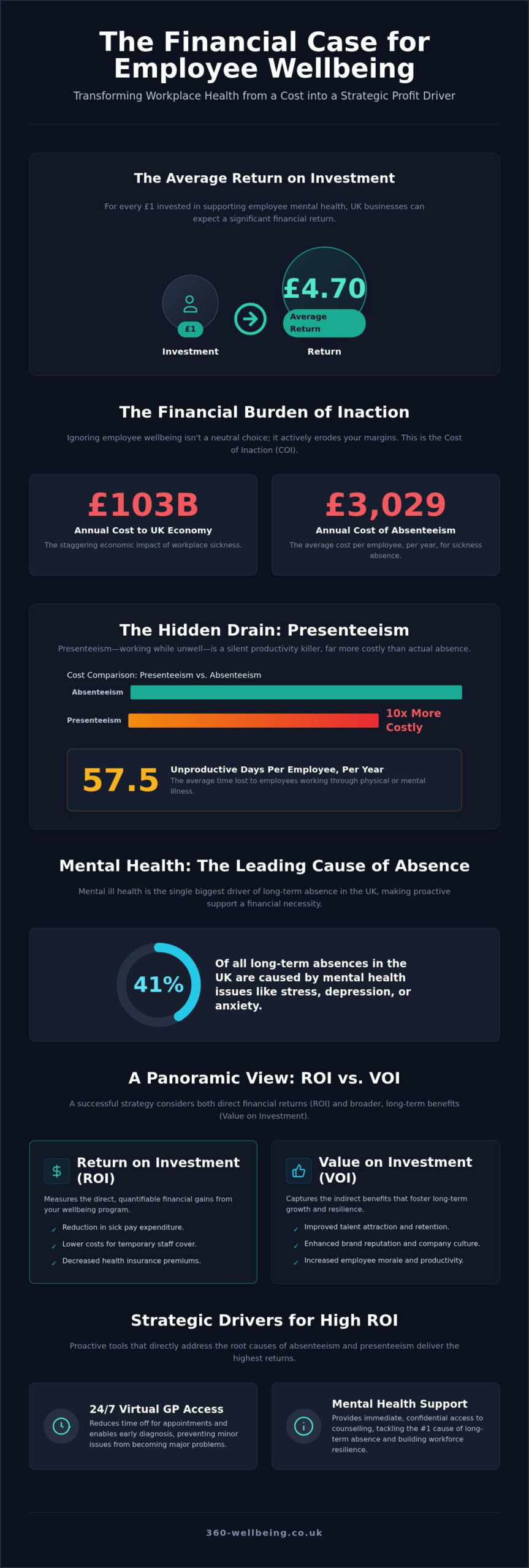
Did you know that for every £1 your business invests in supporting mental health, you can expect an average return of £4.70? With UK sickness absence reaching its highest level in over 15 years, the roi of employee wellbeing programs has shifted from a human resources goal to a core financial strategy. You’ve likely felt the pressure of rising premiums and the hidden cost of presenteeism, which is now estimated to cost businesses ten times more than actual absenteeism.
It’s challenging to justify wellness spend when the benefits feel intangible or soft compared to hard operational costs. We understand the need for a clear, evidence-based business case that respects both your budget and your duty of care. This guide explores how to quantify the financial impact of workplace health and transform it into a strategic profit driver. We’ll examine how proactive tools, such as 24/7 Virtual GP access and mental health support, reduce the £3,029 average annual cost of absenteeism per employee. You’ll discover a methodical path to improving recruitment and building a panoramic view of health that protects both your team and your margins.
Key Takeaways
- Shift your perspective from wellness as a cost to wellness as a profit driver by establishing your business’s “Cost of Inaction” as a financial baseline.
- Master the specific formulas needed to quantify the roi of employee wellbeing programs, balancing hard financial savings with the broader Value on Investment.
- Discover how 24/7 Virtual GP access and mental health support directly tackle the hidden costs of presenteeism and the £3,029 average annual cost of absenteeism.
- Identify the five essential KPIs you need to monitor to prove the long-term durability and success of your corporate health initiatives.
- Learn how a unified approach to physical, mental, and social support creates a more resilient and productive workforce in the 2026 hybrid working landscape.
The Financial Burden of Inaction: Absenteeism and Presenteeism in 2026
To accurately measure the roi of employee wellbeing programs, we must first establish a baseline known as the Cost of Inaction (COI). This figure represents the total financial loss your business incurs by maintaining the status quo. In 2026, the UK landscape shows that workplace sickness costs the economy an staggering £103 billion annually. On an individual level, the average cost of absenteeism has risen to £3,029 per employee each year. Ignoring these numbers doesn’t make them disappear; it simply allows them to erode your margins from within.
While absenteeism is visible on a payroll report, presenteeism is a far more complex challenge. It’s the act of showing up for work while physically or mentally unwell. You might see your team at their desks, but their productivity is often compromised. Research indicates that presenteeism costs businesses ten times more than total absence. Employees are unproductive for an average of 57.5 days each year due to this “working through it” culture. It’s a silent drain on resources that often leads to a cycle of declining health and eventual long-term leave.
The Hidden Drain of Mental Health Issues
Mental ill health is now the leading cause of long-term absence in the UK, accounting for 41% of all cases. When stress and burnout go unaddressed, they don’t just affect the individual; they ripple through your entire team, increasing the workload on others and damaging morale. High-quality Workplace wellness programs provide a panoramic view of health that prioritises early intervention. By offering Mental Health Support or an Employee Assistance Programme (EAP), you catch the first signs of struggle. This proactive approach prevents temporary stress from hardening into long-term disability claims that are far costlier to manage.
Calculating Your Current Baseline Costs
Understanding your specific roi of employee wellbeing programs starts with a methodical look at your current outgoings. You can calculate your baseline by following these steps:
- Direct Sick Pay: Total your annual expenditure on Statutory Sick Pay (SSP) and any enhanced company sick pay.
- Operational Friction: Estimate the cost of hiring temporary cover or the overtime paid to other staff to fill gaps.
- Lost Opportunity: Calculate the revenue lost due to missed deadlines or decreased client satisfaction during periods of high absence.
Most businesses discover a significant “wellbeing gap” during this process. This gap is the distance between your current benefits and the actual health needs of your workforce. Bridging this gap isn’t just a kindness; it’s a professional necessity that protects the durability of your business.
Calculating the ROI of Employee Wellbeing: Beyond Healthcare Savings
Calculating the roi of employee wellbeing programs requires moving beyond a simple “feel-good” factor to build a robust financial case. To do this, we use the standard formula: (Total Gains minus Cost of Investment) divided by the Cost of Investment. For a UK SME, these gains aren’t just abstract figures on a spreadsheet. They represent reclaimed hours, reduced recruitment fees, and lower insurance premiums. While short-term clinical savings provide immediate relief, the true power of a holistic health platform lies in the “multiplier effect.” When an employee can access a 24/7 Virtual GP, Mental Health Support, and Legal Advice in one unified space, they solve problems before they escalate into complex, expensive crises.
ROI vs. VOI: Which Metric Matters Most?
ROI measures direct financial returns, such as the reduction in sick pay or the lower cost of temporary cover we established in the previous section. However, the 2026 landscape demands an additional focus on Value on Investment (VOI). VOI captures the indirect benefits that sustain a business over time, like improved brand reputation and talent attraction. This is especially critical in a hybrid work world where culture is harder to maintain. A recent Deloitte report on mental health found that universal interventions show an average return of £5 for every £1 spent. By combining hard ROI data with VOI metrics, you create a panoramic view of health that appeals to both the finance director and the people manager.
The Per-Employee Subscription Advantage
Traditional “pay-as-you-go” clinical services can be unpredictable for smaller businesses. A sudden spike in staff illness or a seasonal flu outbreak can lead to unexpected costs that strain your cash flow. In contrast, a fixed-fee SaaS model provides a predictable baseline for your budget. This per-employee subscription model ensures that your costs remain stable even as usage increases, allowing you to offer high-quality care without the fear of hidden fees. It’s a scalable solution that grows with your team, making the roi of employee wellbeing programs easier to forecast and track over several years. This foresight is essential for building a durable business that prioritises its most valuable asset.
Building this financial case is simpler when you have a clear, fixed-cost structure. You can explore how a unified platform supports your team’s durability by reviewing the SaaS-based employee benefits available for your business.
Strategic ROI Drivers: How Virtual GPs and Mental Health Support Pay Back
To truly understand the roi of employee wellbeing programs, we have to look at the specific service drivers that turn a health platform into a financial asset. It’s not just about offering perks; it’s about removing the clinical and administrative friction that slows your business down. By integrating physical, mental, and social support into a single narrative, you create a more resilient workforce. This strategic approach ensures that minor health concerns are addressed before they evolve into the complex, long-term absence cases that cost UK businesses £103 billion annually.
The 24/7 Virtual GP: Eliminating the “Half-Day” Appointment
A traditional GP visit is rarely just a twenty-minute appointment. When you factor in travel, waiting room delays, and the struggle to find a slot during office hours, a simple consultation often results in a half-day of lost productivity. For a business, this micro-absenteeism is a constant drain on resources. By providing 24/7 access to a UK-registered Virtual GP, you reclaim those hours. Employees can consult a doctor from the comfort of their home or a private office space, often within minutes. This rapid access leads to faster diagnosis and treatment, which significantly shortens return-to-work timelines and keeps your operations running smoothly.
Preventative Mental Health and Life Coaching
Mental health challenges account for 41% of long-term absences in the UK. The financial impact of a single crisis is high, involving not just sick pay but also the substantial cost of recruitment and training if that staff member leaves. Our approach to Mental Health Support and Life Coaching is rooted in early intervention. Life coaching, in particular, acts as a powerful engagement tool, helping employees navigate personal hurdles before they impact their professional performance. This proactive support builds durability within your team, ensuring that stress doesn’t harden into burnout. To get a clearer picture of these potential savings, you can use the UK Government’s wellbeing tool to calculate the specific costs of ill-health in your sector.
Beyond mental health, address physical and social stressors to prevent “brain drain.” Preventative Physiotherapy is essential for managing musculoskeletal issues, which are a leading cause of UK workdays lost. Meanwhile, providing Financial Support and Debt Advice reduces the cognitive load on employees who might otherwise be distracted by personal worries. When your team feels supported in every aspect of their lives, their focus returns to their work. This holistic care is the foundation of a high roi of employee wellbeing programs, transforming health from a reactive cost into a proactive driver of workplace harmony and profit.
Measuring Success: KPIs for Tracking Your Wellbeing Program’s Impact
Measuring the roi of employee wellbeing programs requires a methodical approach to data that moves beyond guesswork. To see the full picture, you need to track both clinical outcomes and operational efficiency. High utilisation rates on your platform are a positive sign; they show that your team trusts the tools you’ve provided, whether they’re accessing the 24/7 Virtual GP or seeking mental health support. When these tools are used proactively, they prevent the micro-absences that quietly erode your bottom line. By 2026, the most successful UK businesses will be those that treat wellbeing data with the same rigour as financial forecasting.
To build a panoramic view of your program’s success, focus on these five essential KPIs:
- Sickness Absence Rates: Tracking the total number of days lost and identifying seasonal trends.
- Platform Engagement: Monitoring how many staff members are actively using the 360 Rewards or health services.
- Employee Retention: Correlating staff tenure with the availability and usage of wellbeing benefits.
- Employee Net Promoter Score (eNPS): Gauging how likely your team is to recommend your business as a great place to work.
- Presenteeism Impact: Using internal surveys to estimate the productivity reclaimed by resolving health issues early.
Hard Metrics: Sickness Absence and Turnover
The Bradford Factor is a helpful tool for quantifying the impact of your initiatives. It weights frequent short-term absences more heavily than single long-term illnesses, helping you identify patterns of micro-absenteeism that often signal deeper issues like burnout or low engagement. By providing early intervention through an Employee Assistance Programme (EAP), you can effectively lower these scores. This reduction directly translates into lower recruitment and onboarding costs, as a healthier team is a more stable one. Comprehensive benefit provision acts as a powerful anchor, directly extending employee tenure by fostering a sense of being valued and protected.
Soft Metrics: Culture and Sentiment
While hard data is essential, soft metrics provide the emotional context for your ROI. Using eNPS allows you to measure the shift in workplace harmony and employee loyalty over time. It’s also vital to track the usage of specific resources, such as financial support for employees, to understand which stressors are most prevalent in your workforce. This foresight enables you to customise your strategy, ensuring your investment remains durable and relevant to your team’s actual needs. When you address social stressors like debt or legal worries, you reduce the “brain drain” that distracts your best talent from their core work.
Start tracking your impact today by exploring our integrated wellbeing reporting tools to see how your investment is performing in real-time.
Implementing a High-Yield Wellbeing Strategy with 360 Wellbeing
Moving from a theoretical understanding of health to a practical, high-yield strategy requires a shift in how you view your benefits package. Many UK SMEs struggle with “point solution fatigue,” where employees are expected to navigate a fragmented collection of different apps for mental health, fitness, or GP services. This friction often leads to low engagement and a poor return on your spend. Choosing a unified platform is the most effective way to secure a high roi of employee wellbeing programs. By consolidating physical, mental, and social support into one accessible hub, you create a seamless experience that respects your team’s time and your company’s budget.
In a hybrid work world, 24/7 accessibility is no longer a luxury; it’s a professional necessity. Your team needs support that follows them from the office to the home, providing reassurance whenever a health concern arises. A unified platform simplifies this journey, ensuring that whether an employee needs a late-night consultation or financial advice, the path to support is clear and immediate. This all-encompassing approach builds the durability your business needs to thrive in 2026.
The 360-Degree Approach to Corporate Health
Our philosophy is rooted in a panoramic viewpoint that treats health as a single, unified narrative. The 360 Wellbeing suite integrates a 24/7 Virtual GP, Mental Health Support, and Physiotherapy into one cohesive ecosystem. This isn’t just about clinical care; it’s about providing a sense of completeness and balance. For example, our 360 Rewards program offers immediate cost-of-living support, addressing the social stressors that often lead to poor physical health. By using UK-registered GPs, we provide a level of expertise and reliability that builds deep trust between the provider and your staff. This clinical excellence, combined with a warm, human touch, ensures your team feels empowered to take a proactive role in their own vitality.
From Onboarding to ROI: The Launch Process
Launching a wellbeing program shouldn’t feel like an administrative burden. We’ve designed a methodical onboarding process that focuses on immediate engagement. Every client benefits from dedicated account management, ensuring that your program isn’t just a “one-off” service but a long-term partnership. To drive immediate perceived value, employees gain instant access to a discount marketplace. This creates a positive association with the platform from day one, even before they need to use the clinical services. When your team sees tangible benefits in their daily lives, they’re more likely to engage with the preventative tools that drive your long-term roi of employee wellbeing programs. If you’re ready to transform your workplace health from a cost centre into a strategic profit driver, Book a demo to calculate your potential ROI and start your journey toward a more harmonious, productive workforce.
Securing Your Company’s Future Through Proactive Care
The landscape of workplace health in 2026 demands a shift from reactive crisis management to a proactive, panoramic viewpoint. By establishing your Cost of Inaction and tracking specific KPIs, you can move beyond the “soft” benefits of wellness to prove a hard financial case. We’ve explored how a unified platform eliminates micro-absenteeism and reduces the high cost of staff turnover. It’s clear that the roi of employee wellbeing programs is found in the seamless integration of physical, mental, and social support.
Choosing 360 Wellbeing means partnering with an expert caregiver who understands the durability of your business depends on your team’s vitality. With predictable per-employee monthly pricing, you gain access to 24/7 UK-registered GPs and a comprehensive EAP that prioritises early intervention. This isn’t just a cost; it’s a commitment to workplace harmony and long-term success. Ready to see the impact for yourself? Calculate your business ROI with 360 Wellbeing and transform your team’s health into your greatest strategic advantage. You have the tools to build a more resilient, empowered workforce today.
Frequently Asked Questions
What is the average ROI for employee wellbeing programs in the UK?
Deloitte’s 2026 analysis indicates that UK employers receive an average return of £4.70 to £5 for every £1 invested in mental health and wellbeing. Universal interventions that are available to your entire workforce show an even higher return of £6.30. These figures demonstrate that a panoramic view of health is a sound financial strategy that protects your company’s long-term durability and profit margins rather than just a luxury perk.
How do you calculate the ROI of a virtual GP service?
You calculate the ROI by measuring the productivity hours reclaimed through 24/7 access to medical advice. Traditional GP visits often result in half-day absences, but virtual consultations allow staff to speak with a UK-registered doctor without leaving their workspace. By reducing this micro-absenteeism and accelerating return-to-work timelines, a fixed-fee service provides a predictable return. This foresight helps you manage health risks before they escalate into expensive long-term disability claims.
Can small businesses see the same ROI as large corporations?
Yes, small businesses often see a more significant relative impact because every individual’s productivity is critical to their daily operations. While larger firms benefit from scale, SMEs use fixed-fee SaaS models to gain corporate-level health tools without the high premiums of traditional insurance. This ensures that the roi of employee wellbeing programs is accessible to organizations of all sizes, fostering workplace harmony and resilience across your entire team.
How long does it take to see a financial return on wellness programs?
You can see immediate gains through soft metrics like employee sentiment, while hard financial returns typically emerge within six to twelve months. Early wins often come from reduced micro-absenteeism and the immediate perceived value of a rewards platform. Over time, these small improvements compound into significant savings on recruitment fees and Statutory Sick Pay. This creates a more durable and stable business environment for your workforce to thrive in.
What are the biggest hidden costs of poor employee wellbeing?
Presenteeism is the most significant hidden cost, as it’s estimated to be ten times more expensive than total absence for UK businesses. When employees work while unwell, their productivity drops, leading to an average loss of 57.5 days per worker each year. Other hidden drains include the “brain drain” caused by financial stress and the rising cost of staff turnover. Addressing these factors requires a methodical, all-encompassing approach to mental and social health.
Is mental health support more cost-effective than physical health support?
Both are essential for a panoramic viewpoint of health, but mental health support often shows a higher direct ROI because it addresses the leading cause of long-term absence. Mental ill health accounts for 41% of UK absence cases. However, a unified platform that integrates therapy with preventative physiotherapy ensures that you don’t leave any gaps in your care strategy. This protects the essential human entitlement to total wellness while securing your business interests.
How does a wellbeing platform improve staff retention rates?
A comprehensive platform improves retention by fostering a culture where employees feel genuinely valued and protected by their employer. When staff have 24/7 access to Virtual GPs and mental health support, their job satisfaction increases. This sense of security reduces the likelihood of them leaving due to burnout or unmanaged health challenges. Improving tenure through these benefits also saves your business the substantial costs associated with recruitment and onboarding new talent.
What is the difference between ROI and VOI in workplace health?
ROI focuses on direct financial returns like reduced sick pay, while VOI measures broader gains such as brand reputation and employee engagement. Balancing both metrics is crucial for understanding the true roi of employee wellbeing programs. While ROI appeals to the finance director, VOI demonstrates how a healthy culture attracts top talent and builds a more resilient, forward-thinking organization that can thrive in a competitive and demanding hybrid work landscape.