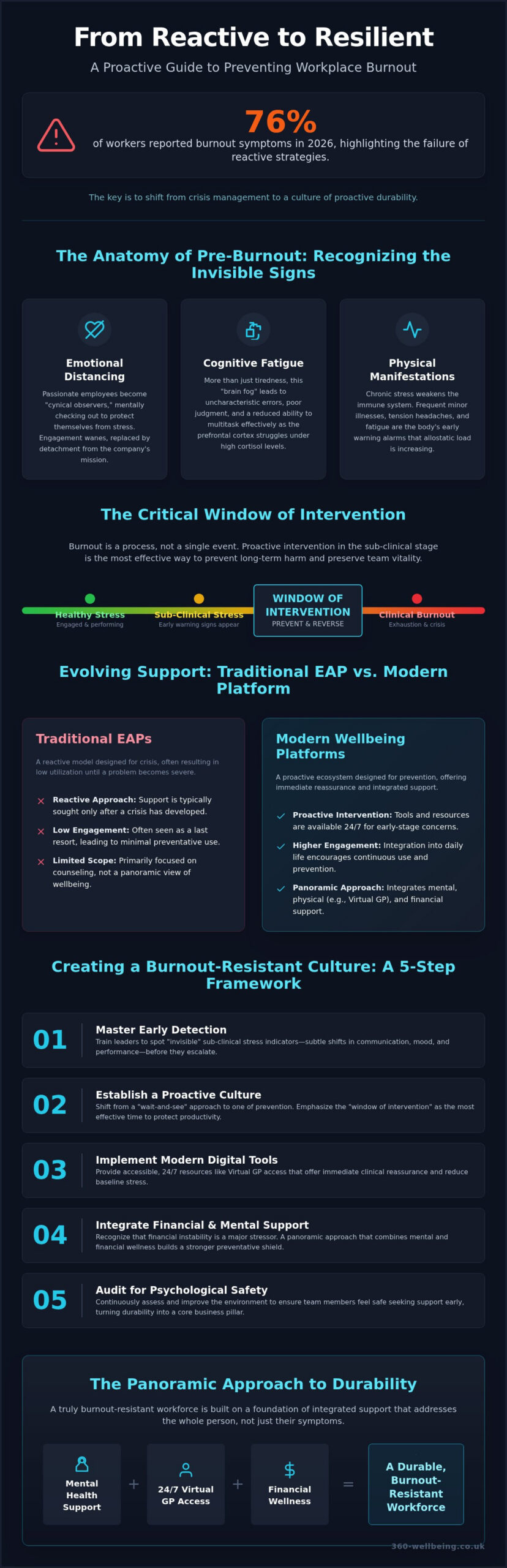
With over 76% of workers reporting burnout in 2026, the traditional approach of waiting for a crisis to occur is no longer a viable business strategy. You’ve likely felt the weight of rising turnover costs and the quiet drain of presenteeism, where your team is physically present but mentally exhausted. It’s understandable to feel overwhelmed by the complexity of modern mental health support. However, protecting your people is about more than just reactive fixes. It’s about preventing workplace burnout before it starts by shifting your focus toward a proactive, panoramic view of employee health.
We agree that the pressure to maintain productivity while managing sensitive mental health needs can feel like an impossible balance. This guide promises to equip you with a clear roadmap for early intervention, moving from a reactive stance to a culture of durability. You’ll learn how to identify the subtle signs of sub-clinical stress and implement an infrastructure that stops exhaustion before it impacts your team’s health. We’ll explore how integrating tools like 24/7 Virtual GP access and financial support creates a sense of safety and order. By the end, you’ll have a strategy that makes wellbeing a professional necessity and a core pillar of your success.
Key Takeaways
- Master the art of spotting “invisible” sub-clinical stress indicators, like subtle shifts in communication, before they become clinical health issues.
- Understand the critical “window of intervention” and why preventing workplace burnout before it starts is the most effective way to protect your team’s productivity.
- Compare the limitations of traditional, reactive EAPs against modern wellbeing platforms that provide 24/7 clinical reassurance and higher engagement.
- Implement a clear five-step framework to audit your team’s psychological safety and provide the digital tools necessary for early support.
- Learn how a panoramic approach integrating financial support and mental health support builds a durable, burnout-resistant workforce.
The Anatomy of Pre-Burnout: Recognizing the Invisible Signs
Before the total exhaustion of Occupational burnout sets in, there’s a quieter, sub-clinical stage known as pre-burnout. This isn’t a sudden collapse; it’s the gradual erosion of an employee’s resilience. Understanding this phase is the cornerstone of preventing workplace burnout before it starts. While clinical burnout is a documented syndrome, pre-burnout is often invisible to the untrained eye, manifesting as subtle shifts in a person’s typical work patterns and communication style.
You might notice a normally collaborative team member becoming shorter in their email tone or a consistent high-achiever beginning to miss deadlines by just a few hours. These aren’t necessarily signs of poor performance; they’re often the brain’s way of managing a prolonged elevation in cortisol. When the body stays in a state of high alert, the prefrontal cortex, which is responsible for complex decision-making and emotional regulation, begins to struggle. This physiological toll makes even simple tasks feel like insurmountable hurdles.
It’s also vital to distinguish between healthy high performance and high-functioning anxiety. True high performance is sustainable and fueled by genuine engagement. In contrast, high-functioning anxiety looks like productivity from the outside, but it’s driven by a fear of failure and an inability to switch off. Recognizing this distinction allows you to support your team before their “fuel” runs out entirely.
The Three Dimensions of Early Erosion
- Emotional distancing: Watch for when once-passionate employees start acting as “cynical observers.” They may still do the work, but they’ve mentally checked out from the company’s mission to protect themselves from further stress.
- Cognitive fatigue: This is more than just being tired. It’s a persistent “brain fog” that leads to uncharacteristic errors in judgment or a sudden inability to multitask effectively.
- Physical manifestations: Chronic stress compromises the immune system. If a team member is frequently catching minor colds or complaining of tension headaches, their body is sounding an early alarm.
The Role of Presenteeism in the Burnout Cycle
Presenteeism occurs when employees are physically at their desks but are mentally incapacitated by stress or illness. It’s a quiet productivity killer that often goes unnoticed because the person is “putting in the hours.” However, this habit of powering through actually accelerates the transition from manageable stress to clinical exhaustion. Presenteeism is a leading indicator of future absenteeism.
By identifying these invisible signs early, you can create a safer environment where employees feel empowered to seek support before they reach a breaking point. It’s about moving from a culture of endurance to one of proactive durability.
The Science of Proactive Intervention: Why Wait and See Fails
Many employers treat burnout as a destination rather than a process. This reactive mindset ignores the “window of intervention,” which is a critical period where sub-clinical stress can be reversed before it evolves into a chronic medical condition. Preventing workplace burnout before it starts requires understanding that mental fatigue rarely exists in a vacuum. It’s often the result of a cumulative biological and social burden that weighs on an individual’s ability to perform. By intervening early, you aren’t just managing symptoms; you’re preserving the core vitality and durability of your organization.
The Biological Cost of Unchecked Stress
The concept of Allostatic Load explains the physiological “wear and tear” on the body that accumulates when a person is exposed to chronic stress. When employees struggle to balance work with personal health, minor concerns often go untreated because they don’t have the time or energy to seek care. These small worries act as a constant drain on mental energy, leading to escalating fatigue. Immediate access to a 24/7 Virtual GP provides medical reassurance that can stop a minor health worry from spiralling into a significant source of anxiety. It’s a simple way to lower the baseline stress levels of your entire team. This clinical foresight ensures that minor physical symptoms don’t evolve into complex psychological hurdles.
Financial Wellness as a Preventative Shield
Financial instability is a silent multiplier for workplace burnout. In the UK, there is a stark correlation between personal debt and mental health crises. When an employee is distracted by financial or legal worries, their professional resilience is compromised. Providing financial support for employees through debt helplines and legal advice creates a vital safety net. This panoramic approach ensures that external pressures don’t erode their performance at work. Having access to complimentary will writing or debt advice on-demand offers a level of stability that allows employees to remain focused and present.
Life coaching also plays a pivotal role in this preventative strategy. It offers a structured path for employees to build professional durability and manage life’s complexities with confidence. These sessions provide a space for foresight, helping individuals anticipate challenges rather than just reacting to them as they arrive. Integrating these diverse support systems into a single platform provides a sense of safety and order. You can learn more about building this type of infrastructure by exploring the resources at 360 Wellbeing. By making these tools a professional necessity, you create a culture where wellness is the foundation of high performance.
Traditional EAPs vs. Modern Wellbeing Platforms
For decades, the Employee Assistance Programme (EAP) was the standard for corporate care. However, these traditional models are often reactive, tucked away in an employee handbook until a crisis hits. Preventing workplace burnout before it starts requires a shift from these “break-glass-in-case-of-emergency” services to proactive digital platforms. While a phone-line EAP might offer a sympathetic ear after an employee has already reached their limit, a modern wellbeing platform provides the foresight and tools to intervene weeks or months earlier.
Engagement remains the biggest hurdle for old-school EAPs. Many employees view them as clinical or bureaucratic, leading to low adoption rates. Modern SaaS interfaces change this dynamic by making support feel like a professional necessity rather than a last resort. By moving health and wellbeing into a user-friendly app, businesses can offer a panoramic view of care that integrates physical, mental, and social health into one unified narrative. This accessibility is what transforms wellbeing from a luxury into a durable part of the company culture.
Accessibility and the 24/7 Medical Advantage
The stress of a minor health concern can quickly spiral when an employee faces a two-week wait for a local GP appointment. This delay creates unnecessary anxiety and often leads to absenteeism. Having a 24/7 Virtual GP at hand provides immediate clinical reassurance, allowing team members to address worries the moment they arise. For hybrid and remote workers, this flexibility is essential. It ensures that care is available regardless of their schedule or location, providing a sense of safety and order that traditional office-based services simply cannot match.
Beyond Counselling: Holistic Support Pillars
True prevention goes beyond traditional counselling. A unified platform like 360 Wellbeing integrates mental health therapy with life coaching and physiotherapy to address the person as a whole. We also recognize that external pressures, such as the rising cost of living, are significant stressors. This is where 360 Rewards and financial support play a critical role, offering practical ways to reduce daily financial strain. When legal advice, debt support, and physical therapy are all accessible through one interface, the friction of seeking help disappears. This seamless integration ensures that your team stays durable, balanced, and focused on their professional success.
Creating a Burnout-Resistant Culture: A 5-Step Strategic Framework
Building a resilient organization requires moving beyond theory and into practical, repeatable action. Preventing workplace burnout before it starts isn’t a one-off initiative; it’s a strategic commitment to the long-term durability of your team. This framework provides a structured path to transition from a reactive culture to one that prioritizes proactive health and psychological safety.
- Step 1: Audit Psychological Safety. Evaluate your team’s communication. Do employees feel safe admitting they are overwhelmed, or do they fear judgment? A culture where people can speak openly about stress is the first line of defense.
- Step 2: Decentralize Health Access. Remove the friction of seeking help. Providing digital wellbeing tools gives employees the autonomy to access a Virtual GP or mental health support without needing to go through HR first.
- Step 3: Normalise Professional Support. Lead by example. When leadership openly discusses the value of life coaching or therapy, it transforms these services from “crisis interventions” into essential professional tools.
- Step 4: Implement Panoramic Check-ins. Shift the focus of 1-to-1 meetings. While task management is necessary, these sessions should also address the human element. Ask about energy levels and physical health to catch sub-clinical stress early.
- Step 5: Review and Iterate. Use anonymous platform usage data to understand your team’s needs. If usage of financial support tools spikes, you know where to focus your next internal communication.
You can start building this framework today by exploring the integrated solutions at 360 Wellbeing.
Training Managers as First Responders
Managers are the front line of your prevention strategy. They don’t need to be clinical experts, but they must be trained to recognize the invisible signs of pre-burnout, such as uncharacteristic errors or a cynical tone in communication. Appointing Mental Health Champions in every department provides a peer-to-peer network that feels accessible and safe. During regular meetings, managers should frame wellbeing as a professional necessity. It’s a requirement for sustained high performance, not an optional extra that’s only considered when work is slow.
Optimising the Hybrid Work Environment
The hybrid model brings unique risks, particularly digital exhaustion and the “always-on” mindset. Preventing workplace burnout before it starts in a remote setting requires clear boundaries. Encourage your team to disconnect fully outside of work hours to prevent cognitive fatigue. Use digital tools to bridge the gap for remote staff, ensuring they have the same 24/7 access to clinical reassurance as those in a central office. This creates a unified culture of durability that values human health as much as short-term intensity.
Scaling Prevention with 360 Wellbeing: Integrated Tools for Total Protection
360 Wellbeing acts as a comprehensive prevention engine, designed to catch the subtle tremors of stress before they lead to a total collapse. Preventing workplace burnout before it starts requires more than just a helpline; it demands an integrated infrastructure where physical, mental, and financial health are treated as a single, unified narrative. For UK SMEs, this SaaS platform offers a manageable way to provide high-level care that was once only accessible to large corporations. By centralizing these tools, you remove the barriers to care and establish a proactive vision of workplace harmony.
The 24/7 Virtual GP is a cornerstone of this approach. By addressing minor health concerns the moment they arise, employees avoid the anxiety of waiting for appointments and the physical drain of untreated conditions. This immediate clinical reassurance is a powerful tool for reducing absenteeism. When combined with professional-grade Mental Health Support, it creates a safety net that catches sub-clinical stress early, ensuring your team remains durable and focused. This integration of clinical medical access and psychological support addresses the gap where many traditional health programs fail.
The 360 Wellbeing Suite in Action
Professional growth and stress management are two sides of the same coin. Our Life Coaching services empower employees to navigate professional challenges with foresight, building the resilience needed to thrive in high-pressure environments. We also recognize that external factors, such as rising costs, significantly impact mental clarity. Through 360 Rewards, staff can alleviate daily financial pressure, while complimentary will writing and legal support provide a deep sense of security. This panoramic approach ensures that every aspect of an employee’s wellbeing is supported, transforming health from a luxury into an essential human entitlement.
Measuring the ROI of Prevention
Investing in a proactive wellbeing strategy is a sound business decision with measurable outcomes. When you focus on preventing workplace burnout before it starts, the return is visible in reduced staff turnover and a significant drop in absenteeism. A resilient, high-performing workforce is your most valuable asset, and protecting their health is a professional necessity. The long-term value of this durability far outweighs the cost of reactive crisis management or the hidden drain of presenteeism. Onboarding your team to the 360 Wellbeing platform is a methodical process designed for immediate impact. By providing these essential tools, you aren’t just buying a service; you’re investing in a partner dedicated to your team’s long-term success.
Building a Durable Future for Your Team
Transitioning from reactive crisis management to a proactive culture of durability is the most significant step you can take for your organization’s health. You’ve learned that recognizing the invisible signs of sub-clinical stress is essential for preventing workplace burnout before it starts. By integrating physical, mental, and financial support into a single, unified narrative, you provide your team with the foresight they need to stay balanced. This isn’t just about productivity; it’s about honoring the human entitlement to total wellness and workplace harmony.
Now is the time to implement a strategic framework that makes wellbeing a professional necessity. 360 Wellbeing provides a platform designed specifically for UK SMEs and organizations, offering 24/7 access to UK-registered Virtual GPs alongside comprehensive mental health and financial support. These tools empower your staff to address concerns immediately, reducing the biological and cognitive costs of unchecked stress. Protect your team and prevent burnout with 360 Wellbeing today. We are here to help you build a resilient, high-performing workforce that feels truly valued and secure.
Frequently Asked Questions
Is it possible to stop burnout once it has already started?
Yes, but it requires immediate clinical intervention and a structured shift in workload. While the best strategy is preventing workplace burnout before it starts, recovery is possible through professional mental health support and dedicated rest. Employers should provide access to therapy and life coaching to help individuals rebuild their professional durability. It’s about moving from a state of exhaustion back to balance with expert guidance and support.
What are the first signs of workplace burnout I should look for?
Look for subtle invisible signs like increased cynicism, a drop in cognitive focus, or frequent minor illnesses. You might notice a team member who was once highly engaged becoming a cynical observer or making uncharacteristic errors due to brain fog. These physical and emotional markers are early indicators that the body’s stress response is overwhelmed. Catching these signs early allows for proactive intervention before a crisis occurs.
Can a Virtual GP help with mental health and burnout prevention?
A Virtual GP provides essential medical reassurance that reduces health-related anxiety. By offering 24/7 access to a UK-registered doctor, employees can address minor physical symptoms that often stem from or contribute to mental fatigue. This clinical foresight helps stop minor worries from spiralling into significant psychological hurdles. It’s a vital component of a panoramic approach to health, ensuring physical and mental wellbeing are treated as a single narrative.
How much does an employee wellbeing platform cost for a small business?
Most modern platforms operate on a recurring SaaS model with a fixed monthly fee per staff member. While specific rates depend on the organization’s size and required features, this model makes holistic health support accessible for UK SMEs. Rather than a large upfront investment, it’s a manageable professional necessity. This allows even small organizations to provide the same level of care and integrated tools found in much larger enterprises.
What is the difference between an EAP and a wellbeing platform?
Traditional EAPs are often reactive services that employees only use during a crisis. In contrast, a modern wellbeing platform like 360 Wellbeing is a proactive engine designed for daily engagement. It integrates clinical medical access, mental health therapy, and financial support into one user-friendly interface. This shift from emergency only to professional necessity is key to preventing workplace burnout before it starts by catching stress at a sub-clinical level.
How can I encourage my employees to actually use wellbeing benefits?
Normalise the use of these tools by integrating them into your company culture and leadership discussions. When managers openly discuss the benefits of life coaching or 24/7 GP access, it removes the stigma of seeking help. You can also use rewards and discounts to drive daily platform engagement. Highlighting these benefits as a professional entitlement rather than a luxury ensures your team feels empowered to prioritize their own long-term durability.
Does 360 Wellbeing offer support for financial stress and debt?
Yes, the platform provides comprehensive financial and legal support to address external stressors. This includes access to debt helplines, legal advice, and even complimentary will writing services. We recognize that financial instability is a leading cause of workplace anxiety. By offering these tools alongside mental health support, we create a safety net that protects employees from the external pressures that often lead to professional exhaustion and reduced productivity.
How does preventing burnout improve company ROI in the UK?
Proactive prevention significantly reduces the high costs associated with staff turnover and absenteeism. In the UK, the financial impact of presenteeism, where employees are at work but underperforming due to stress, is a major drain on business productivity. By investing in a resilient, high-performing workforce, businesses see a measurable return through improved retention and lower recruitment costs. A durable team is a more profitable and sustainable asset for any organization.