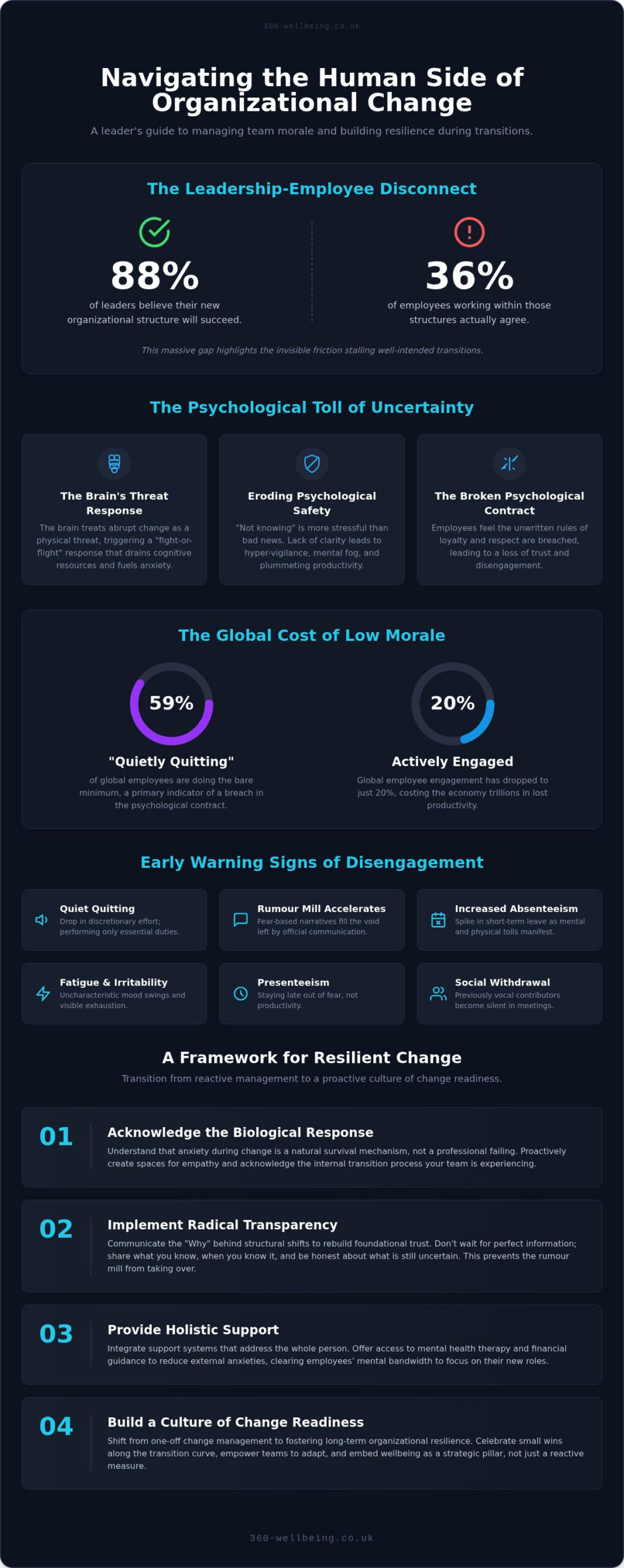
Did you know that while 88% of company leaders believe their new organisational structure will succeed, only 36% of the employees working within those structures actually agree? This massive disconnect highlights the invisible friction that often stalls even the most well-intended transitions. Managing team morale during organisational change isn’t just about shifting boxes on a chart; it’s about safeguarding the people who make those boxes move.
You likely know the feeling of watching productivity dip as uncertainty grows, or the weight of carrying your team’s anxiety while trying to meet your own targets. It’s exhausting, and the fear of losing your best talent during a restructure is a valid concern for any modern leader. This guide will show you how to bridge that gap by prioritising psychological safety and holistic wellbeing as strategic pillars of your transition plan. We’ll explore practical ways to maintain trust, reduce burnout, and use supportive tools like mental health resources and financial guidance to build a resilient, stable workforce.
Key Takeaways
- Understand the biological “threat response” that triggers during transitions and how to repair the psychological contract between leadership and staff.
- Identify early warning signs of disengagement, such as the rise of the “rumour mill,” to take a proactive approach to managing team morale during organisational change.
- Implement a “Radical Transparency” communication model that prioritises the “Why” behind structural shifts to rebuild foundational trust across the workforce.
- Learn how integrating holistic support, including mental health therapy and financial guidance, can clear an employee’s mental bandwidth and reduce external anxieties.
- Transition from reactive change management to a culture of “change readiness” by celebrating small wins and fostering long-term organisational resilience.
The Psychology of Transition: Why Organisational Change Impacts Morale
Organisational change is a disruption of predictability that requires proactive empathy to navigate. While many leaders focus on the logistical side of organisational change management, the most significant hurdles are often psychological. It’s helpful to distinguish between “change,” which is the external event like a merger or a restructure, and “transition,” which is the internal process employees go through to come to terms with the new reality. Managing team morale during organisational change requires acknowledging that while the business can pivot in a day, the human heart often needs more time.
The human brain is hardwired to seek patterns and safety. When those patterns are suddenly broken, the amygdala treats the shift as a physical threat rather than a corporate strategy. This biological response explains why even small changes can trigger significant anxiety; it isn’t a lack of professional maturity, it’s a fundamental survival mechanism designed to protect us from the unknown.
The Threat to Psychological Safety
Psychological safety is the bedrock of a healthy workplace. When uncertainty replaces clear expectations, the brain’s flight-or-fight response is triggered, leading to a state of hyper-vigilance. Research consistently shows that “not knowing” is actually more stressful for the nervous system than receiving definitive bad news. This constant state of alert drains cognitive resources, leading to the productivity slumps and “mental fog” often seen during transitions. According to 2026 Gallup data, global employee engagement has dropped to 20%, costing the economy trillions in lost productivity. Much of this is due to the physical and mental exhaustion that follows a prolonged lack of psychological safety.
The Erosion of the Psychological Contract
Every employee operates under a “psychological contract,” an unwritten set of expectations regarding mutual loyalty, respect, and career growth. When structural shifts occur without clear communication, employees often feel this contract has been breached. They may feel their years of dedication have been undervalued, which is a primary driver for the 59% of global employees currently “quietly quitting.” This perceived breach of trust doesn’t just impact current performance; it damages your employer brand and makes long-term retention significantly harder. Rebuilding this contract requires leaders to look beyond the org chart and reconnect with the individuals who make the work possible.
Identifying Early Warning Signs of Low Team Morale
Early detection is your most powerful tool when the foundations of your company are shifting. You shouldn’t wait for a surge in resignations to realise your team is struggling. Managing team morale during organisational change requires a keen eye for the subtle behavioural shifts that precede a total breakdown in engagement. One of the most telling signs is the transition from “active engagement” to “quiet quitting,” where employees perform only the essential duties of their role without the passion or innovation they once showed. According to 2026 Gallup data, 59% of employees are already in this state globally. A sudden drop in discretionary effort is a primary indicator of morale failure.
You may also notice the “rumour mill” accelerating. When official communication feels insufficient, people fill the silence with their own narratives, often rooted in fear. This is frequently accompanied by a spike in short-term absenteeism as the physical and mental toll of uncertainty manifests. To effectively motivate and lead teams, you must first identify where the connection is fraying.
Physical and Mental Signs of Change-Related Stress
Stress doesn’t always look like a frantic employee. It often looks like fatigue, uncharacteristic irritability, or a withdrawal from social interactions. You might see an increase in presenteeism, where staff stay late not because they’re productive, but because they’re afraid of being seen as redundant. Social anxiety can also surface in team meetings; previously vocal contributors may become silent, fearing that a wrong word could jeopardise their position. Providing access to mental health support can give your team the tools they need to manage these physiological responses before they lead to burnout.
The Productivity Paradox
It’s normal to see a temporary dip in output when people are learning new workflows or adjusting to new structures. This is a natural part of the transition. However, a sustained drop in the quality of work is a sign of a deeper crisis. You should monitor the “velocity of work” versus the “quality of work.” If tasks are being finished quickly but with frequent errors, it suggests your team is rushing out of anxiety. Your role is to track these metrics with empathy, using them as a conversation starter rather than a reason for discipline. This balanced approach ensures you’re supporting the person, not just the output, which helps maintain stability during the most turbulent phases of a restructure.
Effective Communication Frameworks to Rebuild Trust
Trust is often the first casualty of a poorly managed transition. To succeed in managing team morale during organisational change, you must adopt a “Radical Transparency” model. This approach involves sharing the “Why” behind the “What” at every possible opportunity. When employees understand the strategic necessity of a shift, they’re far more likely to align with the new direction rather than resisting it. Silence from leadership is always filled with employee anxiety. By utilising multi-channel communication, including video updates, town halls, and personal check-ins, you ensure your message reaches every level of the organisation without being distorted by the rumour mill.
It’s equally important to create safe spaces for dissent. Your team needs to know they can “vent” or voice their concerns without fear of professional repercussions. This isn’t about encouraging negativity; it’s about providing a necessary release valve for the pressure that change creates. When people feel heard, their defensive barriers lower, making them more receptive to the path forward.
Active Listening and the Feedback Loop
While most companies rely on exit interviews, forward-thinking leaders in 2026 use “Stay Interviews” to understand what keeps their best people engaged during a restructure. These proactive conversations allow you to identify specific pain points before they lead to turnover. Implementing anonymous feedback tools can also help you capture the unvarnished sentiment of the workforce. However, the most critical step is “Closing the Loop.” You must demonstrate exactly how employee feedback has influenced your decisions. If you ask for input but fail to act on it, you risk deepening the sense of disillusionment.
Empathetic Leadership in 2026
Modern leadership requires moving away from clinical corporate speak in favour of human-centric language. Managing team morale during organisational change is significantly easier when managers are trained to handle difficult conversations with a warm, human touch. This means balancing operational requirements with a genuine acknowledgment of the emotional toll transitions take. Don’t shy away from vulnerability. Admitting you don’t have all the answers can actually build more trust than presenting a facade of total certainty. It positions you as a partner who is navigating the journey alongside your team, rather than a distant authority figure.
Supporting Employee Wellbeing Through the Change Curve
Transitions are rarely linear. Most employees move through a “Change Curve,” experiencing an initial dip in morale and productivity as they process the loss of familiar routines. Managing team morale during organisational change requires you to look beyond the office walls and consider the total mental bandwidth of your staff. When an individual is preoccupied with health concerns or external pressures, they have less cognitive energy to devote to new workflows. By integrating comprehensive health support as a core pillar of your strategy, you provide the stability needed to navigate this curve successfully.
Positioning robust wellbeing benefits during a restructure serves as a tangible proof point of your commitment to your staff. It transforms “corporate values” from abstract concepts into practical support. For instance, providing 24/7 Virtual GP access ensures that the physical symptoms of workplace stress, such as chronic fatigue or tension headaches, are addressed promptly. This proactive care prevents minor health issues from escalating into long-term absenteeism during critical phases of your transition.
Leveraging Mental Health and Life Coaching
Change often involves a form of professional grief. Employees may feel a deep sense of loss for “the old way” of working or for colleagues who have moved on. Access to mental health therapy sessions allows individuals to process these emotions in a confidential, safe environment. While an Employee Assistance Programme (EAP) provides immediate crisis support, life coaching can help employees re-orient themselves. A coach assists staff in finding their new purpose and place within the updated organisational structure, turning a period of uncertainty into an opportunity for personal growth and renewed career focus.
Reducing Financial and Personal Anxiety
Fear for job security often triggers a cascade of external anxieties, particularly regarding personal finances. If your team is worried about their mortgage or rising debt, their focus on the restructure will naturally waver. Offering Financial Support for Employees: A Comprehensive Guide for UK Employers in 2026 provides a roadmap for managers to help reduce these “hidden” stressors. Beyond debt advice, lifestyle perks and rewards can maintain a sense of value and appreciation during periods of high effort. These small, daily benefits help balance the social and financial health of your workforce, ensuring they remain resilient throughout the transition.
To see how a unified approach to physical and mental health can protect your organisation, explore our holistic employee wellbeing platform today.
Building a Resilient Culture for the Future of Work
The traditional approach to change management often treats transitions as isolated events with a clear start and end. However, the modern workplace requires a shift toward “Change Readiness,” where the ability to adapt is woven into the very fabric of the company. Managing team morale during organisational change becomes significantly more manageable when your workforce feels empowered rather than exhausted. A resilient culture is one where wellbeing is the foundation of every strategic pivot. By investing in continuous professional development, you give employees the skills and confidence to thrive in a new structure, transforming fear of the unknown into a sense of agency.
Rebuilding momentum starts with celebrating small wins. Whether it’s a successful pilot of a new workflow or a team meeting where everyone feels heard, these moments of recognition act as a psychological fuel. They remind your staff that progress is being made and that their contributions are valued even during periods of flux. This steady, methodical focus on positive reinforcement helps to repair the psychological contract and restore team spirit.
Continuous Wellbeing Monitoring
Maintaining this resilience requires constant vigilance. Using digital wellbeing platforms allows you to track long-term trends in staff health and morale rather than relying on gut feelings. Wellness check-ins should become a permanent fixture of your management rhythm, moving away from being a crisis-only response. Aligning your practices with ISO 45003 standards for psychological health and safety at work provides a scientifically grounded framework for protecting your team from the psychosocial risks that often accompany structural shifts. This panoramic viewpoint ensures that you’re supporting the whole person, not just the employee.
Next Steps: Strengthening Your Team’s Foundation
As you look toward the future, it’s vital to review your current employee benefits package. Does it truly meet the demands of a changing workplace? A holistic platform can serve as a permanent anchor for staff morale, providing a sense of continuity and care even when operational structures are in motion. By offering a unified narrative of total wellness, you demonstrate that your team’s health is a professional necessity and an essential human entitlement. See how 360 Wellbeing supports your team through transition by providing the 24/7 Virtual GP access, mental health therapy, and financial guidance necessary to build a durable, future-ready workforce.
Transforming Uncertainty into Lasting Resilience
Navigating structural shifts requires more than just logistical precision; it demands a deep commitment to the human beings behind the organisational charts. By recognising the psychological impact of transition and replacing silence with radical transparency, you can repair the trust that change often erodes. Managing team morale during organisational change isn’t a one-off task; it’s a continuous process of nurturing psychological safety and providing the tools your staff need to thrive under pressure.
True resilience is built when holistic care becomes a professional necessity rather than a luxury. Providing your workforce with 24/7 UK Virtual GP access, comprehensive mental health therapy, and financial and legal support demonstrates a proactive vision of workplace harmony. These resources clear the mental bandwidth of your employees, allowing them to focus on the future with confidence. This panoramic approach ensures your strategy remains grounded in human support and scientific reliability.
Ready to protect your most valuable asset? Empower your team through change with 360 Wellbeing and build a culture that remains stable, no matter how the landscape shifts. You’ve got the vision; we’re here to help you see it through.
Frequently Asked Questions
How long does it typically take for team morale to recover after a major change?
Morale typically takes six to twelve months to stabilise after a significant transition, though this timeline varies based on the scale of the shift. Leaders often see an initial “valley of despair” where productivity dips as staff process the loss of old routines. Recovery accelerates when you consistently use transparent communication and provide robust support systems to help employees navigate the internal transition phase successfully.
What is the most common mistake managers make when communicating organisational change?
The most frequent error is focusing exclusively on the logistical “what” while neglecting to explain the strategic “why.” Employees need to understand the purpose behind a shift to feel a sense of security. When leadership remains silent about the reasoning, the “rumour mill” fills the void with fear. Managing team morale during organisational change requires a radical transparency that addresses the human impact of every business decision.
Can an Employee Assistance Programme (EAP) really help with change-related stress?
An Employee Assistance Programme (EAP) is highly effective because it offers a confidential space for staff to process anxiety outside of the corporate hierarchy. These programmes provide immediate access to professional counselling and mental health support, which is essential when employees feel overwhelmed by structural shifts. By offering an EAP, you demonstrate a proactive commitment to your team’s psychological safety and long-term wellbeing during turbulent times.
Is it better to announce change all at once or in smaller increments?
It’s generally more effective to announce the broad vision and major impacts all at once rather than in small, unpredictable increments. Constant, incremental changes often lead to “change fatigue” and a permanent state of hyper-vigilance. While the implementation can be phased, providing a panoramic view of the final destination helps employees begin the psychological process of transition without fearing a new surprise every week.
How do I support staff who are staying after a round of redundancies?
Supporting staff who remain after redundancies involves acknowledging “survivor guilt” and the increased workload they may face. You should prioritise open dialogue and provide access to life coaching to help them find their new purpose within the updated structure. Rebuilding trust takes time, so ensure you’re offering tangible support like mental health therapy to address the emotional toll of losing colleagues and familiar workflows.
What role does financial wellbeing play in a person’s ability to handle change?
Financial wellbeing plays a critical role because personal money worries often exacerbate workplace anxiety. If an employee fears for their job security, existing debt or financial instability can become overwhelming. Offering financial support and debt advice clears an individual’s “mental bandwidth,” allowing them to focus on adapting to the new organisational structure rather than being distracted by external stressors that hinder their personal resilience.
How can I measure team morale without sounding like I am micromanaging?
You can measure morale effectively by using anonymous pulse surveys and “Stay Interviews” rather than tracking individual output too closely. These tools allow you to identify long-term trends in sentiment without making staff feel under constant surveillance. Monitoring the “velocity of work” versus the “quality of work” at a team level also provides insights into managing team morale during organisational change while maintaining a supportive, human-centric management style.
What are the legal requirements for supporting employee mental health during a restructure in the UK?
In the UK, employers have a legal “duty of care” under the Health and Safety at Work Act 1974 to protect employees from stress-related illness. During a restructure, you must also comply with the Equality Act 2010 by making reasonable adjustments for staff with mental health conditions. Aligning with ISO 45003 standards for psychological health and safety ensures you meet these requirements while fostering a truly resilient workplace culture.