In 2024/25, 964,000 workers in Great Britain experienced work-related stress, depression or anxiety, according to the Health and Safety Executive. Preventative mental health strategies for the workplace start by looking beyond individual resilience: workload, management practices and job design can all affect how people feel at work.
Wellbeing initiatives and access to support matter, but they can’t compensate for working conditions that create avoidable strain. If your organisation has invested in wellbeing but uptake is low, or problems still emerge late, a more connected approach can turn good intentions into consistent action.
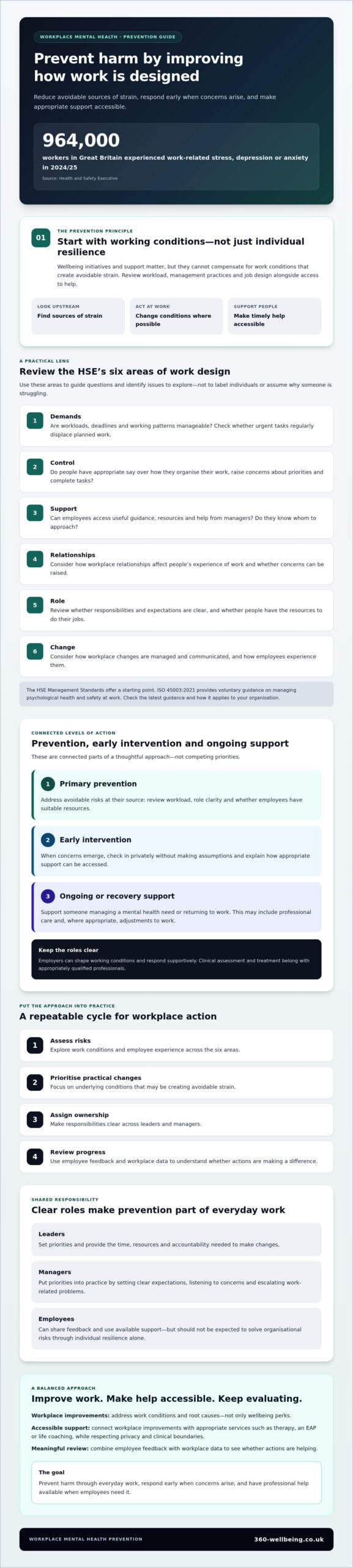
This UK guide explains how to identify and reduce psychosocial risks using the HSE’s six areas of work design: Demands, Control, Support, Relationships, Role and Change. You’ll also find practical ways to clarify leaders’ and managers’ responsibilities, make support accessible while respecting privacy and clinical boundaries, and evaluate progress through employee feedback and workplace data. The aim is to prevent harm through everyday work, with professional help available when employees need it.
Key Takeaways
- Understand how prevention, early intervention and clinical care work together to support employees at different stages.
- Use preventative mental health strategies for the workplace to address underlying work conditions, not just offer wellbeing perks.
- Follow a clear cycle to assess risks, prioritise practical changes, assign ownership and review progress.
- Choose meaningful measures, including employee feedback and workplace data, to understand whether actions are making a difference.
- Connect workplace improvements with accessible support, while keeping services such as therapy, an EAP and life coaching in their proper role.
What preventative mental health strategies for the workplace actually involve
Effective preventative mental health strategies for the workplace do more than make help available after someone is struggling. They aim to reduce avoidable sources of strain in the way work is organised, while making it easier for employees to find timely, appropriate support. This could mean reviewing workloads and role expectations, checking whether people have the resources to do their jobs, and ensuring everyone knows where to turn when they need help.
Prevention means reducing workplace conditions that can contribute to psychological harm before they escalate, while making support accessible when concerns arise. It isn’t about employers diagnosing employees or replacing clinicians. Employers can shape working conditions and respond supportively; clinical assessment and treatment belong with appropriately qualified professionals. For a broad introduction to the topic, see Mental health in the workplace.
How primary, secondary and tertiary prevention differ at work
These three levels describe connected parts of a thoughtful approach, not competing priorities:
- Primary prevention addresses avoidable risks at their source. For example, an organisation might review whether workloads are manageable, responsibilities are clear and employees have suitable resources to do their jobs.
- Early intervention means responding when concerns emerge. A manager might notice a change, check in privately without making assumptions, and explain how the employee can access appropriate support.
- Ongoing or recovery support helps someone manage a mental health need or return to work. This may involve professional care and, where appropriate, adjustments to work. It complements prevention rather than removing the need to address harmful work conditions.
Why prevention is a shared workplace responsibility
Leaders set priorities and provide the time, resources and accountability needed to make changes. Managers put those priorities into practice by setting clear expectations, listening to concerns and escalating work-related problems. Employees can share feedback and use available support, but they shouldn’t be expected to solve organisational risks through individual resilience alone.
That distinction matters. Encouraging coping skills may help someone manage pressure, but it won’t fix a persistently unmanageable workload or unclear responsibilities. A supportive workplace considers how its decisions affect people’s mental, physical and social wellbeing, then acts on what employees say about their experience.
Prevention is part of sustainable working conditions, not a one-off campaign or a task for HR alone. It brings together practical improvements to work, respectful conversations and clear routes to professional help. This gives organisations a balanced foundation: reduce avoidable pressures where possible, respond early when someone needs support, and maintain appropriate care over time.
Build workplace mental health prevention around work conditions and root causes
To identify preventable strain, look at how work is planned and experienced, not only at whether employees report feeling stressed. The HSE Management Standards offer a practical starting point, organising work-related stress risks around six areas. The HSE’s guidance on mental health explains this framework, while ISO 45003:2021 provides voluntary guidance on managing psychological health and safety at work. Check the latest guidance and how it applies to your organisation before using either as a benchmark.
Which workplace conditions should employers review?
Use the six areas to guide questions and identify issues to explore. They are not a way to label individuals or assume why someone is struggling:
- Demands: Are workloads, deadlines and working patterns manageable? Check whether urgent tasks regularly displace planned work.
- Control: Do people have appropriate say over how they organise their work? Consider whether they can raise concerns about priorities or how a task is completed.
- Support: Can employees access useful guidance, resources and help from managers? Check that people know whom to approach and what help is available.
- Relationships: Are communication and team interactions respectful, with concerns addressed? Look at how disagreements or reports of poor treatment are handled.
- Role: Do employees understand their responsibilities and know which priorities come first? Review whether handovers and changes to responsibilities are clear.
- Change: Are changes explained clearly, with space to ask questions and understand what’s expected? Consider whether employees know what is changing and where to get further information.
Look for patterns in everyday practices: repeated urgent requests may signal competing priorities, while unclear handovers can leave people unsure who is responsible. These are prompts to investigate, not proof of a specific mental health condition or the reason an individual is struggling. Financial pressure can also affect wellbeing; employers considering broader support can read this guide to financial support for employees.
How to listen to employees and identify patterns
Combine what employees tell you with suitable, aggregated information, such as absence or turnover trends. Neither source tells the whole story on its own: feedback can reveal friction that figures miss, while trends can point to areas worth exploring. Offer different ways to contribute, such as confidential surveys, facilitated discussions or a private route to raise concerns, so one format doesn’t exclude people.
Set expectations before asking sensitive questions. Explain who will see responses, whether answers are anonymous, any limits to confidentiality, and what the organisation will do with the findings. Then share themes and planned next steps without exposing individuals. This helps build trust and makes feedback useful when prioritising changes to working conditions.
For organisations reviewing their employee support offer alongside workplace risks, explore employee wellbeing support as one potential part of a wider approach, not a replacement for addressing root causes.
Why wellbeing perks alone are not a preventative workplace mental health strategy
An Employee Assistance Programme (EAP), therapy access or an awareness campaign can help employees find support, but none automatically removes the work conditions contributing to strain. If deadlines are routinely unrealistic, for example, a wellbeing app won’t resolve the workload problem. Effective preventative mental health strategies for the workplace combine action on organisational risks with clear routes to individual help.
Healthier work design reduces avoidable pressures; support services help people address personal needs and concerns. These actions serve different purposes, and employees benefit when both are available. The CIPD’s mental health factsheet offers further employer guidance on building a supportive culture and putting practical support in place.
Workplace changes versus individual wellbeing initiatives
This comparison shows what each part of an approach can contribute. The impact depends on the issue and how well the action is implemented.
| Approach | Example | What it can address |
|---|---|---|
| Workplace changes | Review workloads, staffing plans or priorities. | Organisational pressures that make work difficult to sustain. |
| Awareness and skills | Help managers practise supportive conversations. | Uncertainty about how to notice concerns and respond appropriately. |
| Early support | Make routes to an EAP or other help easy to find. | Barriers to seeking help when a concern arises. |
| Clinical care | Enable access to appropriate therapy or GP support. | Individual health concerns requiring professional input. |
A campaign can explain how to raise concerns, but it can’t substitute for reviewing unclear priorities or excessive demands. If support services are available but rarely used, check whether employees know how to access them and feel able to do so. Don’t ask staff to become more resilient while leaving preventable workplace problems untouched.
When employee support services belong in a prevention plan
Therapy, an EAP and GP access can offer important routes to professional help, but they don’t guarantee that mental health difficulties will be prevented or resolved. Make access information easy to understand, including who is eligible, how to use each service and what confidentiality means in practice. Explain any limits clearly, and leave clinical decisions to qualified professionals.
For example, 360 Wellbeing’s employee benefits platform includes mental health therapy sessions, an EAP and access to a UK-registered GP. Employers should check current service details, access conditions and eligibility before communicating benefits to staff. To explore how an employee support platform could sit alongside work-design improvements, see 360 Wellbeing’s employee support platform.
How to put a preventative mental health strategy into practice and measure progress
Turn good intentions into a repeatable cycle. Preventative mental health strategies for the workplace are more likely to stay relevant when someone is accountable, employees can see what happens next, and progress is reviewed using more than one measure. Scale the process to your organisation: a small employer may coordinate actions through regular team discussions, while a larger organisation may need clearer responsibilities across departments.
- Establish ownership. Name a senior person accountable for the strategy and agree how managers will identify workplace concerns, respond supportively and direct employees to appropriate help. Managers aren’t expected to diagnose or provide clinical care.
- Assess conditions. Bring together employee feedback and relevant workplace information to identify where pressure may be building. Be clear about what you’re assessing and how information will be handled.
- Prioritise actions. Choose changes that address the most relevant risks and can be delivered with available resources. Give each action an owner, a realistic timeframe and a way to check whether it’s been completed.
- Communicate and act. Tell employees what you heard, what will change, who is responsible and when they’ll hear more. If something can’t change immediately, explain why and what will happen in the meantime.
- Review and adapt. Check progress with employees, revisit outstanding actions and adjust the plan when work or workforce needs change.
Create an action plan employees can see and trust
Make communication part of delivery, not just an announcement at the start. Share key themes without identifying individuals, explain what can and can’t remain confidential, and offer accessible ways to raise concerns or give feedback. Where an action is delayed or not possible, say so plainly and describe any alternative steps. Visible follow-through helps employees see how sharing concerns can inform practical decisions.
Measure progress without reducing wellbeing to one metric
Set a baseline before judging change, then choose a small set of measures that reflect both action and experience. For example, review whether agreed risk-reduction actions were completed, whether employees understand how to access support, and what feedback says about workload or role clarity. Aggregated absence or turnover trends can add context, but they don’t explain individual experiences or establish cause.
Review the measures together and over a period suited to the changes being made. A rise or fall in absence, participation or productivity alone can’t prove that a particular programme caused improvement. Use the findings to ask better questions, identify gaps and decide what to adjust next.
If you’re reviewing employee support alongside organisational changes, explore 360 Wellbeing employee support as one part of a broader workplace approach.
Connect workplace prevention with timely, whole-person employee support
Improving how work is organised and helping people access support belong in the same strategy, but they do different jobs. A therapy service or GP can offer professional input for an individual; it can’t resolve a persistent workload problem or unclear responsibilities. Keep reviewing work-related risks even when employees have benefits available, so support complements prevention rather than standing in for it.
For employers considering preventative mental health strategies for the workplace, a broader support offer can help employees find routes that fit different needs. 360 Wellbeing’s platform includes mental health therapy sessions, an Employee Assistance Programme (EAP) and life coaching. It also includes 24/7 access to a UK-registered GP. Check the current eligibility and access terms for each service before explaining what employees can use.
Make support understandable, accessible and appropriately bounded
Share clear, practical information about available services without asking staff to explain or disclose personal circumstances. State who can access each benefit, how to begin, what confidentiality arrangements apply and where employees should turn for urgent help. Don’t imply that every service is suitable for every situation; clinical assessment and treatment should remain with qualified professionals.
Accessibility is more than publishing a benefits page. Check whether employees in different roles and working patterns can find the information and understand the steps involved. Offer more than one way to share the details, and invite questions privately. Before describing session limits, response times or availability, verify the specific service arrangements rather than making assumptions.
Keep prevention active after introducing employee benefits
A support offer doesn’t remove the need to revisit workplace conditions. Set a regular review point to consider whether agreed changes are happening and whether employees can use support in practice. Look across roles, locations, working patterns and different employee needs. If a route is difficult to access or a recurring pressure remains, adjust the plan rather than treating the benefit itself as the solution.
Whole-person support recognises that mental wellbeing can be affected by physical, social and practical circumstances. Employers can signpost relevant available support while continuing to address organisational risks and protect employees’ privacy. That balance helps make support a dependable part of working life, without confusing it with an employer’s role in designing healthier work.
If you’re exploring options to complement workplace improvements, explore 360 Wellbeing employee support as one possible support partner. Check current service details and eligibility to understand what may suit your organisation and employees.
Make prevention part of everyday working life
Strong preventative mental health strategies for the workplace begin with the conditions people work in. Review demands, roles, relationships and organisational change, then prioritise practical improvements employees can see. Make support easy to understand and access, but treat it as a complement to healthier work design, not a substitute for addressing preventable pressures.
Keep the approach active: assign ownership, listen to employee feedback and review a balanced set of indicators over time. This helps your organisation learn what’s working and where support or working conditions need further attention, without reducing wellbeing to one measure.
360 Wellbeing’s employee benefits platform includes mental health therapy sessions, an Employee Assistance Programme and life coaching. Employees can also access a UK-registered GP 24/7. Check current eligibility and service access terms before sharing these details with your workforce.
Explore employee wellbeing support with 360 Wellbeing as one option within a wider prevention plan. Small, considered changes can help build a workplace where people feel supported and able to do their best work.
Frequently Asked Questions
What are preventative mental health strategies for the workplace?
Preventative mental health strategies for the workplace are planned actions that reduce avoidable work-related risks, strengthen supportive conditions and make timely help accessible. They include reviewing how work is organised and building a respectful culture, not just offering individual wellbeing activities. Prevention isn’t diagnosis or treatment: employers focus on working conditions, while qualified professionals provide clinical care. Employee support services can complement organisational action, but shouldn’t replace efforts to address preventable workplace pressures.
How can employers prevent mental health problems at work?
Employers can reduce avoidable risks by reviewing workload, role clarity, employee control, support, workplace relationships and how change is communicated. Listen to employees, assess which concerns need attention first, assign someone to each action and explain progress clearly. Make appropriate support routes easy to find, then revisit the plan as working conditions change. These steps can help create a healthier environment, but no approach can prevent every mental health condition or replace professional care.
Are employee wellbeing benefits enough to prevent workplace mental health problems?
No, benefits alone can’t address every cause of workplace strain. An Employee Assistance Programme or access to counselling may help an employee seek support, but it won’t resolve excessive demands, unclear roles or poor communication by itself. Combine accessible services with practical changes to work conditions. The right mix depends on the risks your organisation identifies and employees’ needs, so review both the workplace and the support offer rather than relying on one intervention.
What is the difference between prevention and early intervention at work?
Prevention aims to reduce risks before harm develops, for example by improving work design, clarifying responsibilities or addressing avoidable organisational pressures. Early intervention begins when concerns first emerge: a manager listens, responds appropriately and helps the employee find suitable support. Both have a place in a thoughtful workplace approach. Some employees may also need clinical treatment or ongoing recovery support, which complements prevention and early action rather than replacing them.
How should a workplace assess psychosocial risks?
Review work demands, employee control, support, relationships, role clarity and organisational change, using staff input alongside suitable workplace information. The HSE Management Standards can provide a reference framework, but check current guidance and its applicability to your organisation. Explain how feedback will be used, who can access sensitive information and any limits to anonymity. Then prioritise practical actions and communicate what will happen, rather than collecting information without follow-up.
How can employers measure whether a mental health strategy is working?
Choose relevant measures before putting actions in place, establish a baseline and review results over time. Combine employee feedback with process indicators, such as progress on agreed workplace changes, and aggregated workforce trends. Absence or retention figures alone can’t explain individual experience or prove what caused a change. Protect privacy, interpret measures in context and use what you learn to adapt the strategy when staff feedback or workplace evidence points to a gap.
Can small businesses create a preventative mental health strategy?
Yes, a small business can begin with a proportionate review of how work is organised and direct conversations with employees. Agree who will take responsibility, identify a few practical changes and make support information easy to find. Share what you plan to do and check back on progress regularly. You don’t need a large formal programme to start improving working conditions; actions can be scaled to the size and needs of the workforce.