What if the best health and wellness for tradespeople and contractors starts by fitting around the job, rather than expecting workers to fit into an office routine? Physical work can involve lifting, awkward positions, changing sites and long days. Unpredictable schedules can also make appointments, regular meals and recovery harder to protect. For self-employed workers, income worries or working alone can add pressure that’s easy to carry quietly.
It’s understandable if looking after your health feels like one more job to fit in. But aches, fatigue, stress and financial pressure don’t have to be treated as inevitable parts of working in the trades. This guide explores realistic ways to care for your body and mind around demanding or unpredictable work, and how to find support that fits your circumstances.
You’ll learn how to build practical wellbeing habits, recognise when extra support may help, and understand the role employers and accessible services can play. The focus is on physical, mental and financial wellbeing, with ideas for on and off the job.
Key Takeaways
- Health and wellness for tradespeople and contractors includes physical, mental, social and financial wellbeing, shaped by the realities of each role.
- Consider how demanding tasks, travel and changing schedules affect your energy, stress and recovery, without assuming every worker faces the same challenges.
- Compare practical self-care, professional support, peer connection and workplace benefits to find options that fit your circumstances.
- Build flexible habits around preparation, breaks where practical, hydration, recovery and staying connected with others.
- Employers and small teams can make support more useful by listening to workers and addressing barriers such as time, access, privacy and awareness.
What does health and wellness mean for tradespeople and contractors?
Health and wellness for tradespeople and contractors is the combined physical, mental, social and financial wellbeing that helps people feel and function well at work and beyond it. It’s more than avoiding injury or illness. It also includes having the energy to recover, feeling connected to others and managing pressures that affect life and work.
Trade work can mean varied routines and settings. A day might involve physical tasks, travel between sites, changing schedules or working independently. These conditions can shape how easy it is to rest, keep appointments, stay connected or manage financial uncertainty. Experiences differ, so useful support should reflect a person’s role and circumstances rather than assume all workers face the same pressures.
This whole-person view complements the broader field of Occupational safety and health, which considers the safety, health and welfare of people at work. Neither wellbeing nor safe working should be treated as a luxury, and injury or poor health shouldn’t be accepted as inevitable parts of the job.
How is wellbeing different from workplace health and safety?
Workplace health and safety focuses on identifying and controlling hazards connected with work. Personal wellbeing support can help someone manage physical or emotional health, financial strain or social isolation. The two overlap: safer working practices can support wellbeing, while workers who feel supported may find it easier to raise concerns. The Health and Safety Executive (HSE) provides guidance on topics including manual handling, working at height and work-related stress.
Who is included in trade and contractor wellbeing?
Wellbeing matters to employees, subcontractors, sole traders and small business owners, though their needs and access to support may differ. An employee might have workplace benefits, while a self-employed tradesperson may need to arrange support around their own schedule and resources. Some contractors move between sites; others spend long periods working alone. Recognising these differences helps individuals and employers make support more practical and accessible.
How can trade work affect physical and mental wellbeing?
Trade work doesn’t affect everyone in the same way. The physical demands of one job may differ from another, and a worker’s routine can change with the site, project or season. Lifting, repetitive movements, prolonged standing, travel and variable hours may all influence energy and recovery. When rest is squeezed between shifts or jobs, tiredness can build and make it harder to concentrate or feel well day to day.
These pressures can interact. A long journey followed by physically demanding work may leave less time to unwind, while deadlines or uncertain workloads can add stress. Contractors who work alone may have fewer chances to talk through concerns with colleagues. Job uncertainty and money worries can also affect wellbeing, though they aren’t part of everyone’s experience. This mix of physical demands, changing work patterns and personal pressures is why accessible support matters. A one-size-fits-all approach to health and wellness for tradespeople and contractors may miss what an individual actually needs.
What physical pressures can tradespeople experience?
Depending on the task, workers may lift or carry materials, repeat the same movement, stand for long periods or work outdoors in changing conditions. These are examples of possible demands, not signs that an injury or illness is inevitable. Follow relevant task-specific safety guidance, including Health and Safety Executive (HSE) information on topics such as manual handling or working at height. If pain, discomfort or another health concern persists, a GP or other appropriate healthcare professional can offer individual advice.
How can working patterns affect mental wellbeing?
Irregular hours, travel between sites, tight deadlines and working alone may make it harder to maintain routines or stay connected. For some people, ongoing pressure can coincide with changes in mood, sleep or concentration. These experiences have different possible causes and aren’t a diagnosis. UK workers can refer to HSE guidance on work-related stress for information on recognising and addressing workplace pressures.
If you’re struggling, consider speaking with a GP or mental health professional. An Employee Assistance Programme or other workplace support may also help. For employers and small businesses looking to offer connected wellbeing support, 360 Wellbeing’s support for physical and mental health can form part of a broader approach.
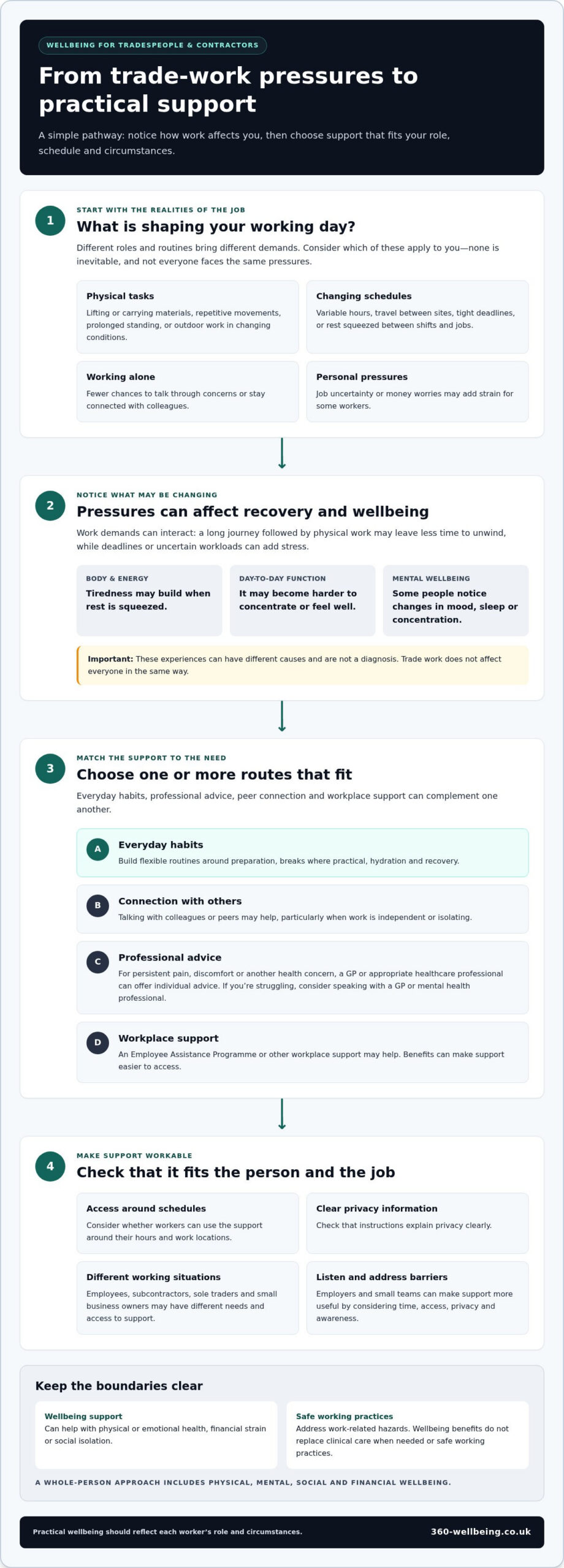
What wellbeing support suits tradespeople, contractors and small teams?
There’s no single route to better wellbeing. Everyday habits and talking with colleagues may help, while a persistent health concern calls for professional advice. Employer-provided benefits can make support easier to access. When comparing options, consider what they cover, how workers can access them around their schedules, and whether instructions explain privacy clearly. The CDC’s report on the mental health of construction workers also highlights the value of considering work-related stress when planning support.
These options can complement one another. Wellbeing benefits don’t replace clinical care when it’s needed or safe working practices that address hazards.
| Support type | Purpose | Access route and practical considerations |
|---|---|---|
| Everyday habits | Help maintain routines for rest, hydration, movement and connection. | Adapt them to the task and workday. Helpful habits can’t resolve every health concern. |
| NHS and other professional care | Assess symptoms and provide appropriate health advice or treatment. | Contact a GP or relevant NHS service. For urgent concerns, follow NHS guidance: use NHS 111 for urgent help that isn’t life-threatening, or call 999 or go to A&E for an emergency. |
| Peer support | Offer connection and a chance to talk with people who understand the work. | Informal check-ins can be useful, but aren’t a substitute for professional care when someone needs it. |
| Workplace benefits | Provide routes to services such as GP access, physiotherapy, mental health support or financial advice. | Clear, private instructions help workers understand what’s available and how to use it. |
What can workers do independently, and when might they need support?
Small steps, such as planning food and water, taking suitable breaks and checking in with someone you trust, may support day-to-day wellbeing. But don’t rely on self-care alone if symptoms persist, worsen or worry you. Seek appropriate clinical advice, and use NHS 111 or emergency services according to the urgency of the concern.
What can employers provide to a small or mobile workforce?
For small teams or people moving between sites, digital and private support can be easier to access than fixed appointments. Employers can explain what’s available, how to access it and where confidentiality applies, using straightforward information workers can find again. Contractors may have different working arrangements, so make eligibility and access routes clear. A joined-up approach to health and wellness for tradespeople and contractors can bring practical, mental and financial support into view without assuming one solution will suit everyone.
How can tradespeople build practical wellbeing habits around busy workdays?
A routine doesn’t need to be rigid to help. Build small actions around the work you’re actually doing, then adjust when the site, schedule or your needs change. These habits can support wellbeing, but they don’t replace clinical advice for health concerns or workplace risk controls that make tasks safer.
- 1. Prepare for the day. Before setting off, consider the tasks and travel ahead. Pack food and water where practical, and think about when you might be able to pause and rest.
- 2. Take suitable breaks. Use safe, practical opportunities to pause during the day. A short break, a drink of water or a change of position may help you reset, depending on the task and your individual capability.
- 3. Make room for recovery. After work, allow time to wind down and protect sleep where you can. If fatigue is affecting your wellbeing or making work harder to manage, take it seriously and seek advice rather than simply pushing through.
- 4. Stay connected. A brief conversation with a colleague, friend or family member can help you feel less cut off, especially if you work alone or move between sites.
- 5. Check in with yourself. Ask: How’s my energy? Has my mood or stress changed? Is anything making it harder to concentrate or recover? Noticing a pattern isn’t a diagnosis, but it can help you decide whether to make a change or seek support.
Which small habits can fit around a working day?
Link habits to moments that already exist in your day, such as filling a water bottle before leaving, planning food around the expected shift, or taking a suitable rest when the work allows. Gentle movement or recovery can be adapted to the job and your own abilities. There’s no need to force a routine that doesn’t fit. Consistency should support your wellbeing, not add another source of pressure.
How can someone take a first step when struggling?
Talk with someone you trust, contact your GP, or speak with another relevant professional if you’re finding things difficult. Before an appointment, jot down what’s concerning you, when it began and any questions you’d like to ask. If a health concern is urgent, use NHS 111 for urgent advice; call 999 or go to A&E for a life-threatening emergency.
Practical habits are one part of a wider approach. Explore accessible wellbeing support, including virtual GP, mental health and physiotherapy support that can complement everyday routines.
How can employers and contractors create a more supportive wellbeing plan?
A useful wellbeing plan starts with the people doing the work. Employees, subcontractors and sole traders may have different schedules, work locations and access to support, so begin by asking what would make help easier to use. Short conversations or anonymous feedback can reveal barriers such as limited time, uncertainty about privacy, difficulty finding information or not knowing what’s available.
Then make the support simple to understand and reach. Share clear instructions where workers can access them, whether they’re on site, travelling or working independently. Explain eligibility, access routes and confidentiality using accurate information about each benefit. Review feedback over time, including whether workers know how to get help. Benefits can complement wellbeing, but they don’t replace safe work practices or action to address workplace risks.
What should an inclusive wellbeing plan consider?
Consider how different workers will find and use the support, not just whether it exists. Information should be easy to revisit, and the route to help should be clear for people working remotely, on site or alone. Make privacy arrangements understandable, invite feedback without pressure and review participation carefully. Low awareness may point to a communication barrier, rather than a lack of need.
How can wider support help with connected wellbeing needs?
Support is more useful when it recognises that physical, mental and financial pressures can overlap. 360 Wellbeing is a UK employee benefits platform for small businesses, sole traders and larger organisations. It includes 24/7 access to a UK-registered GP and mental health therapy sessions, alongside physiotherapy, life coaching, an Employee Assistance Programme, and financial and legal support, including debt advice and complimentary will writing. Its 360 Rewards discount marketplace offers thousands of offers.
For example, someone dealing with an ongoing physical concern may value physiotherapy, while a worker under emotional strain may benefit from mental health support. Financial Support & Debt Advice can also be relevant when money worries add to work pressure. Matching support to the concern can make it easier to identify a useful first step.
A considered plan brings these routes together without assuming every worker needs the same thing. Explore 360 Wellbeing’s platform to see how support for physical, mental and financial wellbeing can fit into a broader approach to health and wellness for tradespeople and contractors.
Make wellbeing part of the working day
Looking after your health doesn’t have to mean following a perfect routine. Small, adaptable habits can support energy and recovery, while noticing changes in mood or stress can help you recognise when it’s time to seek advice. Safe work practices remain essential, and professional support matters when health concerns persist or feel worrying.
Health and wellness for tradespeople and contractors also means looking beyond physical health. Social connection, mental wellbeing and financial pressures can all affect how someone feels at work and at home. Employers and contractors can help by listening to workers, making support easy to understand and considering different working arrangements.
360 Wellbeing brings support together through 24/7 access to a UK-registered GP, mental health therapy sessions and life coaching, alongside wider options spanning physical, mental and financial wellbeing. If you’re looking for accessible support for yourself or your workforce, explore 360 Wellbeing support for healthier working lives.
Every step counts. A more supportive approach can begin with one practical change and grow around the needs of the people doing the work.
Frequently Asked Questions
What are the most common wellbeing challenges for tradespeople?
Possible challenges include physical demands, fatigue, changing schedules, work pressure and isolation, but experiences vary from person to person. These aren’t inevitable outcomes of working in the trades. Consider how your own work and circumstances affect your wellbeing, including recovery and time for life outside work. If a health concern persists, worsens or worries you, speak with a GP or another appropriate health professional for advice.
How can contractors look after their mental health at work?
Stay in contact with people you trust, build in realistic breaks where work allows, and notice changes in your mood, stress or sleep. A brief check-in with a colleague or friend can help you feel connected, particularly if you work alone. These steps may support day-to-day wellbeing, but self-care isn’t a substitute for professional help. If difficulties persist or feel hard to manage, speak with a GP or appropriate support service.
Can self-employed tradespeople access wellbeing support?
Yes. Options may include NHS care, support from relevant professional organisations, and benefits available through a business or membership arrangement. The support you can access depends on your circumstances and arrangements, so don’t assume every self-employed worker has the same benefits. For a health concern, use suitable professional care. You can also review any benefits you already have access to and how to use them.
How can employers support the wellbeing of contractors?
Make support easy to find and understand, listen to workers’ feedback, and consider options that fit mobile teams and changing schedules. Explain how to access available resources and what confidentiality arrangements apply. Wellbeing benefits can sit alongside appropriate processes for identifying and managing workplace risks, but they don’t replace them. Contractors may have different working and employment arrangements, so explain clearly who can access each type of support.
What is the difference between wellbeing support and workplace health and safety?
Workplace health and safety focuses on identifying and managing work-related risks. Wellbeing support can help with broader physical, mental and social needs, such as getting health advice or accessing emotional support. The two can complement each other, but they aren’t interchangeable: benefits don’t remove hazards or replace safe working practices. For guidance on specific workplace topics and responsibilities, refer to current Health and Safety Executive (HSE) information.
When should a tradesperson speak to a GP about a health concern?
Speak to a GP if symptoms persist, worsen, feel worrying or interfere with daily life or work. You don’t need to diagnose the problem yourself before asking for advice. For urgent health concerns in the UK, NHS 111 can direct you to appropriate care when it isn’t a life-threatening emergency. If someone is in immediate danger or has a life-threatening emergency, call 999 or go to A&E.