The more familiar benefit isn’t always the one employees need most. When weighing a health cash plan vs comprehensive wellbeing platform, the key difference is whether you’re helping staff claim money back for eligible healthcare costs or giving them access to a wider range of support.
Cost matters, but so does how a benefit works in practice. A reimbursement plan has rules about eligible expenses and claims. A platform has services employees need to find and access. The best fit depends on your workforce’s priorities, your budget and the kinds of help people are most likely to seek.
This guide compares reimbursement with access-led support, explains what to consider when assessing value and offers practical ways to understand likely patterns of use. You’ll also see when a broader wellbeing platform may suit your business, bringing physical, mental, financial and legal support together. With a clear view of the trade-offs, you can make a decision that’s practical for your organisation and easy to explain to employees and stakeholders.
Key Takeaways
- A health cash plan generally reimburses eligible healthcare costs under its terms, while a wellbeing platform can provide access to a wider range of support.
- Compare what employees can access, the steps they need to take and any plan rules that could affect the benefit’s value.
- Use workforce feedback and a review of existing benefits to identify priorities, without collecting sensitive personal health information.
- Clear communication and simple signposting help employees understand how to access support. Managers can guide them without trying to diagnose their needs.
- The health cash plan vs comprehensive wellbeing platform decision comes down to your team’s needs. 360 Wellbeing brings together GP access, mental health support, physiotherapy and an EAP.
Health Cash Plan vs Wellbeing Platform: What Is the Difference?
A health cash plan is designed to reimburse employees for eligible healthcare costs, subject to the plan’s rules. A wellbeing platform brings together access to defined services and support, which can span physical, mental, financial or other areas of wellbeing. In short, the health cash plan vs comprehensive wellbeing platform choice is usually about claiming for eligible spending versus accessing a broader range of support.
That distinction matters for employers. A cash plan can help with routine costs employees pay themselves, while a platform can connect them with services through its access process. Neither model should automatically be treated as a replacement for private medical insurance (PMI). A health cash plan is not designed to cover major private treatment, and a wellbeing platform is not, by definition, an insurance policy.
How does a health cash plan typically work?
An employee pays an eligible expense, then submits a claim for reimbursement under the plan’s process. Routine dental appointments, eye tests or physiotherapy are examples of costs that some plans may cover, but eligibility and reimbursement depend on the policy. Annual or per-treatment limits, exclusions and claim conditions may apply. The Health cash plan overview explains the general model. For an employer decision, read the relevant policy wording to see which expenses qualify and how claims are assessed.
What makes a wellbeing platform comprehensive?
Look at the breadth of support employees can access rather than relying on the word “comprehensive”. A platform may bring together services such as GP access, mental health support, physiotherapy and an Employee Assistance Programme (EAP), alongside other areas of support. 360 Wellbeing includes access to a UK-registered GP, mental health support, physiotherapy and an EAP.
These services offer routes to support rather than reimbursement for a bill an employee has already paid. Access rules still matter: services may have their own booking steps, eligibility criteria or limits, and platform features vary. Employers should understand what employees can use, how they reach it and whether the services match identified workforce needs.
There can be overlap. Physiotherapy, for instance, might be an eligible expense under a cash plan or a service employees can access through a platform, but the experience differs. With reimbursement, the person generally pays first and claims according to the plan rules. With direct access, they use the service through the platform’s stated process. The right model depends on the support your workforce needs and how it is delivered.
Some businesses may choose one approach; others may combine benefits to address different needs. Compare the mechanism, support areas and access conditions rather than assuming one option covers everything the other does.
Compare What Employees Can Access, Claim and Use
A benefit’s name tells you less than the experience it creates for employees. Compare what people receive, what steps they take and what rules shape access. A cash plan centres on claims for eligible costs; a wellbeing platform can provide routes to services or practical support. Neither automatically leads to better health outcomes or higher uptake. Those depend on workforce needs, accessibility and how clearly the benefit is explained.
| Comparison point | Health cash plan | Wellbeing platform |
|---|---|---|
| Benefit mechanism | Reimbursement for eligible expenses, subject to policy rules. | Access to defined services or support, depending on the platform. |
| Support type | Often focused on specified healthcare costs. | May bring together physical, mental, practical or lifestyle support. |
| Employee action | Usually pay for an eligible expense, then submit a claim and any required evidence. | Find the relevant service and follow its access or booking process. |
| Employer consideration | Review eligible categories, limits, exclusions and claim conditions. | Review service range, access rules and how clearly employees can find support. |
What does a cash plan help employees pay towards?
A cash plan may reimburse some costs in categories such as dental care, eye tests or physiotherapy, but these are examples, not a promise of cover. An expense must meet the policy’s eligibility and claim conditions. Limits can affect how much an employee receives, so reimbursement may cover only part of a bill or may not apply once an allowance has been used. That differs from accessing a service through a platform, where the employee follows the service’s access process rather than claiming back an expense.
What support can a wellbeing platform bring together?
Depending on its design, a platform may connect employees with physical health services, mental health support, an EAP, coaching, financial guidance or lifestyle resources. Different routes can suit different circumstances: one employee may seek help with a physical concern, while another may value emotional or practical support. A UK government example of a digital wellbeing platform focuses on mental health, illustrating how a platform can centre on a particular support area. Broader platforms may include several areas, but services and access conditions vary.
For employers, the useful comparison is not simply how many benefits appear on a list. Consider whether staff can understand what’s available, how to access it and whether the support matches identified needs. Clear information can make either model easier to use, though it can’t guarantee uptake. To explore an access-led approach, view a wellbeing platform alongside your other benefit options.
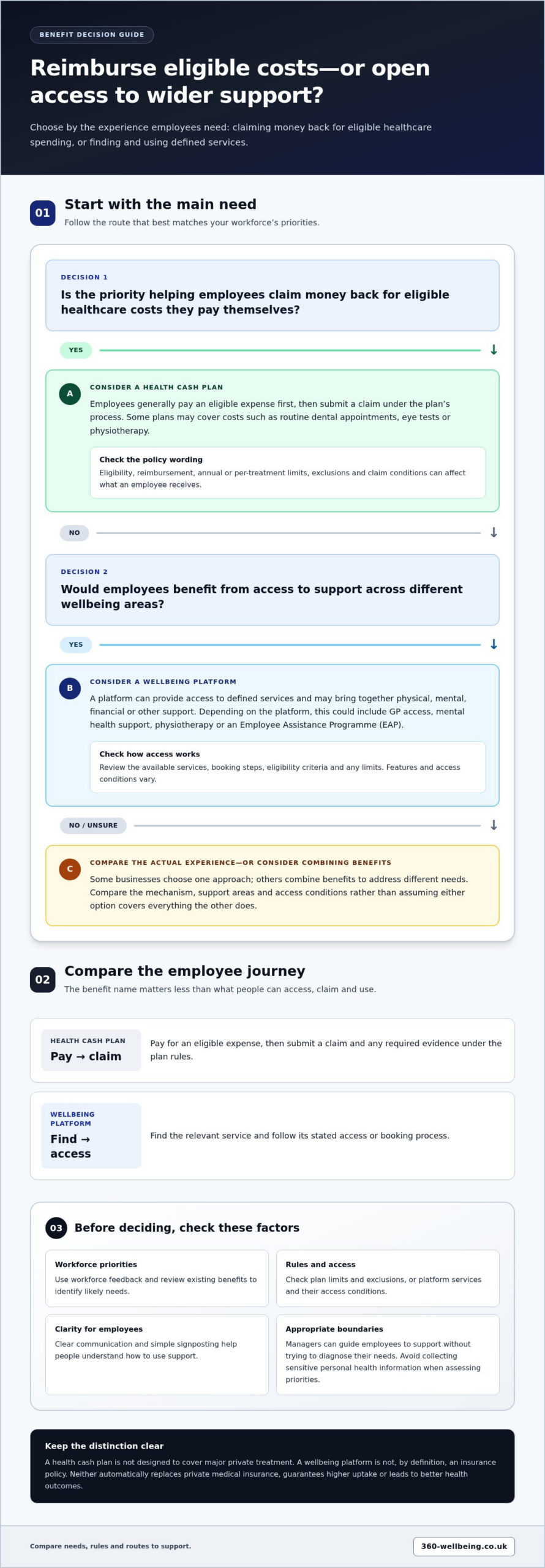
How to Choose Between a Health Cash Plan and a Wellbeing Platform
Start with the support your employees need, not the name or format of a benefit. The health cash plan vs comprehensive wellbeing platform decision becomes clearer when you compare the same practical factors for each option: who can use it, how they get support, what steps they must take and what your organisation needs to manage.
- Step 1: Identify workforce needs. Consider your organisation’s size, working patterns and the different circumstances employees may have. Anonymised feedback can show whether staff value help towards eligible healthcare expenses or access to a wider range of support. Ask about priorities and barriers to using benefits, not personal diagnoses or sensitive health details.
- Step 2: Review existing benefits. Map what’s already available and how employees use it. This can highlight gaps, such as a reimbursement benefit with no direct support route, or show where a proposed option may duplicate an existing service. Review the full benefits picture before deciding what to add.
- Step 3: Compare access consistently. For each option, record eligibility, access routes, employee steps and service boundaries. A cash plan may require an employee to pay an eligible expense, submit a claim and provide required evidence. A platform may involve finding a service and using its booking or access process. Note any limits or exclusions that could affect use.
- Step 4: Assess overall fit. Weigh relevance, accessibility, administration and cost together. Consider whether staff can understand how to use the benefit, whether support suits different working patterns and how much time your team will need to explain or administer it. Cost matters, but it won’t tell you whether the benefit addresses a genuine workforce need.
Keep the comparison grounded in employee experience. For example, a reimbursement process may suit someone able to pay upfront and submit a claim, but be less practical for an employee looking for direct guidance. Equally, a platform’s broad range of services may not be a good fit if access steps are unclear or its support areas don’t match your priorities. Neither model guarantees uptake or better outcomes by itself.
Before making a decision, summarise your findings in a comparison sheet. Include the needs each option addresses, who is eligible, how employees access or claim support, relevant limits and exclusions, and the internal work involved. This makes trade-offs easier to explain to decision-makers and helps you identify what employees will need to know at launch.
If broader access to employee support is a priority, explore employee wellbeing support from 360 Wellbeing as part of your assessment.
Put the Benefit into Practice and Measure Whether It Helps
A well-chosen benefit still needs a thoughtful rollout. Employees should understand its purpose, how to access it and where to find the rules. This matters when comparing a health cash plan with a platform: one may involve submitting eligible expense claims, while the other connects employees with services through a different access route. Clear guidance helps people make an informed choice about using the support available.
Explain the benefit clearly to employees
Use plain language to explain the benefit’s purpose and the steps for using it. For a cash plan, outline how employees can check whether an expense is eligible, what the claims process involves and where to find limits or exclusions. For a platform, show how to locate services and understand access or eligibility conditions. Avoid implying that every treatment or service is covered.
Share this information through channels employees already use, such as an intranet, staff newsletter, onboarding materials or team briefings. A short guide or FAQ can answer common questions, while consistent signposting helps employees find the information later. Make clear that support is available for employees to choose whether to use. Avoid language that makes participation feel compulsory.
Give managers a clear signposting role
Managers can help employees find benefit information, but they shouldn’t be expected to diagnose a concern or decide what support someone needs. Give them simple guidance on where to direct employees and how to respond supportively if someone raises a wellbeing issue. The aim is to make the route to support clearer while respecting each employee’s choice and privacy.
Evaluate relevance without overclaiming impact
Set a review point after rollout and consider several measures together. Depending on the benefit and the information available, you might review:
- Awareness: Do employees know the benefit exists and understand what it offers?
- Engagement: Are employees using the claims process or accessing available services?
- Accessibility: Are staff unclear about eligibility, finding the right support or completing the necessary steps?
- Feedback: What do employees say would make the benefit more relevant or easier to use?
Use aggregated engagement information and anonymised feedback wherever possible. Don’t collect personal health details simply to assess whether the benefit is working. Participation alone doesn’t explain why employees use or avoid a service, so consider feedback alongside engagement patterns. Low use could reflect limited awareness or access barriers rather than a lack of need.
Finally, compare what you learn with the original reason for choosing the benefit. If the aim was to help with eligible healthcare spending, review whether the claims-based design remains relevant. If the need was broader support, consider whether employees can find and access the right services. Changes in absence, productivity or retention may have many influences, so don’t treat a change in those measures as proof that a benefit caused it.
For an access-led approach that brings employee support together, explore 360 Wellbeing’s employee support platform.
When 360 Wellbeing Can Be the Better Fit for Your Team
A health cash plan may suit an employer whose main aim is to help employees claim towards eligible healthcare expenses. If your priorities include giving staff access to support across several areas of wellbeing, an access-led platform may be a closer fit. 360 Wellbeing brings employee support services together, so people can explore different routes depending on their circumstances.
The platform includes 24/7 access to a UK-registered GP, mental health support, physiotherapy and an Employee Assistance Programme (EAP). It also includes life coaching, financial support and debt advice, legal support, complimentary will writing and 360 Rewards. These are distinct services within a broader employee benefits platform, not a promise that every employee will need or use each one.
Which teams may value support across several wellbeing areas?
This approach may suit employers whose teams have varied support needs and who want to bring more than reimbursement into their benefits mix. A small business or sole trader may be looking for a practical way to offer several support routes, while a larger organisation may value having physical, mental, financial and legal wellbeing represented in one platform. Priorities differ by workforce, so consider how the available support aligns with the needs you’ve identified.
A broader platform isn’t automatically the right replacement for every existing benefit. A cash plan may remain relevant if reimbursement for eligible costs is a clear priority. Some employers may choose different types of support to address separate needs. The decision is about the role each benefit plays, how employees access it and whether it fills a genuine gap.
It’s also important to be clear about what the platform is. 360 Wellbeing is an employee wellbeing platform, not private medical insurance. It provides access to defined support services. It shouldn’t be presented as cover for private treatment for serious conditions or as a substitute for a health cash plan’s reimbursement function.
What is a practical next step for employers?
Bring your comparison back to the central distinction: a health cash plan generally reimburses eligible expenses within its policy rules, while a wellbeing platform can connect employees with a broader range of services. Revisit workforce feedback, existing benefits and access considerations, then decide which model best addresses the gaps you found. That gives you a clear rationale to share with employees and business stakeholders.
If access to support across several areas is relevant to your organisation, discover 360 Wellbeing for your organisation and see how its platform brings employee support together.
Make Your Next Benefits Decision Count
Turn your comparison into a decision employees can understand and use. Bring together the priorities you heard, the gaps in existing support and the practical routes staff would take to access a benefit. This gives stakeholders a clear rationale and helps you communicate not just what is offered, but why it fits your workforce.
As you weigh a health cash plan vs comprehensive wellbeing platform, consider whether your aim is reimbursement for eligible costs or a connected range of support options. 360 Wellbeing offers 24/7 access to a UK-registered GP, alongside mental health support, physiotherapy, an EAP and life coaching. Its wider support includes financial and legal assistance, complimentary will writing and 360 Rewards.
A benefits decision doesn’t need to solve every need at once. It should give your people a relevant, approachable place to start and provide a basis for reviewing what works over time. Keep access information easy to revisit as employees’ needs and circumstances change. Explore 360 Wellbeing for your organisation and take a confident next step towards a more supportive workplace.
Frequently Asked Questions
Is a health cash plan the same as private medical insurance?
No. A health cash plan and private medical insurance are separate types of benefit with different purposes and policy conditions. A cash plan generally reimburses eligible expenses under its rules; PMI has its own cover and terms. For clear employee communication, name the benefit accurately and explain what it does. Cash plans and wellbeing platforms shouldn’t be presented as interchangeable with PMI.
What does a health cash plan usually cover?
It depends on the provider and the specific plan. A policy may allow claims across named healthcare categories, but eligibility rules, exclusions and claim limits shape what an employee can receive. For example, don’t assume an eye test or dental appointment qualifies just because it’s a routine expense. Check the policy wording and explain how employees can verify eligibility before paying or submitting a claim.
Can a wellbeing platform replace a health cash plan?
It can if the platform’s support matches the need the employer wants to address, but the two benefits work differently. A cash plan is built around claims for eligible expenses; a platform may offer routes to services instead. In the health cash plan vs comprehensive wellbeing platform decision, consider whether staff need help with costs, direct access to support or both before changing existing benefits.
Is a comprehensive wellbeing platform suitable for a small business?
It can suit a small business that wants to make several types of employee support available through one platform. The right choice depends on the team’s priorities, existing benefits and how straightforward the access process is for staff. A smaller workforce may have different needs from a larger organisation, so assess the actual services and employee experience rather than choosing based on the number of features alone.
How should employers compare health cash plans and wellbeing platforms?
Use the same criteria for each option: who is eligible, how employees access support, what information or action is required, and what exclusions or boundaries apply. Map one employee scenario, such as needing help with a routine cost, through each benefit’s process. Combine that view with anonymised staff feedback and a review of current benefits before deciding.
Can employers offer a health cash plan and a wellbeing platform together?
Yes, employers can consider both if each addresses a distinct need. Before combining them, map where the benefits overlap and where they offer different support. For example, explain separately which expenses may be claimed under the cash plan and how employees access platform services. Clear descriptions can reduce confusion, while reviewing terms and administration helps establish whether the combination is practical for your organisation.
Are employer-provided health benefits taxable in the UK?
Tax treatment depends on the type of benefit and how it’s arranged, so don’t assume that every cash plan or wellbeing platform has the same status. Before introducing a benefit or describing its tax position to employees, check current HMRC guidance and seek appropriate professional advice. Keep tax considerations separate from the benefit comparison: eligibility, access and service design are different questions from how a benefit is treated for tax.