The best Employee Assistance Programme (EAP) for a small company isn’t necessarily the one with the longest feature list. It’s the one employees can understand, access and trust. If you’re working out how to choose an EAP provider for a small company, focus on what support is included, how staff will reach it and how much effort it takes to manage.
You don’t need a large HR team to make a considered choice. Compare practical details such as access routes, support options, privacy information and the effort required to introduce the benefit. Then plan how you’ll keep the information visible. Clear communication and regular reviews make it easier for employees to understand what’s available and where to start.
This guide covers what to look for in service information, how to compare providers and how to introduce an EAP with care. It also explains how an EAP can sit within broader wellbeing provision, bringing mental health support together with physical and financial wellbeing options for a small team.
Key Takeaways
- Learn how to choose an EAP provider for a small company by comparing access, support, privacy information, usability and administration.
- Use clear service documentation to understand what employees can access and how the benefit may fit their needs.
- Compare standalone EAP provision with broader wellbeing support to decide which approach best suits your team.
- Follow a four-step evaluation and rollout plan, using a scorecard to record evidence and make your review more manageable.
- Explore how EAP support can sit alongside mental health support, life coaching, virtual GP access, and financial and legal support.
Why choosing the right EAP provider matters for a small company
In a small company, the person arranging employee support may also handle recruitment, payroll or day-to-day operations. Close working relationships can make asking for help feel personal, too. Employees need to know where to turn without feeling they must first explain a private concern to their manager. A clear route to support can make that first step more straightforward.
An Employee Assistance Programme (EAP) is a workplace benefit that connects employees with support for personal or work-related challenges. The Employee Assistance Program (EAP) overview describes the broad purpose of these programmes, but the services available differ between providers. An EAP is not a substitute for emergency help, a medical assessment or ongoing clinical care when those are needed.
A well-matched EAP gives employees a clear route to support for life’s challenges. That’s a more useful starting point than choosing by the length of a service list. Access, privacy information and relevance all affect whether a benefit feels usable in practice.
What makes EAP selection different for a small company?
In a small business, an owner or manager may handle people processes alongside their main role, without a dedicated HR lead. A complicated referral process can add work when an employee needs a clear next step. Look for service information that explains how staff can access support, what the employer needs to do and how employees can understand the benefit.
A straightforward access route should also feel private and easy to follow. For example, an employee dealing with stress at work or a personal difficulty should be able to find out how to begin without navigating several internal contacts. Clear instructions help managers introduce the benefit while keeping an employee’s decision to seek support separate from routine workplace conversations.
What should a small-company EAP help employees access?
Employees may want help with concerns affecting their wellbeing, whether those concerns arise at work or outside it. An EAP connects them with the support described by the programme; it doesn’t diagnose them or promise a particular personal or business outcome. A service list is useful only if employees can understand what each option is for and how to access it.
Read the service information for details about the support available, access routes and eligibility. Check that it distinguishes the EAP from emergency services and explains what happens when someone needs support beyond the programme’s scope. This helps employees understand what to expect and allows a small employer to describe the benefit accurately, without overstating what it can do.
That clarity matters when considering how to choose an EAP provider for a small company. The right fit should make support easier to find, not leave staff guessing about what’s included or where to start. Next, compare the practical details behind each provider’s service descriptions, including access, support options and the information employees and employers receive.
How to assess EAP providers: five criteria small employers can compare
A useful comparison goes beyond the headline list of services. For each provider, record what its written information says, what remains unclear and how the details fit your team. Comparing the same points across each option helps you judge the evidence instead of relying on broad claims or assumptions.
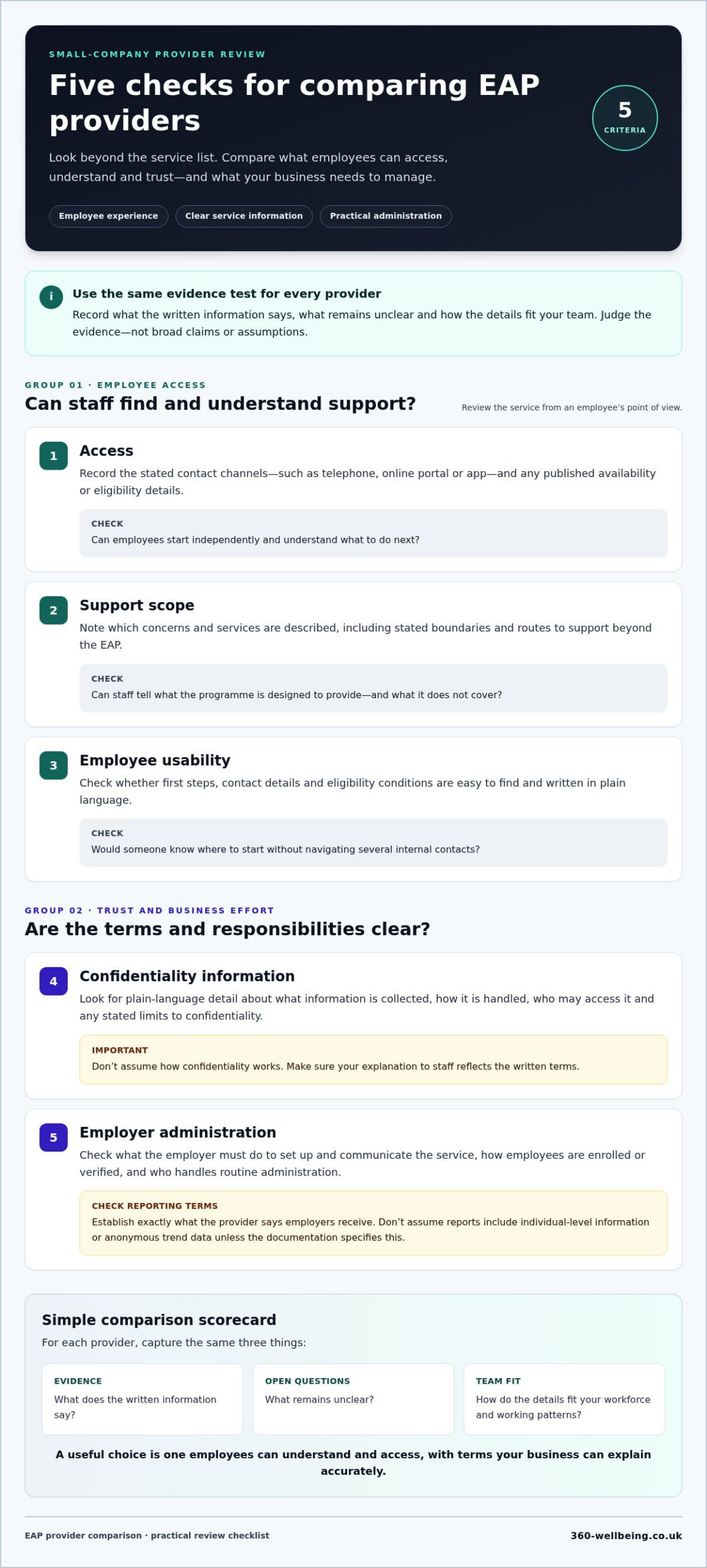
A long feature list isn’t the same as support employees can understand, access and feel comfortable using. Use these five criteria to assess both the employee experience and the practical work involved for your business.
Check access, scope and employee experience
Review the service details from an employee’s perspective. Could someone find the next step without asking a manager to arrange it? Do the support categories suit your workforce and working patterns, including remote work, different shifts or staff spread across multiple locations?
- Access: Record the stated channels, such as telephone, online portal or app, and any published availability or eligibility details. Check whether employees can start independently and understand what to do next.
- Support scope: Note which concerns and services are described, along with any stated boundaries or routes to support beyond the EAP. A clear description helps staff understand what the benefit is designed to provide.
- Employee usability: Check whether the first steps, contact details and eligibility conditions are easy to find and written in plain language.
Review confidentiality, administration and service clarity
Clear information supports informed decisions. Read the privacy and service documents carefully. Don’t make assumptions about confidentiality or reporting if the written terms don’t explain them.
- Confidentiality information: Look for plain-language detail about what information is collected, how it is handled, who may access it and any stated limits to confidentiality. Make sure your explanation to staff reflects the written terms.
- Employer administration: Check what the employer must do to set up and communicate the service, how employees are enrolled or verified, and who handles routine administration. Establish exactly what the provider says employers receive in reports. Don’t assume reports include individual-level information or anonymous trend data unless the documentation specifies this.
Capture the evidence in a simple comparison table: each provider’s statement, where you found it and any unanswered points. This gives you a grounded way to assess how to choose an EAP provider for a small company, especially when several options look similar at first glance.
If you’re considering support beyond a standalone EAP, 360 Wellbeing’s employee support brings an EAP together with mental health support, life coaching, financial and legal support, and access to a virtual GP.
Standalone EAP or broader wellbeing support: what fits a small team?
A standalone EAP and a broader wellbeing platform can both provide routes to employee support, but they cover different ranges of need. The useful question isn’t which option has the longest feature list. It’s whether the support suits your employees, how they can access it and how straightforward it is to manage.
Use the comparison as a starting point, then review each provider’s service information. Scope, access arrangements and administration can vary, so don’t assume every EAP or broader platform works in the same way.
| Consideration | Standalone EAP | Broader wellbeing support |
|---|---|---|
| Potential fit | A defined route for employees seeking the assistance described in the EAP materials. | A wider range of support may suit a team with varied wellbeing needs. |
| Service breadth | Centres on the specific support included in the programme. | May bring together services across areas such as mental, physical and financial wellbeing. |
| Access | Depends on the channels and availability set out by the provider. | Employees may have different routes for different services; review how each works. |
| Administration | May provide a focused benefit to introduce and explain. | Can involve a wider range of services to communicate and make sense of. |
When may a standalone EAP be a practical fit?
A standalone EAP may suit your company if the priority is a defined route for employees to seek assistance, rather than a wider collection of benefits. It can keep the decision focused when your team has identified a specific need the programme is intended to address. Before deciding, establish what support is in scope, who can access it and how employees begin. Choose based on relevance, not simply because a programme appears simpler or has fewer features.
When might connected wellbeing services add value?
Employees’ needs don’t always fit neatly into one category. Financial pressure may affect mental wellbeing, while a physical health concern can influence how someone feels at work. If your team would value support across several areas, a broader platform may be worth considering. More services don’t automatically mean better outcomes or higher use. Employees still need to understand what’s available and how to access it.
For example, 360 Wellbeing brings together an EAP, mental health support, life coaching, access to a UK-registered GP, and financial and legal support. This gives employers a way to consider different types of support within one broader employee benefits platform. Weigh each service against your team’s needs. To explore how one part of that picture can matter at work, see this financial support guide for UK employers.
To decide how to choose an EAP provider for a small company, list the needs you’re trying to address first. Then compare whether a focused EAP or connected services offer the most relevant support, the clearest access routes and an administration approach your business can manage.
A practical EAP evaluation and rollout plan for a small company
A good decision takes more than comparing provider descriptions. Set out what your team needs, record what the service information says and plan how employees will learn about the benefit. This gives a small employer a manageable process without relying on broad promises about what an EAP will achieve.
Use these four steps to move from comparison to a thoughtful review:
- Define needs. Note the support employees are most likely to value, their working patterns and any access barriers you want to avoid. Focus on your team’s needs, not features that sound impressive but don’t address them.
- Compare service information. Review the written details for access, support scope, confidentiality explanations, employee usability and administration. Record what each provider says and where you found it.
- Plan communication. Decide how you’ll introduce the EAP, explain its purpose and show employees where to start. Make the information easy to find beyond a one-off announcement.
- Review use and feedback. Set a time to consider any aggregate service information available and invite employees to share feedback. Use what you learn to improve communication or reassess fit, rather than assuming the benefit guarantees a particular business result.
Build a proportionate provider scorecard
A simple scorecard makes comparisons easier to explain and revisit. Rate each criterion, for example on a 0-to-2 scale, where 0 means the information is unclear, 1 means it is partly explained and 2 means it is clearly documented. Add a note or reference for each rating. Mark unanswered questions as evidence gaps, not proof of poor service, and give more weight to the areas most relevant to your team.
Include access, support scope, confidentiality explanations, employee usability and administrative fit. A provider with a lower overall score may still be the better match if it clearly meets your most important needs. Use the scorecard to inform your judgement, not replace it.
Introduce the benefit and learn from employee feedback
Explain in plain language what the EAP is for, how employees can access it and where they can find further service information. Repeat the details during onboarding and in regular staff communications, so employees can return to them when needed. Make clear that staff can find the access route without relying on a manager.
At your review point, consider employee feedback alongside any aggregate usage information available. Don’t seek or assume individual-level details. If awareness appears low, check whether access instructions are easy to find and understand before drawing conclusions about the service itself.
This process makes how to choose an EAP provider for a small company more manageable and keeps the decision grounded in documented details and your team’s priorities. Explore EAP and wider wellbeing support for your team as you consider the right fit.
How 360 Wellbeing can support a small company’s EAP decision
A sound EAP decision starts with your company’s priorities, then tests each option against the details that matter in practice: how employees access support, what the service covers, how confidentiality is explained, whether staff can understand the next step and how much administration sits with the employer. Comparing written information makes it easier to identify a suitable fit without assuming that more features mean better support.
For some small teams, a defined EAP is the priority. Others may want to bring several forms of employee support together. 360 Wellbeing offers an employee benefits platform for small businesses that includes an EAP alongside wider wellbeing services. Consider whether those services match your employees’ needs and are easy for them to understand.
A broader support picture for employees
Employees may face concerns that overlap across different areas of wellbeing. A financial worry, for example, can add to personal stress, while a health question may lead someone to look for appropriate support. 360 Wellbeing’s platform includes an EAP, mental health support and life coaching, together with 24/7 access to a UK-registered GP.
It also includes financial and legal support, including debt helplines and complimentary will writing. These are distinct forms of support, not a promise that every employee will need or use every service. Consider whether this range reflects the priorities you identified and whether your team can readily understand what each service is for.
Take the next step with a clear selection framework
Before making a decision, return to your notes. Which support categories matter most to your employees? Which access arrangements fit their working patterns? Are the service scope and confidentiality information clear, and can your business manage the communication and routine administration? These questions keep the decision anchored to evidence rather than headline claims.
Consider how an EAP could sit alongside other relevant benefits. A wider platform can bring several support categories into one offering, but employees still need clear information about where to turn for each kind of help. Weigh that convenience against the services your team values and the effort needed to explain them.
If a joined-up approach suits your priorities, 360 Wellbeing brings EAP, mental health support, life coaching, GP access, and financial and legal support together. Explore the platform and see how its employee support fits your small business.
Make employee support part of your next steps
Your next step can be straightforward. Decide who will keep the benefit visible, make its access information easy to find and set a reminder to review whether it still fits your team. As your company changes, employee needs and working patterns may change too. A regular check-in can help you keep support relevant and the route to help clear.
That’s a practical way to approach how to choose an EAP provider for a small company: focus on support employees can understand and access, then learn from their feedback. If your priorities extend beyond one type of support, consider how an EAP could fit within wider wellbeing provision.
Ready to explore a broader approach? Explore employee wellbeing support for your team with 360 Wellbeing.
Frequently Asked Questions
How do I choose an EAP provider for a small company?
To choose an EAP provider for a small company, start with the situations you want the service to support, then assess how easily staff can access it. Compare the programme details with your team’s working patterns and consider who will introduce and maintain the benefit. For example, if employees work remotely, make sure they can find access instructions without printed workplace materials or a manager’s help.
What should a small business look for in an EAP?
Look for a service description that explains who can use the EAP, what support is included and what employees should do first. Check that the language is clear enough to share with staff as written. A useful test is to ask someone unfamiliar with the benefit to explain how they would start using it after reading the employee information.
Is an EAP worth it for a small company?
An EAP may be worthwhile if it gives employees a practical support route that your business would struggle to provide internally. Its value depends on the relevance of the service, whether staff know how to access it and whether the arrangement fits your budget and administrative capacity. Before committing, identify the need it addresses and how you’ll review the benefit. Sign-up alone isn’t evidence of impact.
Can a small company offer an EAP without an HR department?
Yes. A dedicated HR department isn’t essential to introducing an EAP. An owner or manager can coordinate practical steps by sharing clear access information, including it in onboarding materials and deciding who will keep those details current. Keep the support route separate from ordinary management conversations so employees can learn how to use the benefit without disclosing a personal concern to their manager.
How can employees use an EAP confidentially?
Employees should use the access route described in the programme’s information and read its confidentiality explanation before sharing sensitive details. Employers can support trust by sharing that information accurately and avoiding promises beyond the written terms. Explain separately what workplace information managers may ask for, such as general feedback about whether benefit details are easy to find, without requesting details about an individual’s support.
What is the difference between an EAP and an employee wellbeing platform?
An EAP is a defined employee support service, while an employee wellbeing platform can bring several types of support together in one benefits offering. The exact services vary, so compare what each arrangement provides rather than relying on its label. For example, 360 Wellbeing combines an EAP with mental health support, life coaching, virtual GP access, and financial and legal support, bringing connected needs together in one platform.
How do you encourage employees to use an EAP?
Make information about the EAP easy to find and revisit it in ordinary staff communications, not only during a difficult moment. Managers can explain the benefit neutrally, without asking employees to share personal details or implying that using it is expected. A reminder during onboarding, followed by a simple update in a staff newsletter or team meeting, can help employees remember where to find the access instructions if they need them.