What if the most helpful response to an employee’s debt concerns isn’t advice, but a calm conversation and a clear route to support? Money worries can feel deeply personal, so it’s understandable to be unsure how to raise the subject without overstepping or making someone feel judged.
Supporting employees with debt starts with empathy, not assumptions. Financial stress may affect wellbeing and concentration at work, but managers don’t need to solve an employee’s finances. They can listen, protect the person’s dignity and make practical help easier to access, while respecting their choice about what to share.
This guide explains how to open a sensitive conversation, respond without stigma and signpost employees to suitable support. It also covers how to make help easier to find, including access to an Employee Assistance Programme and 360 Wellbeing’s 24/7 legal and debt helplines. Employers can offer a steady first step without taking on the role of financial adviser.
Key Takeaways
- Supporting employees with debt works best when managers listen without judgement and avoid assumptions based on changes in behaviour or performance.
- Use a private, simple conversation to understand what support the employee wants. They don’t need to disclose balances or creditors.
- Distinguish between manager listening, workplace signposting and specialist debt advice, so employees can access appropriate help without managers recommending a debt solution.
- Make support routes easy to find and agree a respectful follow-up, rather than leaving the employee to navigate the process alone.
- 360 Wellbeing includes 24/7 legal and debt helplines as part of a broader employee wellbeing subscription.
Supporting employees with debt starts with understanding the pressure
Debt can be difficult to talk about. An employee may feel shame, fear being judged or simply be unsure where to turn. A supportive workplace response doesn’t require them to explain every detail. Treat the person with dignity, listen to what they choose to share and help them find suitable specialist support if they want it.
Employee debt support is compassionate workplace action that protects an employee’s dignity and connects them with suitable specialist help, without the employer taking on the role of financial adviser. A manager can make a route to support clearer, but shouldn’t assess someone’s debts or tell them which financial solution to choose.
How financial pressure may show up at work
Financial strain can affect wellbeing and concentration, but it doesn’t look the same for everyone. A person might seem less focused, appear less confident in meetings or have changes in attendance. These are non-specific observations, not evidence of debt. They could reflect many circumstances, including health concerns, caring responsibilities or workload pressures.
Respond to the work-related need you can observe, rather than investigating an employee’s private finances. If someone seems distracted, for example, a private check-in can focus on how they’re managing their workload and whether support at work would help. Avoid asking about balances, creditors or spending. The employee decides what personal information to share.
It can also help to understand that individual financial pressures sit within a wider context. The UK’s economy and household finances are shaped by many factors, explored in this overview of the Economy of the United Kingdom. That context can help employers avoid treating debt as a personal failing, while remembering that no broad economic picture explains one employee’s circumstances.
Why a supportive response matters
When people expect blame or unwanted scrutiny, they may find it harder to raise a concern or use available support. A calm, respectful response can make the next step feel more manageable. It also gives employees room to decide whether they want to talk, explore a workplace resource or seek specialist guidance privately.
Financial wellbeing belongs within a wider, humane approach to employee wellbeing. Money worries can sit alongside stress, health concerns and pressures outside work, so recognise the whole person without making assumptions. Use language that keeps the conversation open, such as, “You don’t need to share anything you’d rather keep private. Would it help to talk through support options?”
Employers can listen and signpost employees to appropriate support without solving their debt. This clear boundary protects both sides: the employee retains control over personal decisions, while managers offer practical help within their role. Supporting employees with debt is most constructive when compassion is paired with access to guidance from people equipped to provide it.
How to talk with an employee about debt respectfully
A respectful conversation gives the employee control over what they share and what happens next. You don’t need to diagnose a money problem or uncover private details. Your role is to notice a work-related concern, offer a listening ear and, if they wish, help them find a suitable support route.
A good first conversation is private, grounded in what you’ve observed and guided by the employee’s choice about what to discuss and what support to consider.
Conversation starters that avoid judgement
Choose a private setting where you’re unlikely to be interrupted. Explain why you’re checking in without suggesting you know what’s happening in the employee’s personal life. Describe an observation rather than an interpretation. For example: “I’ve noticed you seem under pressure at work, and I wanted to check how you’re doing.” Then give them time to respond.
Listen without rushing to fill a pause or moving straight into advice. You could ask, “Would it help to talk through support options?” or “Is there anything at work that would make things more manageable right now?” These are invitations, not demands. Employees don’t need to disclose their balances, creditors or reasons for borrowing to discuss workplace support.
Avoid questions that sound like an investigation, such as asking how much someone owes or what they spend each month. Unsolicited budgeting instructions can also feel blaming, even if well meant. Don’t promise to resolve the debt. Instead, acknowledge what the employee has told you and ask whether they’d like to hear about available support, including specialist debt guidance.
Protect privacy and agree a proportionate follow-up
Discuss personal matters discreetly and handle any information shared in line with your organisation’s established policies and processes. Don’t promise absolute secrecy: there may be circumstances where information needs to be handled or shared under applicable policy. Explain this honestly and, where appropriate, let the employee know what will happen next before sharing details.
Agree the next step together. An employee may want a support contact, time to consider their options or no further conversation for now. Ask what follow-up would feel useful, and avoid repeated check-ins that could feel intrusive. If a record is required under your organisation’s process, keep it factual and limited to what that process needs. Don’t record assumptions or unnecessary details about personal finances.
- Choose a private moment and explain why you’re checking in.
- Share a neutral observation, then listen without pressing for personal details.
- Ask what support, if any, the employee would find helpful.
- Explain relevant privacy boundaries and agree a proportionate next step.
For employers considering a broader support option, 360 Wellbeing’s financial and debt support includes 24/7 legal and debt helplines. Employees have a route to guidance beyond a manager conversation, while personal financial decisions remain theirs.
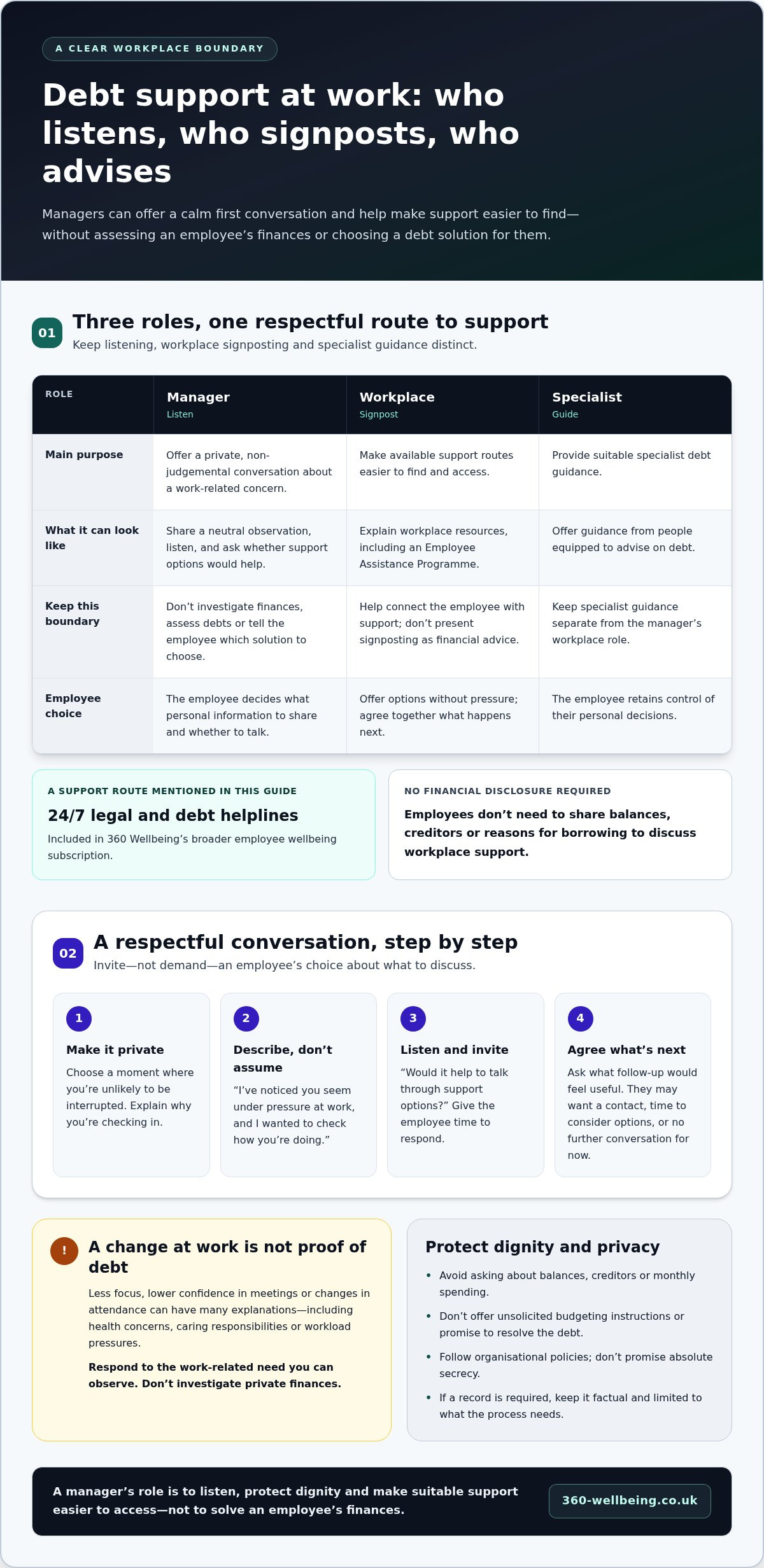
Compare practical debt support routes for employees
There isn’t one workplace response that fits every situation. A manager can offer a supportive conversation, while other routes provide information or specialist guidance. Keeping those roles distinct helps employers offer practical choices without taking responsibility for an employee’s personal financial decisions.
| Support route | What it can help with | Important boundary |
|---|---|---|
| Manager listening | Provides a respectful space to explain a work-related concern and identify immediate workplace support, such as discussing priorities or practical flexibility in line with organisational policy. | Managers listen and respond within their role. They shouldn’t investigate personal finances or recommend a debt solution. |
| Internal signposting | Helps an employee find relevant workplace resources, such as an Employee Assistance Programme or wellbeing benefit, and understand how to access them. | Explain the route clearly, but don’t imply that workplace resources replace specialist financial guidance. |
| Specialist debt advice | Offers guidance that can take account of an individual’s financial circumstances. Signposting options in the UK include MoneyHelper, StepChange and Citizens Advice. | These are third-party organisations, not services operated by 360 Wellbeing. |
| Employer-provided helpline | Creates a direct route to external support through an employee benefit. 360 Wellbeing includes 24/7 legal and debt helplines. | A helpline is a support route, not a promise that a particular debt outcome will follow. Employees remain in control of their decisions. |
What an employer can offer directly
Alongside listening, employers can make existing support easier to reach. Depending on organisational policy and the employee’s needs, practical flexibility might include reviewing priorities or discussing working arrangements. A wellbeing benefit can also give staff a route to help without asking a line manager to provide financial advice. 360 Wellbeing’s 24/7 legal and debt helplines are one option within a broader wellbeing subscription.
Financial guidance and mental health support serve different purposes, though pressures can overlap. Someone worried about debt may also feel distressed or find it harder to concentrate. Mental health support can complement a route to debt guidance, but it doesn’t replace it. Ask what kind of help the employee wants rather than assuming one service will meet every need.
When specialist debt guidance is more appropriate
Personal financial choices depend on an employee’s circumstances, so avoid suggesting a particular course of action based on limited information. Instead, make suitable specialist guidance easier to access. MoneyHelper, StepChange and Citizens Advice are UK signposting options; they are separate organisations, and employees can decide whether to approach them.
Supporting employees with debt means matching the support route to the need while keeping clear boundaries: managers can listen, workplace resources can signpost, and specialists can discuss personal debt. This gives employees options without asking employers to solve a financial problem or make decisions on their behalf.
Create a clear workplace process for supporting employees with debt
A consistent process helps managers respond calmly and makes support easier to find, without turning a workplace conversation into an assessment of someone’s finances. Build a clear route that staff can access whether they raise a concern themselves or a manager offers a check-in. Keep the response consistent, but let each employee decide what they’re comfortable sharing and which options suit them.
A practical process can follow five steps:
- Prepare managers. Explain how to listen, maintain appropriate boundaries, handle sensitive information and signpost to workplace or specialist support.
- Listen privately. Make time for a respectful conversation focused on the employee’s concerns and any work-related needs.
- Share options. Explain relevant internal resources and available routes to specialist guidance without recommending a particular debt solution.
- Agree follow-up. Ask whether the employee would find a check-in useful, and agree what it should cover.
- Review access. Check that employees can find and use the support routes, then update communications and resources where needed.
Equip managers without making them debt advisers
Give managers concise guidance and a named internal contact for process questions. That contact can clarify where to signpost without becoming a channel for unnecessary personal details. Role-play can help managers practise a calm opening, a non-judgemental response and a clear explanation of available options. Focus practice on how managers respond, not on scripting what an employee must disclose.
Keep the boundary clear: managers can listen and help someone access support, but they shouldn’t interpret personal finances or advise on debt decisions. Consistency comes from following the same process, not from giving every employee identical support. A person may want a resource link, a workplace adjustment or simply to be heard.
Make support accessible and review its use
Don’t rely on a single announcement. Include support routes in onboarding, employee communications and manager resources, using formats staff can readily access. Explain where to find help and what each route is for, so an employee doesn’t need to disclose a sensitive concern just to understand their options.
Review anonymised feedback and whether employees know how to access support. Avoid collecting personal debt information simply to measure uptake. Make someone responsible for periodically reviewing communications and resources. This creates a reliable process while protecting employees’ privacy.
For further planning, read the UK employers’ financial support guide. If you’re building a workplace wellbeing offer that includes a debt support route, explore 360 Wellbeing’s employee wellbeing subscription, which includes 24/7 legal and debt helplines.
How 360 Wellbeing can support employees facing debt
Managers can offer a thoughtful first conversation, but they shouldn’t be expected to provide personal financial advice. A workplace benefit that includes a debt helpline gives employees another route to support, so they can seek guidance without relying on a manager to interpret their finances or recommend a solution.
What the debt helpline adds to an employer support approach
360 Wellbeing includes 24/7 legal and debt helplines within its employee wellbeing subscription. Employers can include this defined support option in staff communications and manager signposting. Employees choose whether to use it, while managers focus on listening and helping them understand the workplace support available.
The helpline is a route to support, not a debt management plan or a promise of a particular financial outcome. Personal debt decisions depend on individual circumstances, so the helpline shouldn’t be presented as a substitute for appropriate specialist financial guidance. Employers can explain that the resource is available without asking employees to share what they discuss or disclose details about their debts.
Clear communication makes a benefit more practical. Include information about the helpline in relevant employee resources and make sure managers know how to signpost to it. An employee who doesn’t want to discuss personal finances with their line manager can then consider an option beyond that conversation. The employer’s role remains supportive: make the route visible, respect the employee’s choices and avoid making claims about what the helpline will achieve.
Explore a broader employee wellbeing approach
Debt concerns can sit alongside other pressures, so a broader wellbeing offer may be useful. 360 Wellbeing also includes mental health support and other wellbeing services. These resources can complement access to debt guidance, but they serve different needs and don’t replace specialist financial advice. Employers can present the options together while explaining what each route is intended to support.
The subscription costs £3.99 per month per employee. This gives employers a way to include access to debt and legal helplines within a wider employee wellbeing approach, rather than leaving managers to carry the responsibility alone.
Supporting employees with debt means offering a clear path to help while respecting personal boundaries. Employers can pair compassionate conversations with accessible resources and leave individual financial decisions to the employee and suitable guidance. To explore how this could fit into your workplace wellbeing approach, Explore 360 Wellbeing.
Make financial wellbeing part of your workplace culture
One conversation can open the door, but a lasting sense of support grows from everyday workplace signals. Consider how your organisation talks about financial wellbeing throughout the year: do employees know where to find help, and can they access it without feeling they need to justify their circumstances? Steady improvements to communication can make support feel like a normal part of working life rather than a response reserved for a crisis.
Choose one practical next step, such as reviewing how wellbeing resources are introduced to new starters or asking staff whether support information is easy to find. Keep listening, adapt what isn’t working and make sure managers understand the boundaries of their role. Supporting employees with debt is an ongoing commitment to dignity, choice and accessible help, not a demand that employers solve personal finances.
If you’re considering how to strengthen your team’s wellbeing support, Explore 360 Wellbeing for your team. A thoughtful next step can help create a workplace where people feel more able to ask for support and move forward with confidence.
Frequently Asked Questions
How can I support an employee who tells me they are in debt?
Thank them for trusting you, then ask what would be helpful at work rather than probing into their finances. For example, you might ask whether they’d like help finding a support option or discussing current work priorities. Let them decide what to share and whether to act on any signposting. If they describe an immediate workplace concern, agree a practical next step within your organisation’s usual process.
Should an employer ask staff about their personal debts?
Generally, don’t ask employees to disclose personal debts. If you’ve noticed a change affecting work, raise that observation neutrally and give them space to explain what they choose. Questions about balances, creditors or spending can feel intrusive and aren’t needed to discuss workplace support. Keep the conversation focused on what the employee wants help with, and avoid treating a change in attendance or concentration as proof of financial difficulty.
Can debt affect an employee’s mental health and performance at work?
Yes, financial pressure can contribute to stress and make it harder for someone to concentrate or feel confident at work. Its effects vary, and similar changes can have many other causes, so avoid drawing conclusions about an individual. Ask about the work impact and whether support would help. If the employee raises emotional distress, discuss relevant wellbeing resources separately from routes to financial guidance.
Where can employees in the UK get confidential debt advice?
Employees can explore debt guidance through UK organisations such as MoneyHelper, StepChange and Citizens Advice. These are independent organisations, not services operated by 360 Wellbeing. Employees can approach a suitable service directly and decide what information to provide; managers don’t need to collect details about the advice sought or the employee’s debts.
What should a manager avoid saying to an employee experiencing debt?
Avoid blame, assumptions and quick fixes. Comments such as “You should have budgeted better” or “Just stop using credit” can make someone feel judged and may not reflect their circumstances. Don’t demand an explanation, suggest a particular debt solution or promise that the employer can resolve the problem. A more supportive response is to acknowledge what they’ve shared and ask whether they’d like help finding an appropriate support route.
Can an employer provide access to a debt helpline?
Yes. An employer can make a helpline available through a workplace wellbeing benefit, giving employees a route to seek support beyond a conversation with their manager. 360 Wellbeing’s employee wellbeing subscription includes 24/7 legal and debt helplines. Present this as an option, not a guaranteed resolution or replacement for advice tailored to someone’s individual financial circumstances.
How can a small business make debt support accessible to employees?
Keep the process simple: put support information in places staff already use, such as onboarding materials and regular employee communications, and make sure managers know where to signpost. A small business can also identify an internal contact for process questions and review whether staff can find the resources. Avoid collecting personal debt information to measure awareness.