
In 2024/25, an estimated 964,000 workers in Great Britain experienced work-related stress, depression or anxiety, accounting for 52% of work-related ill health cases. The HSE management standards for workplace stress offer a practical way to look beyond individual symptoms and identify work conditions that may be contributing to the problem.
If you’re unsure what the six standards mean in everyday working life, or how to assess risks without relying on assumptions, you’re not alone. Employee feedback and risk-assessment findings can be difficult to turn into changes that work for both people and the organisation.
This guide explains the six areas, Demands, Control, Support, Relationships, Role and Change, and how to use them to organise a proportionate assessment with employees. You’ll learn how to turn findings into practical improvements, review whether they’re helping, and complement workplace action with suitable employee support. The aim is a clear approach that addresses the causes of stress at work, not just its effects.
Key Takeaways
- Use the six HSE standards to spot work-design pressures, from unmanageable demands to poorly communicated change.
- The HSE management standards for workplace stress provide a structured framework for assessing risks across teams, not just responding to individual cases.
- Build your assessment from more than one source, combining existing workplace information with employee feedback and relevant data.
- Make findings actionable by assigning each improvement an owner and review date, then check whether conditions are changing.
- Pair organisational prevention with appropriate wellbeing support, while keeping clear that support services don’t replace action on workplace causes.
What are the HSE Management Standards for workplace stress?
When a team is under pressure, should you look at individual reactions or the way work is organised? The HSE Management Standards help employers examine working conditions. Pressure can be a normal part of a role; it becomes a concern when demands or other conditions are poorly managed and contribute to harmful stress. The HSE describes stress as an adverse reaction to excessive pressure or other demands. For broader context on causes and effects, see Work-related stress.
In brief, the HSE Management Standards are a framework for identifying and addressing work-design risks across six areas: Demands, Control, Support, Relationships, Role and Change. They give employers a practical structure for exploring possible causes, listening to employees and deciding what to improve. They’re a guide for assessment and action, not a standalone certification or a guarantee that an organisation is free from stress risks.
UK employers have a legal duty to protect employees’ health and safety, including by assessing risks and taking appropriate action. This duty is set out in the Health and Safety at Work etc. Act 1974 and the Management of Health and Safety at Work Regulations 1999. Employers with five or more employees must record the significant findings of their risk assessment in writing. The HSE standards can help structure that work, but using the framework alone doesn’t automatically demonstrate compliance. Findings need to lead to suitable action.
What the standards are designed to help employers do
The framework directs attention to underlying working conditions rather than treating stress only as an individual coping issue. Start with information you already hold, such as workload patterns, absence trends or feedback. Then explore what it may mean through surveys, group discussions or other employee conversations. Involving employees helps test assumptions against their experience and clarify which conditions need attention.
The aim isn’t to diagnose employees or prove that every pressure can be removed. It’s to understand where work may be creating avoidable risk and decide on proportionate changes. The standards provide a shared structure for that conversation, not a pass-or-fail badge or automatic evidence that legal duties have been met.
When the HSE approach is relevant
Use the approach when reviewing stress risks across teams, roles or working arrangements, including when work changes or concerns emerge. A team-wide assessment can reveal patterns that an individual case may not show. An employee may also need a separate, responsive conversation about their circumstances.
There’s no single process that suits every workplace. Adapt the assessment to your organisation, the work people do and the evidence available. A survey may be useful, but it isn’t the only route: structured discussions and existing workplace information can also reveal themes. Consider employees’ perspectives, assess the risks thoughtfully and follow through with action.
The six HSE workplace stress standards, explained in practical terms
How can you turn a broad concern about stress into something a team can examine? The six standards provide a shared set of questions about how work is designed and managed. The HSE’s HSE Management Standards cover conditions that can contribute to work-related stress, helping employers explore risks in a consistent, practical way.
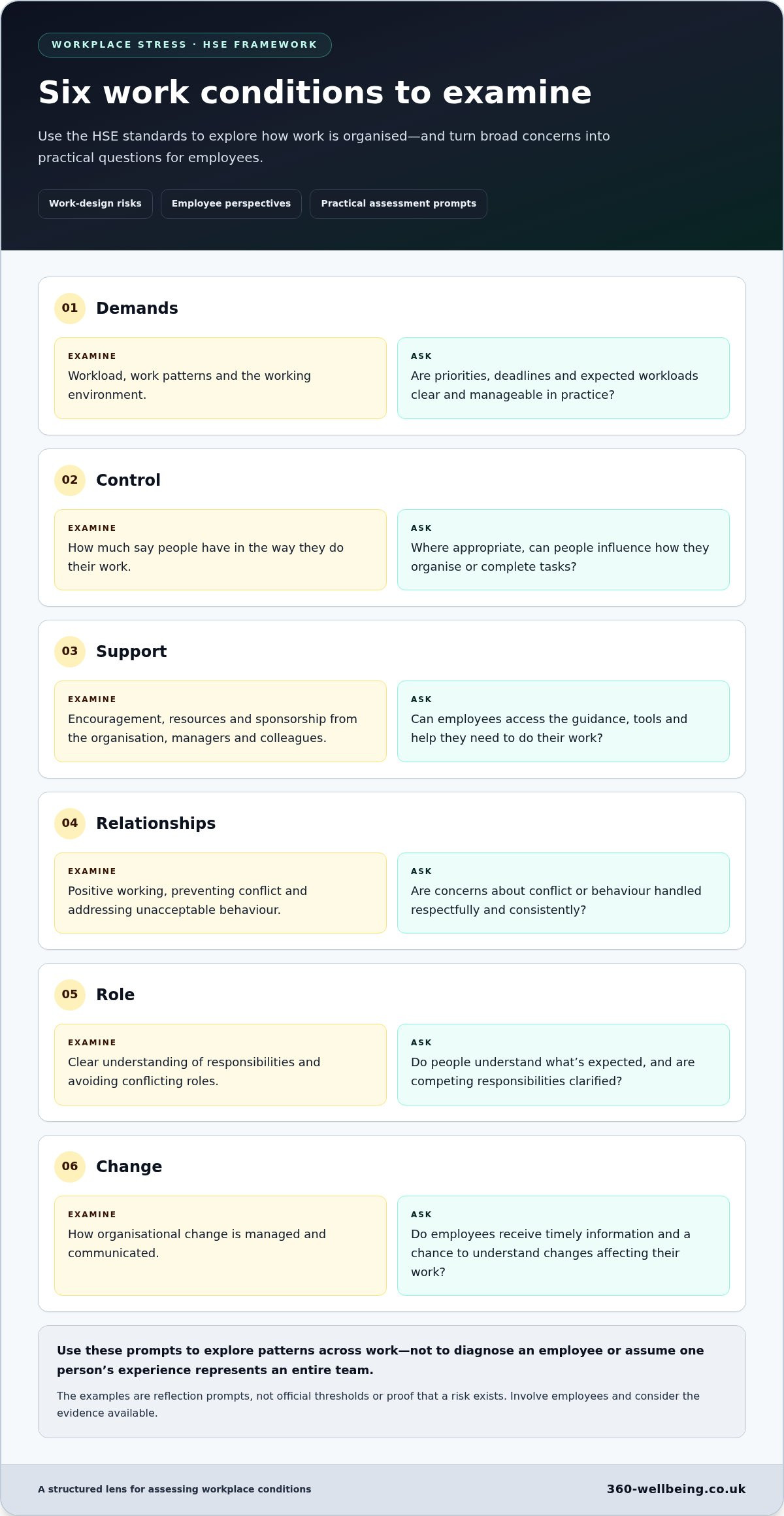
Demands, Control, Support, Relationships, Role and Change are the six HSE standards, covering work-design factors that can affect employees’ health and wellbeing. The table translates each area into a reflection question. Examples are prompts, not official thresholds or proof that a risk exists.
| Standard | What it covers | Reflection question |
|---|---|---|
| Demands | Workload, work patterns and the working environment. | Are priorities, deadlines and expected workloads clear and manageable in practice? |
| Control | How much say people have in the way they do their work. | Where appropriate, can people influence how they organise or complete tasks? |
| Support | Encouragement, resources and sponsorship from the organisation, managers and colleagues. | Can employees access the guidance, tools and help they need to do their work? |
| Relationships | Positive working, preventing conflict and addressing unacceptable behaviour. | Are concerns about conflict or behaviour handled respectfully and consistently? |
| Role | Clear understanding of responsibilities and avoiding conflicting roles. | Do people understand what’s expected, and are competing responsibilities clarified? |
| Change | How organisational change is managed and communicated. | Do employees receive timely information and a chance to understand changes affecting their work? |
For example, repeated last-minute changes to priorities might prompt questions about demands, role clarity or communication. Treat that observation as a starting point for discussion, not a formal threshold or conclusion. The HSE management standards for workplace stress work best as a way to investigate patterns across work, not to diagnose an employee or assume one person’s experience represents an entire team.
Demands, control and support
Look at how workload, working hours or patterns, and the physical working environment shape the day-to-day experience. Explore whether people have suitable discretion over how tasks are done and whether they can reach managers, colleagues or organisational resources for help. Gather examples from different roles and working patterns rather than relying on assumptions about how work is experienced.
Relationships, role and change
Consider whether people can work positively together, whether conflict and unacceptable behaviour are addressed, and whether responsibilities are understood rather than pulling in opposing directions. For change, explore how clearly and promptly decisions are explained. Discuss themes with employees and compare perspectives across roles; don’t treat an individual account as a diagnosis or a team-wide finding.
Accessible wellbeing resources can offer employees additional support alongside action on work conditions. Learn about employee mental health support as one complementary part of a broader approach, while keeping assessment and action on workplace causes at its centre.
How to apply the HSE Management Standards risk-assessment process
A useful assessment turns concerns into a clear picture of what’s happening at work and what can be changed. The HSE approach is a cycle, not a form to complete once: prepare, identify stressors, consider who may be affected, evaluate the risks, record findings and actions, then monitor and review. Involve employees or their representatives throughout so conclusions reflect working experience as well as management information.
Prepare and gather useful evidence
Set the scope first: which teams, roles or working arrangements are being considered, who will lead the assessment, and what time and support are available? Explain how employees can contribute and how their feedback will be used. Review relevant information, such as absence patterns, staff turnover, concerns raised and existing risk assessments. Treat these as possible signals, not proof of a cause.
- Identify hazards. Look for work conditions that could contribute to stress, using the six standards as prompts. For example, recurring deadline pressure may warrant exploring workload, staffing or changing priorities rather than assuming the problem is individual resilience.
- Identify who may be affected. Consider the teams, roles or groups exposed to the conditions, including whether different working patterns or responsibilities create different experiences. Use employee discussions or representatives’ insights to test who may be affected and how.
- Evaluate the risks. Bring evidence together. Suitable surveys or discussions can help surface shared themes, while workplace data can add context. A survey response isn’t a diagnosis, and a pattern in absence figures doesn’t establish a cause on its own. Explore what employees say alongside what the other evidence suggests.
- Record findings and act. Write down the main risks, who could be affected, the decisions made and the changes planned. Give each action an owner and a realistic review date. Clear records help people see what will happen next, rather than leaving feedback without a response.
- Monitor and review. Check whether agreed actions happened and whether the relevant work conditions have improved. Ask employees what has changed, and compare with the evidence used at the outset. Revisit the assessment when circumstances or work arrangements change, or when the actions aren’t addressing the concern.
Evaluate findings and document decisions
Prioritise issues by considering their potential impact and where practical improvements can be made. If workload pressure appears across several roles, examine priorities and capacity before relying on individual coping advice. Record decisions in accessible language, including why actions were chosen, who is responsible and when progress will be reviewed. That creates a usable record for employees and managers, not paperwork for its own sake.
Consultation should continue after information is gathered: share themes, invite clarification and explain what can be acted on. The HSE management standards for workplace stress support a repeatable process, but improvement depends on follow-through. Prepare, listen, assess, act and review, then use what you learn to refine the next cycle.
Turn assessment findings into workplace changes and measure progress
An assessment becomes useful when each finding leads to a response that fits the risk. For every issue, agree an organisational action with employees, name an owner and set a review date. Prioritise changes to working conditions rather than relying on individual coping advice alone. The examples below are options to explore, not universal prescriptions or guarantees of a particular outcome.
| Standard | Possible action to consider | Progress indicator |
|---|---|---|
| Demands | Review how work is allocated, priorities set and deadlines agreed; consider whether available resources fit the work. | Follow-up feedback on workload and priority clarity, alongside relevant work-pattern information. |
| Control | Clarify where employees can make decisions about how they complete tasks. | Employee feedback on whether decision-making boundaries are understood and workable. |
| Support | Review how employees access guidance, resources and help from managers or colleagues. | Feedback on whether people know where to turn and can access appropriate support. |
| Relationships | Reinforce expectations for respectful conduct and review how concerns about conflict or unacceptable behaviour are handled. | Follow-up feedback on respect and confidence in the process for raising concerns. |
| Role | Clarify responsibilities and decision-making where duties overlap or conflict. | Employee feedback on role clarity and whether competing expectations remain. |
| Change | Improve how changes are explained, including what is changing and how it affects work. | Feedback on whether information arrives in time and employees understand its implications. |
Use the table as a planning aid, then tailor actions with the people affected. A workload concern, for example, may call for checking priorities and allocation before considering personal time-management advice. For each action, record the owner, review date and evidence you’ll use to judge progress. Indicators should relate to the original finding; they’re prompts for review, not proof that an intervention caused a change.
Review whether the changes are helping
Before implementation, note the relevant starting evidence, such as employee feedback or an existing workplace pattern. At the review, gather comparable feedback and information, then ask employees what has changed in practice. Consider other influences too, such as shifts in workload or working arrangements, rather than attributing every difference to one action.
Share progress with employees, including what has been completed and what still needs attention. If the concern persists, revisit the cause, refine the response and agree another review point. The HSE management standards for workplace stress support ongoing improvement, not a one-off fix. Complement action on working conditions with relevant wellbeing resources, while keeping clear that personal support doesn’t replace prevention at work.
Read more about employee mental health support as a complementary part of a wider wellbeing approach.
Combine organisational action with supportive employee wellbeing resources
Effective workplace wellbeing has two complementary parts: reducing avoidable risks in how work is designed and managed, and making appropriate personal support accessible to employees. The HSE approach centres on the employer’s responsibility to assess work-related stress risks and act on what the assessment finds. Wellbeing services can help someone seek support, but they don’t remove that responsibility or replace changes to working conditions.
This distinction matters. If employees report unmanageable workloads, for example, access to support may be valuable, but employers should still examine workload, priorities and resources. Treating stress only as an individual issue can leave the source of pressure untouched. A balanced approach recognises that both workplace conditions and personal wellbeing deserve attention.
Where employee support fits alongside HSE-focused action
Employees may value clear routes to professional and wellbeing support, particularly when they’re experiencing difficulty. 360 Wellbeing includes mental health support and an Employee Assistance Programme (EAP), alongside other employee wellbeing services. These resources can sit alongside organisational prevention: employers continue to identify work-design risks, involve employees and make proportionate improvements.
Make support easy to understand and explain how employees can access it, while respecting privacy. Communicate what the service offers without implying that an employee must disclose personal details to their manager to receive workplace improvements. Keep conversations about risk assessment focused on shared work conditions, and handle individual support needs with appropriate care.
Choose a balanced next step for your organisation
You don’t need to solve every issue at once. Choose one relevant risk area, such as demands or role clarity, and review the evidence with employees. Agree one practical organisational action, identify who will take responsibility and set a date to check progress. A focused first step can turn assessment into visible follow-through, while leaving room to revisit other findings in a planned way.
At the review, ask whether the change has made a difference to the work experience and whether further action is needed. Share progress in clear terms, including what has changed and what remains under consideration. If your organisation offers wellbeing support, explain it consistently so employees know where to find it, without presenting it as a substitute for raising workplace concerns or addressing underlying causes.
The HSE Management Standards provide a structure for addressing work-related risks; supportive services can complement that work by giving employees additional routes to wellbeing support. Find out about 360 Wellbeing’s employee support platform.
Make your next wellbeing step practical and sustainable
Progress doesn’t depend on solving every challenge at once. Choose one workplace concern to keep in view, make space for employees to share what would help, and revisit your approach as working conditions evolve. Listening and learning can help make wellbeing part of how the organisation works, rather than a separate initiative.
The HSE management standards for workplace stress focus attention on improving work-related conditions. Alongside that organisational effort, employees can benefit from accessible personal support. 360 Wellbeing’s platform includes mental health support, an Employee Assistance Programme, 24/7 access to UK-registered GPs and 1-to-1 life coaching. These services complement, but don’t replace, action on workplace causes.
To make employee support part of a broader wellbeing approach, explore employee wellbeing support with 360 Wellbeing.
Frequently Asked Questions
Do employers have to use the HSE Management Standards?
No. Employers must assess work-related risks and take appropriate action, but they aren’t required to use the HSE Management Standards as a specific named method. The HSE framework is one way to structure an assessment; another approach may be suitable if it effectively addresses the risks in that workplace. Using the framework alone doesn’t prove compliance. Check current HSE guidance and applicable legislation when deciding how to meet your organisation’s duties.
What are the six HSE Management Standards for workplace stress?
The six areas are Demands, Control, Support, Relationships, Role and Change. Together, they help employers consider whether work design and management could contribute to stress. The HSE management standards for workplace stress aren’t a diagnostic checklist. If an employee raises concerns about conflicting duties, for example, explore role expectations across the relevant work rather than drawing conclusions about that person’s health or assuming the same issue affects everyone.
Can a small business use the HSE Management Standards?
Yes. The framework can be adapted to the size and nature of a business; there’s no requirement to start with a particular survey or workforce size. A small employer might speak with employees about a change in responsibilities, note the work-related concerns raised and agree how to address them. Keep the process proportionate, but make sure decisions and follow-up are clear enough that concerns don’t disappear into informal conversations.
How should employers involve employees in a workplace stress risk assessment?
Invite employees or their representatives to share what makes work harder to manage and what changes might help. Explain the purpose of discussions, how feedback will inform decisions and how you’ll communicate next steps. For example, after gathering views about a new rota, share the themes and explain which adjustments will be explored. Don’t promise absolute anonymity unless the method genuinely provides it, and handle personal disclosures respectfully.
What information can an employer use to assess workplace stress risks?
Employers can consider relevant workplace records, employee feedback, surveys, discussions and other suitable evidence. Each source has limits: an absence pattern may prompt questions, but it doesn’t by itself explain why people are away. Compare information where appropriate, look for themes related to work conditions, and note why you reached a particular conclusion. Handle personal information carefully and follow the data-protection guidance relevant to your organisation.
How often should an employer review a workplace stress risk assessment?
There isn’t one review interval that fits every workplace. Set a review point when actions are agreed, then bring it forward if working arrangements change, new concerns emerge or feedback suggests the original picture is incomplete. At each review, record which actions happened, what employees say has changed and what remains unresolved. This gives managers a clear basis for continuing, adapting or adding to the response.
Do the HSE Management Standards cover mental health conditions?
No. The standards help employers examine work-related conditions associated with stress; they don’t diagnose mental health conditions. If an employee shares a health concern, respond sensitively and respect their privacy, while separately considering whether workplace conditions need attention. Individual support and organisational prevention serve different purposes: offering support can be valuable, but it shouldn’t be used to dismiss or leave unaddressed a work-related risk identified through assessment.