The lowest-looking fee can hide the biggest difference: how the platform charges. In the UK, costs may be calculated per employee each month, while implementation and ongoing platform costs can also affect the total. This guide has employee benefits platform pricing models explained in practical terms, so you can see what sits behind the headline figure.
It’s understandable to want a clear cost per employee, especially when budgeting for a small business. But a fair comparison includes more than the monthly rate: the pricing structure, setup requirements, support and included benefits all shape the overall spend.
Here, you’ll learn how common pricing models work, how small-business expenses add up, and how to distinguish platform fees from wider benefit costs. We’ll also explain cost-per-employee metrics to help you assess value and choose an option that fits your organisation.
Key Takeaways
- For a small business, factor in setup and ongoing support as well as the recurring platform charge to understand the full cost.
- Separate platform fees from the cost of benefits, and use cost-per-employee measures to compare overall spend more clearly.
- Decide whether a quicker, configuration-led platform or a more tailored option better fits your organisation’s needs; an EAP can also form part of a wider wellbeing offer.
How much do employee benefit platforms UK cost?
The subscription is only one part of the total: implementation, ongoing administration and the benefits themselves also shape spending.
Software Cost Visibility
Benefits administration software brings benefit costs, employee choices and usage information into one place. This gives employers a clearer view of spending alongside participation and engagement. For example, reporting can show which benefits employees use and how costs change as enrolment changes. Manual administration can make those details harder to pull together. HR professionals spend 12 hours each week on payroll and benefits administration, while 27% spend 20 hours or more. Automation can reduce repetitive work, while reports help teams understand where administration time goes.
Compliance Costs and Contract Terms
Compliance and contract costs include the work of administering benefits, meeting employer obligations and understanding the platform agreement. Before signing, review the contract term, renewal date, notice period, cancellation fees, price-change terms and any charges for implementation or ongoing support. These details affect the cost of staying, changing or ending the arrangement. UK employers also need to account for statutory provisions: according to the Department for Work and Pensions, eligible employees can receive Statutory Sick Pay for up to 28 weeks. According to The Pensions Regulator, workers qualify for workplace pension auto-enrolment from 22 years of age until state pension age, subject to the stated earnings threshold.
Reporting can simplify administration by bringing participation, provider usage, employee engagement and cost projections together. Exportable dashboards can help HR teams prepare reports and see how benefit choices relate to spending. This visibility matters when benefits or employee numbers change, because a single subscription figure may not show the full effect on the budget.
Employee benefits costs for small businesses
For a small business, the platform fee is only one part of benefits spending. Setup, support and the way a scheme is funded also affect the budget.
Platform Costs for Small Businesses
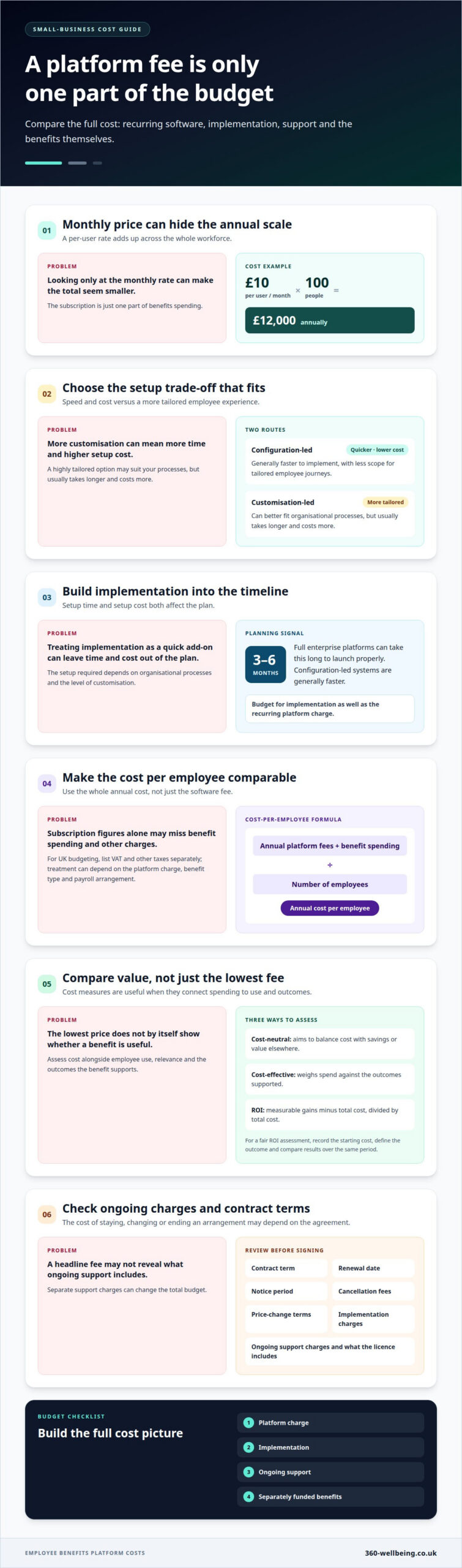
A platform fee is the recurring charge for using benefits software, often calculated per employee. For example, at £10 per user per month, a 100-person workforce would pay £12,000 annually. That example helps show how a monthly rate scales across a team. Small businesses can use the same calculation with their own headcount, then separate the platform charge from the cost of benefits employees receive.
Implementation and Ongoing Costs
Implementation costs cover preparing and configuring the platform, while ongoing costs may include the licence and support. Configuration-led platforms are generally quicker to implement and cost less, but offer less scope for tailored employee journeys. Customisation-led options can better fit an organisation’s processes, but usually take longer and cost more. Ask how ongoing support is included in the licence, since separate charges change the total budget.
Ways Platforms May Reduce Costs
A platform may help control spending by making benefit use and administration easier to manage. Automation can handle tasks such as reviewing and approving benefit selections or producing key reports. That can reduce manual steps for a small workforce, while usage information helps employers understand whether a scheme is reaching employees. Third-party funding can also be arranged through a benefits provider and funders, with no upfront costs to the company.
Allow time for implementation as well as budgeting for it. Full enterprise platforms can take 3-6 months to launch properly, while configuration-led systems are generally faster. The scale of setup depends on the organisation’s processes and the level of customisation. For a useful cost projection, include the platform charge, implementation, ongoing support and any separately funded benefits, rather than comparing subscription figures alone.
Cost-per-employee and benefit-cost metrics
Cost-per-employee measures help compare a benefits package with the workforce it supports. For UK budgeting, list VAT and other taxes separately, because their treatment can depend on the platform charge, benefit type and payroll arrangement.
Cost-Per-Employee Metrics
Cost per employee is the total annual benefits cost divided by the number of employees. Add platform fees and benefit spending to calculate the annual total, then divide by the workforce count. This gives you a comparable figure across packages of different sizes.
Cost-Neutral and Cost-Effective Benefits
A cost-neutral benefit aims to balance its cost with savings or value elsewhere, while a cost-effective option weighs spend against the outcomes it supports. For example, compare a benefit’s cost with its use and relevance to employees, rather than treating the lowest fee as the best investment. Businesses may add 20-50% to salary to cover benefits, making clear cost categories useful for payroll planning.
Cost-Benefit Considerations and ROI
Return on investment compares measurable gains with the cost of providing a benefit. A simple ROI calculation is measurable gains minus total cost, divided by total cost. For a fair assessment, record the starting cost, define the outcome you’re measuring, then compare results over the same period. This helps decision-makers distinguish an attractive package from one that meets a clear organisational need.
Long-Term Cost Projections
A long-term projection estimates how platform and benefit costs may change over three to five years. Include changes in workforce size, package choices, implementation and ongoing fees, then model each year separately. This makes the effect of enrolment or a revised scheme easier to see. Showing assumptions alongside totals helps finance and HR understand how the investment may develop, rather than relying on a single-year snapshot.
Different employee benefits platform pricing models
Employee benefits platform pricing models differ in how organisations pay for software, benefits and customisation. Separate these costs before comparing offers, so a low platform charge doesn’t obscure other spending.
A per-employee model links the platform fee to workforce size, so the charge changes as employee numbers change. Some providers calculate an overall platform cost, while others don’t charge a platform fee. In either case, consider the software charge separately from the benefits themselves. This distinction clarifies what the organisation pays for administration and what funds the employee package.
Tiered pricing offers a base platform package with optional extras, depending on the level selected. This can suit organisations whose needs match the standard features, while customisation-led arrangements can better fit specific processes. The trade-off is that tailored arrangements generally take longer to implement and cost more. Compare what each tier includes, such as support and reporting, rather than judging it by its label alone.
Benefit funding is another part of the overall model. Employers can fund benefits directly or use third-party funding arranged through a benefits provider and funders, with no upfront costs to the company. With self-funded benefits, the employer funds the benefit; for some schemes, the cost is repaid through deductions from the employee’s monthly salary. These are funding arrangements, not platform-fee structures, so keep them separate when comparing budgets.
For a practical comparison, group each proposal into platform charges, optional features, implementation, support and benefit funding. Then assess which costs vary with workforce size, which depend on the selected package, and which follow a scheme’s funding method. This makes the differences between providers’ models clearer without assuming that one structure is automatically best. If employee wellbeing is part of your decision, explore employee wellbeing support as a connected part of your benefits approach.
360 Wellbeing: Employee Assistance Programme (EAP)
360 Wellbeing offers an Employee Assistance Programme (EAP) as part of an employee benefits approach focused on wellbeing. If you’re weighing platform costs against the support your workforce can access, consider how an EAP fits alongside services such as 24/7 Virtual GP, Mental Health Support and 360 Rewards.
This can help organisations consider benefits as more than a line in the budget: the package should connect with the different needs employees may bring to work. 360 Wellbeing brings these offerings together within its employee benefits platform, giving employers a way to consider health, mental wellbeing and rewards in one broader view.
Contact 360 Wellbeing to discuss whether its EAP could suit your organisation.
Make the next benefits decision with confidence
Choosing a platform is also a chance to shape how employees experience support at work. Understanding employee benefits platform pricing models can help you connect budget decisions with the needs your organisation wants to meet. Consider what employees can access, how the benefits fit together and how you’ll assess their value over time.
360 Wellbeing offers Mental Health Support and 360 Rewards as part of its employee benefits platform. These can help employers consider both personal wellbeing and the wider employee experience when planning their benefits approach.
If you’re ready to explore how these options could fit your organisation, contact 360 Wellbeing to discuss your options. A thoughtful next step can help you build a benefits approach that feels relevant, supportive and sustainable for your workforce.
Frequently Asked Questions
What is the total cost?
There isn’t one total that applies to every employer. The amount depends on the platform licence, implementation, support, employee numbers and which benefits the organisation funds. For a clearer budget, separate software charges from benefit costs, then identify one-off setup work and recurring charges. Understanding employee benefits platform pricing models can help you distinguish these cost categories before setting a budget.
What pricing models do employee benefits platforms use in the UK?
UK platforms may charge per employee or user, set a platform fee, or offer different package tiers. Some providers have no platform charge, while optional features may affect a tier’s price. Benefit funding is a separate consideration: an employer might pay for benefits directly or use third-party funding. These distinctions clarify what each charge covers and how it changes with use or workforce size.
How much do employee benefits platforms cost per employee per month in the UK?
Monthly per-employee costs vary according to the platform’s scope and charging basis. A quoted rate may cover software access alone, while other costs relate to implementation, support or benefits. Check whether the bill is based on eligible staff, enrolled users or another agreed headcount. This matters if some employees don’t enrol or the workforce changes during the billing period.
What setup, implementation and onboarding fees do benefits platforms charge?
There’s no single setup fee that applies across UK platforms. Charges depend on the work involved, such as configuring the system, adapting it to organisational processes or supporting onboarding. Some costs may be included in a licence, while others are itemised separately. For example, standard configuration and a tailored employee journey can require different levels of implementation work, affecting the overall quote.
How do per-employee, per-user and percentage-of-spend pricing compare?
Per-employee pricing usually links the charge to a defined workforce count; per-user pricing links it to the people counted as platform users. A percentage-of-spend model varies with the benefits expenditure used as its calculation base. To compare these models, apply each provider’s stated basis to the same workforce and benefit plan. Then assess how the charge changes if enrolment or spending shifts.
Do UK benefits platforms charge minimum fees or tiered rates by company size?
Some platforms set minimum team-size thresholds, commonly ranging from 5 to 50 employees, while others offer different service levels or optional extras. A minimum can affect smaller employers even when their actual workforce is below the threshold. Tiered rates can change as an organisation moves between size bands or selects more features. Understanding employee benefits platform pricing models explained in these terms helps identify which charging structure suits your company’s size.