A company health insurance policy isn’t the only way to support employees’ health. Alternatives include health cash plans, wellbeing benefits and combinations of services for everyday needs, but they don’t all cover the same things as private medical insurance. The right choice depends on whether your priority is routine care, broader wellbeing support or cover for major treatment.
It’s understandable to look for a more flexible or affordable approach, especially if a traditional policy doesn’t match your team’s needs. This guide compares common UK options, including health cash plans, Individual Coverage Health Reimbursement Arrangements (ICHRAs) and medical cost sharing, and explains their trade-offs.
You’ll also see how these models differ from private medical insurance, what each is designed to support, and when combining benefits may make more sense than choosing a single replacement.
Key Takeaways
- Compare alternatives by the care they support, not just their headline cost.
- Understand how ICHRAs let employers set reimbursement contributions to suit their budget and workforce.
- See why medical cost sharing differs from regulated private medical insurance.
- Use the cost factors and comparison table to identify which approach best fits your team’s priorities.
What’s the alternative to traditional private medical insurance?
Health cash plans can help employees manage routine healthcare, while wellbeing benefits support needs beyond treatment. Private medical insurance is designed for eligible major medical treatment, such as surgery, hospital stays and specialist care. Before comparing alternatives to a company health insurance policy, decide which kinds of care matter most to your workforce.
Health Cash Plans
A health cash plan contributes towards everyday costs such as dental check-ups, eye tests and physiotherapy. Employees generally pay upfront, then claim eligible costs back. Unlike private medical insurance, cash plans focus on services used regularly rather than major treatment. They don’t cover medical emergencies or cancer treatment, while most plans cover pre-existing conditions.
Medical Cost Sharing and Healthshare Plans
Medical cost sharing, sometimes called a healthshare plan, pools member contributions towards eligible medical costs. It isn’t insurance: health-sharing programmes aren’t insurance companies and aren’t subject to the same regulations or requirements as traditional health insurance. The arrangement therefore differs from a policy that specifies insured treatment and cover terms.
For non-urgent issues, the NHS target cited by NHS England is 18 weeks to reach a consultant. Private medical insurance may provide access to private specialist treatment, while a cash plan supports everyday healthcare costs. These alternatives to a company health insurance policy serve different needs and don’t replace NHS care.
NHS occupational health support focuses on how health affects work, including workplace adjustments and fitness for work. Private health cover instead helps fund eligible medical treatment, so the two serve different purposes.
UK options include health cash plans, online GP services and employee wellbeing benefits. Cash plans can reimburse routine healthcare costs, online GPs provide medical advice, and wellbeing programmes can support mental health.
Employers can offer health and wellbeing benefits instead of a traditional medical insurance policy. For example, they could combine a cash plan with online GP access or mental health support.
| Option | Main focus | Key difference |
|---|---|---|
| Private medical insurance | Major treatment | Cover depends on policy terms |
| Health cash plan | Routine healthcare | Employees claim eligible costs back |
| Medical cost sharing | Shared medical costs | Not insurance |
| NHS occupational health | Health and work | Workplace-focused support |
Choose among alternatives to a company health insurance policy by weighing whether your priority is major treatment, everyday costs, shared contributions or workplace health support.
Individual Coverage Health Reimbursement Arrangements (ICHRAs)
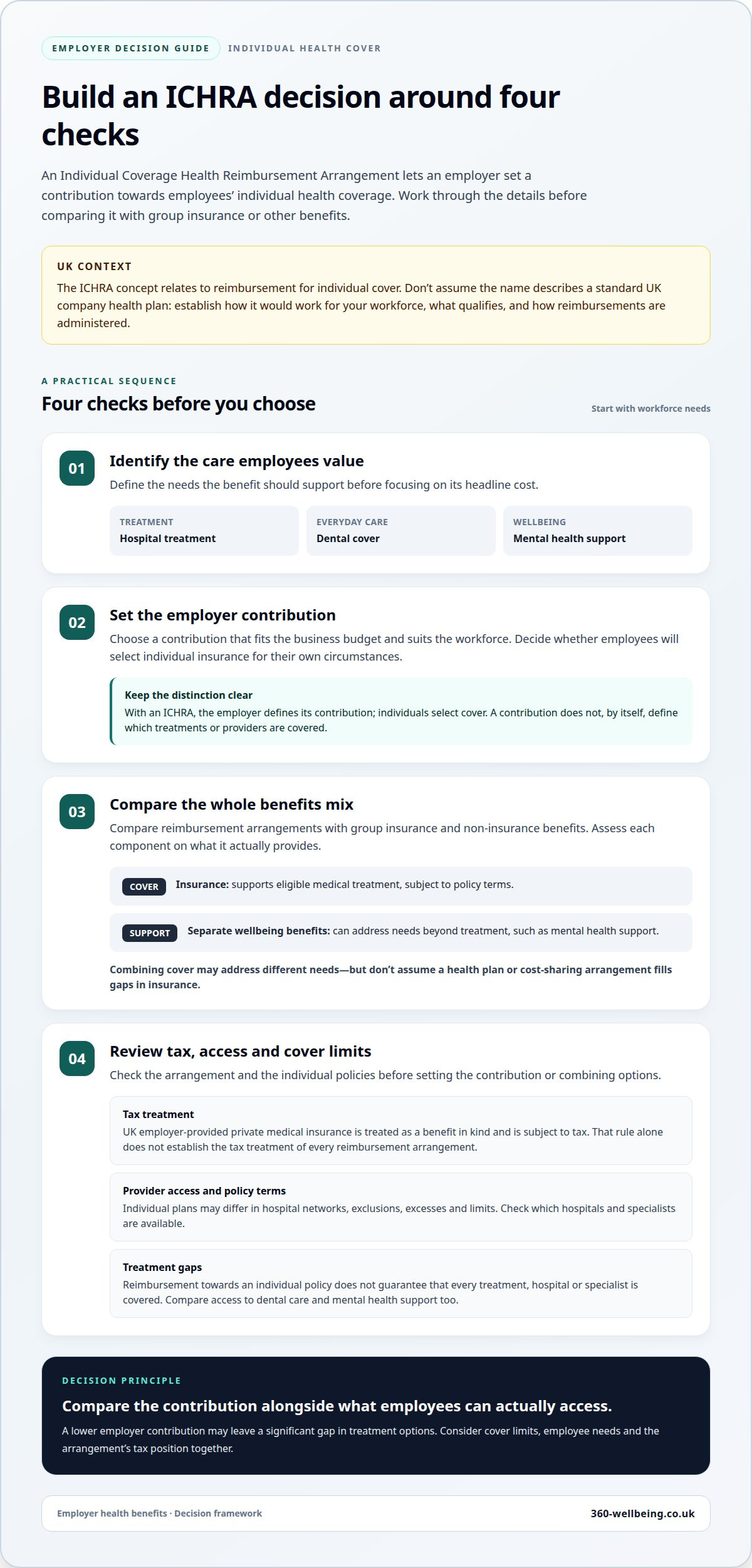
An Individual Coverage Health Reimbursement Arrangement, or ICHRA, lets an employer set a contribution towards employees’ individual health coverage. Small businesses can adjust contributions to fit their budgets and tailor benefits for a diverse workforce. Unlike a group insurance plan, the employer defines its contribution, while individuals select cover suited to their circumstances.
For a UK employer, the key is distinguishing this model from established UK insurance and wellbeing benefits. The ICHRA concept relates to reimbursement for individual coverage, so don’t assume its name describes a standard UK company health plan. Before choosing it, establish how the arrangement works for your workforce, what qualifying individual cover means, and how reimbursements are administered.
Tax treatment needs separate attention. In the UK, employer-provided private medical insurance is treated as a benefit in kind and is subject to tax. That rule alone does not establish the tax treatment of every reimbursement arrangement. Compare the arrangement’s tax position with a conventional insurance plan before setting the employer contribution, and consider the implications for both the business and employees.
Coverage limits matter as much as the contribution. Reimbursement towards an individual policy doesn’t guarantee that every treatment, hospital or specialist is covered. Employees’ insurance plans may differ in hospital networks, exclusions, excesses and limits. Compare those details alongside access to dental care and mental health support: a lower employer contribution may leave a significant gap in treatment options.
Use a simple decision process:
- Identify the care employees value, such as hospital treatment, dental cover or mental health support.
- Set the employer’s budget and decide whether employees choose individual insurance.
- Compare reimbursement arrangements with group insurance and non-insurance benefits.
- Review tax treatment, network access and cover limits before combining options.
Combining cover can address different needs: insurance for eligible medical treatment, plus separate wellbeing support. Compare each component on its own terms, rather than assuming a health plan or cost-sharing arrangement fills gaps in insurance cover.
What Are Medical Cost Sharing Plans?
Medical cost sharing is only one part of the benefits picture. Employers can also consider professional employer organisations (PEOs), individual or group cash plans, and wellbeing support. A PEO can help administer employment and benefits arrangements, but it isn’t itself a medical insurance policy or a medical cost-sharing plan. For UK businesses, compare what each arrangement provides before treating them as equivalent.
Cash plans can be bought individually or offered to an employee group. They focus on eligible everyday healthcare expenses, while access to private hospital treatment or surgery depends on separate cover. Employees generally pay upfront for treatment, then claim eligible costs back, so consider whether they can afford that initial payment.
For self-employed people and freelancers, an individual cash plan may help with routine costs, but it doesn’t serve the same purpose as insurance for major treatment. When deciding between a cash plan and private cover, consider likely everyday expenses, the treatment you want covered, and what you could pay yourself. For employers, a group plan can make benefits available across a workforce, while a PEO may help organise administration.
To set up a cash plan or healthcare allowance, decide which everyday costs to support, set a budget and choose whether employees claim reimbursements or receive an allowance. Explain eligible expenses and claim steps clearly, then review how easy the arrangement is to use.
Benefits can also shape recruitment and retention, although they’re only one part of an employment offer. A Mercer benefits report found that 70% of employees would stay at a company offering 10 or more benefits. Employers can combine a cash plan with mental health support or an Employee Assistance Programme (EAP), while keeping clear that these benefits don’t insure surgery or private hospital treatment. Compare the overall package with employee needs, affordability and practical access, rather than counting benefits alone.
Differences in cost
That wide range makes it important to compare what each premium includes, not just its initial amount. When weighing alternatives to a company health insurance policy, separate the budget for insured treatment from spending on routine care or broader wellbeing.
Insurance premiums depend on cover level, employee take-up, average age, job type, location and policy excess. More comprehensive cover raises premiums, while a higher excess lowers them. For example, a policy with broader treatment cover may cost more but reduce the employee’s share of an eligible claim. A lower premium can shift more costs onto employees.
Cash plans follow a different model, with costs shaped by benefit levels and provider terms. Employees usually pay for eligible treatment upfront and claim reimbursement afterwards. Compare annual limits with likely routine expenses, such as dental or optical care. Alternatives to a company health insurance policy don’t all transfer financial risk in the same way: a cash plan contributes towards specified costs rather than funding major treatment under an insurance policy.
For medical cost sharing, compare member contributions with eligible expenses and the sharing rules. Since this arrangement isn’t insurance, don’t compare its contribution directly with an insurance premium as though both offered identical cover. Also consider what employees may need to pay themselves when an expense falls outside the arrangement.
Use a like-for-like review before setting the benefits budget:
- Compare insurance premiums alongside excesses and treatment scope.
- Match cash plan reimbursement limits against expected routine claims.
- Review cost-sharing contributions alongside eligible expenses and exclusions.
- Estimate employee out-of-pocket costs across each option.
Choose between alternatives to a company health insurance policy by balancing predictable employer spending with the care employees need and the costs they may have to cover themselves. If your package also addresses mental health, assess that support separately from treatment cover.
Explore mental health support as part of a considered employee wellbeing approach.
360 Wellbeing: Mental Health Support
360 Wellbeing can complement your benefits approach with Mental Health Support, alongside practical healthcare and wellbeing services. If your priority is supporting employees beyond insurance cover, this can provide a distinct part of the overall package without being presented as private medical insurance.
Consider how different needs fit together: 24/7 Virtual GP access supports medical advice, while Physiotherapy and 360 Rewards add other dimensions to employee wellbeing. These benefits can sit alongside a health plan, but they serve different purposes from cover for private hospital treatment.
If you’re shaping a more balanced employee benefits package, contact 360 Wellbeing to discuss your needs.
Shape a benefits approach that fits your team
The next step is to decide what your benefits package should make easier for employees. Consider the needs it should support, the level of choice your workforce values and how much administration your business can manage. That gives you a practical basis for assessing alternatives to a company health insurance policy without treating every option as interchangeable.
It can also help to consider where financial protection ends and broader wellbeing support begins. A thoughtful package can recognise both while keeping its purpose clear for employees. The right mix should reflect your organisation’s priorities and make the support available straightforward to understand.
360 Wellbeing can help you consider how employee wellbeing support fits into that broader picture. Contact 360 Wellbeing to discuss your options and take a considered next step for your team.
Frequently Asked Questions
Can small businesses offer multiple insurance alternatives to different employees?
Yes, a small business can build a package using more than one type of benefit, such as a cash plan alongside wellbeing support. For example, one option might help with everyday treatment costs, while another offers mental health support. Set out each benefit’s eligibility, limits and claims process clearly, and consider how different arrangements affect fairness, administration and the overall business budget.
What are the alternatives to company private health insurance in the UK?
UK alternatives include health cash plans, online GP services and employee wellbeing benefits. Some employers combine options to address different needs rather than seeking one like-for-like replacement. For example, a cash plan may contribute towards routine expenses, while an Employee Assistance Programme (EAP) can provide a different type of support. Medical cost sharing is another model, but it isn’t insurance and shouldn’t be treated as equivalent cover.
How does a health cash plan compare with private medical insurance for employees?
A health cash plan is generally suited to routine expenses, while private medical insurance is designed for eligible treatment under the policy. For instance, an employee may use a cash plan towards an everyday dental expense, but a planned operation is a different coverage need. Compare the plan’s reimbursement limits and eligible services with the insurance policy’s treatment scope, excess and hospital access before deciding what each provides.
What are the costs of health cash plans, health insurance and employee assistance programmes in the UK?
EAP pricing varies with services, workforce size and provider model, so compare what each package includes rather than assuming a standard rate.
Can employees use salary sacrifice or workplace benefits to pay for private healthcare in the UK?
Workplace benefits can help employees access healthcare, but salary sacrifice shouldn’t be assumed to make private treatment tax-free. Employer-provided private medical insurance is treated as a benefit in kind and is subject to tax. For example, an employee comparing a salary arrangement with employer-funded cover needs to consider both the benefit offered and its tax consequences. The precise arrangement matters, so distinguish tax treatment from the headline contribution.
What are the limitations and risks of using cash plans or healthcare allowances instead of health insurance?
The main limitation is that support for routine costs may not pay for major or unexpected treatment. A cash plan doesn’t cover medical emergencies or cancer treatment, and an allowance can be used up before a larger expense arises. Employees may also need to pay upfront and claim eligible costs afterwards. Treat these options as support for defined needs, not as a guarantee of private hospital or surgery cover.