What if the biggest drain on your company’s performance wasn’t the people who stayed at home, but the ones who sat at their desks while struggling to focus? It’s a challenge many leaders face, noticing a dip in momentum without a clear cause on the attendance sheet. You likely already sense that working through illness is a silent burden on your team’s resilience, yet quantifying it remains a significant hurdle. This guide will show you how to move beyond the fog of “invisible” lost time to find a clear path toward recovery.
We will explore the £21 billion national impact and provide a concrete framework for calculating the cost of presenteeism uk within your own organization. By the end of this article, you’ll have a formula ready for your board of directors and a proactive strategy to turn employee health into a measurable strategic asset. We’re moving away from reactive crisis management toward a positive vision of vitality and workplace harmony, ensuring your people have the support they need to be truly present and productive every single day.
Key Takeaways
- Understand the scale of the £21 billion “hidden crisis” and why working while unwell is now the primary driver of lost productivity in the UK.
- Learn to apply the “1.5x Rule” to see how presenteeism creates higher financial drains through errors and rework than traditional absenteeism.
- Master a professional framework for calculating the cost of presenteeism uk by combining the Stanford Presenteeism Scale with your specific labour costs.
- Spot the subtle signs of “leavism” and digital exhaustion to protect your team’s resilience before health challenges escalate.
- Discover how shifting to proactive support, such as 24/7 Virtual GP access, transforms employee wellbeing into a measurable commercial asset.
Understanding Presenteeism: The £21 Billion Hidden Crisis in UK Workplaces
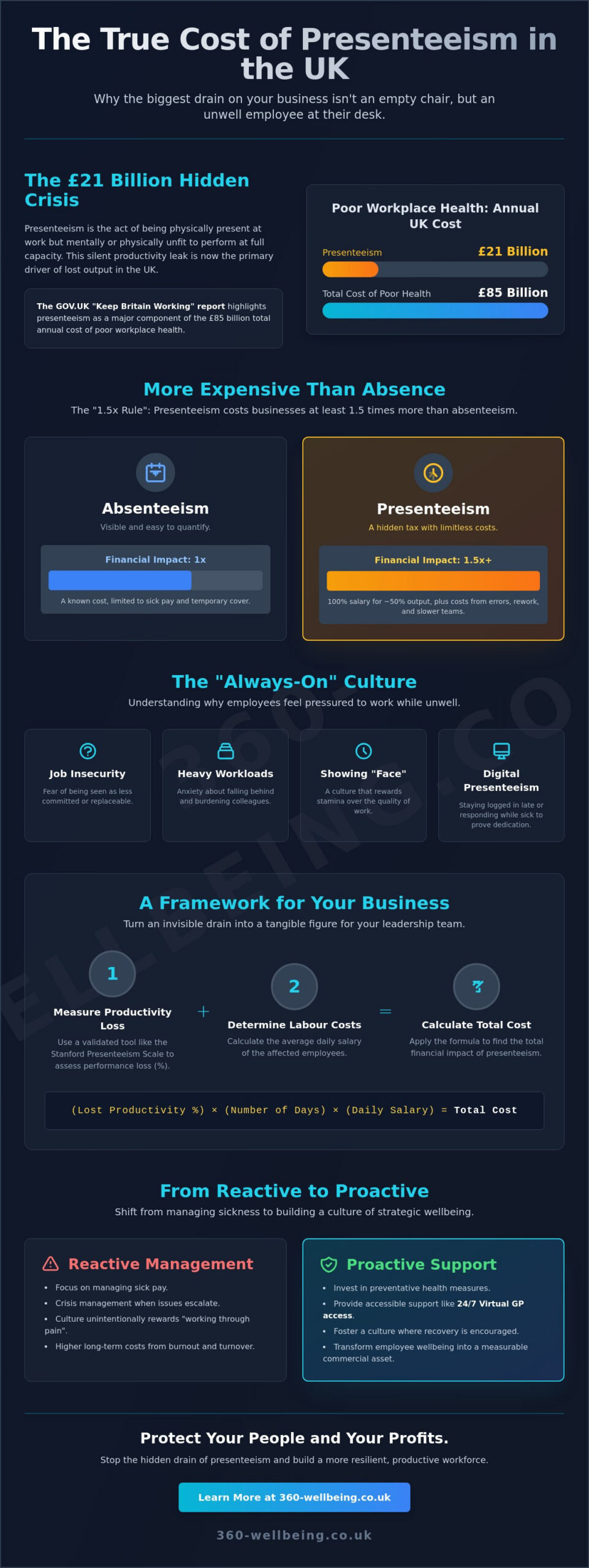
Presenteeism describes the act of being physically present at work but mentally or physically unfit to perform at full capacity. While you can easily see an empty chair, identifying the productivity leak of an unwell employee is much harder. According to the March 31, 2026, GOV.UK “Keep Britain Working” technical note, this hidden crisis is a major part of the £85 billion total annual cost of poor workplace health. For those responsible for calculating the cost of presenteeism uk, the challenge is turning this invisible drain into a tangible figure for the leadership team. It isn’t just about a cold or a headache; it’s about the cognitive load of working while unwell, which often leads to a cycle of decreased performance that is difficult to break without proactive intervention.
The Psychology of the “Always-On” Culture
Why do your team members feel the need to power through illness? In 2026, job insecurity and heavy workloads continue to drive a culture of “showing face.” This has evolved into “digital presenteeism” in hybrid teams, where employees stay logged in late into the evening or respond to messages while sick just to prove their dedication. A foundational step in Understanding Presenteeism is recognizing that these cultural habits often reward stamina over actual quality of work. When your culture unintentionally praises those who “work through the pain,” it sends a message that recovery is a secondary priority, which only serves to deepen the productivity crisis over time and prevent employees from returning to their full potential.
Why Presenteeism is a “Hidden Tax” on Your P&L
Presenteeism acts as a hidden tax that erodes profit margins without ever appearing on a timesheet. When one person struggles with a persistent health issue, the ripple effect can slow down an entire project team, leading to missed deadlines and poor customer service. The cost isn’t just limited to the individual’s salary. It includes the time healthy colleagues spend correcting mistakes or the lost revenue from a client who receives a subpar experience. In the 2026 economic climate, where every percentage point of margin counts, leaving these costs unaddressed is a risk most businesses cannot afford.
Beyond immediate output, the long-term risk of unmanaged health is total burnout and staff turnover. Calculating the cost of presenteeism uk requires looking at the £7 billion lost each year to recruitment and conflict resolution, which often stems from initial cases of unaddressed ill health. When you begin this process, you start to see that health is a strategic asset rather than a line-item expense. By identifying these red flags early, you can move from reactive sick pay toward a proactive vision of workplace harmony that protects both your people and your profits.
Why Presenteeism Costs UK Businesses More Than Total Absence
While an empty desk is a clear signal of lost time, a desk occupied by an unwell employee is far more deceptive. Research in occupational health often points to the “1.5x Rule,” which suggests that presenteeism is at least 1.5 times more expensive than total absence. This happens because you’re paying 100% of a salary for perhaps 50% of the output, while simultaneously absorbing the cost of errors, rework, and damaged customer relationships. When calculating the cost of presenteeism uk, employers must account for these friction points that don’t appear in a standard absence report.
The impact is staggering on a national level. Official data highlights the £21 billion cost of presenteeism, proving that this isn’t just a minor HR headache but a significant drag on UK corporate profitability. Beyond the numbers, there’s a “Contagion Effect” to consider. In physical office spaces, one employee working through a viral illness can quickly diminish the productivity of an entire department, leading to a cluster of underperformance that is difficult to manage. This creates a ripple effect where the quality of output drops across the board, affecting your brand reputation and client trust.
Absence vs. Presenteeism: A Financial Comparison
Absence has a ceiling. You know exactly what a day of sick pay costs your business. Presenteeism has no such limit. It creates workplace friction, where healthy colleagues must pick up the slack or spend valuable time correcting mistakes made by someone struggling to focus. When you’re calculating the cost of presenteeism uk, compare these indirect drains against your direct sick pay costs. Often, offering financial support for employees serves as a powerful preventative measure. Since financial stress is a leading driver of people working through illness, addressing the root cause helps keep your team truly productive rather than just physically present.
The Long-Term Cost of Delayed Recovery
Choosing to work while sick rarely leads to a faster recovery. In fact, it often extends the duration of the illness, turning an acute issue into a chronic health challenge. This transition increases the long-term burden on the UK healthcare system and inevitably leads to higher employer insurance premiums. It’s a cycle that erodes your team’s resilience and your company’s reputation as a supportive employer. Building a comprehensive wellbeing strategy that encourages rest when it’s needed most is not just a kind gesture; it’s a vital commercial decision to protect your long-term output and maintain a high standard of work across your organization.
How to Calculate the Cost of Presenteeism: A Step-by-Step UK Framework
Moving from recognizing a crisis to taking action requires a clear, methodical approach. While presenteeism feels invisible, it’s possible to quantify it with surprising precision. Calculating the cost of presenteeism uk involves moving beyond guesswork and using validated tools that turn employee sentiment into hard financial data. By following this five-step framework, you’ll create a business case for wellbeing that speaks the language of the boardroom while remaining rooted in human empathy.
- Step 1: Deploy a confidential survey using the Stanford Presenteeism Scale (SPS-6) to capture how health impacts focus and task completion.
- Step 2: Determine your true average labour cost per hour, ensuring you include employer National Insurance contributions and pension benefits.
- Step 3: Use the survey results to calculate a “Productivity Loss Percentage” for your specific workforce.
- Step 4: Apply the Presenteeism Multiplier to your total annual payroll to reveal the hidden financial drain.
- Step 5: Benchmark your findings against the 2026 UK average of 4.4 days lost to sickness to see where your organization stands.
Using the Stanford Presenteeism Scale (SPS-6)
The SPS-6 is widely regarded as the gold standard for HR professionals because it focuses on the relationship between health and actual work performance. Instead of asking “how sick do you feel,” it asks how much your health prevented you from finishing work or staying concentrated. This approach aligns with research from the University of Sheffield, which highlights how specific mental and physical health challenges directly impair a worker’s cognitive output. To get honest feedback, you must guarantee total anonymity. When employees feel safe, they’re more likely to provide the data points you need to build a proactive support strategy.
The Mathematical Formula for Your Board Report
To present your findings effectively, use a formula that balances simplicity with depth. The basic calculation is: (Total Employees x Average Annual Salary x % Productivity Loss). For a more nuanced view, you should segment your data by department, as the cost of reduced productivity in high-impact leadership roles is often higher than in administrative functions. The Presenteeism Multiplier is the ratio of productivity loss to salary cost. By using this metric, you can show the board exactly how much “value” is being left on the table. It’s a powerful way to demonstrate that investing in health isn’t a luxury, but a fundamental strategy for recovering lost profit and protecting your most valuable asset.
Identifying the “Red Flags”: Spotting Presenteeism in Your Team
Identifying the subtle shifts in employee behaviour is the first step toward calculating the cost of presenteeism uk. While absenteeism is easily recorded on a spreadsheet, presenteeism requires a more observant, empathetic eye. In our hybrid work era, these signs have shifted from physical coughs and colds to digital markers of exhaustion. If you don’t know what to look for, you’ll miss the early warnings of a workforce that’s physically present but mentally distant.
One of the most concerning trends in 2026 is “leavism.” This occurs when employees use their hard-earned annual leave to work or to recover from an illness because they’re afraid to take a formal sick day. You should also monitor for “digital exhaustion.” This is often visible through late-night emails or a constant “active” status on messaging platforms, even during supposed downtime. Other red flags include:
- Performance Dips: A sudden increase in minor errors or missed deadlines from usually high-performing staff.
- Physical Indicators: Visible fatigue, increased irritability, or a cycle of frequent minor ailments.
- Withdrawal: Reduced participation in team meetings or a lack of engagement in collaborative tasks.
Cultural Drivers of Presenteeism
The “Hero Culture” often found in UK SMEs can unintentionally drive presenteeism. When leaders brag about “powering through” illness, they set a standard that employees feel compelled to follow. If your management team works while they’re unwell, your staff will likely do the same, fearing that taking time off signals a lack of commitment. Restrictive sick pay policies also play a major role. When taking a day off results in a financial penalty, employees are forced to choose between their health and their mortgage. This creates a cycle of delayed recovery that ultimately makes calculating the cost of presenteeism uk even more critical for your long-term financial health.
Mental Health and Presenteeism
Mental health presenteeism is notoriously difficult to spot because there are no physical symptoms like a fever or a bandage. However, it’s often more damaging to productivity. Workplace stress directly reduces cognitive function, leading to “brain fog” and a diminished ability to solve complex problems. Managers should be trained to open empathetic conversations that focus on support rather than scrutiny. Instead of asking why a deadline was missed, try asking how you can support their current workload. If you’re noticing these red flags, our proactive health solutions can help you intervene early and protect your team’s resilience.
Reducing the Burden: Strategic Wellbeing as a Commercial Asset
Once you’ve finished calculating the cost of presenteeism uk for your specific team, the path forward becomes clear. It’s no longer enough to rely on reactive sick pay that only kicks in once an employee has already reached a breaking point. Instead, businesses must shift toward proactive health support that catches issues before they escalate. By viewing wellbeing as a commercial asset rather than a cost centre, you can protect your bottom line while showing your people they’re truly valued. Transitioning to this model is about moving from crisis management to a positive vision of workplace harmony.
Rapid access to clinical care is a cornerstone of this strategy. 24/7 Virtual GP services significantly reduce the “wait time” for treatment, allowing employees to address minor ailments before they turn into long-term health challenges. This is vital in a hybrid world where the “always-on” mentality often prevents people from visiting a traditional clinic during office hours. When you provide immediate access to a doctor from a smartphone, you’re removing the barriers to recovery. Combined with robust mental health support, these tools build the resilience needed to navigate modern work pressures. The ROI is undeniable; a small monthly per-employee fee often offsets thousands of pounds in lost productivity and the errors associated with working while unwell.
The 360-Degree Wellbeing Approach
Our approach integrates physical, mental, and financial support into a single, cohesive platform. This “Total Wellness” philosophy addresses the root drivers of presenteeism, such as the financial stress that forces people to work when they’re sick. By looking at health from a 360-degree perspective, you can identify why your team is struggling before the productivity dip becomes a crisis. Companies that partner with 360 Wellbeing often see a measurable drop in productivity leaks because their employees feel supported in every aspect of their lives. By providing a tailored support system, you’re not just offering a benefit; you’re building a healthier, more engaged culture where everyone can thrive.
Implementing a “Permission to Recover” Policy
Tools alone aren’t enough without a supportive culture. You must communicate a clear “permission to recover” policy, where health is prioritized over mere face time. This involves training your managers to spot the early signs of burnout we discussed in previous sections. When leaders model healthy recovery habits, it removes the stigma of taking time off and makes calculating the cost of presenteeism uk a more accurate process because people feel safe being honest about their health. It’s time to stop guessing the impact of ill health and start building a proactive strategy for vitality.
Discover how 360 Wellbeing can help you calculate and reduce presenteeism costs.
Turning Workplace Vitality into Your Strategic Advantage
Recognizing that presenteeism is a quantifiable financial risk is the first step toward a healthier, more productive organization. By moving beyond reactive sick pay and using the SPS-6 framework, calculating the cost of presenteeism uk becomes a powerful tool for your board reports. You’ve learned to spot the subtle red flags of digital exhaustion and leavism, allowing you to intervene before acute issues become chronic health challenges. This proactive shift doesn’t just save money; it builds a culture where your people feel truly seen and supported.
We’re ready to partner with you to implement a 360-degree health perspective that integrates physical, mental, and social wellness. With 24/7 UK-registered GP access and tailored Mental Health and Life Coaching, your team can access the care they need without the traditional barriers to recovery. It’s an investment that pays dividends in resilience and long-term loyalty. Calculate your team’s wellbeing ROI with 360 Wellbeing and discover how a proactive vision of health can transform your business. You have the data and the strategy. Now, it’s time to lead with vitality.
Frequently Asked Questions
What is the average cost of presenteeism per employee in the UK?
The average cost of presenteeism per employee in the UK is approximately £4,000 per year according to 2024-2026 industry research. This figure represents the value of lost time when an employee is working at a lower capacity. It’s often significantly higher in specialized roles where errors have a greater financial impact. Understanding this individual cost helps you justify the investment in proactive health platforms.
How do you measure presenteeism without micromanaging staff?
You can measure presenteeism effectively by using confidential, trust-based surveys rather than surveillance. Tools like the Stanford Presenteeism Scale allow staff to report their own productivity levels without feeling scrutinized. This approach preserves your company culture while giving you the data needed for calculating the cost of presenteeism uk. It’s about looking at aggregate data to identify trends rather than tracking individuals.
Is presenteeism worse for a business than absenteeism?
Presenteeism is typically more damaging than absenteeism because its impact is hidden and prolonged. While a sick day has a fixed cost, an unwell employee can spend weeks working at 50% capacity, making mistakes that require rework. This “hidden tax” also risks the health of the wider team, especially in physical offices where illness can spread rapidly among colleagues.
What are the main causes of presenteeism in UK SMEs?
The primary drivers in UK small and medium enterprises include heavy workloads and a “hero culture” where working through pain is praised. In 2026, many workers also fear job insecurity, leading them to show face even when they’re unfit. Limited sick pay policies further exacerbate the issue, as employees feel they cannot afford to take the time they need to recover properly.
Can a Virtual GP service really reduce presenteeism costs?
Virtual GP services reduce costs by removing the logistical barriers to medical care. When employees can speak to a UK-registered doctor within minutes, they receive treatment plans earlier, preventing minor issues from becoming chronic. This proactive approach shortens the recovery period and ensures that when your people are at their desks, they’re working with full focus and vitality.
What is the Stanford Presenteeism Scale and how do I use it?
The Stanford Presenteeism Scale (SPS-6) is a validated six-item questionnaire used to assess how health impacts work performance. You use it by asking employees to rate their ability to concentrate and complete tasks despite their health challenges. It converts qualitative feelings into a numerical score, providing a clear data point for your internal ROI calculations and board reports.
How has hybrid work changed the way we calculate presenteeism?
Hybrid work has moved the focus from physical presence to digital availability and “active” status markers. Calculating the cost of presenteeism uk in a hybrid setting involves tracking digital exhaustion, such as late-night emails or constant messaging activity. You must look for changes in output quality and missed deadlines rather than just counting hours spent logged into a system.
Does offering financial advice to employees reduce presenteeism?
Offering financial support is a critical part of a 360-degree wellbeing strategy. Financial anxiety is a leading cause of mental ill health, which accounts for £15.1 billion of the UK’s annual presenteeism burden. By helping employees manage their personal finances, you reduce the stress that often forces them to work when they are mentally unwell and unproductive.