Private medical insurance isn’t the only way to support employee health.
If insurance premiums are putting pressure on your benefits budget, consider support that matches your workforce’s needs rather than paying for cover employees may not use. The right alternative depends on your priority: routine healthcare costs, access to medical advice, or broader physical and mental wellbeing.
This comparison covers cash plans, online GP services and other practical options, focusing on costs and workforce needs. It explains what each can help with, where its limits lie, and how to choose a balanced option for your organisation.
Key Takeaways
- Match the benefit to what your workforce needs most: help with everyday healthcare costs, access to GP advice, or broader wellbeing support.
- Compare the overall budget and the type of care each option supports, not just the per-employee cost.
- Cash plans can help with routine healthcare expenses, but they aren’t designed to cover hospital treatment or unexpected medical emergencies.
- Use the decision guide to weigh standalone benefits against a combined approach, then choose what best fits your organisation’s priorities.
Differences in cost and premiums
These options provide different types of support, so compare what each covers before weighing the monthly cost.
These examples show how age and cover level can affect premiums; they are not quotes for employee groups.
Ways to reduce premiums include choosing a higher excess or narrowing the level of cover. The trade-off is a larger out-of-pocket contribution when claiming. Employer-paid health insurance is usually a taxable benefit in kind, and HM Revenue & Customs says employers pay Class 1A National Insurance on its value.
NHS England sets an 18 weeks target for non-urgent issues. That context can help employers weigh insurance against benefits focused on routine care, advice or wellbeing, rather than assuming every option provides the same access to private healthcare.
| Option | Illustrative cost | Cost consideration |
|---|---|---|
| Health cash plan | Routine healthcare; cover varies | |
| EAP or wellbeing support | Scope affects the overall value | |
| Company health insurance | Age, location and cover influence premiums |
Compare the cover, excess and likely workforce use before deciding. Physiotherapy or support for existing health needs may matter more to some teams than broad insurance cover.
Choosing alternatives based on budget and workforce needs
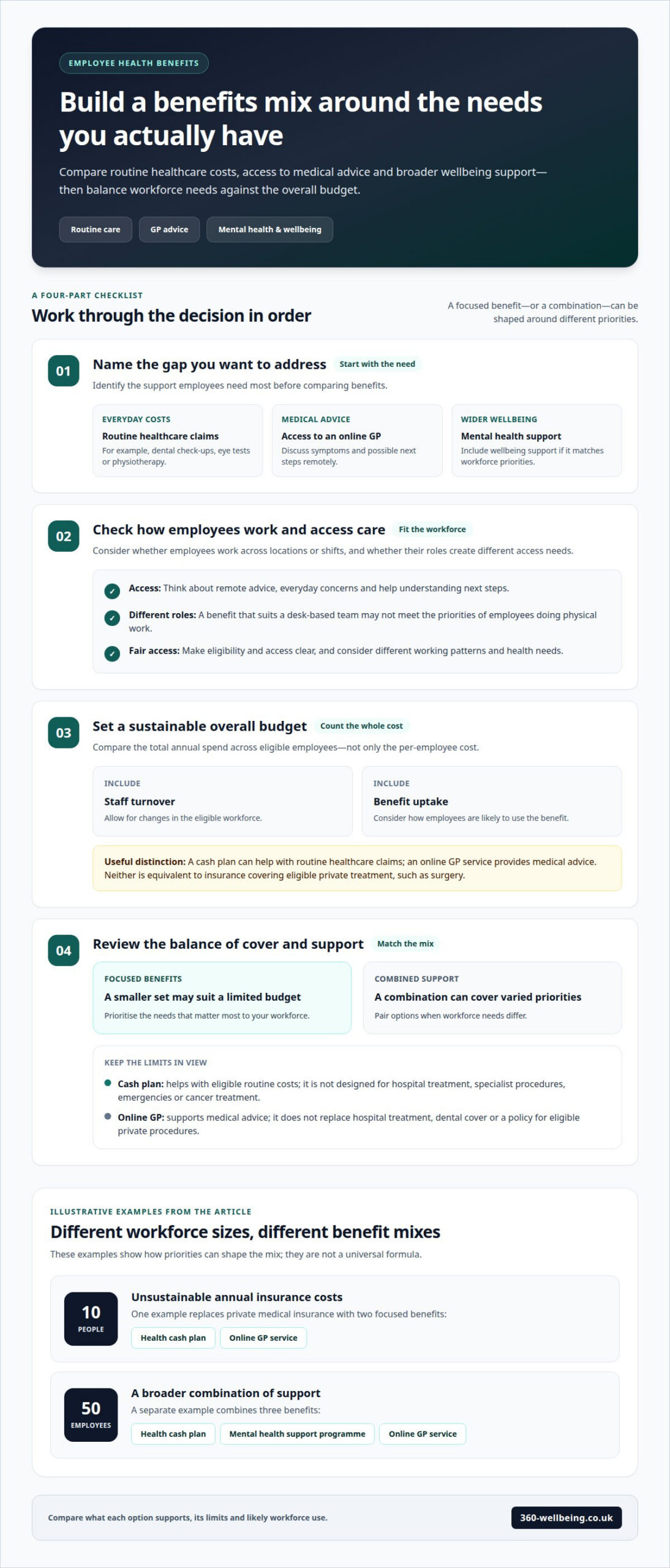
Start by identifying the gap you want benefits to address: routine costs, quicker medical advice, or mental health and wellbeing support. Then consider workforce patterns, such as whether employees work across locations or shifts and have different access needs. A benefit that suits a desk-based team may not meet the priorities of employees doing physical work.
Next, distinguish predictable needs from expensive, less frequent treatment. A cash plan can help employees claim towards routine healthcare, while an online GP service provides medical advice. Neither is equivalent to insurance that covers eligible private treatment, such as surgery.
- Set a sustainable budget. Calculate the total annual spend across eligible employees, then allow for staff turnover and benefit uptake.
- Map needs to support. Compare routine-care claims, GP access, and mental health support with the needs your workforce has identified.
- Consider access and waiting. Think about whether employees need advice remotely, support with everyday concerns, or help understanding their next steps.
- Review the balance. A smaller set of focused benefits may suit a limited budget; a combination can cover more needs when priorities vary.
For example, a 10-person business facing unsustainable annual insurance costs could replace PMI with a health cash plan and online GP service. A separate example involving 50 employees combines a cash plan, mental health support programme, and online GP service. These examples show how workforce size and priorities shape the mix, not a universal formula.
Choose the option that addresses the most relevant needs without stretching the budget. If mental health is a priority, explore mental health support as part of a broader benefits approach.
Individual and employer group cash plans
A cash plan helps with routine healthcare costs, while private medical insurance can cover eligible private treatment. The choice affects who pays, how employees use the benefit, and how the employer manages costs.
Individual Cash Plans
An individual cash plan lets someone claim back eligible routine healthcare costs, such as dental check-ups, eye tests or physiotherapy. Unlike health insurance, it is not designed to cover hospital treatment, specialist procedures, emergencies or cancer treatment. It can suit employees seeking help with regular expenses, but it won’t replace cover for surgery or consultant-led care.
Employer Group Cash Plans
An employer group cash plan extends a defined benefit to employees, with cover and claim limits set by the plan. More than 1.6 million employees in the UK have paid-for corporate cash plans; the total rises above two million people when family members and dependants are included. Compared with private medical insurance, cash plans focus on routine care rather than treatment costs. Employees with access to a health cash plan could save an average of 4.1 sick days, though that figure doesn’t guarantee an outcome for each business.
Tax and Workplace Considerations
Employer-paid health insurance is usually a taxable benefit in kind, and HM Revenue & Customs says the employer pays Class 1A National Insurance on its value. The tax treatment of other employer-funded plans or medical treatments depends on the specific arrangement, so don’t assume a cash plan follows the same rule. For workplace fairness, communicate eligibility and access clearly, and consider how different roles, working patterns and health needs affect employees’ ability to use the benefit.
Salary Sacrifice and Flexible Benefits
With salary sacrifice, an employee exchanges part of their contractual cash pay for a non-cash benefit. Flexible benefits let employees choose from options in a benefits package. Employers can offer more choice through these approaches, such as a cash plan instead of one standard benefit. Before adopting either, explain how choices affect take-home pay and access to benefits. A self-funded medical expense scheme gives the business more direct control over spending, but leaves it responsible for variable claims costs.
Online GP services and faster access to medical advice
Yes. UK employers can offer health screening, virtual GP services or employee assistance programmes as alternatives to private medical insurance. These benefits provide access to advice or wellbeing support, but not the same cover for private hospital treatment, surgery or procedures.
Online GP services let employees discuss symptoms and possible next steps without travelling to a clinic. This can help employees balancing work, family responsibilities or travel. The service focuses on medical advice; it does not replace hospital treatment, dental cover or a policy for eligible private procedures.
Access matters in the UK: 2.7 million patients waited more than 22 days from booking until their appointments took place. A virtual appointment option may help employees seek advice through a different route, though it doesn’t remove NHS waiting lists or guarantee access to a specialist. Employers should distinguish quicker access to a GP conversation from faster treatment.
To decide whether an option suits your budget and workforce, consider what employees need and what the benefit covers. An online GP service may suit staff who value convenient medical advice. A cash plan may better support routine costs such as dental appointments or physiotherapy. An employee assistance programme can provide support with personal or work-related concerns, including mental wellbeing.
- For everyday questions: consider whether remote GP advice suits the workforce’s working patterns.
- For routine healthcare: compare cash plan benefits and claim limits against needs such as dental care.
- For broader support: consider whether an employee assistance programme complements medical advice.
Online GP access works best as a defined part of a wider benefits mix, not as a promise to cover specialist therapies, hospital care or surgery. To explore 24/7 virtual GP support alongside employee wellbeing needs, take the next step with a service designed around access to medical advice.
360 Wellbeing: 24/7 Virtual GP
360 Wellbeing brings a 24/7 Virtual GP together with support for wider employee wellbeing. It may suit organisations looking beyond routine claims and wanting to include access to medical advice, mental health support and physiotherapy within their benefits approach.
360 Rewards adds another dimension, helping employers shape a broader benefits experience alongside health-focused support. These services are distinct from private medical insurance, so consider whether your priority is everyday wellbeing and advice or cover for private treatment. Matching benefits to workforce needs can help create a thoughtful, balanced package without treating one option as a substitute for another.
If you’re considering support that combines virtual GP access with broader wellbeing benefits, contact 360 Wellbeing to discuss your organisation’s needs.
Build a benefits approach that can grow with your team
Choosing alternatives to offering private medical insurance gives you a chance to shape support around the people who make your organisation work. Start with the needs employees raise, then review whether benefits remain relevant as roles, priorities and working patterns change. A thoughtful mix can support health and wellbeing without assuming every employee has the same needs.
360 Wellbeing brings together 24/7 Virtual GP, Mental Health Support and 360 Rewards, giving employers options to consider as part of their wider benefits approach. The next step is to discuss which forms of support best match your workforce and organisational priorities.
Contact 360 Wellbeing to discuss your options and take a considered step towards workplace wellbeing that feels more connected to your team.
Frequently Asked Questions
What’s the alternative to traditional private medical insurance?
A practical alternative is to build a benefits package around the support employees are most likely to use. For example, a small team might prioritise virtual GP access for everyday health questions and offer an employee assistance programme for personal concerns. This improves access to specific support, but does not provide the same financial cover for eligible private hospital treatment.
What are the main alternatives to offering private medical insurance to UK employees?
Common alternatives to offering private medical insurance include health cash plans, online GP services, employee assistance programmes, mental health support and self-funded treatment budgets. Employers can combine options rather than choose just one. For example, a business could provide virtual GP access for initial advice and an assistance programme for wider personal support, while employees use a cash plan towards eligible routine costs.
What alternatives to private medical insurance are suitable for small businesses in the UK?
Small businesses can choose focused benefits that address their team’s priorities without building a large insurance package. A sole trader or small employer might start with virtual GP access, then add mental health support or an employee assistance programme if those needs matter to the team. Employee feedback and working patterns can help identify which services are accessible and relevant before the package expands.
What are the advantages and disadvantages of self-funded healthcare or medical expense schemes for UK businesses?
A self-funded medical expense scheme gives a business more direct control over healthcare spending. However, the business remains responsible for claims, and costs can vary.