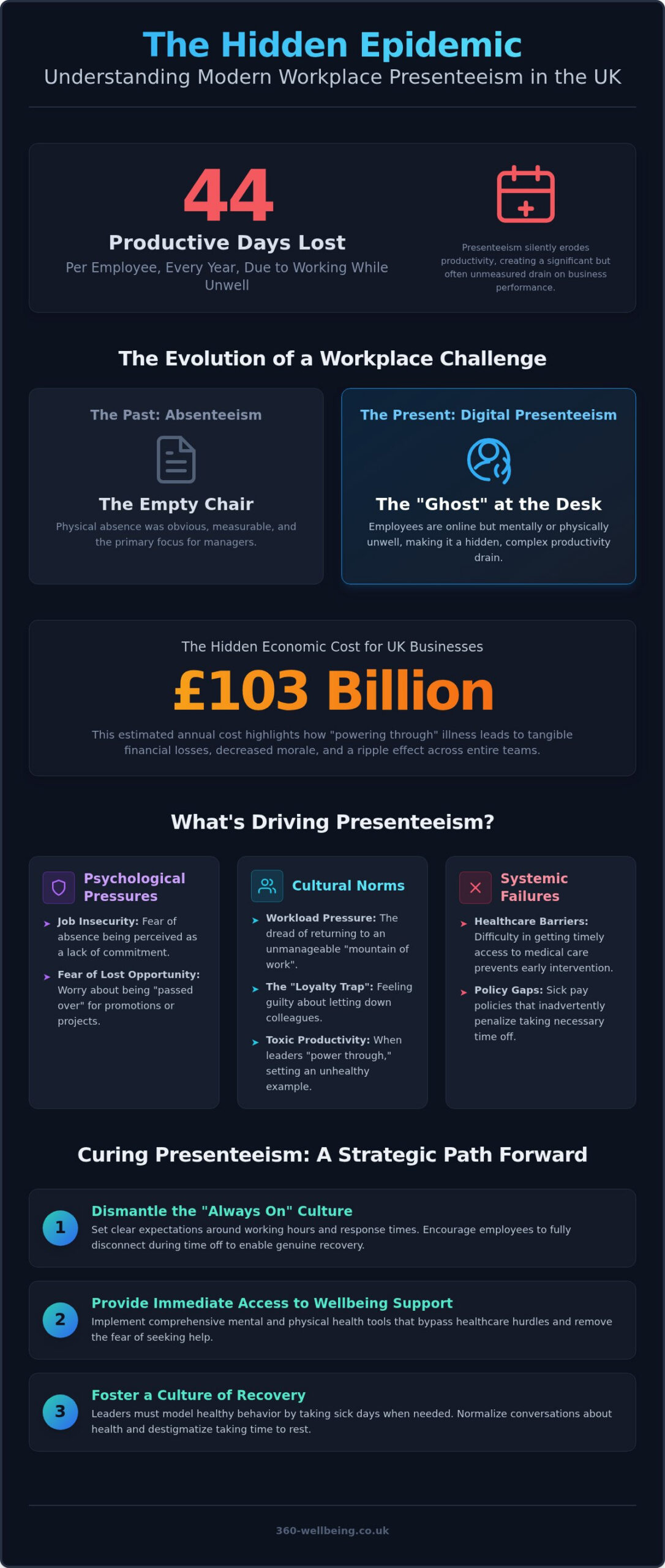
UK employees now lose an average of 44 productive days every year not because they’re absent, but because they’re working while unwell. It’s a staggering figure that highlights how the causes of presenteeism in the workplace have evolved into a complex, digital-first challenge for 2026. You’ve likely noticed the subtle signs in your own teams: the “active” status flickering late into the evening or the colleague who joins a video call despite being clearly exhausted. While this might look like dedication, it’s often a symptom of a culture where people feel they can’t step away, leading to hidden productivity losses and rising staff burnout.
We agree that measuring the impact of someone being “there but not working” is one of the toughest hurdles for any modern employer. This guide promises to help you identify the root psychological and systemic drivers of this behaviour so you can reduce the long-term cost of illness. We’ll preview the latest UK trends, including the impact of 2026 sick pay changes, and provide a structured path to improve morale. By moving toward a proactive vision of workplace harmony, you can transform your team’s health from a professional necessity into a shared success.
Key Takeaways
- Understand how presenteeism has transitioned from physical attendance to the digital space, making it a more complex challenge for modern UK employers to track and manage.
- Identify the psychological and cultural causes of presenteeism in the workplace, including the fear of job insecurity and the mounting pressure of unmanaged workloads.
- Recognise the signs of digital presenteeism in hybrid teams and learn how to dismantle the “always on” culture that often leads to hidden productivity losses.
- Explore the systemic healthcare barriers that prevent early intervention and discover how providing immediate access to support can bypass these hurdles.
- Develop a proactive strategy to foster a culture of recovery, using comprehensive wellbeing tools to improve employee retention and long-term morale.
The Evolution of Workplace Presenteeism in 2026
By 2026, the way we measure employee engagement has undergone a radical shift. For decades, managers focused on absenteeism, the obvious metric of who was missing from their desk. Today, a far more complex challenge has taken centre stage. To understand this shift, we must first look at What is Presenteeism? in a modern context. It’s defined as the act of attending work while physically or mentally unwell, a state where an employee is “checked in” but unable to function at their full capacity. While an empty chair is easy to spot, the “ghost” at the desk is much harder to track, making it a silent drain on UK productivity.
The 2026 context is unique. With average sickness absence days rising to 9.4 per employee in 2025, many businesses have inadvertently created cultures that reward “showing face” over actual output. This has led to presenteeism overtaking absenteeism as the primary threat to organisational health. To address the root causes of presenteeism in the workplace, we must adopt a panoramic viewpoint. This means looking beyond just physical symptoms to understand how mental and social health are inextricably linked to a person’s ability to perform. When one element of this triad is out of balance, the entire foundation of productivity begins to crumble.
Why ‘Powering Through’ is a Productivity Killer
The “Hero Complex” is a pervasive issue in professional environments. It’s the belief that showing up while ill is a sign of dedication, but the reality is far less noble. In a physical office, this leads to contagion, while in digital spaces, it spreads a culture of exhaustion. When employees work through illness, their decision making suffers and error rates climb. This is particularly dangerous in high pressure roles where precision is vital. The persistent habit of working while ill acts as a multiplier effect, where minor ailments evolve into long-term sick leave or total burnout.
The Hidden Economic Cost for UK Businesses
The financial impact is no longer a theoretical concern. Research shows the cost of presenteeism in the UK reached an estimated £103 billion recently, a massive leap from previous years. For the average SME, this isn’t just a line on a spreadsheet; it’s a tangible loss of momentum. When one team member is visibly struggling but refuses to rest, it creates a ripple effect that lowers the morale of the entire group. Traditional attendance metrics are failing modern managers because they don’t account for the quality of time spent working. A “green light” on a messaging app doesn’t guarantee that work is being done, and it certainly doesn’t mean the employee is healthy.
Psychological and Cultural Drivers of Presenteeism
While physical symptoms are the most visible signs of illness, the psychological causes of presenteeism in the workplace often stem from deep-seated fears and cultural expectations. Many employees feel trapped by job insecurity, fearing that any absence might signal a lack of commitment or lead to being “passed over” during the next round of promotions or redundancies. This isn’t just about the risk of losing a role; it’s about the perceived loss of status or future opportunity in a competitive market. When people feel their position is fragile, they’re far more likely to show up when they’re struggling, prioritising visibility over their own recovery.
Workload pressure is another primary driver. The thought of returning to a “mountain of emails” often outweighs the need for rest. This is frequently compounded by the “Loyalty Trap,” where individuals feel they’re letting their colleagues down by being absent. As noted in research from IZA World of Labor, these job demands and constraints on absence are significant systemic drivers that force people to work when they should be recovering. It’s a cycle that’s difficult to break without a fundamental shift in how we value health.
The Impact of Workplace Culture and Leadership
Leadership behaviour acts as a powerful signal within any organisation. When managers “power through” illness, they inadvertently suggest that rest is a sign of weakness. This creates a performance-only culture where health concerns are silenced by toxic productivity. Identifying these cultural causes of presenteeism in the workplace is the first step toward change. By providing accessible Mental Health Support, you can remove the fear of seeking help and replace a culture of fear with one of empowerment and durability.
Personal Financial Stress as a Driver
Personal financial stress is a silent but powerful motivator. With the cost of living remaining a significant concern in 2026, many workers simply can’t afford any reduction in income, especially if they’re worried about the limits of their sick pay. This anxiety leads to “mental presenteeism,” where an employee is physically present but their mind is occupied by debt or household bills. Employers can play a transformative role here by offering Financial Support for Employees to alleviate these burdens, helping them regain their focus and vitality.
The Rise of ‘Digital Presenteeism’ in Hybrid Teams
As hybrid working becomes the standard for UK businesses in 2026, a new phenomenon has emerged: digital presenteeism. It’s no longer just about physical attendance. Today, it’s about the pressure to maintain a “green” status on Slack, Teams, or Zoom, even when an employee is struggling with illness. This shift has created a unique set of causes of presenteeism in the workplace, where the boundary between recovery and work is almost entirely eroded. In fact, 35% of organisations report that presenteeism has increased specifically due to employees working from home. When your office is also your bedroom, the temptation to “just log on” while sick is immense, turning what should be a day of rest into a day of low-quality, exhausting output.
This erosion of boundaries means that working from bed has become the modern equivalent of coming into the office with a heavy cold. It feels less intrusive, yet the impact on health is just as damaging. In a remote environment, mental health struggles become invisible. Without the face-to-face cues of a physical office, managers often miss the subtle signs of burnout or anxiety. Digital exhaustion sets in when employees feel they must perform “presence” through constant activity, leading to a lack of genuine engagement and a slow decline in vitality.
The ‘Always-On’ Expectation
The constant pings of notifications outside of core hours create a persistent sense of urgency. When remote monitoring tools are used to track activity rather than outcomes, they inadvertently fuel digital presenteeism. Employees begin to fear that stepping away for a nap or a doctor’s appointment will be viewed as slacking. Managers must take a proactive role here. Encouraging specific “offline” blocks for recovery isn’t just a kindness; it’s a professional necessity to ensure the long-term durability of the team.
Spotting the Signs of a Disengaged Remote Worker
Identifying presenteeism in a hybrid team requires a keen eye for digital red flags. You might notice:
- A sudden slowing of response times on simple tasks.
- A noticeable dip in the quality or creativity of work.
- “Performative” activity, such as sending emails at odd hours without meaningful progress.
Taking a proactive approach is essential. Instead of waiting for a crisis, provide your team with the tools they need to prioritise health. Providing immediate 24/7 Virtual GP access removes the “I’ll just work from home” compromise, allowing employees to get a professional diagnosis in minutes and take the rest they actually need.
Systemic Causes: Healthcare Barriers and Policy Failures
The structure of the healthcare system itself is one of the most overlooked causes of presenteeism in the workplace. Even with the landmark changes to Statutory Sick Pay (SSP) in April 2026, which removed the three-day waiting period and earnings limit, many employees still face significant systemic hurdles. When a worker feels a nagging physical pain or a dip in their mental vitality, their first thought is often the “GP Barrier.” In many parts of the UK, securing a routine appointment can take weeks. This delay forces staff into a state of diagnostic limbo, where they continue to work because they lack a formal diagnosis or a professional recommendation to rest.
Traditional benefit packages often lack the holistic depth required to address why people show up when they’re struggling. While an employer might offer basic sick pay, the absence of legal or financial advice leaves employees to navigate personal crises while sitting at their desks. This lack of integrated pathways means that mental health concerns are often ignored until they reach a breaking point, turning manageable stress into a long-term productivity drain. Without a panoramic view of health, these structural failures continue to trap employees in a cycle of “showing face” while their wellbeing declines.
The Friction of Modern Healthcare Access
For many staff, taking a half-day to sit in a surgery waiting room feels like a waste of time they don’t have. They’d rather “power through” than deal with the administrative friction of traditional healthcare. This is where the 24/7 Virtual GP becomes an essential tool for workplace harmony. By providing immediate access to a UK-registered doctor, employees can get professional reassurance or a prescription in minutes. This removes the diagnostic delay and prevents minor ailments from spiralling into chronic presenteeism, ensuring your team stays durable and focused.
When Wellbeing Platforms Fail to Connect
Many businesses fall into the trap of “tick-box” wellness, offering fragmented services that don’t speak to each other. Accessibility is the most vital feature of any support system. If a platform is hard to navigate or only offers surface-level advice, it won’t be used by the people who need it most. We believe in transitioning from “employee benefits” to “essential human entitlements,” where mental health support and financial aid are woven into a single narrative of care. To move beyond fragmented care, you can access our integrated 360 Wellbeing platform to provide your team with the panoramic support they deserve.
Curing Presenteeism: A Strategic Path Forward
Addressing the root causes of presenteeism in the workplace requires more than just a policy update; it demands a fundamental cultural shift. To move away from the “hero complex” and digital exhaustion we’ve discussed, leaders must actively build a culture of “Permission to Recover.” This means more than just telling staff to take time off; it involves demonstrating that rest is a professional necessity and a shared value. When managers lead by example and prioritise their own recovery, they dismantle the unspoken expectation that visibility equals value. This shift is the first step in transforming a fragmented environment into a proactive vision of workplace harmony.
The transition from reactive “sick notes” to proactive “vitality plans” is essential for long-term workforce durability. Rather than waiting for an employee to reach a breaking point, a vitality plan focuses on foresight and prevention. It encourages regular check-ins where health is discussed as an essential human entitlement rather than a luxury. By training managers to recognise the subtle digital red flags of disengagement, you can intervene before minor stress evolves into chronic burnout. This methodical approach creates a sense of safety and order, allowing employees to feel supported throughout their entire health journey.
Integrating 24/7 Virtual GP and Mental Health Support
A truly effective strategy must provide a panoramic safety net that covers physical, mental, and social health. By offering immediate clinical access through a 24/7 Virtual GP, you remove the most common excuse for “powering through” illness. There is no longer a need to wait weeks for a diagnosis or spend hours in a waiting room. When this is paired with robust Mental Health Support and life coaching, you address the social causes of workplace stress, such as relationship issues or personal anxieties. This all-encompassing care ensures that every barrier to seeking help is removed, making wellbeing accessible and manageable for everyone.
Measuring Success Beyond Attendance
Traditional attendance metrics are obsolete in 2026. To understand the true health of your organisation, you must look at deeper indicators such as employee engagement, retention rates, and platform utilisation. A workforce that is present, focused, and vital provides a far higher ROI than one that is simply “logged on” while struggling. When employees feel genuinely cared for, their loyalty and morale improve, leading to a more stable and productive team. You can discover how 360 Wellbeing can transform your team’s productivity by providing the modern, empathetic support they need to thrive.
Building a Future of Sustainable Workplace Vitality
The landscape of work in 2026 has transformed, and with it, the causes of presenteeism in the workplace have become more nuanced than ever. We’ve explored how the shift from physical to digital spaces has blurred the lines between recovery and performance, often leaving employees feeling trapped by a perceived need to be “always on.” By addressing these psychological, cultural, and systemic drivers, you can move beyond simply tracking attendance and start fostering genuine engagement. Cultivating a culture where health is seen as a professional necessity rather than a luxury is the key to long-term durability.
Providing your team with a panoramic support system removes the friction that often leads to “powering through” illness. When you replace diagnostic delays and financial anxiety with immediate, accessible care, you empower your workforce to prioritise their recovery. We’re here to partner with you in creating a workplace where health and harmony are the foundations of every success story.
Empower your team with 24/7 Virtual GP and holistic support from 360 Wellbeing. Our platform is designed specifically for UK SMEs and sole traders, offering integrated mental health and financial support alongside access to UK-registered GPs within minutes. Together, we can build a resilient team that’s truly present and ready to thrive.
Frequently Asked Questions
What are the most common causes of presenteeism in the UK?
Job insecurity, high workloads, and a lack of sick pay for lower earners are historically the primary causes of presenteeism in the workplace. In 2026, these are joined by digital pressures and the “always-on” culture of hybrid work. Employees often feel that showing up while ill is the only way to prove dedication. Addressing these systemic issues requires a shift toward proactive wellbeing strategies that prioritise long-term durability over short-term visibility.
How does digital presenteeism differ from traditional office presenteeism?
Traditional presenteeism involves physically attending an office while unwell. In contrast, digital presenteeism is the pressure to remain “active” on platforms like Slack or Teams from home. It’s often harder to detect. Employees can “power through” from bed without visible signs of illness. This digital version leads to longer recovery times as the boundaries between work and rest disappear, making it a primary concern for modern hybrid teams.
Can an Employee Assistance Programme (EAP) actually reduce presenteeism?
An Employee Assistance Programme (EAP) is a vital tool. It provides a confidential gateway for staff to address the underlying issues that drive them to work while unwell. By offering immediate access to mental health therapy and life coaching, an EAP helps employees manage stress before it leads to a crisis. It transforms the culture from “silent suffering” into proactive health management, ensuring every team member feels supported, empowered, and truly valued.
Is presenteeism more expensive for a business than absenteeism?
Presenteeism is significantly more expensive than absence. Research estimates the annual cost to the UK economy is now over three times higher than that of absenteeism. While an empty desk is easy to measure, presenteeism results in “ghost work” where output is low and error rates are high. It also leads to longer-term illness. The cost of replacing a burnt-out employee far exceeds the cost of a few days of recovery.
What are the physical signs of stress to watch for in staff?
Managers should watch for consistent fatigue, frequent headaches, and changes in appetite. Other signs include irritability, a lack of concentration, or physical tension like jaw clenching. These symptoms often signal that an employee is struggling with “mental presenteeism.” In this state, they are physically present but their cognitive capacity is diminished by unmanaged stress. Recognising these signs early is essential for maintaining a healthy, balanced, and productive workforce.
How can a Virtual GP service help reduce presenteeism in my team?
A 24/7 Virtual GP service reduces presenteeism by removing the “GP Barrier.” It allows staff to speak with a UK-registered doctor within minutes. Instead of waiting weeks for an appointment or “powering through” a minor illness that might become chronic, employees can get an immediate diagnosis and prescription. This fast intervention provides the reassurance needed to take rest, leading to a much quicker return to full vitality and sustained workplace productivity.
What role does financial stress play in workplace presenteeism?
Financial stress is a powerful driver among the causes of presenteeism in the workplace, especially for those who feel they cannot afford a reduction in income. Anxiety over debt or household bills often manifests as a lack of focus and reduced cognitive capacity at the desk. Providing access to financial support and debt advice helps alleviate these burdens. This allows employees to bring their full, healthy selves to work rather than just their physical presence.
How should managers talk to employees about presenteeism without being accusatory?
Managers should approach these conversations from a panoramic viewpoint of support. Instead of performance monitoring, try a human touch. Ask, “I’ve noticed you haven’t seemed yourself lately; how can we support your recovery?” This empathetic approach establishes a partnership between the employer and the user. It moves the focus toward a shared goal of long-term health and workplace harmony, making the employee feel valued as a professional necessity and a human being.