What if the strongest case for wellbeing isn’t a promise of happier employees, but a practical response to challenges your organisation already faces? If you’re considering how to convince senior leadership to invest in wellbeing, connect employee needs to priorities such as retention, attendance and sustainable performance.
Leaders may question whether wellbeing belongs in the budget, especially when evidence, costs and competing priorities all need careful consideration. Deloitte estimates that poor mental health costs UK employers up to £51 billion a year, with presenteeism accounting for the largest share. This is a reason to look beyond absence alone, not a promise that a particular programme will produce savings.
This guide will help you build a concise proposal grounded in your workforce’s needs. You’ll learn how to make a business case, respond honestly to questions about evidence and measurement, and recommend a manageable next step for leadership to assess.
From choosing relevant measures to considering joined-up support for physical, mental and financial wellbeing, you’ll find a practical way to turn a broad idea into a focused proposal.
Key Takeaways
- Learn how to convince senior leadership to invest in wellbeing by linking a defined workforce need to the organisation’s current priorities.
- Use anonymised feedback, absence patterns, retention data and benefit uptake thoughtfully, separating what the evidence shows from what it may suggest.
- Prepare balanced responses to questions about costs, expected outcomes and evaluation without promising a guaranteed return.
- Shape your case into a concise proposal with a clear objective, delivery plan, review measures and specific decision request.
- Structure the leadership conversation around the need, evidence and practical next step, while making space for trade-offs and questions.
How to Convince Senior Leadership to Invest in Wellbeing
Leaders weigh employee wellbeing alongside service delivery, budgets, staffing and other immediate demands. A proposal is more likely to receive serious consideration when it explains why support is relevant now, who needs it and what decision you’re asking leaders to make. The aim isn’t to suggest wellbeing matters more than every other priority. It’s to show where it fits in the organisation’s wider plans.
A wellbeing investment is planned support that responds to identifiable workforce needs, rather than a perk selected without a clear purpose. It is a considered commitment to support employees, with a clear plan for delivery and review. Support might include mental health support, physiotherapy or financial guidance. A neutral overview of workplace wellness programmes can help clarify the range of approaches, but your proposal should focus on what fits your people and organisation.
Your role is to translate employee needs into a decision leaders can assess and review. Describe the need specifically, explain the evidence behind it, set out the resources involved and be open about what the evidence can’t establish. A persuasive case isn’t a sales pitch. It doesn’t rely on dramatic promises or claim that one programme will automatically improve productivity, retention or financial performance. It invites leaders to consider a practical response and agree how to assess it.
Why leadership may not yet see wellbeing as a priority
Short-term operational pressures can make longer-term workforce needs harder to see. A leader may recognise that employees need support but still have questions: how widespread is the need, how would the approach work, is it affordable, and how will progress be reviewed? These are reasonable decision-making questions, not proof that leaders are uncaring. Address them with relevant information, clear boundaries and a proportionate next step.
What a credible wellbeing proposal needs to answer
Before presenting your case, be ready to explain:
- Whose needs are being addressed? Identify the employee groups or circumstances in focus, and explain how you recognised those needs.
- What organisational outcome matters? Connect the proposal to a priority leaders already value, such as supporting workforce capability, without claiming the initiative alone will cause a particular result.
- What decision is needed? State the proposed support, resources and immediate approval request. Then explain what you’ll review and when.
This is the foundation of how to convince senior leadership to invest in wellbeing: make the need, proposal and limits easy to understand. A focused case gives decision-makers a sound basis for discussing the next step, even when the evidence also raises questions to explore.
Build the Wellbeing Business Case Around Evidence and Organisational Priorities
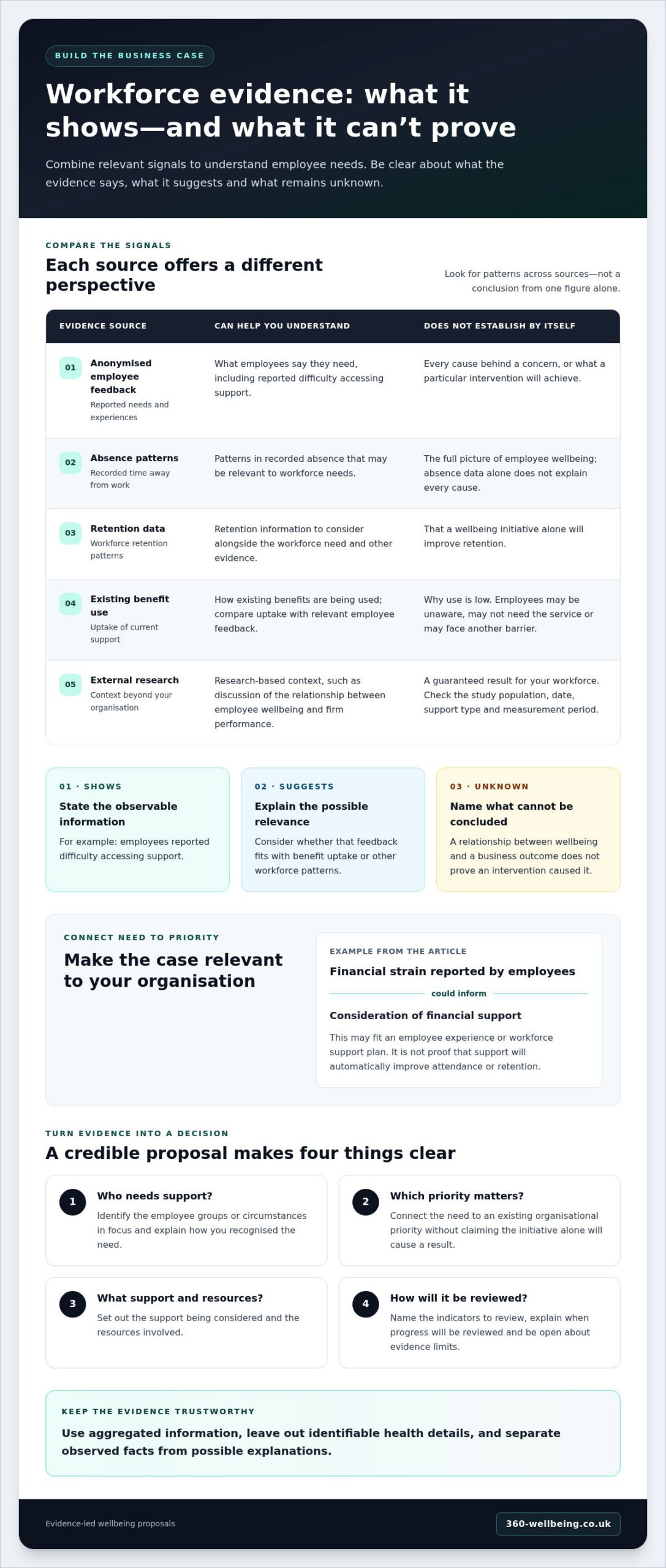
A credible business case starts with what’s happening in your organisation, not a striking statistic from somewhere else. Bring together workforce signals such as anonymised employee feedback, absence patterns, retention data and existing benefit use. Each offers a different perspective: feedback can reveal reported needs, while absence data shows recorded time away. Neither alone explains every cause or proves what a particular intervention will achieve.
Choose evidence that fits your organisation
Look for patterns across sources rather than building the case around one figure. For example, employee comments about difficulty accessing support may be worth considering alongside relevant benefit uptake. Low use by itself doesn’t show whether employees lack awareness, don’t need the service or face another barrier. Present what the data shows, what it suggests and what remains unknown. Use aggregated information and leave out identifiable health details.
External research can add context if you describe its limits. Check the study’s population, date, type of support and measurement period before applying its findings to your workforce. Harvard Business School’s paper on evidence on employee well-being and firm performance offers a research-based discussion of the relationship. Broader findings shouldn’t be presented as a guaranteed outcome for your organisation.
An association between wellbeing and a business outcome can support a case for action, but it doesn’t prove that a particular intervention caused that outcome. This distinction builds trust. It also gives you a sound reason to agree how progress will be reviewed, rather than promising a return the available evidence can’t establish.
Translate wellbeing needs into leadership priorities
Connect the need you’ve identified to an existing organisational priority. If employees report financial strain, for instance, you could explain how financial support might fit into an employee experience or workforce support plan. That’s a reason to consider the approach, not evidence that it will automatically improve attendance or retention. For more context, read this guide to financial support for employees.
Keep the proposal specific: name the need, the support being considered, the resources required and the indicators leaders could review. When needs span physical, mental and financial wellbeing, a joined-up offer is one option to explore. 360 Wellbeing brings employee support together through a platform that includes 24/7 access to a UK-registered GP, mental health support, physiotherapy, life coaching, financial and legal support, and 360 Rewards. Explore 360 Wellbeing’s employee support to see how this range could fit the needs you’ve identified.
Address the Biggest Objections to Wellbeing Investment Without Overclaiming
Questions about cost, evidence and delivery are a normal part of deciding whether a proposal is right for the organisation. Answer them directly. Wellbeing support may address meaningful employee needs, but no single programme guarantees a financial return or a specific change in attendance, retention or performance. Explain what can be assessed, what remains uncertain and how leaders can make a proportionate decision.
| Leadership concern | Balanced response and practical next step |
|---|---|
| “Can we afford it?” | Set out the full proposed commitment, including recurring fees and internal time needed to communicate and coordinate the offer. Compare it with the agreed objective, not with speculative savings. |
| “How do we know it will pay off?” | Don’t promise a return. Agree suitable measures and explain that changes in workforce indicators may have several causes, so they can’t automatically be attributed to the programme. |
| “Will employees use it?” | Plan clear, inclusive communication and review awareness, access, uptake and employee feedback. Low uptake is a prompt to understand barriers, not proof that support has no value. |
| “Will this create more work?” | Name who will manage communications, answer practical questions and review results. A defined delivery plan makes responsibilities visible before approval. |
| “Is access fair?” | Explain who can access the support and how employees will learn about it. Consider whether different needs, working patterns or circumstances could affect awareness and access. |
How to respond when leaders ask for proof of ROI
Start with a baseline and objectives that matter to the organisation. Depending on the proposal, measures might include awareness, uptake, employee feedback or relevant aggregated workforce indicators. Compare results at agreed review points, and report what changed alongside factors that may have influenced it. A limited pilot can help test delivery and understanding before a broader decision, but be transparent about its full costs and limits. It can reduce uncertainty, not remove it.
How to respond to concerns about uptake and delivery
Make the employee experience concrete: explain how support will be introduced, where employees will find information and who handles internal coordination. Clear communication and visible leadership endorsement may help employees understand an offer, but don’t treat them as a guarantee of participation. Review awareness and feedback as well as uptake. Keep health information confidential, and use aggregated reporting suited to the decision rather than individual details.
This is a practical part of how to convince senior leadership to invest in wellbeing: replace broad assurances with transparent trade-offs and a review plan. Leaders can then assess whether the approach remains useful, needs adjustment or should not continue, based on agreed objectives and the evidence available.
Turn the Case into a Practical Wellbeing Proposal Leaders Can Approve
A clear proposal helps leaders understand what they’re being asked to approve, what delivery will involve and how progress will be reviewed. Keep the main document concise, with supporting detail available if needed. You don’t need to remove every uncertainty. Show that the decision has been considered and can be revisited in light of evidence.
Build the case in this order:
- Define the need. State whose needs the proposal addresses and summarise the evidence behind them.
- Set an objective. Describe what the organisation wants to support, such as greater awareness of available help or a more accessible route to support.
- Compare an approach. Explain why the proposed support fits the identified need, including whether a focused or joined-up offer is more suitable.
- Cost the proposal. Set out the full financial commitment and any internal time or coordination required. For a per-employee subscription, make clear how the recurring cost will be budgeted.
- Agree review measures. Choose a small set of indicators, a baseline where available and a review point. Explain how findings will inform the next decision.
What to include in a one-page leadership proposal
Use an executive summary to make the decision request easy to find. Then briefly cover the workforce need, evidence sources, employee groups in scope, proposed support, delivery responsibilities and resource requirements. Include the objective, measures, review timing and important risks or limitations. End with a specific request, such as approval to explore a defined pilot or proceed with a phased implementation, where appropriate.
Name an owner for coordination and explain how employees will hear about the support and access it. If the proposal brings together physical, mental, financial or other forms of support, show how that range responds to the needs you identified. A broad offer isn’t a benefit on its own unless it fits those needs.
How to set realistic measures and a review point
Pick indicators that match the objective and information you can responsibly access. Awareness, access, uptake and employee feedback can help show whether support is reaching people and how it is experienced. Relevant workforce trends may add context, but don’t treat them as proof that the initiative caused a change. Agree in advance who will review the findings, what leaders will receive and whether results could lead to continuation, adjustment or further evaluation.
A focused proposal can turn how to convince senior leadership to invest in wellbeing into a practical decision, with clear ownership and a proportionate next step. Explore 360 Wellbeing’s joined-up employee support as one option when shaping an approach around varied workforce needs.
Present Your Wellbeing Case and Agree the Next Step
A thoughtful proposal is only part of the work. The leadership conversation gives decision-makers a chance to test the reasoning, raise practical concerns and agree what should happen next. Keep the discussion calm and focused: start with the workforce need, explain the evidence, outline your proposal, acknowledge trade-offs, describe how progress will be reviewed, then make a clear decision request.
A clear way to open and close the leadership conversation
Begin with the need and its connection to an organisational priority. For example: “Employee feedback points to a need for more accessible support, which may be relevant to our aim of strengthening the employee experience.” Then summarise what you’re proposing and what the evidence can and can’t tell you. Invite questions rather than treating concerns as resistance.
Prepare concise answers on practical details, including the full cost, how employees will access support, how it will be communicated and how health information will remain confidential. Be clear about evaluation limits too: a change in a workforce indicator may have several causes and won’t, on its own, prove that the wellbeing initiative produced it.
Close with a decision leaders can act on. For example: “I’m asking for approval to take this defined approach forward, with a named owner and an agreed review of access, feedback and relevant workforce measures.” If the proposal isn’t ready for full approval, request a proportionate next step, such as permission to develop a more detailed plan. Before the meeting ends, confirm the action owner, next action and date for revisiting the decision.
Where a joined-up support offer can fit
Employee needs rarely fall into one neat category. One person may need help with a physical concern, mental health support or financial pressure, while another may need something different. A joined-up platform can bring several forms of support together, helping an employer consider a broader range of circumstances in one proposal. 360 Wellbeing brings physical, mental, financial and legal support together for employees, including access to a UK-registered GP 24/7, mental health support, physiotherapy, life coaching, financial and legal support, and complimentary will writing.
Assess this kind of offer against the needs you’ve identified, rather than presenting it as a guaranteed route to better business outcomes. The decision should still rest on fit, affordability, access and agreed measures.
Taking a clear, balanced approach is central to how to convince senior leadership to invest in wellbeing. If a joined-up offer may suit your proposal, explore 360 Wellbeing’s employee support platform as a way to bring different forms of support into the discussion.
Make Your Wellbeing Proposal Easier to Act On
A convincing case starts with a real workforce need and connects it to a priority leaders already recognise. Use relevant evidence carefully, be upfront about costs and uncertainty, and agree how progress will be reviewed. You don’t need approval for a sweeping programme all at once. A clear, proportionate next step gives leaders a practical way to move forward.
If you’re considering how to convince senior leadership to invest in wellbeing, make the decision straightforward: define the need, outline the support and state exactly what approval you’re seeking. A joined-up approach may help address varied employee circumstances by bringing physical, mental, financial and legal support together. 360 Wellbeing’s platform is designed for small businesses, sole traders and larger organisations, and includes access to a UK-registered GP 24/7.
Explore 360 Wellbeing’s employee support platform and consider how its support could fit the needs you’ve identified. A thoughtful proposal and manageable first step can help make employee wellbeing a more considered part of organisational planning.
Frequently Asked Questions
How do you convince senior leadership to invest in employee wellbeing?
Build a concise case around a clearly identified workforce need, credible evidence and an organisational priority leaders already recognise. To understand how to convince senior leadership to invest in wellbeing, explain what support you propose, what it requires and how progress could be reviewed. Be clear about what the evidence can’t prove, then make one specific decision request, such as approval to develop a proportionate pilot or implementation plan.
What evidence should you use to make a case for workplace wellbeing?
Use a combination of anonymised employee feedback and relevant workforce information, such as absence patterns, retention data or existing benefit use. Explain what each source shows and where its limits lie. External research can add context if its population, intervention and measurement period are relevant to your organisation. Avoid presenting a relationship between wellbeing and a business outcome as proof that a particular programme caused that outcome.
How do you calculate the ROI of employee wellbeing?
Start by defining the programme’s full costs, objectives, measures and review timeframe. Compare the investment with outcomes you can observe, such as access, uptake or relevant workforce trends, rather than relying on speculative savings. Changes may have multiple causes, so they don’t automatically demonstrate that the programme created a financial benefit. Report findings transparently, including limitations, and avoid promising a guaranteed return.
What should a wellbeing business case include?
A wellbeing business case should set out the workforce need, evidence sources and employees the proposal aims to support. Describe the proposed support, how it will be implemented, who will own delivery and what resources are required. Include realistic objectives and measures, relevant risks, a review point and the specific approval being requested. A short executive summary can help leaders see the decision clearly before reading further detail.
How can a small business make a case for employee wellbeing support?
Keep the proposal proportionate and base it on needs your staff have expressed or that available workforce information suggests. Explain how the support could fit the business’s practical budget and how employees would access it. Choose a manageable evaluation plan, such as reviewing awareness, uptake and feedback at an agreed point. Focus on a clear first step rather than proposing a broad programme without a defined purpose.
What if senior leaders say there is no budget for wellbeing?
Ask what budget constraints apply and when funding decisions can be revisited. Then prioritise the workforce need most relevant to organisational goals and consider whether a phased approach could make the decision manageable. Be open about the resources involved, including internal time, and identify what information leaders would need to assess a next step. Don’t claim that the support will pay for itself unless your own evidence can substantiate that conclusion.
How do you measure whether an employee wellbeing programme is working?
Agree objectives and a review period before the programme begins. Choose suitable measures, which might include employee awareness, access, uptake and feedback, alongside relevant workforce indicators where appropriate data is available. Review these together rather than relying on a single figure. Changes in absence or retention, for example, may have several contributing factors, so interpret results carefully and use them to decide whether to continue, adjust or evaluate further.