
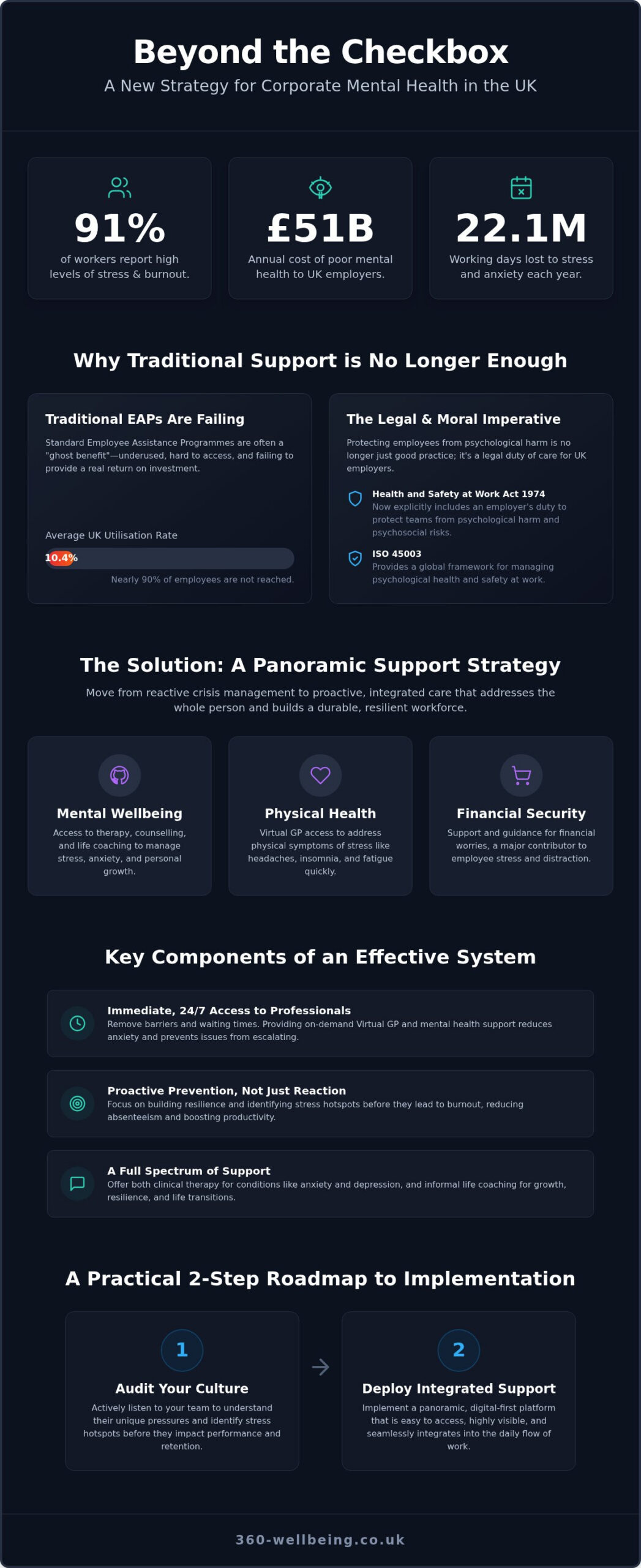
With 91% of workers now reporting high levels of stress and burnout, the traditional “check-the-box” approach to employee wellbeing has reached its breaking point. It’s a challenging time to lead, especially when you’re trying to balance your moral duty of care with the practical need for a productive team. If you’ve found that your current corporate mental health support uk feels more like a hidden insurance perk than a living part of your culture, you aren’t alone.
You already know that a healthy business is built on healthy people, yet the path to achieving that balance often feels clouded by complex legal obligations and underused services. This guide will show you how to move beyond reactive crisis management to implement a high-impact, panoramic strategy that improves retention and boosts productivity across your entire UK workforce. We’ll explore the shift toward psychological safety as a legal requirement, the clear ROI of proactive care, and the essential steps needed to transform workplace harmony into a sustainable professional asset.
Key Takeaways
- Understand why 2026 marks a critical shift in legal expectations for UK employers, making psychological safety a core pillar of the modern workplace.
- Learn how to adopt a panoramic viewpoint that seamlessly integrates mental, physical, and financial health into a single, unified support strategy.
- Evaluate the most effective models for corporate mental health support uk, from DWP Access to Work schemes to specialized private platforms.
- Discover a practical, two-step roadmap for auditing your current culture and identifying stress hotspots before they lead to burnout.
- See how providing immediate, 24/7 access to professional care can significantly reduce absenteeism and foster a more resilient, loyal workforce.
The State of Corporate Mental Health Support in the UK (2026)
In its simplest form, corporate mental health support uk encompasses the systems, benefits, and cultural values an employer implements to safeguard the psychological safety of their team. It isn’t just about offering a helpline; it’s about building a durable environment where employees feel seen, heard, and supported. As we move through 2026, this has shifted from a “nice-to-have” benefit to a strategic pillar of the “Great Retention.” Businesses now realize that a resilient workforce is their most valuable asset, and protecting that asset requires a panoramic view of wellbeing that balances professional necessity with genuine compassion.
The financial impact is staggering, with poor mental health costing UK employers around £51 billion each year. This isn’t just a balance sheet issue; it’s a human one, reflected in the 22.1 million working days lost to anxiety and stress. We’ve reached a turning point where reactive crisis management is no longer enough. The most successful organisations in 2026 are those moving toward proactive prevention, looking at health through a panoramic lens to catch issues before they escalate into long-term absences. This shift is driven by a need for stability in an economic climate where burnout has become a persistent risk to productivity.
Why Traditional EAPs Are No Longer Enough
For years, many organisations relied on standard Employee Assistance Programmes (EAPs) as a “tick-box” exercise. However, with an average utilization rate of just 10.4% in the UK, it’s clear these services aren’t reaching those who need them most. Employees often forget these “hidden” helplines even exist, or they find the barrier to entry too high during a moment of distress. In our digital-first, hybrid world, support needs to be immediate and accessible. If a platform isn’t integrated into the daily flow of work, it remains a ghost benefit that fails to deliver a real return on investment for the business or its people.
The Legal and Moral Case for UK Employers
The conversation around Mental health in the United Kingdom has evolved significantly, particularly regarding employer responsibility. Under the Health and Safety at Work Act 1974, regulators now explicitly include protection from psychological harm as part of an employer’s duty of care. This legal shift is supported by international standards like ISO 45003, which provides a framework for managing psychosocial risks. Treating mental health as a professional necessity rather than a luxury isn’t just the right thing to do; it’s a fundamental requirement for any modern business aiming for long-term stability and workplace harmony.
Key Components of a Comprehensive Support Strategy
Effective corporate mental health support uk requires more than a reactive helpline. It demands a panoramic viewpoint that recognizes how mental, physical, and financial health are deeply intertwined. When an employee is struggling, the cause is rarely isolated to a single area of their life. A comprehensive strategy addresses the whole person, providing a safety net that catches small worries before they escalate into significant crises. This integrated approach ensures your team feels supported in every dimension of their wellbeing, fostering a culture of durability and trust.
Immediate access to professional help is the cornerstone of this panoramic care. In a traditional system, an employee might wait weeks for a GP appointment to discuss stress or fatigue. By providing 24/7 Virtual GP access, you remove the friction of waiting. This isn’t just about physical prescriptions; it’s about the reassurance that comes from speaking to a professional at the exact moment it’s needed. This immediate connection reduces anxiety for both the employee and their family, creating a sense of safety that carries over into their professional performance.
It’s also essential to distinguish between different types of support. While structured mental health therapy is vital for clinical conditions like anxiety or depression, informal life coaching serves a different purpose. Coaching is often about growth, resilience, and managing life transitions. By offering both, you ensure that employees have the right tool for their specific journey, whether they’re healing from a setback or looking to build their future potential.
The Role of Virtual Healthcare in Mental Wellbeing
Physical symptoms are often the first signs of psychological stress. Chronic headaches, insomnia, and digestive issues frequently stem from workplace pressure. Digital-first care allows employees to address these symptoms quickly, reducing the need for time off and preventing minor ailments from becoming long-term health hurdles. The UK government has recently emphasized the necessity of Prioritising mental health in the workplace, noting that proactive healthcare is a professional necessity for a thriving, modern economy.
Addressing the ‘Stress Triggers’ Beyond the Office
Financial anxiety is one of the most significant, yet overlooked, drivers of workplace stress. When a team member is worried about debt or legal complications, their focus and engagement naturally decline. Providing access to debt advice and complimentary will writing offers a practical form of “mental health insurance.” These services provide the peace of mind needed to remain present and productive. You can explore how to integrate these benefits in our guide on Financial Support for Employees: A Comprehensive Guide for UK Employers in 2026.
Building this kind of durability into your business starts with choosing a partner who understands the panoramic nature of health. Discover how our integrated support platform can help you protect your most valuable asset.
Comparing Support Models: Charities, DWP, and Private Platforms
Choosing the right model for corporate mental health support uk requires a clear understanding of your team’s unique pressures and the speed at which they need assistance. Employers today generally look toward three main avenues: government-funded schemes, charity partnerships, and private wellbeing platforms. Each serves a distinct purpose in a panoramic health strategy. While some provide the foundational “legal floor,” others offer the high-engagement, proactive care needed to truly reduce absenteeism and foster loyalty.
The Department for Work and Pensions (DWP) offers the Access to Work Mental Health Support Service. This is an excellent starting point for businesses requiring specific workplace adjustments or support for employees returning after a long-term absence. It’s cost-free and provides a solid base, but it often lacks the 24/7 immediacy that modern hybrid teams require. Charity partnerships, such as those with Mind, are brilliant for high-level consultancy and training managers to lead with empathy. These collaborations help build a long-term strategy but may not offer the direct, clinical intervention needed during an acute personal crisis.
When to Utilise Publicly Funded Support
Publicly funded programmes are most effective when used as a baseline for your duty of care. To be eligible for Access to Work, an employee typically needs to have a mental health condition that affects their work. While these services are invaluable for small businesses with limited budgets, they often involve application processes and wait times. For a “gold standard” approach, many UK employers combine these public basics with a private platform to ensure no one falls through the cracks while waiting for an assessment. This dual approach aligns with the latest HSE guidance on mental health at work, which emphasizes that support must be both accessible and effective.
The ROI of Private Corporate Wellbeing Platforms
For SMEs and sole traders, the shift toward SaaS-based corporate mental health support uk is accelerating. The ROI becomes clear when you compare the modest per-employee subscription fee against the high cost of a single mental health absence, which averages 23 days per case. Private platforms provide immediate, 24/7 access to services like Virtual GPs and mental health therapy, catching stress before it leads to a total breakdown. This proactive care reduces “presenteeism,” where employees are physically at their desks but mentally disengaged. By investing in a holistic platform, smaller organisations can offer the same level of care as major corporations, creating a more resilient and loyal workforce without the need for complex, fragmented insurance products.
Implementation: How to Build a Culture of Support
Transforming your panoramic vision into a daily reality requires a structured, empathetic roadmap. Moving beyond reactive fixes means embedding corporate mental health support uk into the very fabric of your organisation. It starts with a clear-eyed audit of your current culture to identify “stress hotspots.” These are often specific departments or roles where turnover is high or engagement is low. Once you’ve mapped these areas, the next step is onboarding a multi-channel platform that meets employees where they are, whether that’s via a smartphone app, a web portal, or a direct phone line.
Consistency is the heartbeat of a supportive culture. Far too often, wellbeing benefits are mentioned once during a new starter’s induction and then forgotten. To drive real change, you must communicate these resources regularly. Training your managers is equally critical. Since nearly 70% of employees say their manager has as much impact on their mental health as their partner, these leaders must be equipped to spot the physical signs of stress and signpost effectively. This moves the manager’s role from policing productivity to supporting the whole person.
Empowering Managers as Caregivers
Currently, only 45% of UK managers feel trained to handle mental health conversations. Closing this gap is essential for building a resilient workforce. Managers don’t need to be clinicians, but they do need the tools to have sensitive, non-judgmental health conversations. When senior leadership leads by example, openly prioritising their own wellbeing, it gives the rest of the team permission to do the same. This top-down approach removes the stigma often associated with seeking help and positions health as a professional necessity rather than a luxury.
Driving High Engagement with Wellbeing Benefits
One of the biggest hurdles is the low utilisation of traditional services. To overcome this, use lifestyle perks like 360 Rewards or discount marketplaces to draw employees into the platform. When they visit for a cinema discount or a retail offer, they become familiar with the mental health tools and 24/7 Virtual GP access. This creates a pull factor rather than a push. Maintaining a wellbeing calendar ensures that support remains top-of-mind throughout the year. Above all, trust is paramount. Employees must feel certain that their use of support services is entirely anonymous and safe. This security is what allows the 91% of workers experiencing high stress to finally reach out for help.
Ready to build a culture that truly lasts? Explore our holistic SaaS platform and start your implementation journey today.
360 Wellbeing: Integrated Mental Health Support for Modern Teams
At 360 Wellbeing, we believe that effective corporate mental health support uk isn’t just a list of features; it’s a commitment to the person behind the professional. Our panoramic approach recognizes that a team member isn’t just their job title. They’re individuals with physical needs, financial pressures, and mental health goals. By integrating these elements into a single, seamless SaaS platform, we provide a unified narrative of wellness that feels both scientifically grounded and deeply personal.
Our 24/7 Virtual GP and mental health therapy sessions work in tandem to catch issues at the earliest possible stage. If a GP notices that a physical symptom like chronic fatigue is rooted in stress, they can immediately signpost to our specialists. This interconnected care model ensures that nothing is overlooked, providing a level of durability and foresight that fragmented insurance products often lack. For SMEs and sole traders, our model offers an affordable and scalable solution that was once reserved for large corporations. It’s easy to manage and grows with your business, ensuring that wellbeing remains an essential human entitlement rather than a luxury reserved for the few.
Beyond the Therapy Room: Our Holistic Ecosystem
True resilience comes from a balanced life. We go beyond the therapy room by offering a holistic ecosystem that includes Life Coaching and Physiotherapy as preventative tools. These services help employees manage life’s transitions and physical limitations before they lead to burnout or long-term absence. Our 360 Rewards marketplace adds an extra layer of engagement, making wellbeing feel accessible and rewarding in everyday life. From legal advice and debt support to complimentary will writing, we protect the “whole person” to ensure they can bring their best selves to work every day.
Ready to Transform Your Workplace Health?
Building a healthier, more loyal workforce shouldn’t be a complex burden for your HR team. Our onboarding process is specifically designed for UK organisations to be as simple and supportive as possible. You’ll have access to expert account management to help you tailor the platform to your unique culture and identify those stress hotspots we discussed earlier. We aren’t just a service provider; we’re a partner looking out for your long-term interests and the vitality of your people. Take the first step toward a more resilient business today. Book a consultation with 360 Wellbeing today and discover how a panoramic approach to health can change your organisation for the better.
Building a Resilient Future for Your Workforce
The landscape of workplace wellbeing has evolved into a strategic necessity where psychological safety is as vital as physical health. By adopting a panoramic viewpoint, you can transition from reactive crisis management to a proactive culture that truly values the whole person. Implementing effective corporate mental health support uk is no longer just about compliance; it’s about building a durable, loyal team that feels supported through every challenge, whether personal, financial, or professional.
A successful strategy relies on immediate access and integrated care. When your workforce has the tools to manage stress before it leads to burnout, the return on investment is reflected in reduced absenteeism and a more vibrant office harmony. At 360 Wellbeing, we’re here to partner with you on this journey. Our platform provides 24/7 access to UK-registered GPs, a comprehensive EAP with mental health therapy, and financial and legal support included as standard.
Secure your team’s vitality with 360 Wellbeing
Investing in your people is the most powerful way to protect your business’s future. Let’s work together to make wellbeing a living reality in your organisation.
Frequently Asked Questions
What is the best mental health support for employees in the UK?
The most effective corporate mental health support uk organisations can provide is a panoramic strategy that addresses the whole person. It isn’t just a reactive helpline; it’s a proactive ecosystem that integrates 24/7 medical access with psychological therapy and financial guidance. This ensures employees have the right tool for every stage of their wellbeing journey, from daily stress to acute crisis.
How much does corporate mental health support cost per employee?
Pricing for workplace wellbeing services is typically structured as a per-employee subscription fee, making it predictable for budgeting. While traditional insurance products often carry high premiums, modern SaaS platforms provide a scalable alternative. This allows organisations to provide premium care without the financial barriers of legacy medical schemes, offering a clear path to improved productivity.
Is an Employee Assistance Programme (EAP) the same as mental health support?
An EAP is one specific tool within a wider mental health strategy. While an EAP focuses on crisis helplines and short-term therapy, comprehensive support also includes preventative measures like life coaching and physiotherapy. A truly supportive culture uses an EAP as a foundation while layering in more accessible, digital-first health tools that employees use daily.
What are the legal requirements for workplace mental health in the UK?
UK employers must protect staff from psychological harm under the Health and Safety at Work Act 1974. Additionally, the Equality Act 2010 requires businesses to make reasonable adjustments for employees with long-term mental health conditions. These legal duties mean that managing workplace stress and conducting regular risk assessments are professional necessities rather than optional extras.
Can small businesses afford private mental health platforms?
Small businesses and sole traders can certainly access high-quality corporate mental health support uk through flexible SaaS models. These platforms remove the need for large upfront investments or complex insurance contracts that often favor larger firms. By choosing a digital-first provider, SMEs can offer the same level of care as global corporations, helping them attract and retain top talent.
How do I encourage employees to use mental health benefits?
Driving engagement starts with consistent communication and removing the stigma around seeking help. You can use “pull factors” like lifestyle rewards to encourage employees to log into the platform regularly for non-clinical reasons. When people use the service for daily perks, they’re more likely to remember and trust the mental health tools when they truly need them.
Does corporate mental health support include financial or legal advice?
Modern support strategies recognize that external pressures like debt or legal disputes are major drivers of workplace anxiety. Including financial support and legal advice as standard provides a practical safety net for your team. Services like debt counseling and complimentary will writing address the root causes of stress, allowing employees to remain present and productive.
What is the difference between a Virtual GP and traditional mental health therapy?
A Virtual GP addresses the physical manifestations of stress, such as insomnia or headaches, and provides immediate medical reassurance. Mental health therapy is a deeper psychological intervention designed to help individuals process emotions and build long-term resilience. Both work in tandem to provide a complete, panoramic view of an employee’s health, catching issues before they escalate.