Can corporate virtual GP health checks give employees a full picture of their health? Virtual GP access makes it easier to speak with a doctor, but an individual consultation is not the same as a formal health assessment or screening programme. Knowing the difference helps you choose support that meets your team’s needs and set realistic expectations about what the benefit can do.
For employees working different hours or from different locations, remote access can provide a convenient route to medical advice. The key is to be clear about what the service covers and how it fits alongside other workplace wellbeing support.
This guide explains how virtual GP consultations differ from structured health checks, occupational health and employee assistance. It also sets out practical steps for introducing a benefit, communicating access and reviewing whether employees find it useful.
Key Takeaways
- Corporate virtual gp health checks usually refers to access to individual GP consultations, not a workforce-wide screening programme.
- Compare virtual GP consultations with formal health checks, occupational health and EAP support to identify what fits your team’s needs.
- Use a clear rollout plan to explain access, help employees get started and review whether the benefit is reaching your workforce.
- 360 Wellbeing combines unlimited access to UK-registered GPs by phone, video or text with wider wellbeing support.
- The subscription costs £3.99 per month per employee, with an annual payment option and no minimum employee requirement.
Corporate virtual GP health checks: what employers are actually offering
Searches for corporate virtual gp health checks can refer to two different things: convenient access to a doctor, or an organised assessment of particular aspects of employees’ health. These approaches both relate to workplace wellbeing, but they are not interchangeable. A virtual GP benefit lets employees raise their own health concerns with a doctor; it does not automatically arrange screening across the workforce.
Start by identifying the need. If employees need a straightforward way to discuss symptoms or personal health questions, remote GP consultations may be a fit. If your goal is to assess a defined set of health factors across a group, you need a separately planned health-check process with a clear scope and purpose.
What does corporate virtual GP access mean?
Virtual GP access means speaking with a doctor remotely rather than attending an in-person appointment. Depending on the service, a consultation may take place by phone, video or text. These digital interactions are one form of Telehealth, a broad term for healthcare delivered using communication technology.
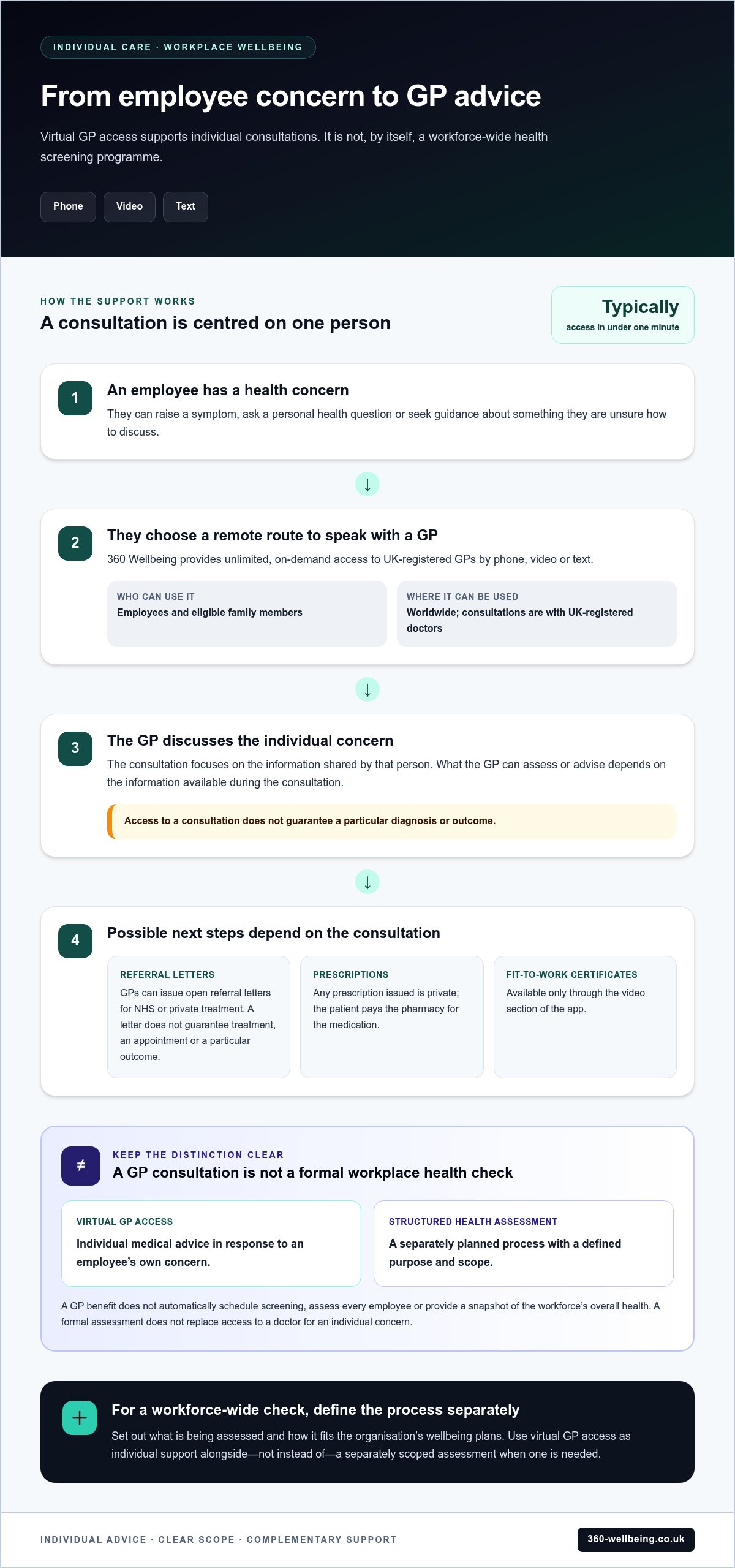
With 360 Wellbeing, employees have unlimited on-demand access to UK-registered GPs by phone, video or text, typically in under one minute. They can use a consultation to discuss an individual health question and receive medical advice. The conversation focuses on that person’s concern, rather than automatically checking every employee or reporting on the workforce’s overall health. What the GP can assess or advise depends on the information available during the consultation.
How is a virtual GP different from a health check?
An employee usually initiates a virtual GP consultation when they want to discuss a health concern. A structured workplace health check, by contrast, is organised around a defined assessment purpose and process. Employers should establish its scope in advance, including what is being assessed and how the activity fits their wellbeing plans. The term “health check” can describe different approaches, so it does not refer to one standard package.
A virtual GP benefit provides access to individual medical consultations; a formal workplace health assessment is a separately designed process with a defined scope.
That distinction matters in practice. Offering GP access can make it easier for an employee to seek advice, but it does not provide a scheduled screening exercise, a workforce-wide health snapshot or an assessment tailored to a particular workplace objective. Equally, an organised health check is not a substitute for access to a doctor when an individual wants to discuss a concern.
Before choosing an intervention, decide what outcome you want. Do employees need a route to personal medical advice, or is the organisation planning a specific assessment? For an overview of remote GP access for UK organisations, explore this guide to virtual GPs for UK businesses. Defining the purpose helps you set expectations and combine complementary support where needed.
What a corporate virtual GP can do for employee health
Corporate virtual GP health checks can be a useful way to provide employees with individual medical advice, but they are not a blanket health check for the whole workforce. An employee raises a personal concern and speaks with a doctor, who can discuss the information shared in the consultation. This gives people a way to ask health questions without turning each conversation into a formal screening exercise.
For employers, that distinction helps set expectations. Virtual GP access supports individual care, while a structured screening programme has its own purpose and process. Remote consultations can be a practical part of a wider wellbeing approach, particularly for teams working across different locations or schedules.
When can employees use virtual GP access?
Employees can use the service to discuss a symptom, ask a health question or seek guidance about a concern they are unsure how to raise. 360 Wellbeing offers unlimited on-demand access to UK-registered GPs by phone, video or text, typically in under one minute. Employees and eligible family members can use the service worldwide, while consultations are with UK-registered doctors.
The choice of communication format can make it easier to raise a concern, but it does not guarantee a particular diagnosis or outcome. The GP’s advice depends on the individual consultation and the information available.
What can a virtual GP provide beyond a consultation?
Following a consultation, GPs can issue open referral letters for NHS or private treatment. An open referral letter can support someone’s next steps, but it does not guarantee treatment, an appointment or a particular outcome. This differs from occupational health, which focuses on the relationship between work and health. Acas explains more about occupational health at work.
Any prescription issued by a GP is private, and the patient pays the pharmacy for the medication. Fit-to-Work certificates are available only through the video section of the app, so employees must use that route to request one.
Consultation access helps an employee discuss an individual concern; it does not replace a structured screening programme for a workforce. Keeping this boundary clear helps employers describe the benefit accurately and avoid presenting it as a formal health assessment.
For employees, the practical value is a direct way to raise personal health questions through a channel that suits them. For employers, it can complement other workplace support, while any formal assessment can be planned separately around a defined aim. Find out more about 360 Wellbeing’s virtual GP access.
Virtual GP access vs workplace health checks, occupational health, and EAP
These services can all contribute to employee wellbeing, but they address different needs. Corporate virtual GP health checks can sound like a single package; in practice, employers should distinguish individual GP consultations from planned health assessments, occupational health input and employee assistance. The useful question is not which service is best overall, but what kind of support your people need.
| Service | Purpose | Typical trigger | Delivery | Suitable employer need |
|---|---|---|---|---|
| Virtual GP access | Individual medical consultation and advice | An employee has a health question or concern | Remote consultation, such as by phone, video or text | Making it easier for employees to speak with a doctor |
| Formal workplace health check | Assessing health within a defined scope | The employer plans an assessment for a stated purpose | A planned process, with its scope and approach set in advance | Addressing a specific assessment objective |
| Occupational health | Considering how health and work relate | A workplace health question or situation needs attention | Occupational health input tailored to the work-related issue | Understanding health matters in a work context |
| Employee Assistance Programme (EAP) | Providing a separate route to employee support | An employee seeks help with a personal or work-related challenge | Support through an EAP service | Offering staff an additional support channel |
Which employee health need does each service address?
Virtual GP access suits an individual who wants to discuss a health concern with a doctor. A workplace health check starts with a defined assessment scope, rather than an employee’s immediate question. Clarify that scope before deciding how to organise the assessment, since the phrase “health check” alone does not specify what will be assessed.
Occupational health brings the work context into focus, while an EAP offers a distinct employee support route. An EAP is not a GP consultation, and GP access should not be presented as a replacement for occupational health advice. Explain each service’s role plainly when communicating benefits to staff.
Can virtual GP access complement formal health checks?
Yes, when each service addresses a different, clearly identified need. A planned assessment may support an employer’s defined objective, while virtual GP access gives an employee a way to raise an individual concern. Neither should be described as doing the other’s job. They can sit alongside one another as parts of a wider wellbeing approach, rather than competing as interchangeable benefits.
Begin by naming the need: individual access to medical advice, an assessment with a particular scope, support relating to work and health, or another employee support channel. This makes it easier to explain what each service is for and avoid creating expectations of screening through a GP access benefit. Clear boundaries help employees understand and use the support appropriately.
How to introduce corporate virtual GP access and assess its usefulness
A thoughtful rollout starts with the need, not the feature list. If employees need a convenient route to individual medical consultations, explain how virtual GP access meets that need. If your priority is a defined health assessment or broader wellbeing support, plan for that separately. Clear expectations help employees understand what the benefit is designed to do and how to use it.
A practical rollout sequence for employers
- Define the need. Decide whether your priority is GP consultations, a separately planned health check or wider wellbeing support. Be precise about the gap you want the benefit to address.
- Explain the access route. Tell employees in straightforward, non-clinical language how to access GP support and what it is for. With 360 Wellbeing, consultations are available by phone, video or text, and the signup form takes under one minute.
- Onboard the purchaser. After signup, the 360 Wellbeing team contacts the purchaser within one working day. Prepare clear employee instructions before announcing the benefit, including what happens next and how employees receive their access details.
- Communicate more than once. Introduce the benefit through channels your workforce already uses, such as an employee update or internal benefits page. Repeat the key access information later so people can find it when they need it.
- Review and refine. Choose a suitable review point and ask whether employees know about the benefit, understand how to access it and find the process straightforward. Use what you learn to improve your communications.
How can employers review whether access is useful?
Start with practical questions. Do employees know the service exists? Can they explain how to access it? Do they find the process clear? A short, voluntary feedback survey can help identify confusion or access barriers without asking employees to disclose personal medical details.
Employers may also review suitable workforce-level indicators, such as overall absence patterns, alongside other relevant organisational information. Treat these as observations, not proof that a particular benefit caused a change. Do not infer individual health conditions from absence data or seek identifiable consultation details to assess the service. Keep the review focused on access, awareness and employee experience, and explain what information is collected and how it will be used.
Keep measures proportionate to the decision you need to make. If awareness is low, clearer reminders may help more than changing the benefit. If feedback shows that employees find the access route confusing, simplify your instructions. Separate what employees report from assumptions about health, productivity, absence or financial return. Introducing GP access cannot guarantee those outcomes.
For a more rounded wellbeing plan, consider how practical GP access sits alongside mental, physical and financial support. This employee financial support guide can help you consider financial wellbeing as part of that broader picture.
Explore 360 Wellbeing for your workforce to see how accessible GP support can fit your team’s needs.
How 360 Wellbeing brings virtual GP access into a broader employee benefit
Corporate virtual GP health checks may be part of an employer’s search for accessible healthcare, but the distinction remains important: 360 Wellbeing provides GP consultations, not a formal workforce screening programme. Its subscription combines unlimited access to UK-registered GPs with other forms of wellbeing support, giving employees different routes to help depending on what they need.
The subscription costs £3.99 per month per employee, with an annual payment option. There are no contract tie-ins and no minimum employee requirement, so sole traders and businesses with teams of different sizes can use the service. Describe the offer clearly: GP consultations support individual health concerns, while any structured assessment should be planned separately around its own purpose.
What support sits alongside 24/7 virtual GP access?
Alongside 24/7 virtual GP access, the subscription includes mental health support, physiotherapy, life coaching and an Employee Assistance Programme (EAP). Financial support includes debt advice and 24/7 debt helplines. Legal support and complimentary will writing provide help with other practical matters. Employees can also access career guidance, a digital gym and menopause support from specialist doctors.
Eligible family members who reside at the same address can access services, except structured counselling. The up to 8 sessions per condition per calendar year allowance is for the main account holder only. Making these boundaries clear helps employees understand who can use each part of the benefit.
The subscription also includes 360 Rewards, a discount marketplace with 1,000+ brand discounts across areas such as groceries, entertainment, motoring, gym memberships and fuel cards. Employees need to register with third-party partners to use discounts. Up to three physical fuel discount cards are available, with Direct Debit setup.
How does an employer get started with 360 Wellbeing?
Getting started begins with completing the signup form, which takes under one minute. The team contacts the purchaser within one working day, Monday to Friday, 9 am to 6 pm. Employees then receive a welcome email with a unique six-digit activation token. Each token can be used once only, so employers should explain that employees need to follow the welcome email instructions to activate access.
A simple launch message can clarify what the benefit is and is not. Employees can use the GP service to discuss individual health concerns, while a formal health check remains a separate assessment. Setting that expectation helps people understand the available support without mistaking consultation access for workforce screening.
For employers, the combined offer provides distinct routes to medical consultations and mental, physical, financial and legal support. It does not promise a particular health or business outcome, but gives employees access to support they can use according to their circumstances.
To explore a broader employee benefit, explore 360 Wellbeing and see how virtual GP access can sit alongside wider support for your team.
Shape a wellbeing approach your team can use
Turn your wellbeing priorities into a clear, practical plan. Consider what employees need help accessing, how you will explain each support option and how you will invite feedback without asking people to share private health details. Keep the purpose of each benefit clear so staff can make informed choices and your wider approach feels coherent.
That clarity is especially useful when discussing corporate virtual gp health checks. Decide whether your immediate priority is access to individual GP consultations or a separately organised assessment, then explain the difference in everyday language. This helps employees understand the support available and gives you room to adapt as your team’s needs change.
Explore 360 Wellbeing for your team to see how the employee benefit could fit your organisation’s approach to support.
Frequently Asked Questions
Can a corporate virtual GP service provide employee health checks?
It provides individual GP consultations, which are not automatically a structured workplace health-check programme. For employers researching corporate virtual gp health checks, decide whether staff need a way to discuss personal concerns, a planned assessment with a defined scope, or both. 360 Wellbeing offers unlimited access to UK-registered GPs, but this should not be presented as formal screening. Explain the purpose and process of any separate assessment independently.
Can employees use 360 Wellbeing’s virtual GP service when they are abroad?
Yes. Employees and eligible family members can access the service worldwide by phone, video or text, with unlimited GP use throughout the year. The doctors are UK-registered; worldwide access does not mean they are based in every country or that local healthcare arrangements are identical. Employees travelling abroad can seek a remote consultation, while considering local care arrangements for needs that require in-person attention.
Can a virtual GP issue a Fit-to-Work certificate?
Yes, 360 Wellbeing GPs can issue Fit-to-Work certificates through the video section of the app only. Employees must use video rather than assume a phone or text consultation can provide one. A certificate is not guaranteed; the GP considers the circumstances. Employers should also consider the employee’s workplace context separately when deciding how to handle a certificate.
Can a virtual GP issue prescriptions, and are they NHS prescriptions?
360 Wellbeing GPs can issue private prescriptions, not NHS prescriptions. The patient pays the pharmacy for the medication. A consultation does not guarantee that a prescription is appropriate or will be issued, as the GP considers the individual circumstances. Employees should account for the private nature of the prescription and should not assume the medication itself is covered by the benefit.
Are family members covered by a corporate virtual GP benefit?
With 360 Wellbeing, eligible family members residing at the same address are covered for services except structured counselling. The allowance of up to 8 sessions per condition per calendar year applies to the main account holder only, not family members. Explain these boundaries so employees know who can access each type of support.
Does a business need a minimum number of employees to access 360 Wellbeing?
No. There is no minimum employee requirement, so sole traders and self-employed people can subscribe as well as businesses with teams. The price is £3.99 per month per employee, with an annual payment option. There are no contract tie-ins. This makes the benefit available to organisations considering support for employees, whatever their team size.