
59% of UK employers benchmark their employee benefits against peers, while 36% don’t. The employee benefits benchmark report for the UK in 2026 analyses responses from 200 UK organisations, offering a reference point for reviewing whether a package reflects workplace priorities and employee expectations. Benchmarking can help identify where benefits may need a closer look, rather than relying on assumptions.
It’s understandable to focus on familiar measures such as pension contributions, but benefits also create value when they address employees’ needs and support wellbeing at work. A thoughtful review connects what you offer with employee satisfaction, engagement and retention.
Here, you’ll learn why benchmarking matters, what the figures say about workplace pensions and salary sacrifice, and which benefits trends are shaping UK workplaces in 2026. We’ll also look at how to interpret the data in context, so you can make more considered decisions about a balanced benefits package.
Key Takeaways
- Set clear goals for your benefits package, then assess whether its health, wellbeing, financial, leave, learning and workplace support meets them.
- Compare pension contributions and salary-sacrifice arrangements as part of a wider review of value and employee priorities.
- Use benchmarking to spot gaps that could affect recruitment, satisfaction and retention, rather than treating peer averages as targets in isolation.
- Consider emerging workplace trends alongside your employees’ needs to shape a balanced, relevant benefits package.
Why Benchmark Your Benefits?
Benchmarking helps organisations test whether benefits meet workforce needs and business goals, rather than relying on habit. The 2026 UK survey analysed responses from 200 organisations, focusing on those with no more than 1,000 employees. It found 77% had objectives for their benefits package, while 22% had none. An employee benefits benchmark report UK 2026 can help set a useful reference point. Set clear aims, then review health, wellbeing, financial support, leave, learning and workplace benefits against them.
Benefits vary by industry, organisation size and region because workforce needs, budgets and recruitment pressures differ. A physically demanding workplace may prioritise health support, while flexible working may matter more where roles can be done remotely. Small businesses may focus on targeted benefits; larger employers may have more scope to provide a broader package. Use an employee benefits benchmark report UK 2026 to compare employers with relevant working patterns and priorities.
European wellbeing research can add perspective: The Great Employee Benefits Study: Global Insights covers six European countries. In the UK, 31% of employers with benefit objectives link benefits to productivity or business performance, and 23% link them to employee health and wellbeing. Financial support merits attention too: 15% of UK organisations surveyed had a formal financial wellbeing policy, while 39% felt responsible for signposting employees to financial information or guidance.
There is no single cost benchmark for private medical insurance, life assurance or income protection that suits every workforce. Compare like with like: align the level of cover, eligibility and employer contribution, then assess costs against the outcomes each benefit is intended to support.
For 2026, 40% of UK organisations surveyed provide flexible working as a benefit, while 54.7% of employers offer some level of holiday trading. The survey also found statutory maternity pay was offered by 18.5% of employers, up from 15.8% in 2025. These examples show why a benefits review should consider flexibility, wellbeing and family needs alongside traditional insurance and leave. Revisit the package as employee expectations evolve, and use relevant survey sources to identify gaps.
Workplace pension contributions and salary sacrifice
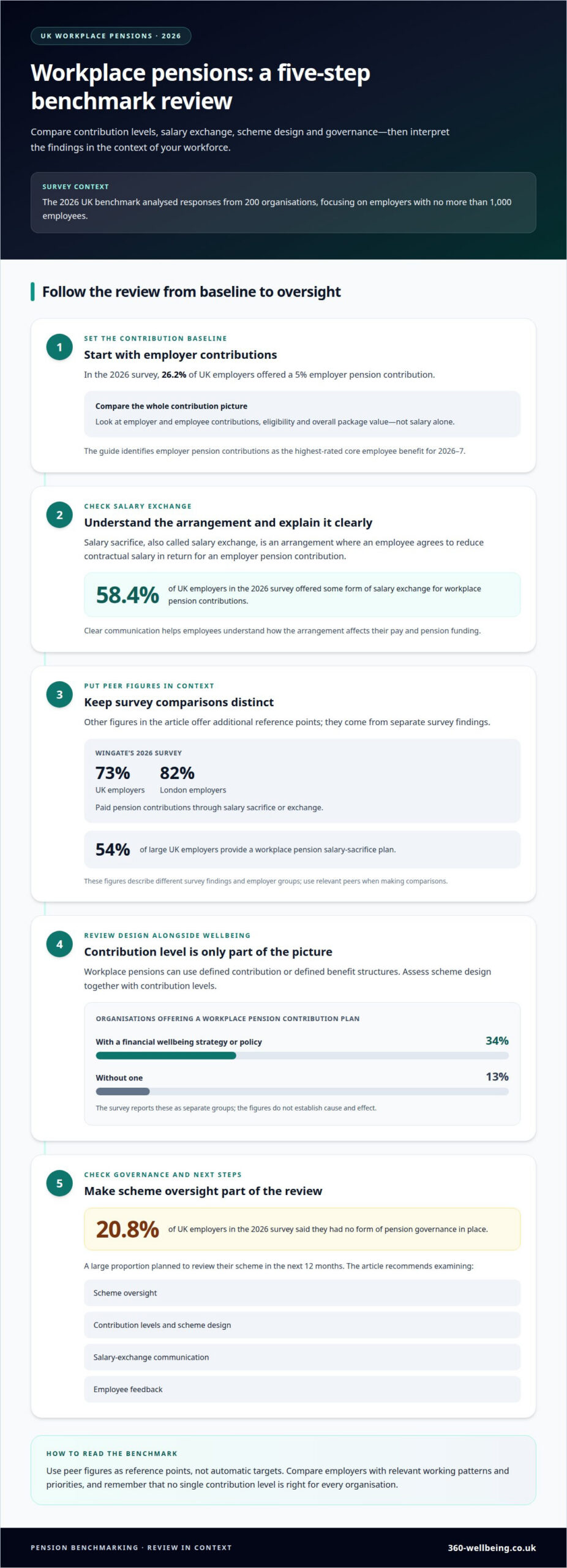
Pension contributions can shape an employee benefits package and influence how employees judge their long-term financial security. In the 2026 survey, 26.2% of UK employers offered a 5% employer pension contribution. Compare employer contributions alongside employee contributions, eligibility and the overall value of the package, rather than looking at salary alone.
Salary sacrifice, also called salary exchange, is another approach: an employee agrees to reduce contractual salary in return for an employer pension contribution. The 2026 survey found 58.4% of UK employers offered some form of salary exchange for workplace pension contributions. Wingate’s 2026 survey found 73% of UK employers and 82% of London employers paid pension contributions through salary sacrifice or exchange. Clear communication helps employees understand how the arrangement affects their pay and pension funding.
Workplace pensions can use different structures, including defined contribution and defined benefit arrangements. For useful comparisons, assess the contribution level and scheme design together. The guide identifies employer pension contributions as the highest-rated core employee benefit for 2026-7, while 54% of large UK employers provide a workplace pension salary-sacrifice plan. These findings offer insights into talent expectations, but they don’t make one contribution level right for every organisation.
Financial security extends beyond pension provision. Bonuses may recognise performance, while pension contributions support longer-term saving; review each against your reward objectives. Among UK organisations with a financial wellbeing strategy or policy, 34% offer a workplace pension contribution plan, compared with 13% of those without one. Financial Support & Debt Advice can complement workplace planning by helping employees address financial pressures that affect their wellbeing.
Governance matters as much as contribution design. In the 2026 survey, 20.8% of UK employers said they had no form of pension governance in place, while a large proportion planned to review their scheme in the next 12 months. A practical review can examine scheme oversight, contribution levels, salary exchange communication and employee feedback. To find out how broader financial support may fit alongside pension provision, explore financial support and debt advice.
How do employee benefits impact satisfaction and retention?
Benefits can shape how valued employees feel, but their effect depends on relevance and access. In the 2026 benchmarking survey, 44% of UK employers with benefit objectives aimed to support retention. Another 37% aimed to support motivation and engagement. These findings make clear objectives useful: decide whether your benefits strategy should strengthen loyalty, improve the employee experience, or support both.
Recruitment pressures also make the benefits package part of an employer’s overall offering. In 2025, benefits were the biggest challenge in attracting talent for 32% of companies. For 27%, benefits were their biggest retention challenge. These figures do not mean a richer package automatically resolves hiring or turnover pressures. They show why reviewing the benefits offering against rising expectations can inform a broader reward strategy.
Benchmarking gives your review a practical structure. Compare your offering with relevant employers, then consider whether it reflects your workforce’s roles, priorities and feedback. A benefit valued by one group may matter less to another. Employees seeking flexibility, for example, may value adaptable working arrangements, while others may prioritise financial security or wellbeing support. Use participation data and employee feedback to identify which benefits feel accessible and meaningful.
Set a baseline before changing your package so you can assess how benefits relate to satisfaction. Track uptake, feedback and retention patterns over time, and review results against each benefit’s objectives. If employees don’t understand an offering or find it difficult to access, they may not see its value. Explain benefits in plain language and show how they support different needs. Review the data regularly as roles and expectations evolve, and adjust your strategy when findings reveal a gap. Benchmarking is most useful as an ongoing process, not a one-off comparison.
Employee benefits trends for 2026
In 2026, benefits trends point towards broader workforce needs, not just traditional financial rewards. The 2026 survey found 31.5% of UK employers offered group health insurance, compared with 28.2% in the previous year’s survey. This rise signals a shift worth considering, but insurance alone doesn’t address every employee’s health and wellbeing needs. Review the balance between protection, flexibility and practical support.
Leave policies are also evolving. In the 2026 survey, 27.5% of UK employers offered 24 days or less annual leave, excluding bank holidays and service-related days. A further 26.8% offered up to five extra days for length of service. Compare these approaches with workforce priorities, then consider whether leave can support recovery, engagement and retention.
There’s no single average UK employer spend per employee on benefits in 2026. Costs depend on the mix of benefits, eligibility, workforce size and the level of support offered. For useful decisions, group spending by benefit type and assess it against uptake and the outcomes your strategy aims to support.
The most commonly offered benefits vary by survey and employer group. The 2026 figures include group health insurance and additional leave, while UK tech market findings report hybrid working at 85% and wellness days at 14%. These examples aren’t universal benchmarks; compare like with like before treating any trend as a competitive standard.
Tax and legal treatment in 2026 depends on the benefit and how an employer provides it. Benefits in kind can have tax and reporting implications, so include a compliance review when changing your package. Market Insights reports also cover National Insurance, the National Minimum wage and the Employment Rights Act 2025, themes that can shape reward decisions. More than half of surveyed organisations had implemented AI within their people function, while UK organisations are focusing on employee experience and technology over the next 12 months. To strengthen workplace support, explore employee assistance support as part of a considered benefits strategy.
360 Wellbeing: Employee Assistance Programme (EAP)
360 Wellbeing can complement your benefits strategy with practical support for employees’ health and everyday wellbeing. Its Employee Assistance Programme (EAP) brings together support options that can help address needs beyond pay and pension provision.
Employees can access Mental Health Support, Physiotherapy and a 24/7 Virtual GP, while 360 Rewards adds a range of offers. Together, these options can support a more rounded benefits package, particularly when your review identifies health and wellbeing as priorities. They are distinct from private medical insurance and on-site medical clinics.
If you’re considering how this support could fit your workforce, contact 360 Wellbeing to discuss your needs.
Turn your benchmark into a considered next step
A benchmark is most useful when it informs a practical decision, not simply a comparison. Use the employee benefits benchmark report for the UK in 2026 as a prompt to identify which employee needs deserve attention, where support is difficult to access, and how you’ll assess whether changes are helping. Employee feedback can help shape priorities that feel relevant across different roles and life circumstances.
For organisations looking to strengthen workplace wellbeing, 360 Wellbeing brings together options including Mental Health Support, a 24/7 Virtual GP and 360 Rewards. These can form part of a broader approach to employee support, alongside your organisation’s existing benefits. The right next step is to focus on the needs your review has surfaced and consider what support would complement your current package.
Discuss wellbeing support with 360 Wellbeing and explore how it could fit your benefits approach. A thoughtful, people-centred review can help you move forward with greater clarity.
Frequently Asked Questions
Is the guide relevant to all industries and company sizes?
It can provide a useful reference, but it won’t represent every workplace equally. Benefit priorities differ across industries, roles and workforce sizes, so treat the figures as a starting point rather than a universal target. For example, compare organisations with similar working patterns and recruitment needs, then consider whether your own employees’ priorities call for a different balance.
What makes the latest guide different from the previous edition?
Its value lies in providing a 2026 view of employee benefits, rather than relying only on older comparisons. To assess changes between editions, compare the same benefit categories, survey questions and employer groups across both. A difference in results may reflect a genuine shift, but it can also arise from changes in the survey sample or methodology.
What should employers compare first?
Start with the benefit most closely linked to your current workforce objective, such as improving access to support or strengthening recruitment. Compare eligibility, employee access and uptake, not just whether an organisation offers the benefit. This helps distinguish a benefit that exists on paper from one employees can use and value in practice.
What types of benefits are covered in the guide?
The report covers a broad mix of workplace provision, including pensions, flexible working, leave and health-related benefits. It also examines protection such as group life assurance, income protection and critical illness cover. This wider view helps employers consider how financial security and day-to-day working arrangements sit alongside health and wellbeing support.
What’s in the guide?
The report brings together benchmark findings on the benefits employers provide and how they assess their packages. Use its findings to identify relevant comparison points, then consider how each relates to your objectives and workforce. A prevalence figure, for instance, can show how common an option is, while employee feedback helps reveal whether it fits your organisation.
Which benchmark reports are most useful?
Choose reports focused on UK employers, with a recent publication date and a clearly described survey population. The CIPD 2026 Reward Survey can add a reward-focused perspective, while The Great Employee Benefits Study: Global Insights offers a wider European wellbeing context. Use each report for the question it can answer, and avoid treating different samples as directly interchangeable.