What makes an employee benefits proposal persuasive isn’t the length of its benefits list. It’s how clearly it connects employee needs with a workable plan. If you’re turning feedback into a case for change, a template for a new employee benefits proposal can help you set out the essentials and make a recommendation leaders can assess.
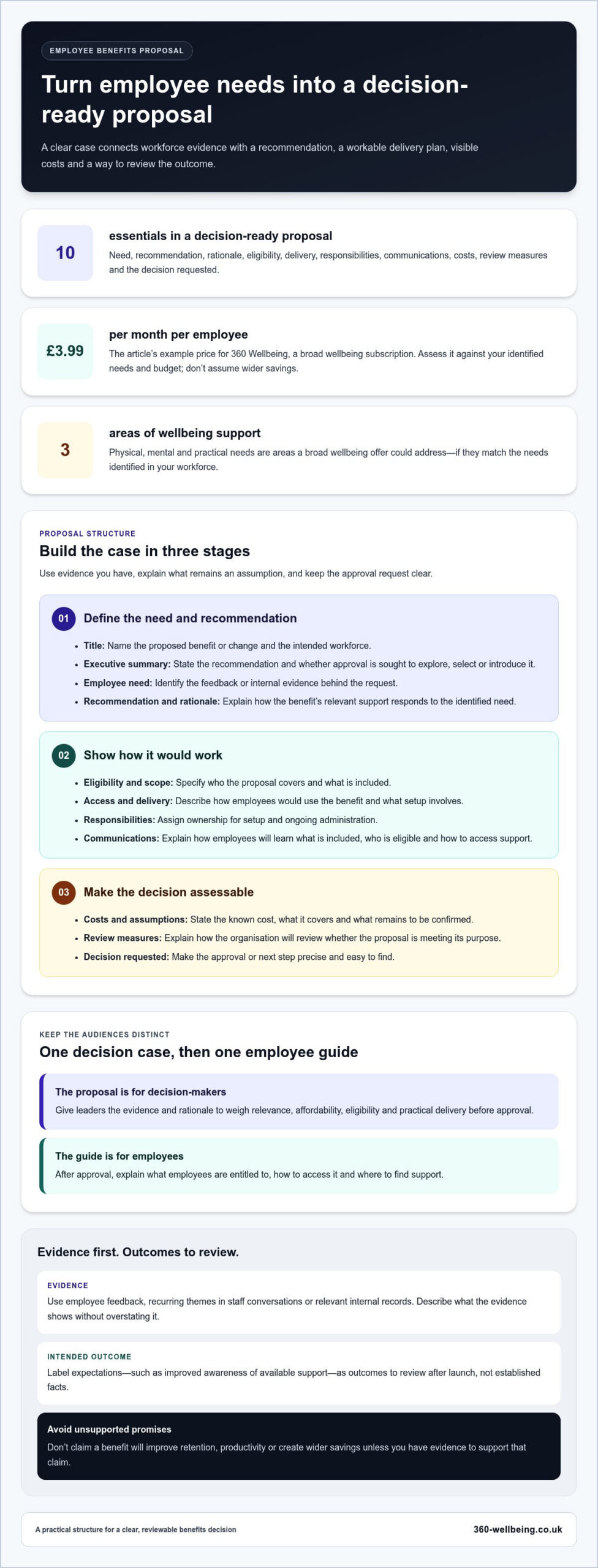
A convincing proposal answers the questions decision-makers care about: who the benefits are for, what needs they address, what they’ll cost and how they’ll be introduced. It should also explain the offer in language employees can understand. For example, you could assess 360 Wellbeing, a broad wellbeing subscription priced at £3.99 per month per employee, without assuming it will create wider savings.
This UK guide for 2026 gives you a reusable structure, prompts and sample wording. You’ll learn how to compare options against employee needs and budget, plan approval and communication, and set review points so the benefits remain relevant as your team changes.
Key Takeaways
- Use a template for a new employee benefits proposal to turn workforce needs into a clear recommendation leaders can assess and approve.
- Separate the decision-making business case from the employee-facing guide, so each audience gets the information they need.
- Compare options against employee relevance, accessibility, administration, cost visibility and reviewability, using your own workforce evidence and budget.
- Assign clear ownership for approval, setup, communication, launch and scheduled review to make the proposal practical to deliver.
- Assess whether broad wellbeing support could address identified needs across physical, mental and practical areas.
Why a new employee benefits proposal needs more than a list of perks
A list of appealing benefits can start a conversation, but it doesn’t give decision-makers enough information to approve a change. Leaders need to understand what employees need, why a particular benefit is recommended, what introducing it involves and how its value will be reviewed. A template for a new employee benefits proposal brings those points together, so the request can be assessed as a practical workplace decision rather than a collection of ideas.
A benefits proposal is a decision document that explains an identified employee need, recommends a response, sets out how it will be delivered and describes how it will be reviewed. A benefits package is the set of benefits employees can access; the proposal is the reasoned case for creating or changing that package. For context on the range and purpose of benefits, see this Employee benefits overview.
Keep the business case separate from the employee-facing guide. The proposal helps leaders weigh relevance, affordability, eligibility and practical delivery before approval. The guide comes later, explaining what employees are entitled to, how to access it and where to find support. Combining the two can leave decision-makers short of detail while giving employees information about a plan that hasn’t been approved.
A clear proposal should let a reader find the essentials quickly:
- The need: What employee feedback or internal evidence points to a gap?
- The recommendation: Which benefit or change responds to that need, and why?
- The delivery: Who will manage setup, eligibility and communication?
- The decision: What approval or next step is being requested?
Who is the proposal for, and what decision should it support?
Write for the people who can assess the case and move it forward. Depending on the organisation, that may be a business owner, leadership team, HR decision-maker or a combination of them. Put the recommendation and decision request near the start. Be precise about whether you’re asking to explore an option, select a defined benefit or approve its introduction. A specific request makes it easier to identify the right decision-makers and the information they need.
How to connect employee needs with business priorities
Start with evidence your organisation already has, such as employee feedback, recurring themes in staff conversations or relevant internal records. Describe the need without overstating what the evidence shows. Then connect it to a genuine priority, such as making support easier to access or strengthening the employee experience. Don’t promise that a benefit will improve retention or productivity unless you have evidence to support that outcome.
Distinguish what you know from what you expect. For example, label an employee survey response as evidence, while describing improved awareness of available support as an intended outcome to review after launch. This helps leaders judge the case on its merits and gives your organisation a sound starting point for measuring whether the proposal is meeting its purpose.
A fill-in template for a new employee benefits proposal
Use this copy-ready structure to turn a recommendation into a clear decision document. Replace each bracketed prompt with your organisation’s evidence, costs, eligibility rules and responsibilities. If a detail is still being worked out, label it as an assumption rather than presenting it as settled fact.
The core sections to copy into your proposal
Keep the order logical: explain the need first, then the recommendation and how it would work. A decision-ready benefits proposal states the need, recommendation, rationale, eligibility, delivery, responsibilities, communications, costs, review measures and decision requested.
- Title: “[Proposed benefit or change] for [team or workforce].” Make the subject and intended audience clear.
- Executive summary: “We recommend [benefit] to address [identified need] and request approval to [explore, select or introduce it].” Keep the request visible on the first page.
- Employee need: “Feedback from [source] indicates [specific need or gap].” Name the evidence and its date or context where available.
- Recommended benefit and rationale: “We recommend [benefit] because it offers [relevant support or feature] for [identified need].” Explain the connection, not just the benefit’s appeal.
- Eligibility and scope: “The proposal would apply to [eligible employees or groups] and include [defined scope].” Identify any groups or conditions that need a decision.
- Access and delivery: “Employees would access the benefit through [known route], supported by [setup or delivery steps].” Separate confirmed arrangements from items still to resolve.
- Responsibilities: “[Role or team] would own [task], while [role or team] would manage [related task].” Assign clear ownership for setup and ongoing administration.
- Communications: “Employees would receive an explanation of [what’s included], [eligibility] and [how to access support] through [planned channels].” Consider accessibility and different employee needs.
- Costs and assumptions: “The known cost is [£ amount and basis]; [assumption or item to confirm] is excluded.” State what the figure covers and avoid claiming savings you can’t evidence.
- Review measures: “We would review [participation, feedback or another relevant measure] to assess whether the benefit is meeting [stated aim].” Choose measures that can realistically be gathered.
- Decision requested: “Please approve [specific next step] and confirm [decision owner or resource needed].” Make it clear what happens after approval.
Keep the proposal distinct from the employee benefits guide
The proposal covers rationale, approval, responsibilities and evaluation. Once a benefit is approved, create a separate employee guide with practical sign-up instructions, eligibility details and answers to common questions. Keep communications clear and accessible, and tailor the format or channel to different employee needs.
If your proposal considers broad wellbeing support, assess 360 Wellbeing against your stated need, scope and budget. Its subscription costs £3.99 per month per employee. Record this as a known cost without assuming wider savings.
How to compare benefit options and build a credible business case
A fair comparison helps you see which option best fits the need, rather than simply which sounds most attractive. Apply the same criteria to every option, using the same workforce evidence, budget assumptions and eligibility rules. A template for a new employee benefits proposal can include a comparison framework, but your organisation’s information must fill it in.
For each benefit under consideration, record a concise assessment against these criteria:
- Employee relevance: What need does it address, and what feedback or internal evidence supports that connection?
- Accessibility: Can eligible employees understand what’s available and how to use it? Note any access requirements or barriers relevant to your workforce.
- Administration: What setup and ongoing tasks would the employer need to manage, and who would own them?
- Cost visibility: What is the known cost, how is it charged, who is covered, and what assumptions affect the estimate?
- Reviewability: What evidence could show whether the benefit is reaching employees and addressing the stated need?
Use identical fields for each option, even if some answers are “to be confirmed”. This makes gaps visible instead of allowing one benefit to appear more complete simply because it has been described in greater detail. Add a short note explaining why each criterion matters to your team, based on feedback or workforce context.
Choose criteria that reflect your team and organisation
Let employee feedback guide the comparison. If staff have raised difficulty finding support, consider whether a benefit is easy to understand and access. If support already exists, map what it covers before adding another option. This helps you identify overlap and decide whether a proposal fills a genuine gap, complements existing provision or needs a narrower scope.
Explain costs and expected value without overclaiming
For every option, record the cost basis, payment frequency and population included. Separate confirmed figures from estimates, and state assumptions such as the number of eligible employees or whether participation affects the total. Treat expected outcomes as objectives to assess later, not guaranteed results. For example, “increase awareness of available support” is an aim, not evidence of improved retention or productivity.
As a worked example, 360 Wellbeing costs £3.99 per month per employee. State that price and identify the employee population used for your own calculation. Don’t imply savings or calculate a total without using your organisation’s confirmed eligibility and workforce figures. Compare the option against the same relevance, access, administration and review criteria as every alternative. This gives decision-makers a transparent basis for weighing fit and affordability.
Before submitting the business case, check that the comparison reflects your actual budget, eligibility rules and available workforce evidence. Where information is incomplete, name the gap, assign an owner to resolve it and state whether you’re asking for approval to investigate further or proceed. This keeps uncertainty visible and grounds the decision in what you know.
How to present, implement and review the approved benefits proposal
Approval is the handover from a well-argued case to a benefit employees can understand and use. Keep the approved proposal as the reference point: it records what was agreed, who owns the next steps and how the organisation will assess whether the benefit is meeting its purpose. A template for a new employee benefits proposal supports this handover by making ownership and review part of the plan, not afterthoughts.
Set out the implementation sequence in a simple action list. For each step, name the responsible role, the task or decision, and any dependency that must be resolved before moving on:
- Approval: Record the agreed option, scope, budget and any conditions attached to the decision.
- Ownership: Assign an internal lead and clarify who is responsible for setup, employee communications and ongoing administration.
- Setup: List the practical tasks needed before access begins, including confirming eligibility and preparing accurate benefit information.
- Communication: Explain who can use the benefit, what it offers, how to access it and where to find help. Choose accessible formats and channels that suit your workforce.
- Launch: Confirm that the agreed setup and communications are in place, then make the benefit available as planned.
- Review: Set a review date and name who will gather evidence and bring recommendations to the relevant decision-maker.
Turn approval into a clear launch plan
For 360 Wellbeing, describe the sign-up process accurately in employee communications: employees receive a welcome email containing a unique six-digit activation token. The token can be used only once, following the activation process in that email. Include those steps clearly so staff know what to expect, while keeping the proposal focused on ownership and delivery rather than turning it into a user guide.
Before launch, make sure employees can understand the eligibility rules and where to find support. If the proposal includes legal, tax or regulatory considerations, keep the wording specific to the benefit and check it against current authoritative UK guidance before presenting it as fact. Avoid broad assurances that could be read as a guarantee of compliance.
Review whether the benefit is working as intended
Choose review measures that match the original aim. If the proposal is intended to make support easier to access, consider awareness, participation and employee feedback. If the aim is to address a particular support gap, review whether employees feel the offer is relevant. Use suitable, available evidence and be clear about what it can and can’t demonstrate.
At the scheduled review, compare findings with the proposal’s objectives and record the decision: continue, adapt or replace the benefit. Note the reasons, follow-up actions and who owns them. This creates a learning loop, helping the organisation respond thoughtfully as employee needs and circumstances change. Explore 360 Wellbeing as an option for your benefits plan.
Use 360 Wellbeing as an example in your employee benefits proposal
Once you’ve identified a workforce need and established how you’ll compare options, use a specific benefit to show how the proposal works in practice. 360 Wellbeing is a subscription combining health, wellbeing and practical support. It can be relevant where your evidence points to a need for accessible support across several areas. Describe it in relation to the need you identified, rather than relying on a broad list of services as a reason on its own.
In your proposal, explain which elements respond to the need and how employees would access them. Keep the description factual, include eligibility and scope, and state the price clearly. That gives decision-makers a useful basis for assessing relevance, affordability and delivery without implying that the subscription guarantees particular outcomes or savings.
Describe the included support accurately
360 Wellbeing includes unlimited on-demand access to UK-registered GPs by phone, video or text. It also includes mental health support, 1-to-1 life coaching, personalised virtual physiotherapy, a digital gym with scheduled classes and personalised workouts, and menopause support from specialist doctors. Financial and legal support includes 24/7 legal and debt helplines, complimentary will writing and career guidance. The discount marketplace offers 1,000+ brand discounts, with registration required through third-party partners.
The main account holder can access up to 8 sessions per condition per calendar year with BACP-accredited counsellors. State clearly that structured counselling is for the main account holder only.
Make the example specific, transparent and easy to evaluate
State the subscription price as £3.99 per month per employee. Then apply your own eligibility rules and workforce figures to show the relevant cost basis. Avoid presenting potential savings as fact; instead, identify intended outcomes as objectives for later review.
Family members residing at the same address are covered, except for structured counselling. Include this boundary when describing who can access the support, so employees and decision-makers have a clear picture of the scope. You can also relate the different areas of support to the proposal’s identified need, such as physical, mental or practical wellbeing, without suggesting every element addresses every employee’s circumstances.
If financial wellbeing is part of your case, the financial support guide for UK employers offers related context to consider alongside your workforce evidence and comparison criteria.
Use this example to make your proposal concrete, then assess it consistently against the alternatives. A clear description of scope, cost and relevance helps leaders make an informed decision and gives you a sound basis for communicating the benefit if it’s approved.
Take the next step towards a thoughtful benefits plan
Use your proposal as a starting point for an ongoing conversation with employees and decision-makers. Their questions and feedback can help you refine how support is explained, identify practical barriers and shape future reviews. Keep the focus on whether the benefit responds to a real need, and make space to adjust the plan as your organisation learns what works for its people.
If you’re ready to consider a practical example, 360 Wellbeing combines health, mental wellbeing, financial and legal support in a subscription priced at £3.99 per month per employee. Include it in your template for a new employee benefits proposal as an option to assess against your team’s needs and budget, without assuming savings or outcomes.
Explore 360 Wellbeing for your team and take a confident next step towards workplace support that feels relevant, accessible and considered.
Frequently Asked Questions
What should a new employee benefits proposal include?
A new employee benefits proposal should give leaders enough information to make a defined decision. Use a template for a new employee benefits proposal to cover the employee need, objectives, recommended benefit, intended eligibility, cost basis, implementation responsibilities, communications and review measures. State whether you’re asking leaders to explore, select or introduce the benefit. Separate confirmed facts from assumptions, and keep detailed sign-up instructions for a separate employee guide.
How do I write a business case for employee benefits?
Start with a workforce need supported by relevant employee feedback or internal evidence. Explain how the recommended benefit addresses that need and connects with an organisational priority, such as improving access to support. Present known costs separately from estimates, and explain the assumptions behind any projections. Name the outcomes you intend to review, but don’t promise improvements as certain. A credible case makes the rationale clear and shows how the decision will be assessed.
Can I use an employee benefits proposal template for a small business?
Yes. Keep the document proportionate to your organisation and the decision at hand. A small business could use a concise proposal that explains the need, describes the benefit, identifies who it supports and sets out the cost basis. Include the person responsible for setup and how employees will learn about the offer. Treat the template as a flexible starting point: remove irrelevant fields and label assumptions that depend on your circumstances.
How do I compare employee benefits before making a proposal?
Compare every option against the same criteria, including relevance to employee needs, accessibility, administration, cost visibility and fit with existing support. Use workforce feedback to explain why each criterion matters, and record where an option fills a gap or overlaps with current provision. Keep confirmed details distinct from estimates. This consistent approach helps decision-makers understand trade-offs and assess each benefit fairly, without assuming one option will suit every workforce.
Should an employee benefits proposal include the cost per employee?
Yes, include a per-employee figure when it’s available, alongside the payment frequency and the employee population used in the calculation. Label estimates and state the assumptions behind them, such as eligibility. Don’t claim a return or savings without supporting evidence. For 360 Wellbeing, the subscription price is £3.99 per month per employee. Use that amount as stated, and calculate any organisational total using your own confirmed figures.
What is the difference between a benefits proposal and a benefits guide?
A benefits proposal helps decision-makers consider whether to approve a benefit; a benefits guide helps employees understand an approved offer. Leaders need the rationale, cost basis and delivery responsibilities, while staff need clear information about eligibility and how to access support. Keeping the documents separate lets you update practical instructions without changing the original decision case, and avoids sharing sign-up details before the organisation has agreed the offer.
How should I measure whether a new employee benefit is useful?
Set review measures before launch and link each one to an objective in the proposal. Depending on the offer, you might review whether employees know about it, whether eligible staff are participating, what feedback they share and how manageable administration has been. Assign someone to gather the evidence and set a review point. Use the findings to decide whether to continue or adapt the benefit, without treating participation alone as proof of broader outcomes.