
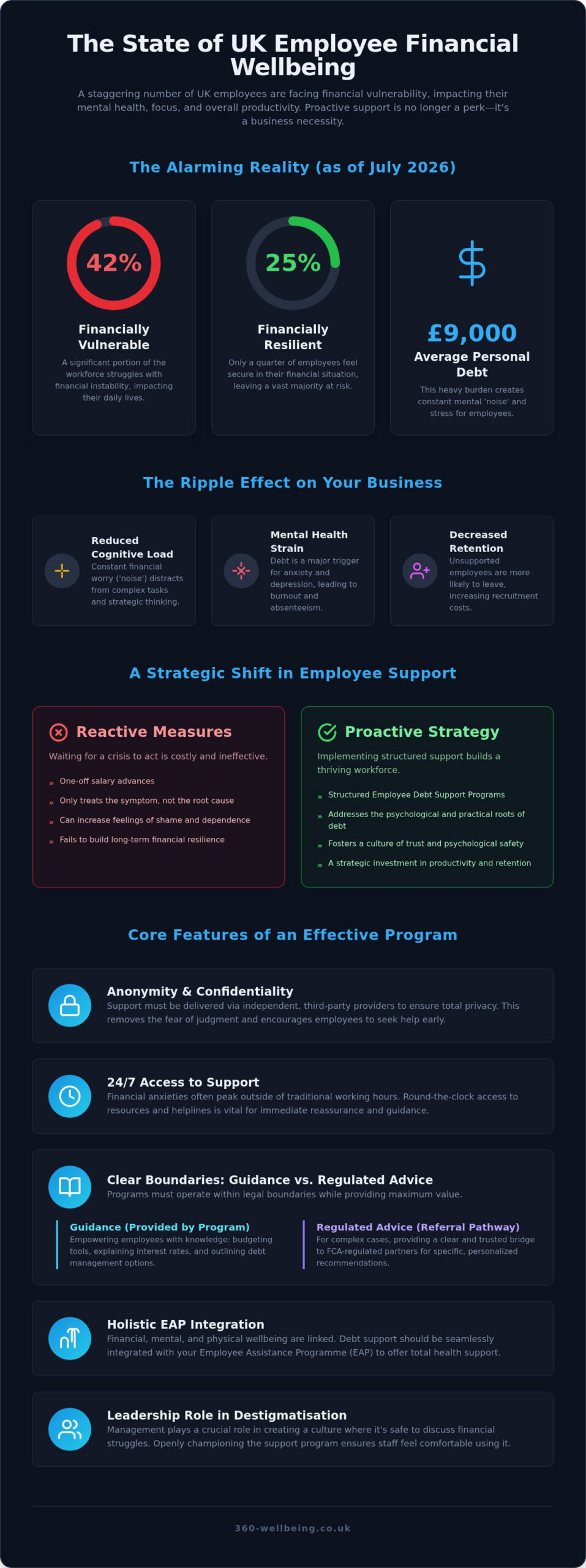
As of July 2026, only 25% of the UK workforce is classified as financially resilient, leaving a staggering 42% of employees in a state of financial vulnerability. When nearly half of your team is struggling to manage an average debt that has climbed to almost £9,000, the impact doesn’t stay at home. It shows up in your office as decreased productivity, heightened anxiety, and a rise in requests for emergency salary advances. You know your people are your greatest asset, yet seeing them buckle under financial pressure can feel overwhelming. Implementing structured employee debt support programs is no longer a luxury perk; it’s a professional necessity that bridges the gap between clinical expertise and compassionate care.
We understand you want to help but are likely wary of overstepping boundaries or adding complex management tasks to your schedule. This guide provides a clear framework for offering effective debt support that improves employee engagement and mental health. We’ll clarify the differences between financial coaching and regulated advice while showing you how to foster a resilient workforce. You’ll gain a panoramic view of how to integrate financial wellbeing into your total health strategy, ensuring your staff feels supported and empowered to thrive.
Key Takeaways
- Understand the direct link between personal financial ‘noise’ and a drop in workplace productivity, cognitive load, and decision-making quality.
- Discover how to implement effective employee debt support programs that provide clear boundaries between general guidance and regulated financial advice.
- Learn why 24/7 access to support is vital for addressing financial anxieties that often peak outside of traditional working hours.
- Identify the role of leadership in destigmatising debt to ensure staff feel comfortable accessing help before financial issues escalate.
- Explore how a holistic Employee Assistance Programme (EAP) can seamlessly integrate debt advice with mental health and physical wellbeing services.
The Impact of Financial Stress on Workplace Productivity
By mid-2026, the financial landscape for UK workers has reached a critical juncture. With 42% of employees now classified as financially vulnerable, the quiet weight of personal debt is no longer a private matter. It walks through your office doors every morning. When an individual carries an average debt of nearly £9,000, their mental space is occupied by survival rather than innovation. This creates a phenomenon known as financial ‘noise’, which significantly reduces cognitive load. Instead of focusing on complex projects, a person’s brain is stuck on a loop, calculating bill payments or worrying about the next credit card statement. This mental distraction is a primary driver of reduced Workforce productivity across every sector.
Debt as a Mental Health Trigger
We view health through a panoramic lens, recognizing that financial, mental, and physical wellbeing are inextricably linked. Debt doesn’t just affect a bank balance; it’s a potent trigger for chronic anxiety and depression. This creates a destructive cycle where poor mental health leads to decreased focus, which then impacts performance and job security, heightening financial fears further. You might notice subtle signs: a usually punctual team member suddenly arriving late, increased irritability, or a noticeable withdrawal from social interactions. By the first week of January 2026, Citizens Advice had already assisted 13,300 people with debt issues, a figure that highlights the scale of the challenge. These aren’t just numbers; they represent colleagues whose mental resilience is being tested to its limit. When the pressure becomes too much, absenteeism rises as staff take time off to deal with the physical and emotional fallout of financial exhaustion.
The Business Case for Debt Support
The link between financial stability and business success is undeniable. Many employers traditionally wait for a crisis to act, offering one-off salary advances that only treat the symptom, not the cause. Shifting toward proactive employee debt support programs allows you to address the root of the problem before it leads to long-term absenteeism or burnout. Providing these tools isn’t just about being a compassionate employer; it’s a strategic move to improve staff retention in a competitive UK market. When people feel their employer genuinely cares about their total wellness, they’re more likely to stay, fostering a culture of trust and psychological safety. Investing in employee debt support programs is often more cost-effective than the high price of recruitment and the lost output associated with a distracted team. It’s about moving from a reactive stance to a proactive vision of workplace harmony where every member of the team has the stability to perform at their best.
What is an Employee Debt Support Program?
At its core, a debt support program is a structured framework of tools and services designed to help your team manage and resolve personal financial challenges. It moves beyond the traditional model of simple salary advances, which often only mask a deeper problem. Instead, these programs provide a pathway to long-term stability by addressing the psychological and practical roots of debt. Providing Financial wellbeing support for your employees is about creating a safe, confidential environment where staff can seek help without fear of judgment or professional repercussions. Anonymity is the cornerstone of success here. Most workers are hesitant to disclose financial struggles to HR, so effective employee debt support programs must operate through independent, third-party providers to ensure total privacy.
There is a vital distinction to understand between general debt guidance and regulated financial advice. Guidance involves providing information on budgeting, explaining how interest rates work, or listing different debt management options. Regulated financial advice, however, involves making specific recommendations based on an individual’s unique circumstances. Most workplace programs focus on guidance and coaching, but they should also provide a clear bridge to FCA-regulated partners when a situation requires formal intervention. This ensures you are providing high-quality support while staying within legal boundaries.
Key Components of a Modern Program
Comprehensive employee debt support programs should offer more than just a helpline. They function best when they provide a multi-layered approach to care. This includes:
- Confidential Helplines: Immediate access to trained advisors who can provide a calm, steady voice during a financial crisis.
- Digital Budgeting Tools: Interactive apps that help staff track spending, prioritise debt repayments, and visualise a path toward savings.
- Legal Assistance: Support for complex issues like County Court Judgments (CCJs) or tenancy disputes that often stem from unresolved debt.
By integrating these features into a wider Employee Assistance Programme, you ensure that financial health is treated as a core pillar of your team’s overall vitality.
Financial Education vs. Crisis Support
Effective support must balance proactive education with reactive crisis management. Proactive education involves workshops on credit scores, interest rates, and the long-term impact of borrowing. This builds durability and foresight, helping employees avoid debt traps before they begin. Reactive support is the safety net for those already in distress. It offers a methodical path forward for staff facing bailiffs, insolvency, or extreme pressure from creditors. A successful program ensures that no matter where an employee is on their journey, they have a knowledgeable authority to guide them. This dual approach fosters a sense of order and safety, which is essential for maintaining a positive workplace culture.
Core Features of Effective Workplace Debt Advice
Financial worries don’t keep office hours. They often peak at 3 AM when the house is quiet and the weight of a credit card statement feels heaviest. Effective employee debt support programs recognize this reality by providing 24/7 access to help. It’s not just about the numbers on a spreadsheet; it’s about the person behind them who needs reassurance in their most vulnerable moments. By integrating debt advice with Mental Health Support, you provide a panoramic view of care that addresses both the financial crisis and the emotional fallout it creates.
Debt Helplines and Expert Guidance
When an employee reaches out to a dedicated helpline, they aren’t just getting a generic list of resources. They’re entering a professional consultation designed to identify challenges and present a clear, structured path forward. Expert advisors help staff navigate the complexities of the UK financial system, explaining options such as Debt Management Plans (DMPs) or Individual Voluntary Arrangements (IVAs) in plain English. This guidance is essential for moving away from the fear of the unknown. The psychological relief of having a methodical plan cannot be overstated. It replaces a sense of chaos with a feeling of safety and order, allowing the individual to regain their focus both at home and at work.
Lifestyle Savings and Rewards
Sometimes, the most effective way to support a team is by helping their existing wages go further. A modern program should include a holistic marketplace, such as 360 Rewards, which helps the ‘squeezed middle’ of the UK workforce manage the rising cost of essentials. This isn’t a luxury perk; it’s a practical tool for durability. These platforms offer significant savings on:
- Weekly grocery shops at major UK supermarkets
- Fuel and transport costs
- Utility bills and household essentials
- Health and wellness products
By reducing the daily cost of living, these rewards function as an indirect pay rise. They encourage healthier spending habits through platform engagement and provide a tangible benefit that supports an employee’s financial resilience every single day.
Legal Aid and All-Encompassing Care
Debt rarely exists in a vacuum. It often brings legal complications, from tenancy disputes to concerns about family security. Providing Legal Support and Complimentary Will Writing as part of your employee debt support programs ensures that staff have the foresight to protect their long-term interests. This all-encompassing approach mirrors our core philosophy of total wellness. When you link these services with a 24/7 Virtual GP or Physiotherapy, you create a unified narrative of care. It sends a powerful message: your health, in all its forms, is a professional necessity and a human entitlement that we are committed to protecting.
Implementing Support: Overcoming the Workplace Stigma
Despite the prevalence of debt, a deep-seated stigma remains in many UK workplaces. Employees often associate financial struggle with personal failure, leading to a silence that can be damaging to both the individual and the business. They worry that disclosing a County Court Judgment or a mounting credit card balance might signal a lack of discipline, potentially impacting their career progression. This is why leadership must take a proactive stance in destigmatising these conversations. By framing financial health as a professional necessity rather than a private luxury, you create a culture where seeking help is seen as a sign of responsibility. Normalising the use of employee debt support programs through initiatives like ‘Financial Wellness Days’ ensures that these tools are viewed as a standard benefit for everyone, not just a reactive measure for those in crisis.
Communication Strategies for HR
When announcing new initiatives, HR teams should avoid language that implies a ‘problem’ needs fixing. Instead, integrate financial wellness into the standard onboarding process alongside mental health and physical wellbeing. This positions the support as a proactive tool for durability and foresight. It’s about showing that the company is a partner in their long-term success. Consistent, transparent communication is the foundation of program trust, ensuring employees feel safe and supported from their very first day.
Training Managers to Signpost Support
Managers play a critical role as the eyes and ears of the organisation. However, they aren’t expected to be financial experts. Training should focus on the ‘signposting’ technique: identifying subtle shifts in performance or mood and gently pointing the individual toward the appropriate professional resource. You can learn more about How to Offer Staff Debt & Financial Advice to empower your leadership team. This approach maintains professional boundaries while ensuring help is always within reach. It moves the manager from a position of prying into a position of providing a clear, structured path forward.
Ensuring Total Data Privacy
Trust is built on the bedrock of total data privacy. Every modern program must be fully GDPR compliant, with all sensitive financial information handled by independent third parties. This separation is essential for encouraging staff to engage with the support they need without fear of judgment. At 360 Wellbeing, we ensure that while you see high-level engagement data to measure program success, individual identities and debt levels remain strictly confidential. This creates a sense of safety and order, which is vital when discussing sensitive topics like money. If you’re looking to protect your team’s privacy while offering expert care, discover our range of confidential financial support services.
Holistic Financial Wellness with 360 Wellbeing
Implementing employee debt support programs shouldn’t be a logistical burden for your business. We recognise that SMEs and sole traders often lack the internal resources to manage complex wellbeing initiatives. This is where 360 Wellbeing steps in as a knowledgeable partner. Our platform simplifies the entire process by providing a UK-registered, expert-led solution delivered through a single, intuitive app. By moving away from fragmented services, you can offer your team a steady and methodical path to stability. Our per-employee subscription model ensures that high-quality care remains affordable and scalable, allowing you to protect your most valuable assets without overextending your budget.
The true power of our approach lies in the ‘all-in-one’ advantage. Rather than requiring staff to navigate multiple providers, we house 24/7 Virtual GP services, Mental Health Support, and Financial Support & Debt Advice under one digital roof. This creates a sense of safety and order for the user. It also ensures that when a financial crisis triggers a mental health challenge, the support is already integrated and ready to help. It’s about providing a partner who is looking out for the long-term interests of the client rather than just providing a one-off service.
Beyond Debt: The Total Wellness Narrative
We believe in a panoramic view of health where financial security is inseparable from physical vitality. For instance, an employee struggling with debt might also be experiencing physical symptoms of stress. Through our app, they can consult a Virtual GP or access Physiotherapy while simultaneously working with a debt advisor. We also provide Life Coaching to help individuals set long-term career and financial goals, moving them from a state of survival to one of proactive growth. Even sensitive tasks like Complimentary Will Writing are included, providing the long-term peace of mind that comes from knowing their family’s future is secure. This unified narrative of total wellness feels both scientifically grounded and deeply personal.
Getting Started with Your Wellbeing Strategy
Launching your strategy is a calm and structured process. Our onboarding for new businesses is designed to be low-friction, requiring minimal internal management. Once live, you can measure the impact of the platform on your workplace culture through anonymised engagement data. This allows you to see how your team is utilising the tools to build resilience and harmony. If you are ready to move toward a more supportive and empowering vision of workplace wellness, Explore our Financial & Debt Support solutions today. We are here to act as your expert caregiver, ensuring your employee debt support programs provide the durability and foresight your workforce deserves.
Building a Resilient Future for Your Workforce
Financial health is the bedrock of a productive and harmonious workplace. By moving beyond reactive measures and embracing structured employee debt support programs, you provide your team with the durability they need to navigate today’s economic landscape. You’ve seen how integrating these tools with mental health and physical care creates a panoramic safety net that protects both your people and your bottom line. It’s about moving away from the noise of financial stress toward a proactive vision of workplace harmony.
At 360 Wellbeing, we act as your expert caregiver, offering empathetic support for teams of all sizes. Our platform provides immediate access to 24/7 UK-registered GPs alongside specialist debt and legal helplines to ensure your staff always has a knowledgeable authority to turn to. It’s time to transform financial anxiety into professional vitality and long-term loyalty. Book a demo of our comprehensive wellbeing platform and take the first step toward a more resilient, empowered workforce. We’re here to help you lead with compassion, foresight, and clinical expertise.
Frequently Asked Questions
Is an employer liable for the financial advice given through a support program?
Employers are generally not liable for the specific financial guidance provided through third-party employee debt support programs. By partnering with a dedicated provider like 360 Wellbeing, the professional responsibility for the advice sits with the experts delivering the service. This clinical separation ensures you’re providing a safe, helpful resource without overstepping into regulated financial territory yourself. It’s about acting as a facilitator for care rather than a financial consultant.
How do I know if my employees actually need a debt support program?
You can identify the need by observing subtle shifts in workplace harmony and performance. Increased requests for salary advances, rising absenteeism, or a noticeable drop in cognitive focus often point to underlying financial distress. With 42% of UK workers classified as financially vulnerable as of July 2026, it is safer to assume a portion of your team is struggling. Proactive implementation provides a safety net before these issues escalate into a full-blown crisis.
What is the difference between a debt helpline and a financial advisor?
A debt helpline typically offers guidance and coaching to help individuals manage existing liabilities and build budgeting skills. In contrast, a financial advisor usually provides regulated advice on investment products, pensions, or mortgages. Most employee debt support programs focus on the former, providing a structured path forward for those feeling overwhelmed. This distinction is vital for ensuring staff receive practical, immediate help without the complexity of high-level wealth management.
Can a small business with only 5 employees afford these programs?
Yes, modern wellbeing platforms are designed specifically to be accessible for businesses of all sizes, including those with only five employees. We use a per-employee subscription model that makes the cost predictable and manageable for SMEs and sole traders. This ensures that even small teams can access 24/7 Virtual GPs, mental health support, and debt helplines. Providing these tools is a professional necessity that helps smaller firms compete for talent while protecting their staff.
Will my employees be embarrassed to use a workplace debt service?
Confidentiality is the foundation of our service, which helps eliminate the embarrassment often associated with personal debt. Because the support is delivered by an independent third party, employees can seek help without their managers or HR ever knowing the specifics of their situation. We focus on a warm, human touch that destigmatises the conversation. When staff realise the service is a standard, private benefit, they feel empowered to take control of their finances.
Does offering debt support encourage staff to ask for pay rises?
Offering debt support actually tends to decrease the pressure on salary negotiations by providing staff with practical tools to manage their current income better. When employees have access to budgeting guidance and lifestyle rewards that make their wages go further, they feel less desperate. It shifts the focus from a reactive demand for more money to a proactive strategy for financial resilience. This creates a more stable, satisfied workforce that understands the value of their total benefits package.
How does financial support integrate with our existing EAP?
Financial support is a natural extension of a holistic Employee Assistance Programme. At 360 Wellbeing, we integrate debt advice with mental health therapy and physical health services because these areas are inextricably linked. When an employee calls about a debt issue, they can be seamlessly signposted to a counsellor if the stress is impacting their mental wellbeing. This panoramic view ensures that every aspect of an individual’s health is supported through a single, unified narrative of care.
What are the most common types of debt UK employees seek help with?
UK employees most commonly seek help with high-interest credit card balances, utility bill arrears, and mounting council tax debts. By January 2026, the average credit card debt per household had reached approximately £2,691, putting significant pressure on monthly budgets. Many individuals also struggle with rent or mortgage arrears as the cost of living continues to impact household stability. Our specialists are trained to handle these specific challenges with clinical expertise and genuine compassion.