
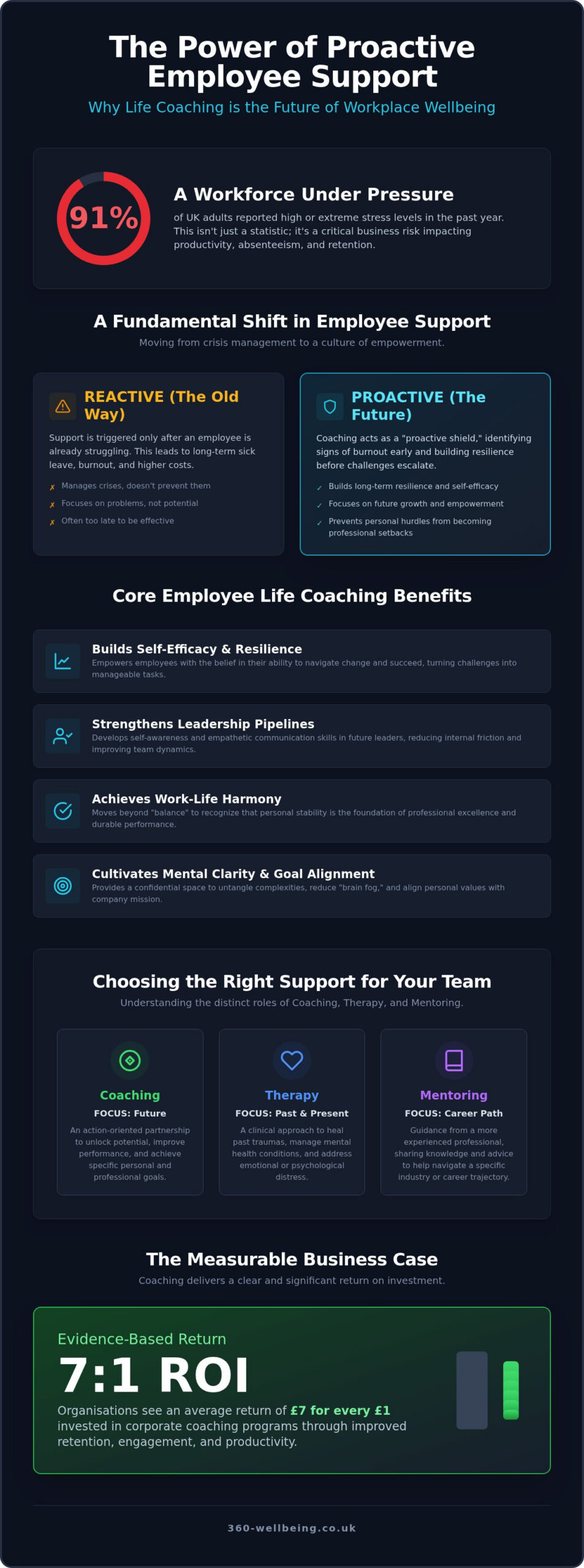
Did you know that 91% of UK adults reported experiencing high or extreme levels of stress over the past year? For many employers, this isn’t just a statistic; it’s a daily reality reflected in rising absenteeism and the constant challenge of retaining top talent in a competitive market. You’re likely looking for a way to support your team that moves beyond reactive measures, seeking a strategy that fosters genuine, long-term vitality. Understanding the employee life coaching benefits is the first step toward transitioning from simple crisis management to a proactive culture of empowerment and durability.
In this guide, we’ll show you how life coaching serves as a vital bridge, preventing personal hurdles from becoming professional setbacks. We’ll explore how this holistic approach delivers a measurable ROI, with many organisations seeing significant returns through improved retention and engagement scores. You’ll discover a clear, structured path to justifying your wellness spend while building a resilient workforce that’s equipped to thrive. We will look at the practicalities of 2026 standards, the distinction between coaching and therapy, and how to integrate these services into a unified strategy for total wellness.
Key Takeaways
- Understand how life coaching has transitioned from an executive luxury into a fundamental employee right that empowers growth at every level of your organisation.
- Explore the core employee life coaching benefits, focusing on how it builds self-efficacy and strengthens resilience against rapid workplace changes.
- Learn to distinguish between coaching, therapy, and mentoring to ensure your team receives the most appropriate, future-focused support for their specific needs.
- Discover the evidence-based 7:1 ROI for corporate coaching and how proactive intervention significantly reduces the hidden costs of absenteeism in the UK.
- See how integrating life coaching into a panoramic wellbeing ecosystem creates a unified, all-encompassing approach to long-term employee health and vitality.
The Evolution of Employee Support: Why Life Coaching is Essential in 2026
For years, many businesses viewed coaching as a luxury reserved for the executive suite. That perspective has shifted dramatically. Right now, the UK workforce is navigating hybrid work fatigue and a pressing need for greater self-efficacy. This has turned coaching into an essential employee right. It’s no longer just a perk; it’s a fundamental tool for growth. To understand the value, we should first look at what is life coaching in a professional setting: a future-focused, action-oriented partnership that drives both personal and professional development.
The primary employee life coaching benefits lie in their proactive nature. Traditional workplace support often relies on reactive interventions that only trigger once an employee is already struggling. Coaching flips this narrative. It provides an empowering vision of vitality and workplace harmony. By focusing on foresight and customisation, it helps individuals build the durability needed to thrive in a fast-paced environment. It establishes an immediate partnership between the provider and the user, making complex wellbeing topics feel manageable and accessible.
The Proactive Shield: Preventing Crisis Before It Starts
One of the most valuable employee life coaching benefits is its ability to act as a vital early warning system for your organisation. It identifies the subtle signs of burnout long before they escalate into long-term sick leave. Coaches serve as accountability partners, helping staff maintain mental clarity and stay on track with their goals during high-pressure periods. This approach represents a significant move away from medicalising every challenge. Many non-clinical life hurdles don’t require a doctor; they require a structured path forward and the support of a knowledgeable authority who is invested in their success.
Bridging the Gap Between Personal and Professional Success
We don’t leave our personal lives at the door when we start work. If someone is struggling with personal habits, relationship stress, or a lack of balance, their professional focus will inevitably decline. Life coaching addresses the whole person rather than just the worker. It recognises that personal stability is the foundation of professional excellence. When employees feel balanced and secure in their private lives, they bring more energy and agility to their roles. Life coaching acts as a powerful catalyst for professional durability by ensuring that the foundations of an individual’s life are stable and secure.
Core Employee Life Coaching Benefits for Performance and Wellbeing
Building a resilient workforce requires more than just standard health checks; it requires a focus on the internal “muscle” of your team. Modern employee life coaching benefits extend deep into the psychological fabric of your organisation, specifically by fostering “self-efficacy.” This is the fundamental belief in one’s own ability to succeed in specific situations. When employees possess high self-efficacy, they don’t just endure organisational change; they navigate it with agility and confidence. They move from a state of being overwhelmed to one of mastery, where challenges are viewed as tasks to be managed rather than threats to be feared.
We’re also seeing a necessary shift away from the rigid, outdated concept of “work-life balance” toward “work-life harmony.” Harmony acknowledges that professional and personal spheres are deeply interconnected. Stability in an employee’s personal life naturally fuels their performance at work. This holistic approach also strengthens leadership pipelines. By developing better self-awareness through coaching, future leaders learn to communicate with empathy and clarity, reducing friction and improving internal communication across all departments.
Cultivating Mental Clarity and Goal Alignment
Coaching provides a secure, confidential space for staff to untangle life’s complexities. It acts as a refuge from the noise of a busy office, allowing for deep reflection that is rarely possible during a standard workday. This clarity helps employees align their personal values with your company’s mission, creating a powerful sense of shared purpose. When people feel this alignment, “brain fog” and decision fatigue begin to dissipate. They aren’t just ticking boxes; they’re moving toward meaningful goals with a clear mind. While many leaders focus on the ROI of executive coaching, providing this level of structured goal-setting to your entire workforce ensures that every level of the business is pulling in the same direction.
Boosting Retention and Reducing Presenteeism
Presenteeism is a silent drain on UK productivity. It occurs when staff are physically at their desks but mentally absent due to personal stress, financial worries, or burnout. Research indicates that employees are five times less likely to leave an organisation when they feel their wellbeing is supported holistically. By offering coaching, you’re addressing the root causes of mental absence before they lead to resignation. This directly boosts employee engagement scores and creates a culture where people feel genuinely valued as individuals. If you’re looking to enhance your retention strategy, exploring how an integrated wellbeing platform can support your team is a proactive step toward professional harmony.
Life Coaching vs. Therapy and Mentoring: Choosing the Right Support
Choosing the right support for your team requires a clear understanding of the different modalities available. While therapy, mentoring, and life coaching are all valuable, they operate on different timelines. Therapy is often past-focused, dealing with healing and clinical mental health conditions. Mentoring relies on experience-sharing, where a senior colleague guides a junior one through specific career paths. In contrast, life coaching is future-focused and action-oriented. It creates a partnership dedicated to personal and professional growth. This distinction is vital for HR managers who want to maximise the employee life coaching benefits within their organisation.
A common objection is that an existing Employee Assistance Programme (EAP) covers all bases. While EAPs are excellent for crisis intervention, they often lack the proactive, developmental edge that coaching provides. These services complement rather than replace each other. By offering all three, you ensure a panoramic support system. Regardless of the modality, clinical-grade privacy remains the non-negotiable foundation. Employees must feel certain that their conversations are confidential to engage fully and honestly with the process.
When to Deploy Coaching Over Counselling
Distinguishing between clinical needs and developmental goals is a key skill for modern HR leaders. You should consider coaching when an employee is looking to improve their performance, navigate a life transition, or build resilience. It’s particularly effective for those who might feel a stigma around “therapy” but are eager to work with an accountability partner. Coaching offers a non-medicalised approach that feels empowering rather than clinical. It’s also an incredible tool for supporting employees returning to work after a mental health absence, helping them rebuild their confidence and professional durability in a structured way.
- Therapy: Best for clinical anxiety, depression, or past trauma.
- Coaching: Best for goal setting, habit formation, and resilience.
- Mentoring: Best for industry-specific knowledge and career pathing.
Coaching as a Professional Development Tool
Internal mentoring is valuable, but it often carries the weight of internal office politics. External, impartial coaching provides a level of trust that is hard to replicate in-house. Impartiality allows for honest self-reflection without the fear of judgement or professional repercussions. This external perspective is what makes coaching a premier tool for professional development. Total wellness also requires looking at the practical side of life. Integrating coaching with other pillars, such as financial support for employees, ensures that your team has a stable foundation to build upon. When the employee life coaching benefits are paired with practical aid, you create a workforce that is both mentally resilient and practically secure.
Measuring the Business Case: ROI and Organisational Impact
Investing in your team’s personal growth isn’t just a moral choice; it’s a strategic financial one. For many UK employers, the most compelling evidence lies in the median 7:1 ROI for corporate coaching. This means that for every £1 invested, businesses typically see a £7 return through enhanced productivity and improved retention. These employee life coaching benefits create a measurable shift in the bottom line, particularly for SMEs where the impact of a single high-performing individual is magnified. By moving away from reactive firefighting and toward a culture of foresight, you protect your most valuable assets.
While the financial return is clear, savvy leaders also look at qualitative data to gauge success. Tracking your Employee Net Promoter Score (eNPS) and conducting “stay interviews” can reveal how coaching is influencing the internal culture. When staff feel that their professional durability is a priority for their employer, recruitment costs naturally drop. Your employer brand becomes synonymous with genuine care, making it significantly easier to attract top talent in a competitive market without relying solely on salary inflation.
Reducing the Financial Burden of Absenteeism
Absenteeism due to stress and poor mental health is estimated to cost the UK economy £150 billion annually. For a small business, a single day of stress-related absence can disrupt entire projects and place an unfair burden on remaining staff. Proactive coaching acts as a vital early intervention tool. It identifies the precursors to burnout before they result in long-term sick leave. By providing an accountability partner to navigate life’s complexities, you prevent “burnout contagion” from spreading through small, tightly-knit teams. Keeping your staff at their desks and mentally present is one of the most immediate employee life coaching benefits you will experience.
Improving the Internal Leadership Pipeline
Coaching is an incredibly efficient way to prepare junior staff for management roles. It bypasses the need for expensive external degrees by focusing on the practical “soft skills” that modern leaders require. Empathy, time management, and conflict resolution are all sharpened through regular coaching sessions. This creates a robust internal leadership pipeline, ensuring that your organisation is prepared for future challenges. It fosters a proactive mindset across the workforce, where employees are empowered to solve problems before they escalate. To see how this fits into a wider strategy, you can explore our holistic wellbeing platform to support your team’s growth.
The Panoramic Approach: Why Integrated Wellbeing is the Future
Total wellness is never a series of isolated events; it’s a unified narrative where physical, mental, and social health intersect. At 360 Wellbeing, our philosophy is rooted in this panoramic viewpoint. We believe that employee life coaching benefits are most potent when they exist within a seamless ecosystem of care. When a life coach identifies that an employee’s stress is compounded by a persistent physical ailment, having immediate access to a 24/7 Virtual GP ensures that the issue is addressed before it escalates. Similarly, if a coaching session reveals deeper clinical needs, the transition to Mental Health Therapy is smooth and supportive, rather than a fragmented hurdle for the individual to clear alone.
This integrated approach also recognises the practical pressures of modern life. Stress isn’t always purely psychological; it’s often tied to the cost of living and financial stability. By combining life coaching with Financial Support and Debt Advice, we address the root causes of anxiety from multiple angles. This synergy creates a sense of completeness and balance, ensuring that your team feels looked after through a single, unified strategy. It’s about moving away from siloed support systems and toward a proactive vision of workplace harmony that feels both scientifically grounded and deeply personal.
A Unified Ecosystem of Care
Managing multiple wellness providers can be an administrative burden for SMEs and large organisations alike. A single platform for all employee health needs simplifies the process, ensuring that support is always accessible and manageable for the end user. Our 360 Rewards platform plays a crucial role here, offering a Rewards Marketplace that complements the positive, growth-oriented mindset built during coaching sessions. These tangible perks provide immediate, everyday value that reinforces the employee life coaching benefits gained through personalised sessions. For sole traders and small teams, the ease of onboarding means you can implement elite-level support without the need for a massive HR department. It’s a methodical, calm path toward a more durable workforce.
Making Wellbeing an Entitlement, Not a Luxury
The traditional model of corporate wellness often left high-level support out of reach for many staff members. We’ve democratised access through an affordable, per-employee subscription model that makes comprehensive care a professional necessity rather than a luxury. By prioritising foresight and customisation, you’re building a future-ready workforce that feels empowered and valued. Providing expert care is an essential human entitlement that drives long-term success for both the individual and the organisation. If you’re ready to see how a unified strategy can transform your business, Book a demo of the 360 Wellbeing platform today.
Building a Future-Ready Workforce Through All-Encompassing Care
Creating a culture of vitality requires a shift from reactive health warnings to a proactive vision of harmony. By embracing the employee life coaching benefits we’ve explored, you’re not just offering a perk; you’re providing an essential entitlement that fosters professional durability. You’ve seen how this action-oriented support complements clinical therapy and 24/7 Virtual GP access to create a secure, panoramic ecosystem of care.
The business case is undeniable. With a proven 7:1 ROI on wellbeing spend, these strategies are specifically tailored for UK SMEs and sole traders who need to protect their talent and reduce the heavy burden of absenteeism. This integrated approach ensures that personal stability fuels professional excellence, turning potential crises into opportunities for mastery. We’re here to help you navigate this transition with compassion and expert foresight. It’s time to move toward a workplace where everyone has the tools to thrive.
Empower your team with 360 Wellbeing’s integrated life coaching and health platform and start building a more resilient, engaged workforce today.
Frequently Asked Questions
What is the difference between life coaching and an Employee Assistance Programme (EAP)?
Life coaching and Employee Assistance Programmes serve different but complementary roles within a modern business strategy. An EAP typically provides reactive support for crises or short-term personal issues. Life coaching is a proactive partnership focused on personal and professional growth. While an EAP helps an employee manage a sudden crisis, life coaching builds the long-term resilience and self-efficacy needed to navigate daily challenges before they escalate into larger problems.
How much does it cost to provide life coaching to employees in the UK?
In the UK, the cost of life coaching can vary significantly based on whether you hire independent specialists or use a managed platform. Private hourly rates often range from £75 to £200. However, 360 Wellbeing provides a more accessible route for organisations through a recurring per-employee subscription model. This approach democratises elite support, making it affordable for businesses of all sizes to offer these services as a professional necessity rather than a luxury.
Can life coaching help with workplace stress and burnout?
Life coaching is a powerful tool for addressing workplace stress and burnout by identifying early warning signs before they lead to long-term sickness. Coaches act as accountability partners, helping employees develop the mental clarity and durability needed to manage high-pressure environments. By focusing on future-focused actions rather than just reacting to symptoms, coaching helps individuals build a proactive shield against the mental fatigue that often leads to absenteeism.
How do you measure the ROI of employee life coaching?
Measuring the employee life coaching benefits involves tracking both quantitative and qualitative data over time. You can monitor changes in absenteeism rates, staff turnover, and overall productivity levels. Additionally, qualitative tools like employee satisfaction scores and stay interviews provide insight into how coaching improves the internal culture. Combining these metrics helps you justify wellness spend by showing a clear link between employee vitality and your organisation’s financial performance.
Is life coaching confidential for employees?
Confidentiality is the non-negotiable foundation of any successful coaching relationship. For employees to engage honestly, they must feel certain that their conversations are private and secure. At 360 Wellbeing, we maintain clinical-grade privacy standards for all our services. This ensures that personal challenges can be discussed without fear of professional repercussions, which is essential for fostering the trust required for genuine personal and professional transformation within your team.
How many coaching sessions do employees typically need to see benefits?
Many employees begin to see noticeable benefits after just a few sessions, though a standard engagement often consists of six sessions. This duration allows for identifying core challenges, setting actionable goals, and establishing new habits. The goal isn’t a one-off fix but rather a methodical path toward long-term durability. A structured series of sessions ensures that positive changes are integrated into the employee’s daily professional and personal life effectively.
Does life coaching work for small businesses and sole traders?
Life coaching is exceptionally effective for small businesses and sole traders where the impact of a single individual’s performance is magnified. While executive-level coaching was once too expensive for smaller teams, modern platforms have made it highly accessible. By using a per-employee subscription model, even the smallest organisation can provide its team with the same level of support usually reserved for large corporations, significantly boosting resilience and retention.
What is the “7:1 ROI” for corporate coaching based on?
The 7:1 ROI statistic for corporate coaching is based on the median return organisations see through improved productivity and reduced staff turnover. For every £1 invested in wellbeing support like coaching, businesses typically see £7 returned in value. This figure highlights how the employee life coaching benefits extend beyond simple morale boosting to provide a measurable financial advantage, particularly by reducing the high costs associated with absenteeism and recruitment in the UK.