
What if the primary driver of your high staff turnover isn’t a lack of professional skill, but a quiet struggle with personal clarity? Many leaders feel that their current Employee Assistance Programmes are too reactive, acting as a safety net only after a crisis has already occurred. You likely recognise that your team is exhausted by the cycle of ‘quiet quitting’ and burnout, yet you’re searching for a way to support them before they reach a breaking point. Understanding the specific employee life coaching benefits can help you shift from a culture of crisis management to one of proactive vitality, particularly as the global coaching market is projected to reach $3.97 billion in 2026.
This guide explores how life coaching empowers your workforce to overcome personal hurdles and align their individual goals with your company’s vision. You’ll discover how this forward-looking partnership fosters a more resilient, self-reliant team while improving your overall engagement scores. We will also clarify the essential distinction between coaching and therapy, ensuring you can provide the right level of support for every individual. By the end of this article, you’ll have a clear, methodical path toward building a workplace where mental, social, and professional health are integrated into a single narrative of total wellness.
Key Takeaways
- Understand how life coaching has transitioned from an exclusive executive luxury into an essential, proactive tool for employees at every level of your business.
- Discover the specific employee life coaching benefits that foster self-reliance, helping your team navigate personal hurdles and establish sustainable work-life harmony.
- Learn to distinguish between coaching, therapy, and mentoring so you can provide the most appropriate support for your staff’s unique mental and professional needs.
- Explore the business case for coaching, including how it reduces absenteeism and combats presenteeism to drive measurable organisational success and retention.
- See how integrating life coaching into a unified wellbeing ecosystem through the 360 Wellbeing platform creates a more resilient and durable professional culture.
Understanding the Role of Life Coaching in the 2026 Workplace
In the fast-paced environment of 2026, the traditional boundaries of the office have largely dissolved. Hybrid working models and the constant hum of digital connectivity have created a landscape where employees often feel stretched thin. Coaching is no longer an exclusive luxury reserved for the boardroom; it’s a fundamental necessity for a healthy, durable workforce. Unlike traditional interventions that focus on repairing what’s broken, life coaching is an action-oriented partnership designed to unlock future potential.
Many businesses are finding that their existing Employee Assistance Programmes (EAPs) are excellent for crisis management but fall short when it comes to daily vitality. These reactive services wait for an employee to reach a breaking point before offering support. In contrast, the employee life coaching benefits we see today focus on foresight. By providing a structured path for personal growth, coaching helps staff navigate challenges before they manifest as absenteeism or ‘quiet quitting’. It’s about moving from a culture of survival to one of thriving.
The Evolution of Employee Support
Employee expectations have undergone a radical shift. We’re seeing a move away from generic perks toward holistic, deeply personalised lifestyle support. For Gen Z and Millennials, professional development isn’t just about learning a new software; it’s about finding purpose and balance. Life coaching addresses the ‘grey area’ between clinical mental health support and general wellness. It provides a platform for employees to discuss life transitions, such as returning from parental leave or managing personal goals, within a professional framework that values them as whole people.
Coaching as a Preventative Health Measure
Investing in coaching is essentially building ‘mental fitness’ across your organisation. It allows employees to identify their unique stress triggers and develop resilient mindsets before pressure becomes overwhelming. This proactive approach ensures that your team remains present and focused, rather than just physically at their desks. Life coaching is a non-clinical tool designed to create alignment between an individual’s personal aspirations and their professional responsibilities. By fostering this internal harmony, businesses can enjoy the long-term employee life coaching benefits of reduced turnover and a more self-reliant, empowered workforce.
Key Employee Life Coaching Benefits: Beyond Professional Development
The true value of coaching lies in its ability to transform an individual’s internal landscape. When we discuss employee life coaching benefits, we often focus on productivity, but the true impact starts with self-efficacy. By empowering staff to navigate their own challenges, you create a workforce that doesn’t just wait for instructions but actively seeks solutions. This shift in mindset is a core part of the Power Of Workplace Coaching, where personal growth becomes a catalyst for organisational excellence.
Resilience is another critical pillar. In an era of constant change, employees need more than just technical skills; they need the mental tools to handle uncertainty without burning out. Life coaching provides a safe space to align personal values with professional objectives, ensuring that work feels meaningful rather than just a series of tasks. This alignment is what builds long-term durability in your team. It allows individuals to set healthy boundaries and achieve a sense of work-life harmony that prevents the slow creep of exhaustion.
Navigating Life’s Complexities
Life doesn’t stop when an employee logs on. Personal hurdles such as bereavement, divorce, or the transition into parenthood can significantly impact a person’s ability to stay present. Traditional management often feels ill-equipped to handle these sensitive areas. Coaching provides a professional yet empathetic bridge, offering support through these major life events. It also helps with positive transitions, such as preparing for a promotion or a lateral move into a new department. When employees feel supported in their lifestyle and financial goals, they bring a sense of stability back to the workplace. This holistic care ensures that personal milestones or setbacks don’t derail a career.
Building a Culture of Accountability
A coach acts as a dedicated accountability partner, helping employees stay focused on their growth. This external support significantly reduces the ‘mental load’ on your managers. Instead of supervisors needing to act as amateur therapists or life planners, they can focus on operational goals while knowing their team has professional guidance. Clear personal goals lead to sharper daily focus and a more disciplined approach to tasks. You can explore how integrated support systems like 360 Wellbeing help foster this environment of self-reliance and clarity, allowing your leadership team to lead rather than just manage crises.
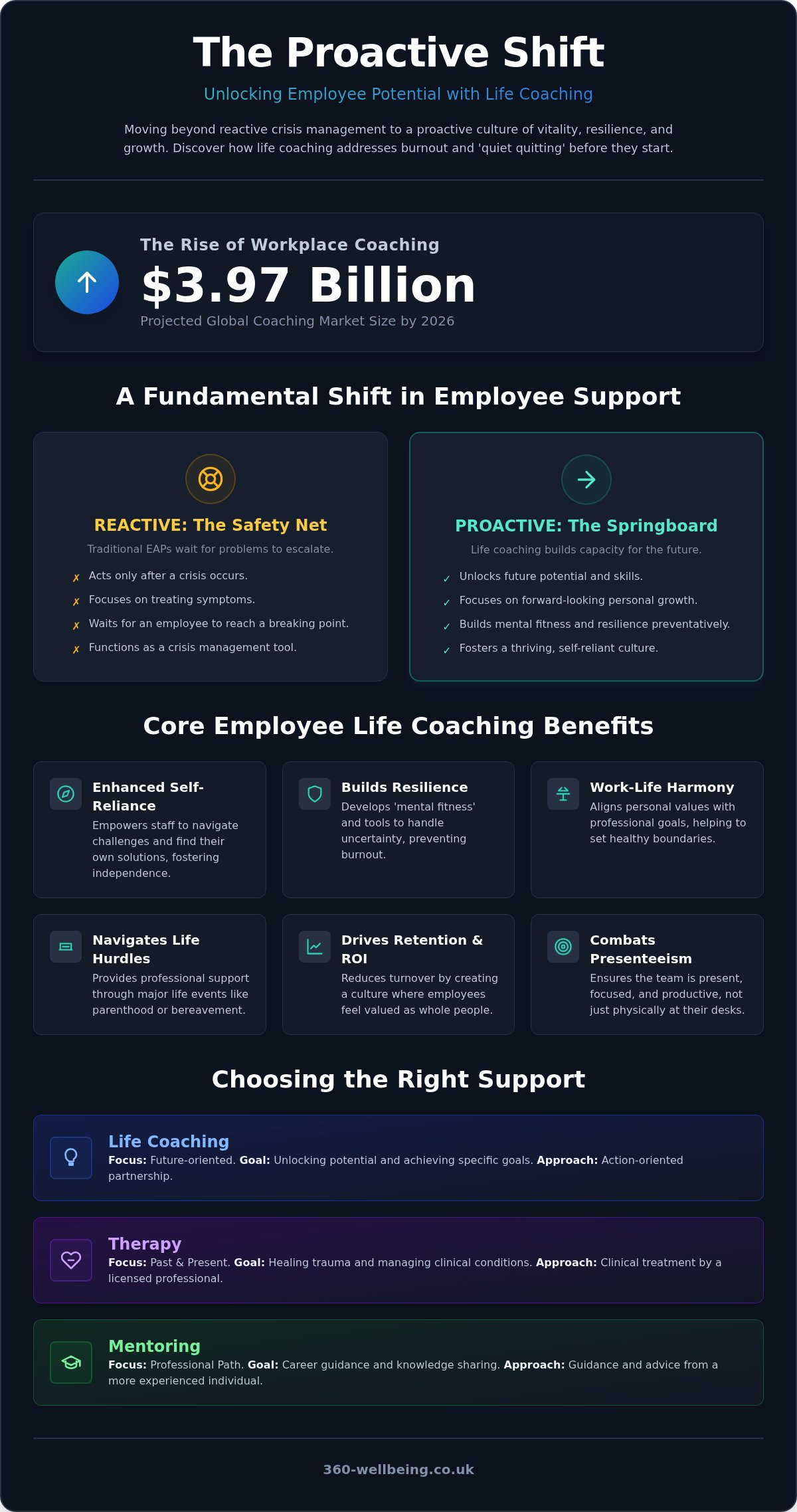
Life Coaching vs. Therapy vs. Mentoring: Choosing the Right Support
Providing the right support requires a clear understanding of where an employee stands on their health journey. While therapy, mentoring, and life coaching are often used interchangeably, they serve distinct purposes within a panoramic wellbeing strategy. Therapy is a clinical intervention designed to address past trauma or diagnosed mental illness. Mentoring focuses on the transfer of specific professional knowledge from an experienced peer. Life coaching, however, is a forward-looking strategy for individuals who are functioning well but seek greater alignment or clarity. It’s about building durability for the future rather than just repairing the past.
A truly effective workplace wellness programme doesn’t force a choice between these services. Instead, it offers a seamless ecosystem where coaching complements mental health therapy without attempting to replace it. This integrated approach is backed by research from the National Institutes of Health, which highlights how wellness coaching positively impacts both mental and physical health. By offering all three, you ensure that every individual has access to the specific type of support they need at that exact moment in their life.
When to Refer to a Life Coach
Identifying the right moment for a referral is key to maximising employee life coaching benefits. If a staff member is consistently meeting deadlines but expresses a lack of direction or struggles with time management, they’re likely ‘stuck’ rather than ‘ill’. Coaching provides the framework to move past these hurdles. It’s particularly effective for high-performers who show signs of early fatigue; intervention at this stage can prevent future burnout. Additionally, coaching supports diversity and inclusion by providing tailored guidance for individuals from underrepresented backgrounds to navigate unique career challenges with confidence.
The Synergy of Integrated Support
Privacy remains the cornerstone of all three support types. Whether an employee is discussing a career transition with a coach or a personal crisis with a therapist, clinical-grade confidentiality is essential. Using a single platform allows for a smooth transition between different levels of care. For example, a coach might recognise that an employee’s challenges require clinical expertise and can guide them toward more intensive support. This ensures that the employee life coaching benefits are part of a larger, unified narrative of care that treats the individual as a whole person, acknowledging that their professional success is inseparable from their personal vitality.
The Business Case: How Coaching Drives ROI and Retention
The financial justification for coaching is becoming impossible to ignore for modern UK businesses. When you invest in your team’s personal clarity, you’re directly addressing the root causes of absenteeism. Many staff absences aren’t due to physical illness but result from overwhelming personal stressors that eventually lead to burnout. By providing a professional outlet to manage these hurdles, the employee life coaching benefits extend far beyond the individual, creating a more stable and predictable operational environment.
Presenteeism is often a hidden drain on resources. This occurs when employees are physically at their desks but mentally absent, distracted by the very life complexities we’ve discussed in previous sections. Coaching helps these individuals regain their focus by providing actionable strategies for their personal lives. This ensures they remain fully ‘present’ and engaged during working hours. Measuring this success is straightforward; businesses can track improvements through regular engagement surveys and specific productivity metrics that correlate with a more focused workforce.
Attracting and Retaining Talent in 2026
In 2026, top-tier talent looks for more than just a competitive salary. They seek employers who view their wellbeing as a professional necessity rather than a luxury. Life coaching acts as a ‘magnet’ benefit, signalling that your company is committed to the long-term durability of its staff. This proactive approach significantly reduces recruitment costs. It’s far more cost-effective to invest in the growth of current employees than to constantly replace those who leave due to a lack of support. Your employer brand becomes synonymous with a culture of empowerment and holistic care.
Calculating the Tangible Impact
Linking coaching sessions to business outcomes reveals a clear return on investment. You’ll likely notice a reduction in HR caseloads as employees become better equipped to resolve their own interpersonal or lifestyle challenges. There is a direct correlation between goal-oriented employees and the achievement of business KPIs. Every £1 invested in holistic wellbeing typically yields a significant return in reduced turnover. In fact, current industry data suggests a median ROI as high as 7:1 for businesses that prioritise these services. To see how these results could transform your organisation, you can explore our life coaching solutions today.
The Panoramic Approach: Implementing Life Coaching with 360 Wellbeing
The 360 Wellbeing platform represents a shift from fragmented perks to a unified ecosystem where every facet of health is interconnected. True vitality isn’t achieved through isolated interventions; it requires a panoramic viewpoint that considers the employee’s physical, mental, and social needs as a single narrative. By integrating life coaching into this broader framework, businesses can offer support that feels both scientifically grounded and deeply personal. This holistic strategy ensures that the employee life coaching benefits we’ve discussed are reinforced by other essential pillars, such as financial support and mental health resources.
Our digital-first access is a cornerstone of this modern approach. Traditional workplace support often carries a lingering stigma that prevents employees from reaching out until they are in crisis. Our platform removes these barriers by providing a discreet, user-friendly interface where help is always a few taps away. This immediate connection, combined with our expert caregiver persona, provides staff with the reassurance and reliability they need to navigate life’s challenges. We act as a knowledgeable partner, deeply invested in each user’s success, which helps move the conversation away from fear-based warnings toward a positive vision of workplace harmony.
Making Wellbeing Accessible for SMEs
UK SMEs and sole traders often face the challenge of providing high-level benefits on a limited budget. Our SaaS-based model solves this by offering a per-employee subscription that makes premium coaching affordable for businesses of all sizes. It removes the administrative burden of managing multiple vendors, consolidating your wellness strategy into one manageable platform. This foundation of total wellness is anchored by our 24/7 Virtual GP service, ensuring your team has immediate access to clinical expertise whenever they need it. It’s a methodical path forward that creates a sense of safety and order for both the employer and the staff.
A Future-Ready Workforce
Building a future-ready workforce is about more than just managing current performance. It’s about fostering durability and foresight so that your team can handle whatever the year 2026 and beyond might bring. 360 Wellbeing supports the ‘total human’, acknowledging that a person’s life at home is inseparable from their life at work. When you implement these employee life coaching benefits alongside clinical tools, you create an environment where employees feel genuinely valued and empowered. This creates the resilience necessary for long-term success. The next steps are simple: onboarding your team onto the platform allows them to begin their coaching journey immediately, setting the stage for a more harmonious and productive professional culture.
Cultivating a Culture of Durability and Vitality
The transition toward a proactive workplace culture is no longer a luxury in 2026; it’s a professional necessity and a fundamental human entitlement. By shifting the focus from reactive crisis management to preventative personal growth, businesses can unlock the full spectrum of employee life coaching benefits. This approach doesn’t just resolve immediate personal hurdles; it builds a self-reliant workforce capable of navigating uncertainty with confidence. When individuals align their personal values with their professional roles, the resulting harmony drives both long-term retention and measurable organisational success.
Integrating these services into a single, panoramic platform ensures that your team feels supported at every stage of their journey. 360 Wellbeing is trusted by UK SMEs to provide this all-encompassing care, featuring 24/7 Virtual GP access alongside mental health and financial support in one unified platform. We invite you to empower your team with 360 Wellbeing’s life coaching and health platform today. By choosing a partner who is deeply invested in your staff’s success, you aren’t just providing a benefit; you’re securing the future vitality of your business. Your team’s journey toward total wellness starts with a single, supportive step.
Frequently Asked Questions
What is the difference between life coaching and an Employee Assistance Programme (EAP)?
Life coaching is a proactive, growth-oriented partnership, whereas traditional EAPs are often reactive and crisis-focused. While EAPs provide essential support for acute issues, coaching focuses on building long-term personal durability. It helps employees move from “surviving” to “thriving” before a problem becomes a crisis. This forward-looking approach is a key part of modern employee life coaching benefits, providing a structured path for future success rather than just a safety net for current distress.
Is life coaching for employees confidential?
Yes, confidentiality is a fundamental requirement of the coaching relationship. Any sessions booked through a professional platform are strictly private between the employee and their coach. Employers do not receive details about the specific content of these conversations. This clinical-grade privacy ensures that staff feel safe discussing sensitive personal hurdles, which is essential for the coaching to be effective and for maintaining a culture of trust within your organisation.
How many life coaching sessions does an employee typically need?
Most employees see significant progress within three to six sessions. While some specific hurdles can be addressed in a single session, a short-term commitment allows for deeper goal alignment and sustainable habit formation. Industry standards in 2026 suggest that three-month programmes are common for achieving lasting change. The frequency is usually tailored to the individual’s unique needs, ensuring the support remains manageable and integrated into their professional schedule without causing additional pressure.
Can life coaching help with workplace stress and burnout?
Life coaching is highly effective at preventing burnout by helping employees identify stress triggers early. Instead of waiting for a clinical diagnosis, a coach works with the individual to set healthy boundaries and improve work-life harmony. This proactive intervention is one of the primary employee life coaching benefits, as it builds the mental fitness required to handle high-pressure environments. It empowers staff to regain control over their time and energy before exhaustion sets in.
Is life coaching suitable for small businesses or just large corporations?
Life coaching is perfectly suited for UK SMEs and sole traders because it addresses the high-impact nature of small teams. In a smaller business, the burnout of even one person can have significant operational consequences. Using a subscription-based platform makes this high-level support affordable and scalable. It allows smaller employers to offer the same quality of holistic care as large corporations, ensuring their workforce remains durable, resilient, and competitive in the talent market.
How do I know if an employee needs a life coach or a therapist?
You should consider whether the employee is focused on their future potential or struggling with past trauma. If a staff member is generally functional but feels “stuck” or lacks direction, a life coach is the right choice. However, if they are experiencing symptoms of clinical illness, such as severe anxiety or depression, they should be directed toward mental health therapy. A panoramic platform allows for a smooth transition between these different levels of expert care.
What are the most common goals addressed in employee life coaching?
Employees frequently focus on achieving work-life balance, improving time management, and navigating career transitions. Other common goals include building confidence for new leadership roles, managing personal financial stressors, or improving communication within their teams. Because coaching is highly personalised, the objectives are always driven by the individual’s unique circumstances. This ensures the support is relevant to their life at home and their performance at work, creating a sense of completeness and balance.
Does life coaching count as a taxable benefit for UK employees?
If the coaching is provided specifically for professional development or to help an employee perform their job better, it may not be considered a taxable “benefit in kind.” However, tax regulations are complex and can change. Employers should always check the current HMRC guidance or consult with a qualified financial professional to confirm the status of specific wellness benefits. Providing this support is increasingly viewed as a professional necessity and an essential human entitlement.