
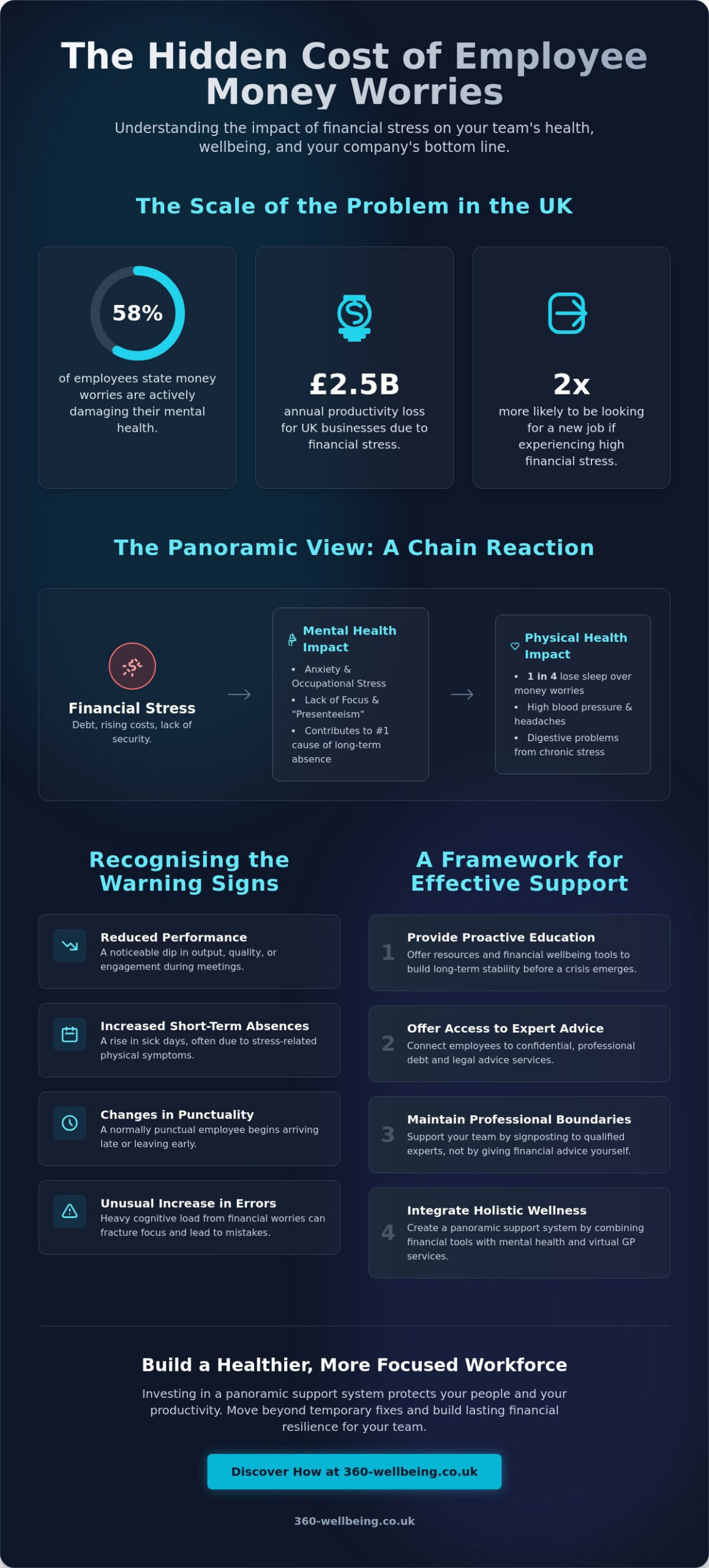
58% of UK employees report that money worries are actively damaging their mental health, contributing to a massive £2.5 billion annual productivity loss for businesses. You likely see the signs in your own team through distracted looks, reduced performance, or a rise in short-term absences. It’s difficult to watch talented people struggle, yet you might worry that offering employee money worries support feels like overstepping a boundary into their private lives.
You don’t have to be a financial expert to make a difference. We believe that effective support isn’t about giving money; it’s about providing a panoramic ecosystem of expert care. By reading this guide, you’ll discover how to proactively support your team’s financial health to boost productivity and reduce workplace stress. We’ll outline a clear, affordable framework for providing professional debt and legal advice, helping you build a healthier, more focused workforce that feels truly supported.
Key Takeaways
- Recognize the deep connection between financial security and physical health to better understand the true impact of stress on your team’s performance.
- Learn how to implement effective employee money worries support by focusing on a proactive framework that balances education with professional advice.
- Master the art of supporting your staff while maintaining professional boundaries through clear signposting to qualified external experts.
- Identify the specific gaps in your current benefit offerings to ensure your team has access to the precise tools they need for long-term stability.
- Discover how integrating financial support and debt advice with mental health tools creates a panoramic support system that protects both your people and your productivity.
The True Cost of Employee Money Worries in the UK Workplace
Financial wellbeing isn’t just about the balance in a bank account; it’s the sense of security and control someone feels over their daily and future finances. In 2026, even with inflation easing to 2.8% in April, many UK workers still feel the lingering pressure of the cost-of-living crisis. For managers, providing employee money worries support is no longer a peripheral HR task. It’s a fundamental pillar of operational success. When a team member is preoccupied with debt or rising costs, they aren’t fully present. This lack of control ripples through your business, affecting everything from morale to the bottom line.
The financial burden on employees translates into a direct cost for your organization. Research published in May 2026 shows that productivity loss linked to financial stress costs UK businesses over £2.5 billion annually. This often manifests as “presenteeism,” where staff are physically at their desks but mentally elsewhere, or through high absenteeism. Financial anxiety is a primary driver of occupational stress, which has now made mental health the number one reason for long-term sickness absence in the UK. Investing in support isn’t just a kind gesture; it’s a vital retention tool. Employees facing high financial stress are twice as likely to be looking for a new role.
Recognising the Signs of Financial Stress
Detecting financial strain requires a keen, empathetic eye. You might notice subtle shifts: a normally punctual employee arriving late, a dip in engagement during meetings, or an unusual increase in workplace errors. These aren’t necessarily performance issues; they’re often symptoms of heavy cognitive load. When someone is losing sleep over money, as 1 in 4 UK employees currently do, their focus naturally fractures. Offering immediate employee money worries support without intrusive questioning or long wait times helps preserve their dignity while protecting your team’s output.
Why SMEs Are Uniquely Positioned to Help
Small and medium-sized enterprises have a distinct advantage: the ability to foster deep, personal connections. In a close-knit environment, you’re more likely to spot early warning signs before they escalate into a crisis. By building a culture where wellbeing is an entitlement rather than a luxury, you reduce the stigma surrounding money talk. It’s time to move beyond the myth that a pay rise is the only solution to debt. While the National Living Wage rose to £12.71 in April 2026, wage increases alone can’t fix complex financial hurdles. SMEs can provide a more durable impact by offering a clear framework for professional guidance and long-term stability.
The Panoramic View: Linking Financial Stress to Mental and Physical Health
To truly understand the weight of financial anxiety, we must adopt a panoramic view of health. Finance, mind, and body don’t exist in separate silos; they are deeply interconnected. When an individual struggles with debt, the stress doesn’t stay confined to their bank statement. It spills into their mental wellbeing and eventually manifests as physical symptoms. By integrating employee money worries support into a broader wellness strategy, you address the root causes of distress rather than just treating the surface-level symptoms. This holistic approach is what transforms a workplace from a high-pressure environment into a culture of vitality where every team member feels empowered to thrive.
The physiological impact of chronic financial stress is profound. When the brain perceives a financial threat, it triggers a constant “fight or flight” response, flooding the body with cortisol and adrenaline. Over time, this chemical imbalance leads to significant health challenges. High blood pressure, persistent headaches, and digestive problems are common among those facing financial uncertainty. These aren’t just minor inconveniences; they are the body’s warning signs that the current situation is unsustainable. A durable wellness strategy recognizes that financial support must be paired with access to mental health therapy and clinical expertise to ensure long-term durability and health.
The Physical Toll of Money Worries
Money worries often result in physical ailments that lead to increased sick days and reduced cognitive function. Data from May 2026 indicates that 1 in 4 UK employees have lost sleep over financial concerns, which directly impacts their safety and focus at work. When these physical symptoms arise, quick access to medical advice is essential for reassurance. A 24/7 Virtual GP service allows staff to seek clinical guidance instantly, helping to manage stress-related ailments before they escalate into long-term sickness. This early holistic intervention is vital in preventing the burnout that 79% of UK employees have experienced at some point in their careers.
Mental Health and Financial Resilience
There is a well-documented cycle where financial debt leads to depression, which in turn makes it harder for an individual to manage their daily finances. Breaking this loop requires professional intervention that addresses both the emotional and practical sides of the problem. Mental health support provides a safe, confidential space to process anxiety, while life coaching helps employees move from a reactive state to a proactive one. By helping your staff set clear goals and build financial resilience, you create a workforce capable of navigating economic shifts with confidence. Our Employee Assistance Programme (EAP) provides this robust employee money worries support, ensuring that mental, physical, and social health are treated as a unified narrative of total wellness.
Building a Framework for Employee Money Worries Support
Effective financial wellbeing isn’t built on a single initiative. It requires a structured framework that provides a panoramic viewpoint of an individual’s needs. A robust system for employee money worries support rests on four distinct pillars: education, ease of access, tangible benefits, and professional advice. By weaving these elements into your existing HR strategy, you create a durable safety net that catches people before they fall into a crisis. Technology plays a central role here, offering a confidential way for staff to access help 24/7 without the fear of being judged by their peers or managers.
Balancing proactive and reactive measures is essential for workplace harmony. Proactive support focuses on foresight, helping employees stretch their income and plan for the future. Reactive support, on the other hand, provides a vital lifeline when debt or legal issues become overwhelming. While many traditional models focus solely on the crisis phase, a modern approach prioritizes prevention. This creates a sense of completeness in your care strategy, ensuring that wellbeing is treated as a professional necessity rather than a one-off luxury. It moves the conversation away from fear and toward a positive vision of long-term vitality.
Proactive Benefits: Preventing Financial Strain
Preventing stress starts with practical tools that ease daily living costs. Access to discount marketplaces, such as 360 Rewards, allows employees to make their monthly salary go further on essentials. We also emphasize the importance of Complimentary Will Writing as a foundational financial benefit. It’s an often overlooked aspect of long-term security that provides immense peace of mind for families. By encouraging this kind of financial foresight, you help your team build a more stable foundation, reducing the likelihood of future anxiety and helping them feel more secure in their personal lives.
Reactive Support: Managing Debt and Crisis
When financial challenges escalate, immediate intervention is critical to prevent a total breakdown in mental health. Providing access to Financial Support & Debt Advice through a confidential Employee Assistance Programme (EAP) ensures that staff can speak to experts without delay. Confidentiality is the cornerstone of this employee money worries support; employees must feel safe knowing their personal situation remains private. Additionally, Legal Support can be a decisive factor in resolving disputes that might otherwise lead to significant financial loss. This structured path forward helps individuals regain control, allowing them to return their focus to their professional responsibilities with a clear mind.
How to Implement Support Without Giving Financial Advice
Many managers hesitate to offer employee money worries support because they fear the legal implications of acting as an unlicensed financial advisor. It’s a valid concern. Your role isn’t to solve an employee’s debt personally; it’s to act as a compassionate bridge to professional resources. By following a structured implementation plan, you can provide life-changing assistance while maintaining clear professional boundaries and protecting your business from liability. This approach ensures that your support is both durable and legally sound.
- Audit your current benefits: Identify where your existing support ends. Do you offer practical tools like 360 Rewards to help with daily costs, or is your support limited to a monthly payslip?
- Signpost to external experts: Instead of offering opinions on debt management, provide direct links to qualified professionals. This keeps you in the role of a supportive employer rather than a financial consultant.
- Train your leadership team: Equip managers with the skills to recognise the physiological signs of stress we previously discussed. They should know how to listen without feeling the need to fix the underlying financial issue themselves.
- Launch a unified EAP: A high-quality Employee Assistance Programme provides a single point of contact for Financial Support & Debt Advice, making it easy for staff to seek help discreetly.
- Communicate consistently: Stigma thrives in silence. Regularly mention your wellbeing tools in newsletters and team meetings so that seeking help becomes a normal part of your workplace culture.
The Role of the Manager: Empathy Over Expertise
When you sit down with a team member, your goal is to offer a partnership, not a lecture. Sensitive conversations about money require a direct and personal approach that focuses on the individual’s wellbeing rather than their bank balance. You don’t need to know the specific details of their debt to be helpful. Instead, focus on the “path forward.” By asking, “How can we support your focus at work while you navigate this?” you validate their experience without overstepping. This empathetic stance builds a durable bond of trust, ensuring the employee feels seen as a human being rather than just a resource.
Confidentiality and Data Privacy
For many workers, the fear that HR might discover their financial struggles is a major barrier to seeking help. This is why third-party platforms are far superior to internal support systems. When you provide employee money worries support through an external partner, you ensure complete anonymity for the user. It’s vital to communicate that the company receives only high-level usage data, never personal details. This level of privacy is not just a legal requirement for handling sensitive information; it’s a professional necessity that gives your team the safety they need to engage with debt advice and legal support fully.
To see how a unified platform can simplify this process for your business, explore our comprehensive EAP solutions.
Holistic Wellness: How 360 Wellbeing Supports Your Team
360 Wellbeing provides a unified ecosystem designed specifically for the unique needs of SMEs. We understand that a fragmented approach to health often leaves gaps where stress can take root and grow. By offering employee money worries support through a single, accessible platform, we ensure that your team has a clear and structured path toward vitality. This integration is key. When an employee accesses our Financial Support & Debt Advice, they’re also just one click away from Mental Health Support, acknowledging that financial strain and emotional health are two sides of the same coin.
Daily relief is just as important as long-term advice. Our 360 Rewards program offers tangible, immediate value by helping staff stretch their household budgets on everyday essentials. This proactive benefit works in tandem with our expert services to create a sense of completeness. It empowers your workforce through foresight and durability, providing them with the tools to manage today’s costs while planning for a more secure tomorrow. This all-encompassing care model ensures that every individual feels seen, supported, and valued as a whole person.
A Single Platform for Total Wellbeing
Managing multiple benefit providers is a significant administrative burden for busy HR teams. Our digital-first approach simplifies this by consolidating everything into a monthly per-employee subscription. This model offers predictable budget control, which is essential for business stability in 2026. Within this single platform, we link 24/7 Virtual GP services, professional therapy, and debt advice into one seamless narrative of total wellness. It’s about creating a partnership where the provider is as invested in your team’s success as you are, reducing the friction often found in traditional healthcare models.
Next Steps for Your Business
Bringing this panoramic viewpoint to your organization is a straightforward and methodical process. As you look at your strategy for the remainder of 2026, consider how a corporate membership can be customized to meet the specific demographic needs of your workforce. Whether your team requires more intensive Life Coaching or immediate Legal Support, our framework is flexible enough to adapt. You can discover how 360 Wellbeing can support your team by exploring our tailored SME packages today. Taking this step ensures that employee money worries support is no longer a luxury, but a professional necessity that protects your people and your productivity.
Empowering Your Team for a Resilient Future
Building a workplace where employees feel secure and focused requires a panoramic approach to health. We’ve explored how financial anxiety directly impacts physical vitality and cognitive performance, costing UK businesses billions in lost productivity. By shifting from a reactive mindset to a proactive framework, you can provide a durable safety net that protects your staff before challenges become crises. Implementing employee money worries support isn’t just about managing debt; it’s about treating wellbeing as a professional necessity and an essential human entitlement.
Our platform offers the expert care your team deserves, from a 24/7 UK-registered Virtual GP to specialized Financial & Debt Advice helplines. You can also provide immediate daily relief through thousands of exclusive staff discounts via 360 Rewards. This combination of clinical expertise and practical benefits ensures your workforce remains healthy, balanced, and deeply engaged. Book a demo to see how our financial support tools work and take the first step toward a more harmonious workplace. Together, we can create an environment where every individual has the opportunity to thrive.
Frequently Asked Questions
How can I support an employee with debt without overstepping?
You support an employee by acting as a compassionate signpost to professional resources rather than trying to solve the debt yourself. Focus on the impact their stress has on their work life while offering a direct link to your Employee Assistance Programme. This maintains professional boundaries and ensures they receive expert care from qualified specialists who understand the complexities of debt management and financial recovery.
What is the difference between financial education and financial advice?
Financial education provides general information and tools to help staff manage their money, whereas financial advice offers specific recommendations tailored to an individual’s circumstances. Employers can safely provide education, such as webinars or access to discount marketplaces like 360 Rewards. However, specific advice should only be delivered by regulated professionals to ensure both the employee and the business are protected from liability.
Can an Employee Assistance Programme (EAP) really help with money worries?
An Employee Assistance Programme is a highly effective tool for providing employee money worries support because it offers a confidential, third-party space for staff to seek help. Through an EAP, employees can access Financial Support & Debt Advice helplines and legal experts. This removes the stigma of discussing personal finances with HR and provides a clear, structured path toward resolving financial crises before they impact mental health.
Why is financial wellbeing important for workplace productivity?
Financial wellbeing is vital because it reduces the presenteeism and cognitive load that occurs when staff are distracted by mounting bills. When an employee is preoccupied with money, their focus on tasks diminishes, leading to increased errors and safety risks. By supporting their financial health, you foster a more resilient workforce that is physically and mentally present, directly protecting your business from the high costs of productivity loss.
What are some low-cost ways to support employee financial health?
Low-cost support includes implementing a rewards platform like 360 Rewards, which helps salaries go further through exclusive staff discounts. You can also provide complimentary will writing services or signpost to free government resources. These initiatives show foresight and care without requiring a large capital investment. They offer a proactive way to ease daily financial pressure and build long-term security for your team members and their families.
How do I spot the signs of financial stress in a remote team?
Spotting signs in a remote environment requires paying close attention to changes in communication patterns and engagement levels. You might notice a previously reliable team member missing deadlines, logging on at unusual hours, or appearing distracted and withdrawn during video calls. These subtle shifts often indicate the cognitive strain of financial anxiety. Regular one-to-one check-ins that prioritize a personal approach can help you identify these issues early.
Is it legal for employers to offer debt advice to staff?
It isn’t legal for employers to provide direct, personalized debt advice unless they are specifically authorized by the Financial Conduct Authority (FCA). To stay compliant, you should focus on signposting staff to third-party experts who hold the necessary licenses. Providing access to professional Financial Support & Debt Advice through a managed platform ensures your staff get the expert help they need while you avoid any potential legal liability.
What should be included in a workplace financial wellbeing policy?
A comprehensive policy should outline the available support tools, such as Mental Health Support and EAP access, while clearly stating the company’s commitment to confidentiality. It should explain exactly how staff can access these services and who to contact for initial signposting. By formalizing this in a policy, you normalize the conversation around money and ensure that employee money worries support is recognized as a professional necessity.