
Could the very laws designed to protect your employees become the biggest hurdle for your business growth if you aren’t ready for the transition? With the Employment Rights Act introduced on 10 October 2024, the UK is entering a new era of workplace regulation. You’re likely feeling the weight of these employment law changes 2025, especially the anxiety surrounding day-one unfair dismissal rights and the financial pressure of Statutory Sick Pay reforms. It’s natural to worry about the potential for increased tribunal claims or the strain on your 2025 budgets.
We’re here to help you transform that uncertainty into a strategic advantage. This guide provides a clear, methodical roadmap to ensure full compliance while fostering a culture of resilience and trust. We’ll examine the specific impact of removing the lower earnings limit for sick pay, the nuances of updated contract requirements, and how a proactive 360-degree approach to wellbeing can reduce staff turnover and safeguard your organisation’s future through 2026 and beyond.
Key Takeaways
- Understand the shift toward a day-one rights culture and what the removal of Statutory Sick Pay waiting days means for your organisation’s bottom line.
- Learn how to successfully transition zero-hours staff to predictable working patterns without compromising your operational efficiency.
- Identify the critical updates required for your employment contracts and handbooks to ensure full compliance ahead of the 2026 deadline.
- Navigate the employment law changes 2025 by viewing legal requirements as a strategic foundation for a thriving, resilient workplace culture.
- Discover how to manage the financial and administrative impact of new leave policies through tailored wellbeing support and proactive health management.
The 2025 Employment Rights Act: Why the UK Workplace Has Changed
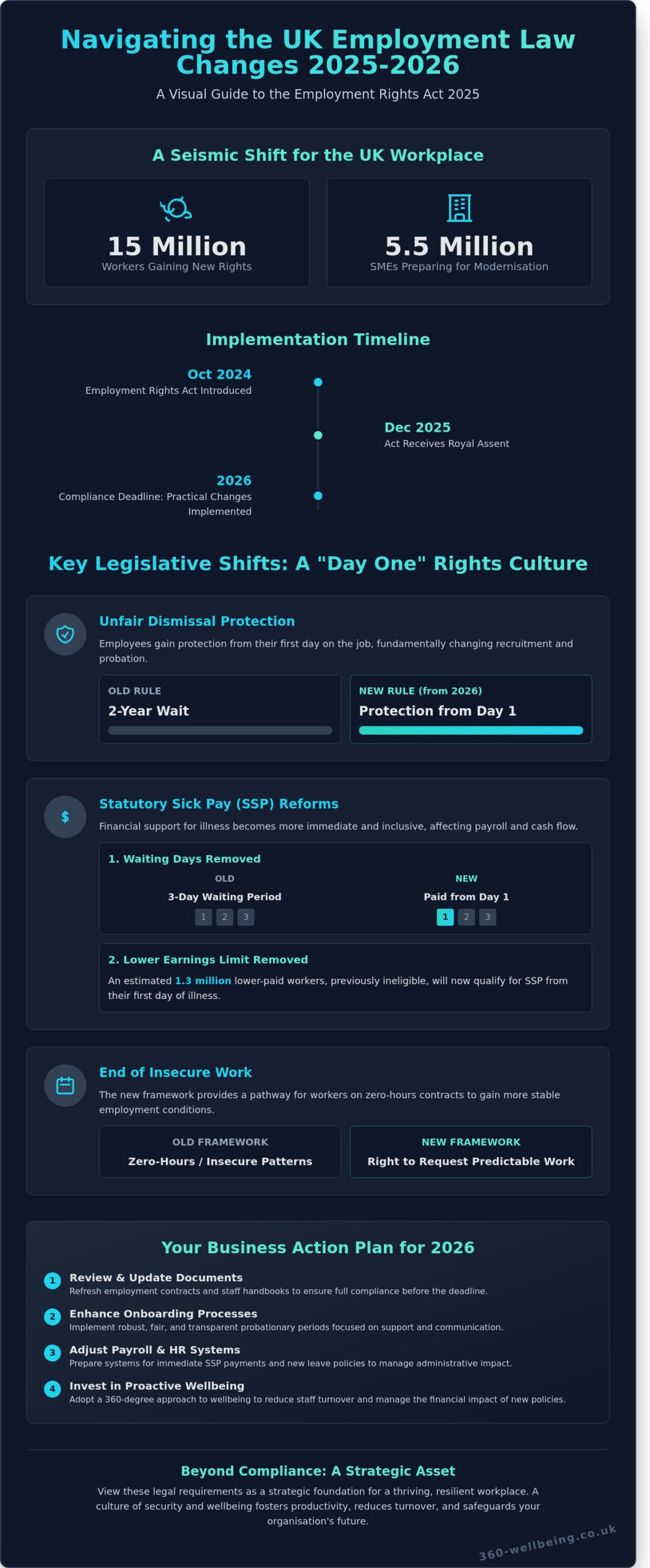
The Employment Rights Act 2025 represents a seismic shift in the UK workplace. After receiving Royal Assent in December 2025, the legislation is set to redefine the professional journey for 15 million workers. By removing traditional barriers to security, the government aims to foster a more resilient and productive workforce. These employment law changes 2025 are designed to treat job security as a fundamental right rather than a reward for long service. This proactive approach ensures every individual feels valued from the moment they step into a new role.
For many of the 5.5 million SMEs in the UK, 2026 will be the critical year for modernisation. It’s the time to refresh staff handbooks and align internal policies with this new reality. Transitioning to a day-one rights culture requires a 360-degree view of your organisational health. It isn’t just about legal compliance; it’s about creating a supportive environment where employees can thrive without the shadow of insecurity. By prioritising these updates early, you demonstrate a commitment to your team’s long-term wellbeing.
The core philosophy behind these updates is simple. When people feel secure, they perform better. The shift away from qualifying periods is a direct response to the need for a more agile and confident labour market. This evolution of UK labour law provides a foundation for a healthier, more balanced economy. It encourages businesses to invest in their people from the very beginning, fostering a culture of mutual respect and shared success. We see this as an opportunity to build stronger, more empathetic workplace communities.
The implementation timeline is tight. While the Act becomes law in late 2025, the practical changes to payroll, HR software, and management training must be ready for 2026. These employment law changes 2025 reflect a broader commitment to workplace harmony. This period of transition is a chance to review your entire employee value proposition. You’ll find that clear, well-documented processes don’t just protect the business; they provide a sense of safety for your staff. This clarity is essential for maintaining mental wellbeing and reducing workplace stress during times of change.
The End of the Two-Year Wait for Unfair Dismissal Protection
The 2025 Act removes the two-year qualifying period for unfair dismissal claims. From 2026, employees gain protection from their first day on the job. This change means your recruitment and onboarding processes must be exceptionally robust. You’ll need to implement fair, transparent probationary periods that focus on support and clear communication. It’s about building a partnership based on trust and ensuring every new hire has a clear path to success.
Understanding the Shift to a Modern Workers’ Framework
The Department for Business and Trade defines the new system as a “Modern Framework” that balances flexibility with security. The 2025 Act is the most significant expansion of worker rights in a generation. ACAS will play a vital role by providing new statutory codes of practice to help businesses adapt. By embracing these changes, you’re not just following the law; you’re building a more resilient, compassionate, and future-proof organisation.
Key Legislative Shifts: Day One Rights and the End of Insecure Work
The 2026 regulatory environment is defined by a move toward immediate security for the UK workforce. These employment law changes 2025 will begin to manifest in daily operations by removing the traditional “probationary” period for basic worker protections. This shift acknowledges that a sense of safety is the foundation of employee wellbeing and productivity. It’s a transition from a culture of earned rights to a model of inherent rights. For your business, this means moving beyond compliance and toward a proactive strategy that values the human element of your workforce from their very first hour on the clock.
Statutory Sick Pay (SSP) and the Removal of Waiting Days
The removal of the three-day waiting period for Statutory Sick Pay (SSP) represents a fundamental shift in how UK businesses manage short-term absence. Under these employment law changes 2025, 1.3 million lower-paid workers who previously earned below the Lower Earnings Limit will gain immediate access to financial support from their first day of illness. From a payroll perspective, this means your cash flow must account for a higher volume of small, frequent payments. You’re now processing payments for every single instance of reported illness, no matter how brief. While the cost per employee might seem manageable, the cumulative administrative burden on a large workforce is substantial. We recommend looking at this through a 360-degree lens; rather than just managing the cost, focus on reducing the need for it. Implementing proactive health interventions like early-stage mental health support can prevent these one-day absences from becoming long-term issues.
Zero-Hours Contracts: Moving Toward Predictability
The move toward predictable working patterns aims to end what the government defines as “exploitative” zero-hours practices. Workers now have a legal right to request a contract that reflects the actual hours they’ve consistently worked over a reference period. You should begin by auditing your current rota patterns to identify staff who regularly work the same shifts despite being on casual contracts. Transitioning these individuals to fixed-term or permanent roles doesn’t have to disrupt your operations. In fact, it often improves retention and morale. As noted in the official government factsheet on the 2025 Act, these measures are designed to provide security without removing the flexibility that specific sectors require. Clear communication is vital here. Ensure your managers understand how to offer shifts fairly to avoid claims of “unjust” shift allocation.
New Entitlements for Bereavement and Parental Leave
New entitlements for bereavement and parental leave are set to humanise the workplace further. For the first time, a universal statutory right to bereavement leave will apply to all employees, acknowledging that grief doesn’t follow a rigid corporate schedule. It’s a compassionate step that protects individuals during their most vulnerable moments. Simultaneously, paternity leave is becoming a day-one right. This change means 32,000 more fathers and partners will qualify for leave regardless of their length of service. These shifts are just the beginning; a comprehensive review of parental leave scheduled for late 2025 will dictate how you shape your 2026 policies. Supporting your team through these life transitions builds a culture of resilience. You might consider how a tailored wellbeing strategy can help managers navigate these sensitive conversations with empathy and clinical precision. It’s about creating an environment where employees feel seen, heard, and supported.
Balancing Compliance and Care: Addressing Employer Misconceptions
Change often triggers a sense of unease in the boardroom. Some leaders worry that the shift toward day-one rights will make it nearly impossible to manage underperforming staff. This is a common misconception. The employment law changes 2025 aren’t designed to trap businesses with unsuitable employees. Instead, they encourage a more proactive and disciplined approach to recruitment and management. By establishing clear expectations from the first day, you actually reduce the likelihood of costly legal disputes later. The average cost of defending an employment tribunal claim can exceed £8,500 in legal fees alone, regardless of the outcome. These updates provide a framework to avoid those risks through better internal communication.
Viewing these regulations through a 360-degree lens reveals they’re powerful tools for employee retention. When people feel secure and respected, their loyalty increases. A 2024 study found that organisations with high levels of psychological safety see a 27% reduction in staff turnover. Embracing these changes helps you build a resilient, committed workforce that feels supported by their employer. It’s about moving away from a culture of reactive discipline toward one of continuous, supportive growth.
Navigating the New Probationary Period Rules
The government’s proposal for a statutory probationary period, likely set at nine months, provides a structured window to assess a new hire’s suitability. It doesn’t mean you can’t dismiss someone who isn’t the right fit. It simply means you must be more methodical. Documented performance reviews from week one are now a necessity rather than a luxury. This level of transparency helps the employee understand their goals while providing you with a clear evidence trail. Early intervention is your strongest legal defence. It shows you’ve acted reasonably and given the individual every chance to succeed, which is the cornerstone of a fair dismissal process.
Flexible Working as a Default: Managing the Transition
There’s a lingering myth that making flexible working the default will lead to operational chaos. It’s vital to distinguish between the “Right to Request” and an absolute “Right to Have” flexible working. You still maintain the authority to refuse requests if they genuinely harm business performance, such as impacting quality or the ability to meet customer demand. Following the latest Acas guidance for employers ensures you handle multiple requests within a small team with fairness and consistency.
Managing this transition requires a tailored approach to each department’s needs. Flexible working is a strategic asset for mental health. In 2023, approximately 33% of UK workers reported feeling close to burnout. By offering flexibility, you directly address this issue, reducing long-term sickness absence and boosting daily productivity. These employment law changes 2025 represent a shift toward a more compassionate workplace. When you prioritise the wellbeing of your team, the operational benefits follow naturally. It creates a culture of mutual trust where employees are empowered to manage their energy and output effectively.
- Clear Documentation: Keep precise records of all performance discussions from the start date.
- Fair Consultation: Always discuss flexible working requests openly before making a final decision.
- Proactive Support: Use regular check-ins to spot signs of stress before they escalate into health issues.
Preparing Your Business: An Action Plan for 2026
The transition toward the 2026 regulatory environment requires more than a cursory glance at your HR files. With the employment law changes 2025 sets in motion, businesses must move from a reactive stance to a proactive strategy. The removal of the two-year qualifying period for unfair dismissal protection affects approximately 9 million employees. This shift means your internal processes must be robust from the very first hour a new hire starts. You’ll need to conduct a comprehensive audit of all existing contracts to strip out outdated “qualifying period” clauses that will become legally void by April 2026.
Payroll accuracy is another immediate priority. The new legislation removes the three-day waiting period for Statutory Sick Pay (SSP). National statistics suggest this change will provide immediate financial support to 1.5 million low-paid workers across the UK. You must ensure your payroll software is configured to calculate SSP from day one of any illness. Failing to do so doesn’t just risk a tribunal claim; it erodes the trust and psychological safety you’ve worked hard to build with your team. Accuracy here is a fundamental component of your duty of care.
Contractual Audits and Policy Updates
Your Employee Handbook needs a total refresh to align with the 2025 legislative framework. Specific wording changes are mandatory for “Unfair Dismissal” and “Sick Pay” sections. You must replace references to two-year “qualifying periods” with clear language that reflects day-one rights. When rolling these updates out, don’t just send a generic PDF. Organise small group sessions to explain how these changes protect everyone. This transparency empowers staff and reduces the anxiety often associated with contract revisions. Professional legal support is vital to ensure your templates are 2026-ready and tailored to your specific industry needs.
Manager Training: The Front Line of Compliance
Managers often feel the pressure of these changes most acutely. They are the ones who will handle the first day-one bereavement leave request or the first performance concern under the new rules. While your HR department knows the law, your managers must live it. Managers need to understand the employment law changes 2025 introduced better than anyone else in the organisation to avoid accidental non-compliance. Training should focus on “empathetic management” to handle sensitive leave requests with grace. Using life coaching and mental health support for your leadership team helps them manage these transitions without burnout. A manager who feels supported is far more likely to support their direct reports effectively. This holistic approach ensures compliance feels like a shared value rather than a legal burden. You can find more information on supporting your leadership teams through our bespoke wellbeing strategies designed for the modern UK workplace.
Beyond Compliance: Wellbeing as a Strategic Asset in 2026
Compliance shouldn’t be your final destination. While the employment law changes 2025 mandates new standards for worker rights and job security, top-performing UK SMEs view these rules as a floor rather than a ceiling. A 2023 study by Deloitte revealed that for every £1 invested in workplace wellbeing, employers see an average return of £5.30. By fostering a culture that prioritises health, you aren’t just ticking boxes; you’re building a resilient workforce that stays loyal when the market fluctuates. It’s about moving from a reactive “fix it when it breaks” mindset to a proactive vision of workplace harmony.
The 360 Wellbeing platform provides a vital shield against the financial strain of day-one sick pay. Under the new legislative framework, the removal of “waiting days” for Statutory Sick Pay (SSP) means a single day of absence now has a direct impact on your payroll. With SSP currently set at £116.75 per week, even minor increases in short-term absence can erode your margins. Our platform helps you manage this shift by addressing the root causes of absence before they escalate into long-term leave, ensuring your business remains profitable and your staff feel supported.
Using Virtual GP Services to Mitigate SSP Costs
NHS wait times reached record highs in 2024, with many patients waiting over 10 days for a non-urgent appointment. Our 24/7 Virtual GP service bypasses these delays, offering clinical advice within minutes. When an employee receives immediate reassurance for a minor ailment, they’re 40% more likely to manage their symptoms effectively without taking extended time off. This speed of intervention transforms a potential three-day absence into a minor disruption, protecting your bottom line.
Holistic Support: Legal, Financial, and Mental Health
Adapting to the employment law changes 2025 requires informed employees. Our Legal Support tool empowers your team to understand their new rights, reducing anxiety and workplace friction. Coupled with our Employee Assistance Programmes (EAP), we provide a safety net for those facing bereavement or family transitions. By integrating these services, you position your firm as a supportive partner, making the transition to new regulations a natural evolution of your care strategy.
Productivity isn’t just about hours logged; it’s about the quality of presence. The Health and Safety Executive (HSE) reported that 17.1 million working days were lost to stress, depression, or anxiety in 2022/23. When employees feel legally secure and mentally supported, “presenteeism” drops. We help you create an environment where staff don’t just show up, but thrive. Consider these benefits as your strategic toolkit for 2026:
- Proactive Mental Health Support: Reducing the risk of long-term burnout through early EAP intervention.
- Financial Wellbeing Tools: Helping staff manage the 6.7% rise in the National Living Wage through better personal budgeting resources.
- Immediate Clinical Access: Minimising the duration of physical illness through rapid Virtual GP consultations.
- Legal Peace of Mind: Providing 24/7 access to legal experts to clarify new workplace rights and responsibilities.
The 360-degree perspective ensures that no aspect of your team’s health is left to chance. By treating wellbeing as a strategic asset, you turn the burden of new legislation into a competitive advantage. You’ll find that recruitment becomes easier and retention rates climb when you offer more than just a salary. You’re offering a partnership in health, which is the most valuable benefit any employer can provide in the modern era.
Future-Proofing Your Business for 2026 and Beyond
The 2025 Employment Rights Act represents the most significant shift in British workplace regulation for a generation. By the time April 2026 arrives, your organisation needs to have mastered “day-one” rights and the transition away from insecure contract models. Navigating the employment law changes 2025 brings doesn’t have to be a source of stress. Instead, it’s a chance to treat wellbeing as a strategic asset that drives long-term retention and productivity. Proactive leaders are already looking past the paperwork to focus on the people who make their business possible.
We’re here to help you bridge the gap between legal compliance and compassionate leadership. Our platform provides 24/7 UK-registered Virtual GP access for all staff alongside comprehensive legal and financial support integrated into one system. You can also offer your team empathetic, expert-led mental health therapy sessions that build genuine resilience. Protect your business and support your team with the 360 Wellbeing platform today. You’ve got the tools to turn these legislative updates into a positive new chapter for your entire workforce.
Frequently Asked Questions
What is the main change in the Employment Rights Act 2025?
The primary shift in the legislation introduced in October 2024 is the removal of the two-year qualifying period for unfair dismissal claims. This change ensures that workers have access to basic protections from their first day of employment. By removing this barrier, the government provides security for 9 million UK workers who previously had to wait 104 weeks to claim these rights.
Do employees really have unfair dismissal protection from day one now?
Employees now receive protection against unfair dismissal from their first day on the job. Under the employment law changes 2025, the previous requirement to serve 730 days of continuous service has been abolished. This proactive approach to worker rights means you must follow fair dismissal procedures immediately, though the government is consulting on a new statutory nine-month probation period to allow for initial suitability assessments.
How does the new Statutory Sick Pay (SSP) work in 2026?
Statutory Sick Pay will be available from the first day of illness rather than the fourth day starting in 2026. The legislation also removes the Lower Earnings Limit, which previously excluded workers earning less than £123 per week. These modifications mean that approximately 1.5 million low-paid workers will gain access to sick pay, ensuring a more comprehensive safety net for your entire workforce.
What happens to zero-hours contracts under the new 2025 laws?
Workers on zero-hours contracts now have a legal right to a contract with guaranteed hours if they work regular shifts over a 12-week reference period. Data from the Office for National Statistics shows 1 million people are on these contracts; the new law ends one-sided flexibility. You must also provide reasonable notice for shift changes and offer compensation if shifts are cancelled at short notice.
Is bereavement leave now a legal requirement for all UK staff?
Statutory bereavement leave is now a legal requirement for all UK staff from their first day of employment. Previously, only parents who lost a child under 18 were entitled to paid leave under the 2020 Act. The employment law changes 2025 extend this compassion to a wider range of relationships, allowing your team members the necessary time to process grief without the immediate pressure of returning to work.
How should I update my employment contracts for 2026?
You should review and update all employment contract templates by Autumn 2025 to reflect the new day-one rights. Focus on revising the waiting period clauses for sick pay and ensuring your disciplinary procedures align with the new unfair dismissal rules. It’s vital to clearly define your new nine-month statutory probation periods to ensure you remain compliant while supporting your new hires’ integration into the company.
Can I still use probationary periods with day-one rights in place?
You can still use probationary periods, but they’ll operate under a new light-touch legal framework. The government’s 2024 consultation suggests a standard nine-month period where employers can follow a simplified process to dismiss an employee who isn’t a good fit. This balance allows you to maintain high standards for your team while respecting the law that protects workers from arbitrary dismissal.
What are the penalties for non-compliance with the 2025 employment law changes?
Non-compliance can lead to unlimited fines at employment tribunals and significant reputational damage. With the Fair Work Agency now established to enforce holiday pay and National Minimum Wage rules, the risk of financial penalties has increased. Tribunals can award compensatory payments for unfair dismissal which are currently capped at £115,115 or one year’s pay, so ensuring your HR processes are robust is a strategic necessity for 2026.