To learn how to get feedback on your employee benefits package, ask in more than one way. Use anonymous surveys, focus groups and one-to-one conversations to find out what employees value, what is difficult to use and what they would improve. Employee forums can also provide an ongoing space to discuss benefits.
Surveys can reveal common themes, while conversations help explain the needs behind individual answers. Both matter: employees may experience benefits differently depending on their role, circumstances or stage of life. Gathering feedback is the first step; its value comes from listening carefully and showing how that input informs decisions.
This guide explains how to gather useful feedback, involve diversity network leaders in a benefits review and use engagement and uptake data to inform decisions. You’ll also learn how to turn feedback into a package that better reflects employee needs, then explain what changed and why. The aim is an ongoing process that keeps benefits relevant, accessible and supportive.
Key Takeaways
- Combine anonymous surveys, focus groups and individual conversations to uncover both shared priorities and personal needs.
- Invite diversity network leaders to review whether benefits are relevant, accessible and communicated clearly across employee groups.
- Consider engagement, satisfaction and benefit uptake together to spot where the package or its communication may need attention.
- Use employee feedback to shape practical changes, then explain what you’ve acted on and why some suggestions may not be adopted.
1. How Do I Collect Employee Feedback?
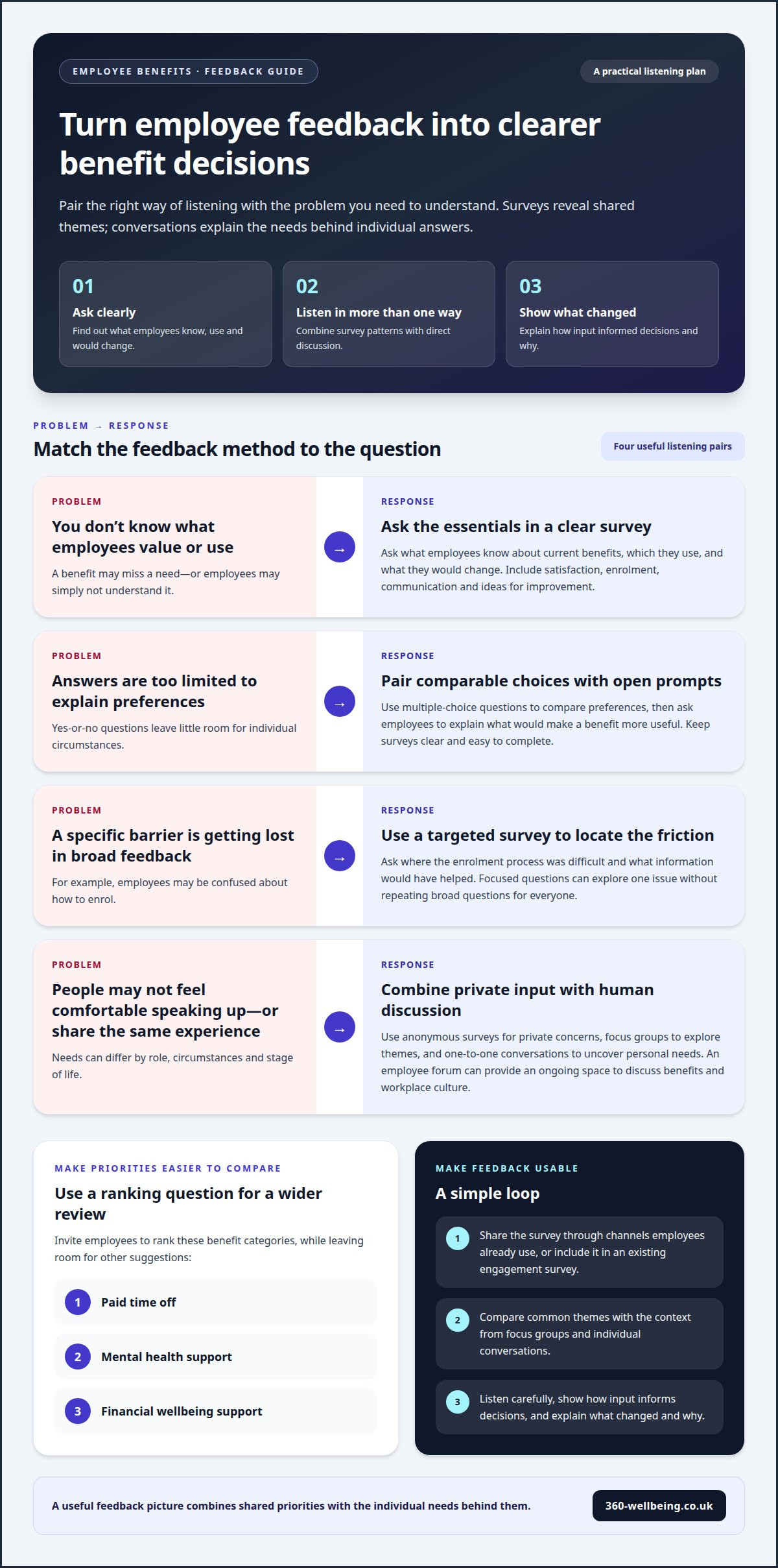
To learn how to get feedback on your employee benefits package, combine anonymous surveys with focused conversations. Ask employees what they know about current benefits, which they use and what they would change. Include questions about satisfaction, enrolment, communication and ideas for improvement. These questions can show whether a benefit misses a need or employees simply do not understand it.
Keep surveys clear and easy to complete. Use multiple-choice questions to compare preferences, then open-ended prompts to gather context. For example, ask employees to choose preferred benefit categories and explain what would make those benefits more useful. Avoid relying only on yes-or-no questions, which leave little room for individual circumstances. Share the survey through channels employees already use, or include it in an existing engagement survey.
Targeted surveys can explore a specific issue without asking everyone broad, repetitive questions. If feedback suggests confusion about enrolment, ask where the process was difficult and what information would have helped. For a wider review, invite employees to rank paid time off, mental health support and financial wellbeing support. This makes priorities easier to compare while leaving room for other suggestions.
Anonymous surveys give employees a private way to raise concerns they might not share in a group. Use focus groups to explore themes, bringing together employees from different parts of the company to discuss what works and what needs attention. An HR colleague or professional can facilitate. One-to-one conversations can reveal personal needs, while an employee forum provides an ongoing space to discuss benefits and workplace culture. Together, these methods show where experiences differ and where changes could better support wellbeing.
2. Reviewing benefits with diversity network leaders
Diversity network leaders can help assess how benefits work for employees with different experiences. Involve them in the review and ask whether the language is clear and communications reach people across demographics. They may identify barriers that general feedback misses, such as information that assumes everyone has the same family circumstances or working pattern. Their input can support a more inclusive workplace strategy without assuming that everyone in a group has the same needs.
Review benefit usage alongside employee comments. Low uptake may mean an offering feels irrelevant, but it could also reflect unclear communication, a difficult enrolment process or low awareness. Ask network leaders whether these issues could affect particular groups, then compare their observations with usage patterns and employee questions. This can help distinguish a benefit that needs redesign from one that needs clearer explanation.
Set a regular review cycle, such as annually or biennially, and revisit benefits when workforce needs or organisational priorities change. Use the same stages each time: review employee feedback, assess uptake, consult network leaders and record decisions. A consistent process helps show whether earlier changes addressed key concerns and keeps talent and wellbeing in view as part of the wider strategy.
Employment review sites can offer another perspective on how people describe their workplace experience. Look for recurring themes about benefits, but use them as prompts for internal discussion rather than a complete picture of employee opinion. Public comments may reflect a limited range of voices, so compare themes with survey responses, benefit usage and network leaders’ perspectives. Record what the evidence supports, what remains unclear and which actions to consider at the next review. This grounds decisions in more than one perspective.
3. Using engagement data to guide benefit decisions
Compare employee feedback with benefit costs and usage by reviewing them side by side for each offering. Check whether low uptake reflects limited awareness, an enrolment barrier or a poor fit with employee needs. Then weigh administration and implementation costs against potential effects on engagement, retention and productivity. This gives decision-makers a fuller picture than usage figures alone.
Bring employee engagement survey results together with platform usage metrics and benefit satisfaction. For example, employees may say they value a reward while platform records show few people use it. That gap could signal unclear communication or difficulty accessing the benefit, rather than a lack of interest. Review communication data alongside uptake to find out whether employees saw and understood the information.
Use consistent measures at each review: engagement and satisfaction, benefit uptake, return on investment, and alignment with workforce expectations and organisational strategy. Compare findings over time and look for patterns across teams or roles where the data allows. An employee engagement tool can bring survey responses and usage trends together, helping HR teams identify follow-up questions instead of treating each metric in isolation.
Engagement can also add context to retention decisions. Employees who feel heard are more likely to stay, so compare feedback themes with retention patterns and exit interview comments. If departing employees mention a missing benefit, check whether the concern also appears in wider feedback before changing the package. A competitive offering should reflect what employees value and support their wellbeing, rather than adding benefits without evidence of demand.
Use your findings to decide whether to improve communication, adjust an existing benefit or consider a different reward. Record the reasoning behind each decision, including employee feedback, uptake and cost considerations. Then explain the outcome to employees, including why a popular suggestion may not proceed. This closes the feedback loop and gives the next review a clear point of comparison.
4. Building a benefits package around employee needs
Build the package around employee insights, not assumptions about what everyone values. Group feedback into themes such as mental health, financial wellbeing and work-life balance. Assess each possible benefit against employee needs, organisational priorities and the practical costs of implementation and administration. A benefit is valuable when employees can access it and understand how it supports them.
Consider whether the package supports wellbeing, aligns with sustainability and corporate social responsibility goals, and compares favourably with competitors. These checks help balance employee preferences with the organisation’s wider strategy. Salary remains important, but 80% of employees reported they would choose additional benefits over a pay rise. Treat this as a prompt to understand your own workforce, not as a reason to assume every employee wants the same offering.
Act on feedback by identifying practical suggestions, then explain what will change and why. Communicate decisions in clear, jargon-free language through channels employees use, such as email, an intranet or a webinar. If a suggestion cannot be adopted, explain the reason respectfully. For example, employees may request a new benefit, while the organisation prioritises improving access to an existing one.
After changes, tell employees what has been implemented and how to use the updated benefits. Reinforce key details with regular reminders, manager talking points and relevant colleague examples. Tailor messages where needs differ by role, location or life stage, while keeping the core information consistent. Review feedback and uptake again to see whether the change addressed the original need. If employee insights point towards stronger wellbeing support, explore employee wellbeing support as part of the package.
360 Wellbeing: Employee Assistance Programme (EAP)
360 Wellbeing’s Employee Assistance Programme (EAP) can complement a benefits package shaped around employee feedback. It may be a relevant next step when employees identify a need for additional support as part of their overall wellbeing. Alongside the EAP, 360 Wellbeing offers Mental Health Support, a 24/7 Virtual GP and 360 Rewards.
Use the themes from your review to decide which areas matter most to your workforce. If employees’ feedback highlights mental wellbeing or access to healthcare, consider how these offerings could fit the needs you’ve identified. If they value added rewards, 360 Rewards may also be relevant. Clear communication helps employees understand which support is available and how it relates to their feedback.
To discuss how 360 Wellbeing could fit your employee benefits approach, contact 360 Wellbeing.
Make employee insight part of your next decision
Knowing how to get feedback on your employee benefits package is only the beginning. The lasting value comes from making listening part of how your organisation decides what support to provide. Use each review to understand what has changed for employees, then make considered adjustments that fit their needs and your workplace priorities.
Keep the conversation open after decisions are made. Employees should be able to see that their views informed the process, even when a suggestion cannot be adopted. This builds a more considered link between feedback and action, and gives future reviews a stronger foundation.
If you’re considering how employee wellbeing support could fit your approach, contact 360 Wellbeing today. A clear next step can help you move from employee insight towards a benefits approach that feels more relevant and supportive.
Frequently Asked Questions
How Do I Collect Employee Feedback?
Give employees more than one way to share their views, so they can choose what feels comfortable. An online form can capture individual responses, while a facilitated discussion can clarify shared concerns. One-to-one conversations may suit sensitive feedback. Explain how responses will inform decisions, then report back so employees know their contributions were considered.
How Do I Analyze My Feedback?
Group responses by theme, such as access, relevance, awareness or enrolment, then compare those themes with benefit usage and satisfaction data. Distinguish recurring concerns from isolated comments without dismissing individual needs. For example, repeated confusion about how to use a benefit suggests a communication issue worth investigating. Record the evidence behind each proposed action to keep decisions transparent.
What are the best ways to collect employee feedback on benefits?
The strongest approach combines private and conversational options. An anonymous form can help employees raise concerns they may not share openly; a focus group can explore why a particular benefit matters. Offer individual conversations for people who prefer not to speak in front of colleagues. Choose channels that suit how your workforce communicates and make participation straightforward.
How do you design an employee benefits survey?
Start with the decision the survey should inform, such as improving awareness or understanding demand for a benefit. Keep each question focused on one topic, use clear wording and offer response choices that cover likely views. Add an open-text field for context, but avoid asking for unnecessary personal details. A small pilot can reveal confusing questions before you send the survey more widely.
What questions should you ask employees about their benefits package?
Ask whether employees understand what is available, how easy it is to access and which benefits meet their needs. Invite them to identify anything that prevents them from using a benefit, such as unclear instructions or an inconvenient process. Finish with an open prompt, such as, “What would you change?” These questions explore both current experiences and possible improvements.
How can employers gather feedback from different employee groups anonymously?
Use an anonymous survey for employees across roles, locations and working patterns, with accessible wording and consistent questions. Avoid requesting details that could identify someone, especially when reporting results from a small group. Diversity network leaders can help review whether the questions and communications reach different communities. Share themes in aggregate, rather than exposing individual responses.