
Did you know that mental health issues now account for 63% of long-term sickness absences across UK organisations, according to the 2024 CIPD Health and Wellbeing at Work report? You likely feel the weight of these statistics through rising staff turnover and the constant pressure of filling resource gaps. It’s frustrating to invest in perks that don’t seem to move the needle, especially when you’re genuinely committed to your team’s vitality and success.
We understand that a healthy business starts with a healthy workforce. This guide explains how to create a wellbeing strategy at work that is proactive rather than reactive, moving your culture toward a more resilient and balanced future. You’ll learn how to implement a holistic, 360-degree framework that improves retention and boosts productivity for 2026. We’ll walk you through a clear, step-by-step roadmap to identify high-value benefits and create a supportive environment where every employee feels empowered to do their best work.
Key Takeaways
- Shift your organisational focus from reactive sickness management to a proactive culture of vitality that supports employee health before issues arise.
- Discover the essential steps of how to create a wellbeing strategy at work, from auditing your current culture to setting measurable objectives that drive real change.
- Implement a holistic 360-degree framework that provides your team with 24/7 medical access and comprehensive mental health support.
- Learn how to overcome budget barriers by reframing wellbeing as a strategic investment in UK workplace productivity and long-term retention.
- Streamline your delivery by moving away from fragmented vendors toward an integrated platform that simplifies access to GP services, mental health, and rewards.
What is a Workplace Wellbeing Strategy and Why Does It Matter in 2026?
A workplace wellbeing strategy is a proactive, structured framework designed to support the physical, mental, and social health of every person in your organisation. By 2026, the traditional model of reactive sickness management has become obsolete. Modern UK businesses have shifted toward vitality support, focusing on identifying health risks before they lead to burnout or long-term absence. This 360-degree approach ensures that support is not just a safety net, but a foundation for daily performance.
The 2026 landscape presents unique challenges. Hybrid work models have matured, but they often leave employees feeling digitally fatigued or socially isolated. Additionally, with the cost of living remaining a primary concern for 64% of the UK workforce, financial stress has a direct impact on cognitive load and productivity. Understanding how to create a wellbeing strategy at work that addresses these specific pressures is essential for any leadership team aiming for stability and growth.
The Business Case: ROI vs. the Cost of Inaction
Ignoring employee health is a significant financial risk. Recent data from Deloitte indicates that poor mental health costs UK employers approximately £51 billion annually. A large portion of this figure stems from presenteeism, where staff are physically present but mentally disengaged. When you prioritise a tailored strategy, you’re protecting your bottom line. Organisations that invest in comprehensive health programmes see an average return of £5 for every £1 spent.
- Retention: Companies with robust health strategies report 25% lower staff turnover.
- Recruitment: In 2026, 78% of job seekers in the UK prioritise wellbeing benefits over minor salary increases.
- Performance: There is a direct correlation between employee vitality and customer satisfaction scores.
Wellbeing vs. Wellness: Understanding the Difference
Many organisations use these terms interchangeably, but they represent different levels of care. Wellness typically refers to individual activities, such as office fruit bowls or discounted gym memberships. While these are positive, they are often superficial. Wellbeing is the total experience of an individual’s life at work. It’s a holistic state that includes psychological safety, physical health, and a sense of purpose.
To be effective, your strategy must move beyond perks and address the systemic causes of stress. This is where Occupational Health Psychology becomes a vital tool for the modern HR professional. It helps us understand the complex relationship between work environments and human behaviour. As your expert caregiver, 360 Wellbeing helps you bridge this gap. We move away from one-off wellness “fixes” and instead build a resilient culture where every employee feels seen, heard, and supported. Learning how to create a wellbeing strategy at work requires this shift in perspective; it’s about moving from a luxury perk to a fundamental strategic asset.
The 4 Pillars of a 360-Degree Wellbeing Framework
Understanding how to create a wellbeing strategy at work requires moving beyond isolated perks like gym discounts or office fruit. A 360-degree framework treats health as an interconnected ecosystem where physical, emotional, and external factors collide to influence performance. This holistic approach aligns with the framework for workplace wellbeing developed by researchers at Harvard, which demonstrates that sustainable health is a strategic driver of organizational success. By addressing the whole person, businesses create an environment where employees feel seen, supported, and ready to contribute their best work.
Clinical Access and Physical Resilience
Physical resilience is a proactive business asset that protects your bottom line. Access to Virtual GP services is no longer a luxury; it’s a necessity that saves an average of 4 hours per employee per appointment by eliminating travel and waiting room time. For an aging or sedentary UK workforce, physiotherapy provides essential support, preventing minor aches from becoming long-term musculoskeletal absences. These services ensure that employees can address health concerns at the earliest stage, maintaining high energy levels and reducing the 185.6 million working days lost to sickness in the UK annually.
Mental Health and Emotional Support
Modern strategies must provide a safety net that catches people before they fall into burnout or chronic stress. Integrating an Employee Assistance Programme (EAP) into daily culture ensures help is visible and stigma-free rather than being a hidden number on an intranet page. While 24/7 crisis support handles emergencies, life coaching helps employees move from “surviving” to “thriving” by building long-term emotional strength and clarity. This proactive support helps individuals manage career transitions and personal challenges with a sense of agency and confidence.
Financial Health and Legal Peace of Mind
External stressors follow employees to their desks and impact cognitive function. Providing financial support for employees is critical, as 57% of UK workers cite money as their primary source of stress according to 2023 PwC data. Essential components for 2026 include debt advice and will writing services, which offer tangible security for an individual’s family. Legal helplines provide psychological relief by offering expert guidance on personal disputes, removing the anxiety that distracts from professional performance.
Adopting this 360-degree approach ensures that no aspect of an employee’s life is left to chance. When physical, mental, financial, and legal supports are integrated, they create a synergy that boosts morale and retention. This isn’t just about ticking boxes; it’s about building a culture of care that adapts to the evolving needs of the UK workforce. Exploring a tailored wellbeing package can help you identify which of these pillars requires the most immediate attention for your specific team.
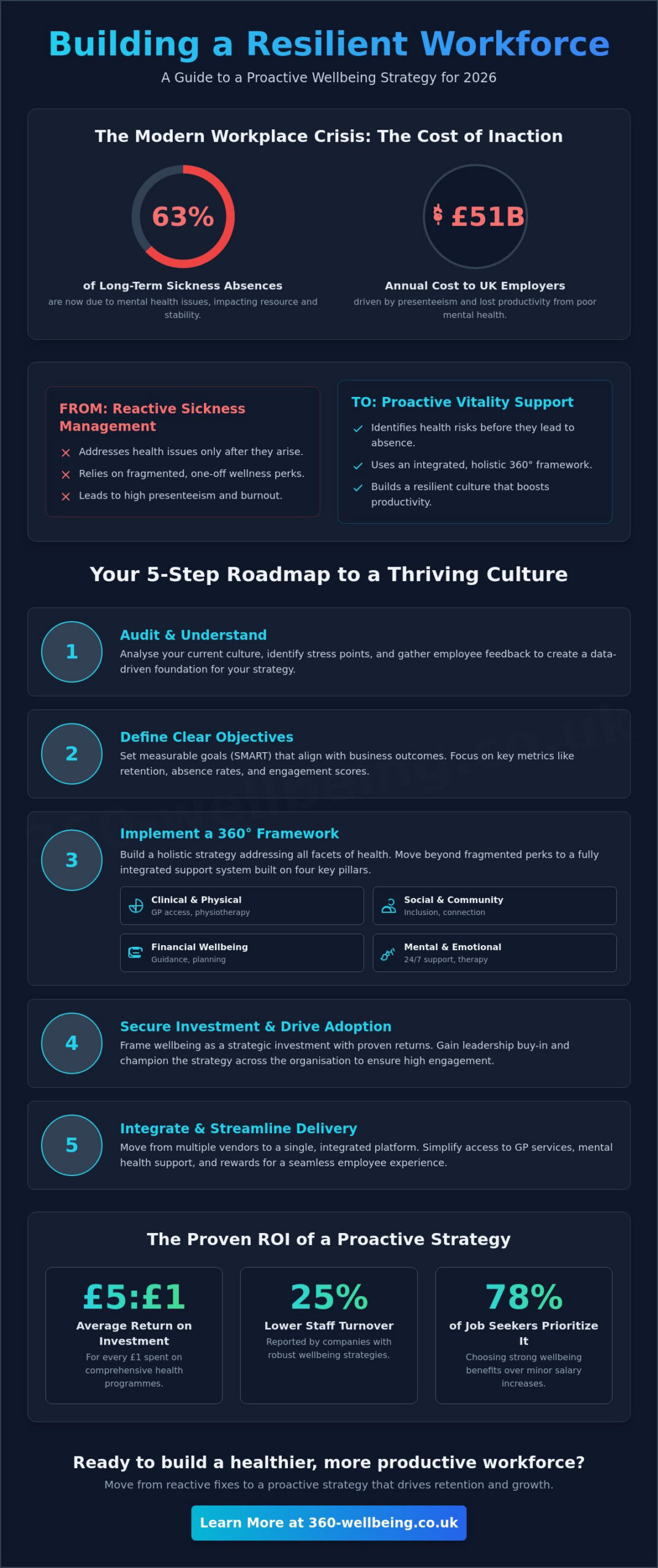
5 Steps to Create Your Wellbeing Strategy at Work
Building a resilient workforce requires more than just reactive measures. It demands a structured, 360-degree approach that treats employee health as a core business asset. When you’re looking at how to create a wellbeing strategy at work that actually delivers results, you must move beyond surface-level perks and focus on meaningful, data-backed interventions that support the whole person.
Step 1 & 2: Data-Driven Foundations
Your strategy should begin with an honest audit of your current culture. Use anonymous surveys to capture the lived experience of your staff. This transparency is vital, as 76% of UK employees report that they’ve experienced symptoms of poor mental health at some point. By gathering this data, you can identify whether your team needs specific support with financial stress, physical fitness, or mental resilience.
Once you have your data, set SMART objectives that align with your commercial goals. For instance, you might aim to reduce sickness absence from the current UK average of 7.8 days per employee by 10% within twelve months. A generic, one-size-fits-all approach usually fails because it ignores the specific demographic nuances and personal challenges unique to your individual team members.
Step 3 & 4: Implementation and Communication
Selecting the right tools is about finding a comprehensive suite that addresses the whole person. Look for a platform that integrates physical health, mental support, and lifestyle rewards into one accessible hub. This ensures that a 25-year-old graduate and a 55-year-old senior manager both find value in the offering. When considering how to create a wellbeing strategy at work that sticks, the implementation phase must include manager training. Your leaders need to be equipped to recognise signs of struggle and feel confident signposting staff to the available support services.
A high-impact launch is essential to build immediate trust. This shouldn’t be a quiet email from HR. Instead, involve your leadership team to demonstrate top-down buy-in. When a CEO speaks openly about the importance of balance, it gives the rest of the organisation permission to prioritise their own health. This cultural endorsement is what transforms a strategy document into a lived experience.
Step 5: Review, Measure, and Evolve
Your strategy must be dynamic to remain effective. Schedule a formal review every 12 months to measure your progress against those initial SMART goals. The needs of your workforce in 2026 may differ significantly from those in 2027. By evolving your benefits and support systems annually, you demonstrate a long-term commitment to your team’s vitality and professional harmony. Use these metrics to refine your approach:
- Engagement rates: How many staff are actually using the provided tools?
- Absence data: Have you seen a reduction in short-term or stress-related leave?
- Retention: Is there a positive shift in your staff turnover rates?
- Qualitative feedback: Do employees feel more supported than they did 12 months ago?
Overcoming Common Barriers to Wellbeing Success
Even the most dedicated HR leaders face hurdles when determining how to create a wellbeing strategy at work that actually sticks. The primary barrier is almost always the perception that health initiatives are a luxury expense. They aren’t. A 2024 Deloitte study revealed that UK employers receive an average return of £4.70 for every £1 invested in staff mental health. Shifting the narrative from “cost” to “investment” is the first step in securing senior buy-in.
To get leadership on your side, you must bridge the gap between clinical care and commercial reality. Presenting data on presenteeism, which the Centre for Mental Health estimates costs UK businesses £24.8 billion per year, helps directors view wellbeing as a strategic asset. It’s about protecting your most valuable resource. When leaders see that a proactive approach reduces long-term sick leave and improves retention, the budget usually follows.
Maximising Value on a Small Business Budget
You don’t need a massive corporation’s treasury to support your team. Traditional Private Medical Insurance (PMI) often carries high premiums that scale poorly for SMEs. In contrast, modern SaaS-based wellbeing platforms offer per-employee monthly fees that are often less than the price of a single team lunch. This democratises access to high-level care, giving small teams the same 360-degree support as global firms. Start with high-impact, low-cost “quick wins.” This might include flexible start times or “no-meeting Fridays.” These adjustments cost nothing but build immediate trust and momentum for your larger strategy.
Driving Employee Engagement
A strategy only works if people use it. Many businesses suffer from an “engagement gap” where expensive benefits sit untouched on a dusty intranet page. To avoid this, use a “Rewards Marketplace” to provide immediate, tangible value. When employees can access discounts on healthy groceries or gym memberships, they interact with the platform daily. It keeps health top of mind without feeling like a chore.
Peer-to-peer support is equally vital. Appointing “Mental Health Champions” across different departments creates a relatable support network. These individuals act as a bridge, making it easier for colleagues to seek help before a minor stressor turns into a crisis. This human touch ensures your strategy feels like a supportive partnership rather than a top-down corporate mandate.
Finally, ensure your plan is inclusive for the 44% of UK workers who now operate in remote or hybrid patterns. Digital-first tools ensure a developer working from a home office in Cornwall receives the same level of care and connection as a manager in a London HQ. Total wellness must be accessible to everyone, regardless of where their desk is located.
Ready to see how a tailored approach can transform your team’s productivity? Explore our comprehensive wellbeing solutions today.
Scaling Your Strategy with an Integrated Wellbeing Platform
Managing multiple health vendors manually is no longer sustainable for modern businesses. It creates friction for employees and administrative bloat for HR departments. Learning how to create a wellbeing strategy at work that actually scales requires a shift toward integration. When GP services, mental health support, and lifestyle rewards are scattered across different apps, engagement inevitably drops. A single-entry point ensures that help is never more than a few taps away, removing the barriers that often prevent people from seeking early intervention.
360 Wellbeing simplifies the administrative burden by consolidating these essential services into one intuitive interface. Instead of juggling six different contracts and sets of login credentials, HR teams can manage their entire provision from a single source. This proactive, digital-first approach represents the future of workplace health. It moves the needle from reactive “crisis management” toward a 360-degree culture of vitality and resilience.
Why a Unified Platform is the Logical Conclusion
Consistency is the backbone of a successful strategy. If your support is disjointed, employees won’t trust the system. A unified platform provides a central dashboard, making it easy to track usage and ROI without chasing five different account managers for data. You can see exactly which services resonate and where your team needs more support. The reassurance factor of having 24/7 UK-registered support is vital. It means your people receive care from experts who understand the UK healthcare landscape, providing peace of mind for both the individual and the organisation.
Next Steps for Your Organisation
Transitioning from a list of random perks to a formalised strategy is the final hurdle in your journey. A 2026-ready workplace isn’t built on gym discounts alone; it’s built on a foundation of accessible, holistic care. To ensure your plan is robust and effective, follow this final checklist:
- Audit current benefits: Identify gaps where your current tools overlap or fail to meet employee needs.
- Define clear KPIs: Set measurable goals, such as a 10% reduction in stress-related absence over the next year.
- Consolidate your tools: Move away from fragmented vendors to a single, integrated platform.
- Communicate with empathy: Ensure every team member knows exactly where to go in a moment of need.
By following these steps, you’ll understand how to create a wellbeing strategy at work that doesn’t just look good on paper but actually transforms lives. It’s time to move beyond the basics and embrace a more compassionate, structured way of looking after your greatest asset.
Ready to unify your approach? Book a demo with 360 Wellbeing to see our platform in action.
Building a Future-Ready Culture of Care
Transitioning from reactive fixes to a proactive framework is the most significant shift you can make for your team’s resilience. By understanding how to create a wellbeing strategy at work that addresses the four pillars of health, you’re not just ticking a HR box; you’re protecting your most valuable asset. The CIPD reported that UK sickness absence hit a ten-year high of 7.8 days per employee in 2023, which highlights why a structured, 360-degree approach is no longer optional for 2026. It’s about creating a sustainable environment where every individual feels supported through every challenge.
Real change happens when support is accessible and integrated into the daily workflow. You can empower your team with 360 Wellbeing’s all-in-one platform, providing 24/7 access to UK-registered GPs and comprehensive mental health and life coaching support. Our system also includes thousands of rewards and discounts for employees to boost their financial and social wellness. Taking these steps today ensures your workforce remains vibrant and engaged throughout 2026 and beyond. You’ve got the roadmap, and we’re here to help you lead your team toward lasting vitality.
Frequently Asked Questions
How much does it cost to implement a wellbeing strategy?
Implementation costs vary based on your company size and specific needs, but industry data from Deloitte’s 2024 Mental Health and Employers report suggests an average investment of £100 to £500 per employee each year. Small businesses often start with low-cost internal initiatives, while larger firms invest in comprehensive digital platforms. It’s helpful to view this as a strategic asset; the same report highlights that UK employers see an average return of £4.70 for every £1 spent on wellbeing interventions.
Can a small business with only 5 employees have a wellbeing strategy?
Yes, a team of five can and should have a proactive wellbeing strategy to protect their most valuable assets. Small teams often experience a higher impact from a single person’s absence, making resilience even more critical for business continuity. You don’t need a massive budget to start. Focus on flexible working hours, regular check-ins, and clear boundaries to create a supportive culture that mirrors the 360-degree perspective of larger corporate programs.
What is the most important part of a workplace wellbeing strategy?
Leadership commitment and cultural alignment are the most vital components when you learn how to create a wellbeing strategy at work. Without genuine support from the top, even the most expensive platforms will fail to gain traction among your staff. A 2023 CIPD report found that only 37% of professionals believe their leaders are truly committed to wellbeing. To succeed, your managers must model healthy behaviours and treat mental health with the same priority as physical safety.
How do you measure the success of an employee wellbeing program?
Success is measured through a combination of quantitative data and qualitative feedback from your staff. Track your sickness absence rates and staff turnover figures over a 12-month period to see tangible shifts in organisational health. Use the WEMWBS (Warwick-Edinburgh Mental Well-being Scale) to gather scientific data on employee happiness levels. When these metrics improve alongside a reduction in “presenteeism” costs, you’ll know your strategy is delivering a real impact on your bottom line.
Is an EAP enough for a complete wellbeing strategy?
An Employee Assistance Programme (EAP) is a helpful reactive tool, but it’s rarely enough for a comprehensive strategy. While 75% of UK employers offer an EAP, usage rates often hover below 10% because these services only help once a crisis has already occurred. A truly effective approach focuses on proactive prevention. You need to integrate physical health, mental resilience, and social connection to ensure your team feels supported before they reach a breaking point.
How can I encourage my team to actually use the wellbeing platform?
High engagement starts with clear communication and removing the stigma around seeking support. If your team sees managers using the platform and sharing their experiences, they’ll feel safer doing the same. Make the platform part of your daily rhythm rather than a hidden link on the intranet. Offering “wellbeing hours” specifically for using these tools can increase engagement by 40% compared to companies that expect employees to use them during lunch breaks.
Does a wellbeing strategy need to be a formal document?
Yes, formalising your strategy into a written document ensures accountability and provides a clear roadmap for your team. A formal policy acts as a “single source of truth” that defines your goals, responsibilities, and available resources. It also helps you stay compliant with UK Health and Safety Executive (HSE) standards regarding workplace stress. Having a documented plan makes it much easier to review your progress during annual strategy meetings and adjust your tactics.
What is the role of a manager in a wellbeing strategy?
Managers act as the primary gatekeepers of your wellbeing culture and are responsible for the daily health of their teams. They’re often the first to notice changes in a colleague’s performance or mood. By training managers in mental health awareness, you empower them to have supportive conversations and signpost employees to the right help. Their role is to balance operational demands with a compassionate, human touch that ensures no one feels overwhelmed by their workload.