What if the strongest case for a new benefits platform isn’t its list of features, but the workforce need it could help address? If you’re considering how to get leadership buy-in for a new benefits platform, expect questions about cost, employee engagement and implementation. Leaders need a clear reason to prioritise the investment alongside other organisational needs.
A persuasive proposal connects employee needs with current business priorities, using credible internal evidence rather than broad promises or unsupported projections. Review staff feedback, existing benefit usage and relevant people data to show where support could be easier to access or better aligned with what employees value.
This guide will help you build a focused, evidence-led case, prepare for likely leadership concerns and make a practical recommendation. You’ll learn how to present a platform as a way to bring different forms of support together, explain how you’d assess engagement and agree on a clear decision and review process. The aim is a conversation grounded in your organisation’s priorities, with realistic expectations and a straightforward next step.
Key Takeaways
- Learn how to get leadership buy-in for a new benefits platform by linking a documented employee need to an organisational priority.
- Use existing workforce information to establish a baseline and choose measures that can be reviewed over time.
- Prepare for questions about cost, employee take-up and value, while being open about what remains uncertain.
- Shape a concise proposal that sets out the decision needed, implementation ownership, employee communications and review plan.
- Assess how a platform such as 360 Wellbeing could bring different types of employee support together for varied workforce needs.
Why leadership buy-in matters for a new benefits platform
A strong benefits idea still needs a clear business case. Leaders weigh it against other priorities, so a catalogue of appealing services isn’t enough. Explain which employee need the proposal addresses, why it matters to the organisation and what decision you’re asking leaders to make.
There’s a meaningful difference between permission to purchase and active sponsorship. Permission may secure a budget, but sponsorship means leaders help establish ownership, support employee communications and make time to review progress. That involvement can help make the platform a considered part of the organisation’s approach to employee wellbeing. A basic understanding of Leadership reinforces why direction and support from decision-makers matter when an initiative needs coordination across a workplace.
For anyone exploring how to get leadership buy-in for a new benefits platform, start with alignment, not novelty. Relate the case to priorities leaders already monitor, such as employee experience, workforce planning or existing wellbeing goals. Then assess the platform against the needs you’ve identified, rather than treating a broad feature set as proof of value.
What leaders need to understand before approving a platform
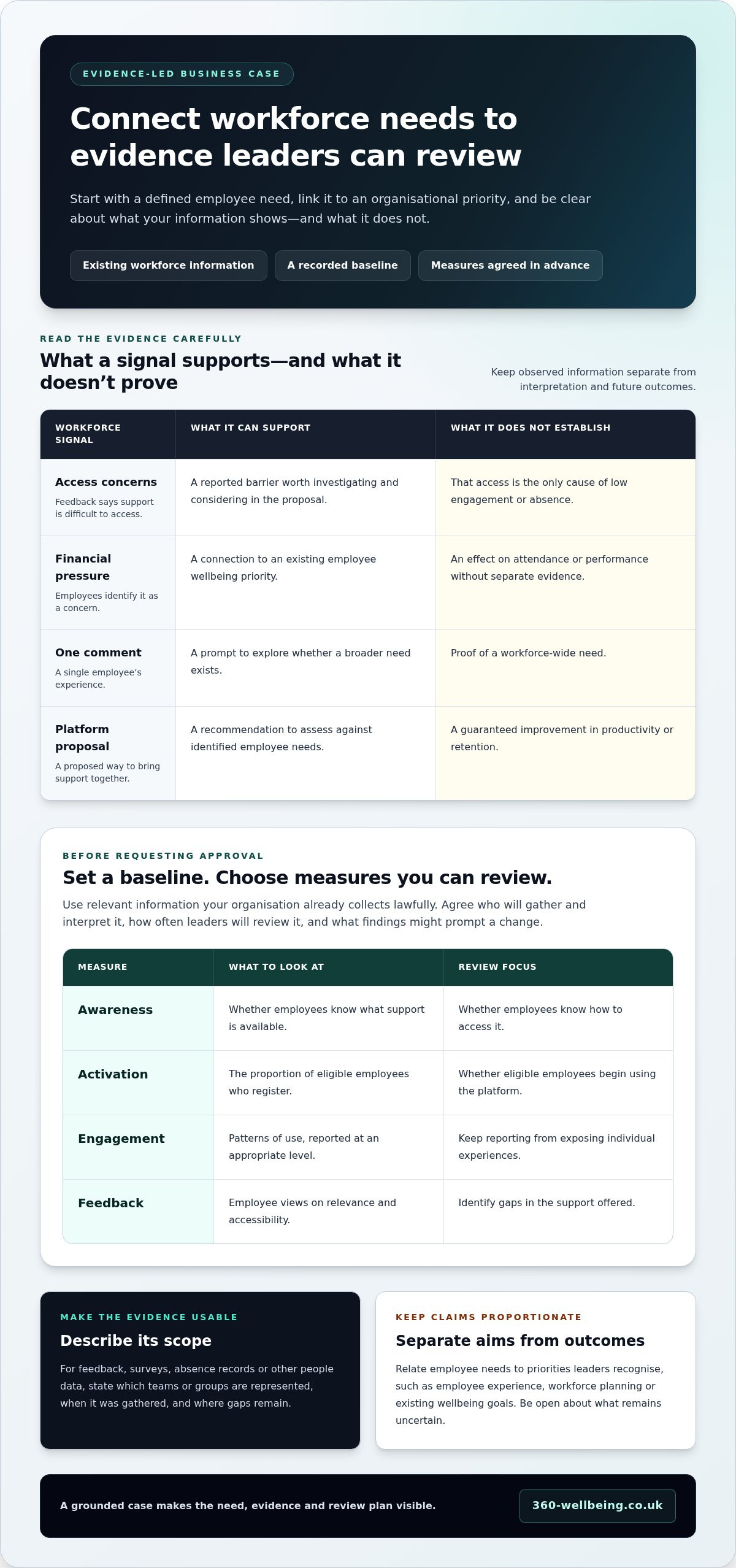
Make the case specific. Identify the workforce need, who is affected and why it deserves attention now. For example, feedback that employees find support difficult to access shows a reported barrier. It doesn’t prove that access is the only cause of low engagement or absence. Separate what your information shows from what you still need to investigate.
State the decision clearly, including who approves the proposal and who would own implementation. This helps leaders understand the practical responsibilities involved, not just the potential benefits.
Why benefits proposals can lose support
An unprioritised feature list can obscure the reason for investment. Leaders may reasonably ask whether the platform is affordable, whether employees will use it, who will manage its introduction and how its contribution will be reviewed. Address these questions directly, even if some answers are provisional.
Be measured about expected outcomes. A platform can support employees, but promising improved productivity or retention without evidence can weaken trust. Explain what you can track, such as awareness, participation or feedback, and what remains uncertain. That gives leaders a credible basis for deciding whether to proceed and what sponsorship would involve.
Approval is more likely to lead to a useful plan when the proposal connects a workforce need with a business priority and makes accountability visible. Leaders don’t need certainty about every future outcome. They do need a grounded reason to act, a clear understanding of practical responsibilities and an agreed way to assess whether the approach is meeting its aims.
Build an evidence-led business case for a benefits platform
A persuasive case starts with a defined need, not a platform’s feature list. Gather what your organisation already knows, identify what it doesn’t, and show how the proposed support relates to a priority leaders recognise. This keeps the recommendation proportionate to your workforce, resources and evidence, rather than relying on broad claims about what benefits platforms achieve elsewhere.
For anyone considering how to get leadership buy-in for a new benefits platform, the distinction between evidence and interpretation matters. Staff feedback may show that employees find support difficult to access. That’s evidence of a reported barrier; it doesn’t establish the cause of absence or predict a change in retention. Keep those points separate.
Connect employee needs to business priorities
Look for relevant themes in staff feedback, absence records and existing people surveys. Use information your organisation already collects, and describe its scope: which teams or groups are represented, when the information was gathered and where there are gaps. Avoid treating one comment or a broad industry statistic as proof of a workforce-wide need.
Then map each need to a recognised organisational priority. For example, if employees identify financial pressure as a concern, connect that need to an existing focus on employee wellbeing, while making clear that this alone doesn’t demonstrate an effect on attendance or performance. A financial support guide for UK employers can help frame why financial wellbeing belongs in a broader support conversation. Keep wellbeing aims distinct from commercial outcomes that need separate evidence.
Choose credible measures before asking for approval
Before presenting a recommendation, record a baseline using relevant information the organisation already collects lawfully. Choose measures that show whether employees can find the offer and whether they use or value it. Possible indicators include:
- Awareness: whether employees know what support is available and how to access it.
- Activation: the proportion of eligible employees who register or begin using the platform.
- Engagement: patterns of use, reported at an appropriate level and without exposing individual experiences.
- Feedback: employee views on relevance, accessibility and gaps in support.
Set a review period that fits your organisation’s decision-making cycle and available data. Agree who will gather and interpret the measures, how often leaders will review them, and what findings might prompt a change in communications or approach. Don’t present take-up as proof of improved productivity or promise a particular return. These indicators can show reach and experience; establishing a link to business outcomes requires separate, careful evaluation.
Tailor your recommendation to the need you’ve documented. If you’re considering a platform that brings different kinds of support together, explore 360 Wellbeing and assess it against your evidence and priorities.
Address leadership’s concerns about cost, take-up, and value
Questions about affordability, employee use and implementation are part of a sound decision, not signs that the proposal has failed. Consider them together: a platform may fit the budget but see limited use if employees don’t understand what it offers, while strong interest still needs clear ownership and review. Compare the proposal with the current approach and relevant alternatives, using the same criteria for each.
The comparison below helps make both the response and its limits visible. Replace the examples with your organisation’s own evidence and budget assumptions.
Objection: “Can we afford it?”
Evidence: Set out the proposed spend using your organisation’s budget assumptions, including the basis for any per-employee calculation and payment schedule.
Response: Compare this with the current approach and other options that address the same documented need.
Remaining uncertainty: The comparison won’t prove the platform’s eventual value or establish savings.
Objection: “Will employees use it?”
Evidence: Review relevant staff feedback, awareness of existing support and available participation information.
Response: Describe how employees will hear about the offer, find it and understand how to access it.
Remaining uncertainty: Interest expressed in feedback may not translate into registrations or ongoing use.
Objection: “Can we implement and assess it?”
Evidence: Identify internal capacity, likely communication channels and existing review processes.
Response: Assign an owner for communications, employee questions and reporting, with a clear route for collecting feedback.
Remaining uncertainty: Workload and engagement may differ from initial expectations.
Respond to cost and value questions without overclaiming
Show how the budget estimate was built, what assumptions it relies on and which costs are included. For a per-employee subscription, explain the employee count used in your calculation and whether it reflects your intended eligible group. 360 Wellbeing costs £3.99 per month per employee, with an annual payment option. Use the price and payment option in your organisation’s budget assessment, alongside the scope and alternatives. Avoid unsupported savings estimates. Leaders can assess the proposed cost and evidence of need before deciding; don’t promise future savings or commercial outcomes without evidence to support them.
Make adoption and implementation feel manageable
Low take-up is a risk to plan for, not dismiss. Explain how employees will learn what support is available, where to access it and where to raise questions. For a platform offering several types of support, keep the message simple: show how different needs connect to one employee-facing route without suggesting every feature will suit every person.
Set practical measures before launch, such as awareness, activation, engagement and feedback. Review them at an agreed point, then decide who will respond if employees don’t know how to access support or say the offer doesn’t meet their needs. This makes implementation a manageable process of communication and learning, rather than an assumption that approval alone will produce take-up. 360 Wellbeing includes 24/7 access to UK-registered GPs, mental health support, life coaching, virtual physiotherapy, and financial and legal support. Treat these as details of the offer, not evidence of likely adoption or business results.
Present a decision-ready proposal leaders can act on
A useful approval paper makes the decision straightforward to understand, even if the final answer is not yet certain. Keep the main case concise and put supporting detail in an appendix if needed. For anyone working out how to get leadership buy-in for a new benefits platform, clarity matters: leaders should be able to see the need, the options, the practical implications and exactly what you’re asking them to decide.
What to include in the approval paper
Open with the workforce need and the internal evidence behind it. Summarise the recommended approach, alternatives considered and assumptions that shape your comparison. Set out the budget basis, who would lead implementation, how employees would be informed and what measures would be reviewed. Make clear which points are known and which need to be assessed after approval.
- Decision requested: specify whether you’re seeking approval to proceed, permission to explore an option further or sponsorship for a defined next step.
- Scope and assumptions: describe who the proposal is intended to support and how you’ve estimated the relevant employee group.
- Accountability: name the proposed owner for coordination, communications and reporting, while identifying any responsibilities that still need agreement.
- Review approach: state which indicators will be considered, when leaders will review them and how employee feedback will inform next steps.
This structure helps leaders assess the proposal without mistaking an estimate for a confirmed cost or a desired outcome for a guaranteed result.
How to make the leadership conversation productive
Send a short pre-read ahead of the meeting and tailor it to the decision-makers. Finance leaders may focus on budget assumptions; people leaders may want to understand employee need and communications; operational stakeholders may ask who will manage the work. Invite questions about evidence and risks before recommending a direction. That makes the discussion collaborative rather than a presentation followed by a rushed yes-or-no.
- State the need and the decision you’re seeking.
- Summarise the evidence, options and assumptions, then invite challenge.
- Discuss ownership, employee communication and how progress will be reviewed.
- Record the decision, decision owner, open questions, responsible people and follow-up dates.
Close by confirming the specific next action, such as refining the proposal, gathering missing information or progressing to the next approval stage. If leaders aren’t ready to approve, agree what evidence or clarification would help them decide and who will provide it. A clear action keeps the conversation moving without implying that approval is inevitable.
If a platform is one of the options under consideration, explore 360 Wellbeing as part of your review of its fit with the documented need and proposed scope.
Turn approval into a practical employee benefits platform plan
Once leaders agree the need and the next decision, turn that direction into a plan employees can understand and use. The platform should respond to the evidence in your proposal, not simply add more features to the benefits list. If employees need different kinds of support, assess whether one employee-facing platform can bring those options together. Don’t treat that as a guarantee of higher engagement, improved retention or savings; keep the measures agreed with leadership in view.
How 360 Wellbeing could fit the proposal
360 Wellbeing brings together unlimited on-demand access to UK-registered GPs by phone, video or text, mental health support, life coaching and personalised virtual physiotherapy. It also includes financial and legal support, complimentary will writing, and a discount marketplace with 1,000+ brand discounts.
This range can be relevant where employees have varied support needs, but relate each component to your evidence. For instance, feedback pointing to interest in financial guidance could make financial support worth considering. It doesn’t establish how many employees will use it or what their outcomes will be. Present the services as available support, not as a promise of productivity, retention or other business results.
The subscription costs £3.99 per month per employee, with an annual payment option and no contract tie-ins. Include the price and payment option in your organisation’s budget assessment, using the employee group and assumptions relevant to your proposal. Weigh the offer against the need, alternatives and measures leaders have agreed to review.
What happens after the organisation decides to proceed
The sign-up form takes less than one minute, and the 360 Wellbeing team contacts the subscriber within one working day. Employees receive a unique 6-digit token in their welcome email to unlock services. Each token can be used once only, following the activation process in that email.
Before introducing the platform to employees, agree who will explain what support is available, how to access it and where questions should go. Keep the message accessible: employees should be able to recognise which kinds of support may be relevant to them without being promised a particular outcome. The internal owner can coordinate the review of awareness, activation, engagement and feedback, then share findings with decision-makers.
A practical plan connects the original employee need to clear communication, ownership and an agreed review. That brings the proposal to life while leaving room to learn from actual employee response. If the approach aligns with your organisation’s priorities, explore 360 Wellbeing as part of your evaluation.
Take the next step with confidence
The next step doesn’t have to be a full commitment. Use your agreed decision criteria to assess whether a platform fits your workforce’s needs, resources and priorities, and identify what you want to learn before making a wider decision. A thoughtful approach to how to get leadership buy-in for a new benefits platform keeps employee support connected to organisational priorities while leaving room to review what works for your people.
360 Wellbeing combines health, wellbeing, financial, legal and lifestyle support, including unlimited on-demand access to UK-registered GPs by phone, video or text. Consider how that breadth aligns with the needs you’ve identified, rather than assuming it will produce a particular business result.
Explore 360 Wellbeing and its employee support platform as you shape a practical next step for your organisation. A clear, evidence-led decision can help create a more considered approach to supporting employees.
Frequently Asked Questions
How do you get leadership buy-in for employee benefits?
Start with a clearly defined workforce need, then connect it to a priority leaders already recognise, such as employee experience or workforce planning. To support how to get leadership buy-in for a new benefits platform, use internal evidence and explain what you can realistically measure. Address cost, likely take-up and implementation responsibilities directly. Ask leaders to make a specific decision, rather than presenting a catalogue of features, and don’t promise business outcomes the evidence can’t support.
What should a business case for a benefits platform include?
A business case should set out the employee need, the internal evidence behind it and the organisational priority it relates to. Include options considered, budget assumptions, implementation ownership and the measures you’ll review. Explain how employee feedback will inform later decisions, such as whether communications need to change. If you use external research, include its publication date and the population studied so leaders can judge its relevance instead of treating general findings as a forecast for your organisation.
How can a small business make a case for employee benefits?
A small business can build a proportionate case from the information it has, such as recurring themes in staff conversations, feedback forms or operational priorities. You don’t need a large employer’s reporting structure. Define a manageable scope, set out the budget assumptions and choose a few relevant indicators, such as whether staff know how to access support. Name someone to coordinate the decision and review feedback. 360 Wellbeing is available to small businesses and sole traders, with no minimum employee requirement.
How can I tell whether employees will use a benefits platform?
You can’t know usage for certain before employees have access. Ask what kinds of support staff value, and use their responses to shape clear, practical communications. After launch, track whether employees are aware of the offer and activate access, then review engagement patterns and feedback over an agreed period. Survey interest is useful when assessing relevance, but it doesn’t prove future use or show that the platform will change business outcomes.
Who should present a benefits platform proposal to senior leadership?
The presenter should understand both the employee need and the organisation’s decision priorities. That could be an HR lead, founder, finance partner or a small cross-functional group, depending on who holds relevant evidence and can explain the practical implications. Before the meeting, clarify who owns the recommendation, who approves the budget and who would coordinate employee communications and measurement. A shared presentation can work well, provided one person is accountable for the request and follow-up.
Is an employee benefits platform the same as private medical insurance?
No. An employee benefits platform and private medical insurance are distinct categories, so don’t describe them as interchangeable or assume one replaces the other. 360 Wellbeing is an employee benefits platform that includes access to UK-registered GPs, alongside other health, wellbeing and practical support. If leaders need to compare options, describe each accurately and assess it against the organisation’s stated needs, rather than relying on labels that may imply different types of cover.