
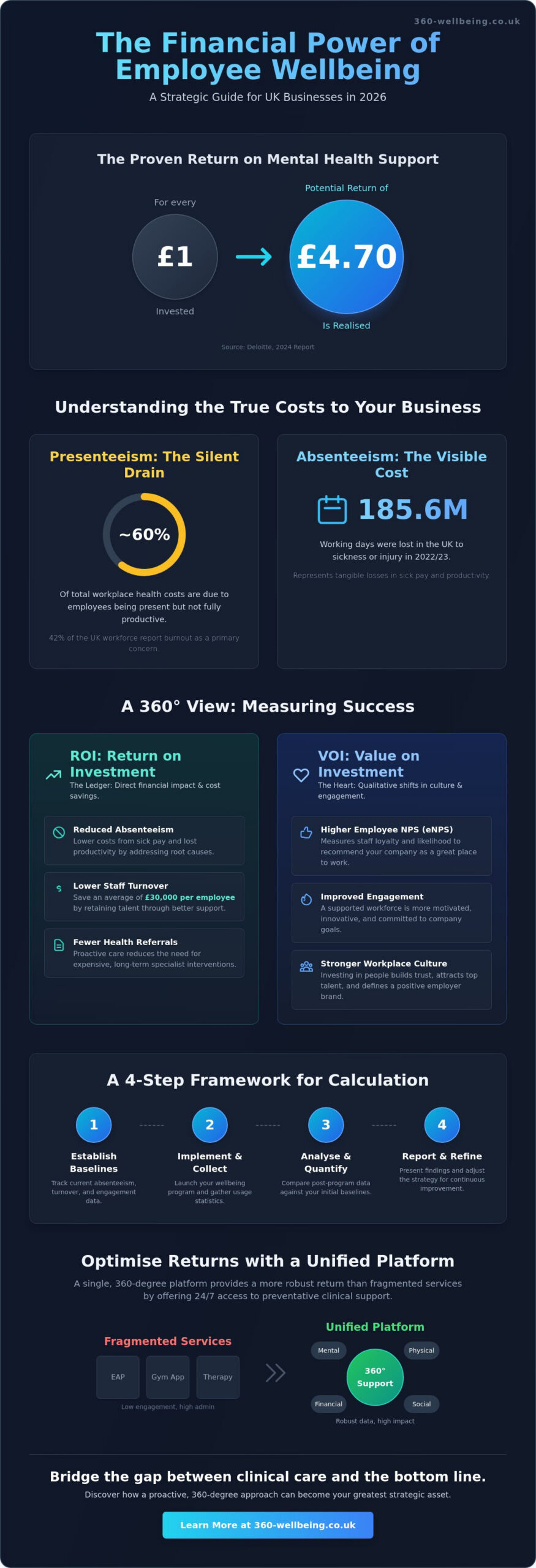
For every £1 your business invests in mental health support, you could be seeing a return of £4.70. Despite this data from Deloitte’s 2024 report, many UK finance directors still view employee wellness as a discretionary expense rather than a core investment. You likely understand that a resilient team is the engine of your success, but learning how to measure roi of wellbeing programs is essential when quantifying the impact of soft benefits. When the board asks for proof of value, vague anecdotes about morale won’t cut it anymore.
This 2026 guide helps you master the specific frameworks and metrics that transform holistic health into a transparent, strategic asset. You’ll gain the confidence to present a clear formula at your next meeting, proving that proactive care is a commercial win for the company. We’ll walk through the essential UK-specific data points, from reduced presenteeism costs to lower recruitment fees, that create a 360-degree view of your program’s performance. It’s time to bridge the gap between clinical care and the bottom line with a methodical, evidence-based approach.
Key Takeaways
- Transition from reactive health management to a proactive strategy that treats employee vitality as a measurable financial asset within the 2026 UK economy.
- Distinguish between direct financial gains like reduced sick pay and recruitment costs versus the broader value of investment in your workplace culture.
- Master a structured four-step framework on how to measure roi of wellbeing programs by establishing clear baselines for absenteeism and turnover.
- Identify the primary data sources and digital health insights needed to turn anonymised usage statistics into actionable quantitative reports.
- Discover why a unified, 360-degree wellbeing platform provides a more robust return than fragmented services through 24/7 access to preventative clinical support.
The Strategic Case for Measuring Wellbeing ROI in 2026
In the 2026 UK economy, defining the financial return on employee health investments is a necessity for sustainable growth. Wellbeing ROI represents the tangible financial gain businesses realize when they invest in structured health and lifestyle support for their teams. The days of a “wait and see” approach are gone. UK employers now face a landscape where long-term sickness and mental health challenges require a shift from reactive crisis management to proactive health maintenance. Waiting for an employee to reach a breaking point is far more expensive than supporting their vitality from day one.
This shift centers on closing the “Wellbeing Gap.” This term describes the stark cost difference between a thriving, energized workforce and one that is struggling with burnout and low engagement. Understanding how to measure roi of wellbeing programs allows leaders to bridge this gap, turning health from a line-item expense into a strategic asset that fuels productivity. It’s about moving toward a model where every pound spent on health is an investment in the company’s future resilience.
Why “Soft” Benefits Require “Hard” Data
HR departments face increasing pressure to justify the costs of a comprehensive wellbeing platform and other subscription-based services. In 2026, stakeholders demand evidence that these investments deliver more than just “perks.” Data builds the necessary credibility to secure long-term budgets and proves that a program is genuinely effective. Beyond the balance sheet, measuring ROI is a profound act of care. It ensures that the support provided actually meets the specific needs of your staff, ensuring your strategy remains relevant and impactful.
The 2026 Economic Context: Absenteeism vs. Presenteeism
While absenteeism is easy to track, presenteeism remains a silent drain on UK corporate resources. Recent 2025 data suggests that mental health-related presenteeism accounts for approximately 60% of total workplace health costs in the UK. Employers who learn how to measure roi of wellbeing programs can finally illuminate these hidden losses. Presenteeism is the cost of employees being at work but not fully functioning due to physical or mental health struggles. In our post-hybrid era, burnout remains a primary concern for 42% of the UK workforce, making proactive resilience training a critical component of any modern corporate strategy.
Core Metrics: Distinguishing Between ROI and VOI
To understand how to measure roi of wellbeing programs, you must first distinguish between the ledger and the heart of your company. ROI measures the direct financial impact; it’s the tangible data found in your profit and loss statements. VOI, or Value on Investment, looks at the qualitative shifts that define your company culture. A 360-degree perspective demands that you track both. Focusing only on the numbers misses the human resilience that fuels them. By 2026, UK employers who ignore the human element risk losing their competitive edge in an increasingly health-conscious job market.
Hard Metrics for ROI Calculation
ROI is your shield against rising operational costs. It provides the fiscal evidence needed to justify continued investment in health initiatives. When we look at hard metrics, we focus on three primary areas:
- Absenteeism rates: The ONS reported that 185.6 million working days were lost to sickness or injury in 2022/23. By tracking these rates before and after implementing a program, you can calculate the exact savings in statutory sick pay and lost productivity.
- Staff turnover: Replacing a single employee costs UK businesses an average of £30,000 according to Oxford Economics. Reducing turnover by even 5% through better wellbeing support creates significant capital retention.
- Occupational health referrals: A proactive approach reduces the need for expensive long-term disability claims and specialist referrals. Fewer referrals indicate a workforce that is managing stress and physical health effectively at the source.
Soft Metrics for VOI Assessment
VOI captures the sentiment and energy of your workforce. While these metrics don’t always appear as a direct line item on a budget, they dictate your company’s long-term viability. Understanding how to measure roi of wellbeing programs requires a deep dive into these “soft” indicators:
- Employee Net Promoter Scores (eNPS): This simple metric gauges how likely your staff are to recommend your company as a place to work. A rising eNPS often correlates with improved mental health support and felt-value.
- Participation and engagement: High uptake in life coaching or mental health sessions isn’t a sign of a struggling workforce; it’s a sign of a healthy culture where people feel empowered to use the tools provided.
- Employer Value Proposition (EVP): In 2026, a robust wellbeing package is a fundamental right rather than a luxury. Strengthening your EVP helps you attract top-tier talent who prioritise workplace harmony and holistic support.
Creating a tailored strategy ensures your investment reaches the right people at the right time. You can explore our comprehensive wellbeing solutions to see how we help businesses balance these two vital metrics. By combining fiscal discipline with genuine compassion, you create a sustainable environment where both the business and the individual can flourish.
Data Sources: Turning Support into Quantitative Insights
Moving from a reactive “hope for the best” strategy to a proactive, data driven model requires a shift in how you view employee support. Understanding how to measure roi of wellbeing programs starts with the raw data your business already generates through daily operations and benefit interactions. By looking at these figures through a 360 degree lens, you can see the direct link between a resilient workforce and a healthy bottom line.
To ensure your measurement is robust, you must balance clinical data with human sentiment. This process requires strict adherence to the UK General Data Protection Regulation (UK GDPR) and the Data Protection Act 2018. When you handle health related data, you’re dealing with “special category” information. You should always ensure that data processed for ROI reporting is aggregated and anonymised at the source, meaning no individual can be identified from the reports you review. This approach maintains the sacred bond of trust between employer and employee while providing the clarity needed for strategic investment.
Platform Analytics: Virtual GP and EAP Usage
Digital health platforms provide a wealth of real time metrics that serve as leading indicators for workplace health. For instance, 24/7 Virtual GP access is a powerful tool for reducing time lost to medical appointments. Industry data from 2024 suggests that the average private GP consultation saves an employee between two and three hours of travel and waiting time compared to traditional routes. If 50 employees use this service annually, you’ve recovered approximately 125 hours of productive time.
- EAP Engagement: High usage of Employee Assistance Programs (EAPs) shouldn’t be viewed as a negative. Instead, it’s a leading indicator that your team is proactively managing stress before it leads to long term burnout.
- Trend Analysis: If EAP data shows a 20% spike in financial wellbeing queries during a specific quarter, it allows you to deploy targeted workshops rather than guessing what your team needs.
- Privacy Assurance: Anonymised usage statistics protect individual privacy while providing the aggregate proof required to justify the utility and value of your wellbeing spend.
Internal HR Records and Surveys
Your existing HR infrastructure holds the keys to deeper insights. By correlating benefit usage with performance data, you can start to see patterns in workforce vitality. A 2024 Deloitte report highlighted that UK employers see an average return of £4.70 for every £1 spent on mental health support. You can track this locally by comparing the performance review scores of frequent “wellbeing hub” users against the company average.
- Stay Interviews: Instead of waiting for an exit interview, use “Stay Interviews” to ask employees directly why they value their benefits. This provides qualitative weight to your quantitative ROI.
- Quarterly Pulse Checks: Integrate three specific wellbeing questions into your standard engagement surveys. Ask about perceived support, energy levels, and work-life balance to track sentiment shifts over time.
By aggregating these diverse data points, you gain a clear, evidence based roadmap for how to measure roi of wellbeing programs without compromising the empathetic culture you’ve built. It’s about seeing the person behind the percentage and the value behind the volume.
The 4-Step Framework for Calculating Your ROI
Moving from a feeling that your program is working to having hard data requires a structured approach. We understand that numbers can feel cold when discussing human health, but they tell the vital story of your people’s resilience and your business’s sustainability. By following this framework, you’ll gain the clarity needed to show exactly how to measure roi of wellbeing programs in a way that resonates with your board of directors.
Step 1: Establishing Your Financial Baseline
You can’t measure progress without knowing where you started. UK employers often underestimate the ripple effect of a single sick day. According to the CIPD Health and Wellbeing at Work 2023 report, the median cost of absence is £958 per employee every year. To find your specific baseline, look at your payroll data for the last 12 months. Calculate the total cost of sick pay and then add a 1.5x multiplier to account for temporary cover or the overtime paid to other staff to fill the gap.
It’s also essential to consider the hidden costs of financial stress. Employees struggling with debt or rising costs are statistically more likely to experience mental health challenges that lead to absence. You can find more context on these specific pressures in our guide on Financial Support for Employees. Once you have this total figure, you have your starting line.
Step 2: Quantifying the Improvements
Compare your current data against your baseline to isolate the impact of your initiatives. If your staff turnover dropped from 15% to 12% after implementing a proactive health strategy, that 3% reduction represents a significant saving. In the UK, the average cost of replacing a mid-level professional is roughly £6,000 when you include recruitment fees and the initial “learning curve” period where productivity is lower.
For “soft” metrics like employee engagement, assign a conservative proxy value. For instance, if your internal surveys show a 10% increase in morale, you might attribute a 0.5% boost in total output based on industry standards. Using conservative estimates ensures your final figures remain credible and defensible when presented to finance teams.
Step 3: Calculate Total Investment and Cost Avoided
To get an honest figure, you must include every penny spent. This includes subscription fees for health platforms, the cost of onsite workshops, and the administrative time your HR team spends managing the program. If your HR lead spends four hours a month on administration, multiply their hourly rate by 48 to get the annual internal cost.
The “Cost Avoided” is the difference between your baseline costs and your current costs. If your absence costs were £50,000 last year and are £40,000 this year, your cost avoided is £10,000.
Step 4: Apply the ROI Formula
The final step in learning how to measure roi of wellbeing programs is the math. Use this simple calculation:
(Net Benefits / Cost of Investment) x 100
For example, if your total cost avoided (Net Benefit) is £20,000 and your program cost £10,000 to run, your ROI is 100%. This means for every £1 you invested, you gained £2 back in value. This clear, methodical path provides the safety and order required to make long-term strategic decisions for your workforce.
Discover how a tailored wellbeing strategy can protect your bottom line.
Optimising Returns with a Comprehensive Wellbeing Platform
Fragmented benefits often fail because employees don’t know where to turn during a crisis. When you integrate physical, mental, and social support into one ecosystem, you stop paying for unused subscriptions and start seeing real impact. Understanding how to measure roi of wellbeing programs becomes significantly easier when all your data lives in one place. It’s about moving from a “perk” mindset to a strategic health investment that protects your most valuable assets.
The Preventative Power of 24/7 Support
Speed is the most effective tool in reducing healthcare costs. A 2023 industry report found that early intervention can reduce the duration of mental health-related absences by up to 30%. By providing 24/7 access to a Virtual GP, you ensure a minor ailment doesn’t spiral into a week of sick leave. This immediate clinical access removes the stress of waiting for local appointments, keeping your team focused and present.
Life coaching and therapy build a psychological safety net, helping staff navigate personal crises before they impact their output. This sense of security directly lowers general workplace anxiety. It creates a culture where people feel protected, which is a key driver for retention in the competitive UK job market. When employees know help is a tap away, their resilience increases naturally.
Reducing Friction with a Single-Point Solution
Complexity is the enemy of engagement. If a staff member has to search through three different portals to find debt advice or a gym discount, they simply won’t use them. High engagement relies on an intuitive app experience that feels like a natural part of the workday. Integrated rewards provide immediate, tangible value that helps offset the cost of living, which 67% of UK employees now cite as a primary source of stress.
Non-medical support, such as legal or financial guidance, addresses the root causes of poor health. Financial worries are a leading cause of insomnia and reduced concentration. By offering these tools, you’re preventing the physical and mental decline that leads to long-term absence. This proactive approach is the most reliable way to ensure your strategy yields a positive return. It transforms wellbeing from a reactive expense into a measurable organisational advantage.
360 Wellbeing acts as your expert caregiver, providing a scientific yet personal path to organisational health. We help you move beyond surface-level metrics to see the full 360-degree picture of your team’s vitality. By consolidating your efforts into one platform, you gain the clarity needed to understand how to measure roi of wellbeing programs with precision and confidence.
Book a demo to see how 360 Wellbeing can transform your workforce ROI
Future-Proofing Your Workforce Through Strategic Insight
Measuring the success of your health initiatives isn’t just a financial exercise; it’s a commitment to your team’s longevity. By 2026, UK businesses that master how to measure roi of wellbeing programs will outperform competitors by aligning clinical outcomes with business performance. You’ve seen that success relies on distinguishing between immediate cost savings and long-term Value on Investment. Moving from fragmented data to a structured 4-step framework allows you to turn employee support into clear, quantitative insights that resonate in the boardroom. This evidence-based approach ensures your wellbeing budget is treated as a high-yield investment rather than a sunk cost.
360 Wellbeing helps you bridge this gap with a proactive approach to corporate health. Our 24/7 access to UK-registered GPs directly reduces medical-related absenteeism, while our comprehensive EAP and mental health support build the resilience your staff need to thrive. We provide a holistic platform covering health, financial, and legal wellbeing to ensure your strategy is both complete and measurable. Discover how 360 Wellbeing delivers measurable returns for your team and start building a healthier, more productive future for your business today. Your team’s vitality is the foundation of your success.
Frequently Asked Questions
How long does it take to see a positive ROI from a wellbeing program?
You’ll typically see a measurable return on investment within 12 to 36 months of launching your strategy. While immediate gains like reduced minor absenteeism can appear in the first year, Deloitte’s 2024 research shows that the highest returns of £5.30 for every £1 spent often take three years to manifest. This timeframe allows for cultural adoption and the cumulative effect of proactive health interventions to take root across your workforce.
Can small businesses with under 50 employees accurately measure ROI?
Small businesses can definitely track returns by focusing on granular data such as sickness absence costs and staff turnover rates. For a firm with 20 employees, a 10% reduction in absenteeism saves approximately £2,400 annually based on average UK sick pay costs. You don’t need complex software; a simple spreadsheet tracking “before and after” metrics provides a clear picture of how to measure roi of wellbeing programs on a smaller scale.
What is the average ROI for employee wellbeing programs in the UK?
The average return for UK employers is £4.70 for every £1 invested in wellbeing initiatives. According to the Deloitte 2024 Mental Health and Employers report, this figure can rise to £11 for every £1 spent when companies focus on early, proactive interventions rather than reactive crisis management. These figures reflect savings gained from reduced presenteeism, lower staff turnover, and decreased recruitment costs across various UK industries.
Is VOI more important than ROI for employee retention?
Value on Investment (VOI) is often a more accurate predictor of long-term retention than financial ROI alone. While ROI tracks hard costs, VOI measures “soft” metrics like employee engagement and psychological safety, which 67% of UK workers cited as a top reason for staying with an employer in 2025. By balancing both, you create a 360-degree view of how your strategy fosters loyalty beyond just the bottom line.
How do I measure the ROI of mental health support specifically?
You measure mental health ROI by tracking reductions in presenteeism and the frequency of long-term stress-related absences. Since presenteeism costs UK businesses an estimated £28 billion annually, monitoring the “lost hours” before and after introducing support provides a concrete financial metric. You should also evaluate your Employee Assistance Program (EAP) utilization rates to ensure your team is using proactive tools before they reach a point of burnout.
What are the biggest mistakes companies make when measuring wellbeing ROI?
The most common mistake is failing to establish a baseline before the program starts, which makes it impossible to prove progress. Many UK firms also focus solely on absenteeism while ignoring presenteeism, which actually accounts for 80% of total productivity loss according to recent occupational health studies. Another pitfall is expecting a quick fix within six months rather than committing to a sustained, three-year strategic roadmap.
How does a Virtual GP service contribute to measurable ROI?
A Virtual GP service delivers ROI by significantly reducing the time employees spend away from work for medical appointments. With the average UK wait time for an in-person GP appointment now exceeding 15 days, providing 24/7 digital access saves an average of 3.5 hours of productivity per consultation. This proactive approach ensures your team receives clinical advice at the point of need, preventing minor health issues from escalating into long-term sickness.