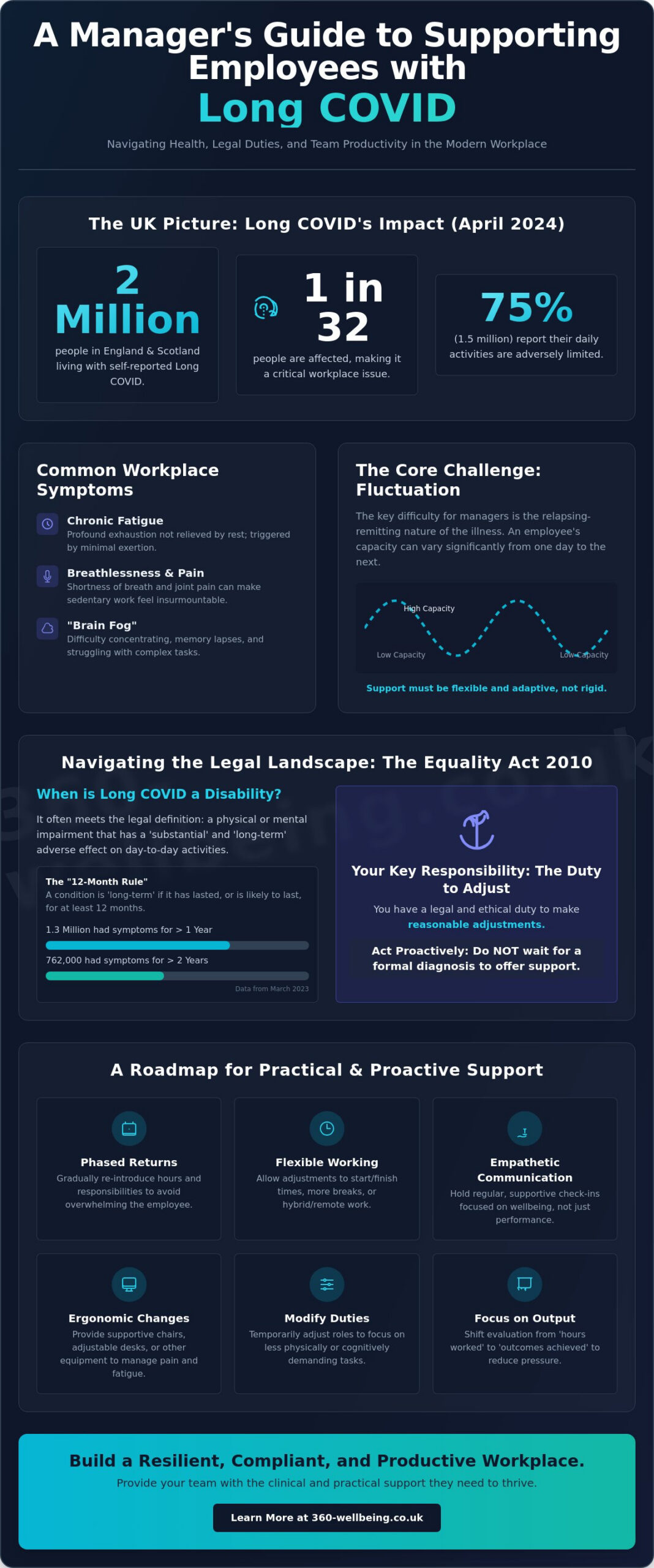
As of April 2024, an estimated 2 million people across England and Scotland were living with self-reported Long COVID. That is roughly 1 in every 32 people, with 1.5 million of those individuals reporting that their daily activities are now adversely limited. For many UK managers, the primary challenge isn’t just the loss of productivity; it’s the uncertainty of how to support employees with long covid when their symptoms fluctuate so unpredictably. You’re likely balancing a genuine desire to help your colleague with the very real pressure of maintaining team output and staying compliant with the Equality Act 2010.
We believe that workplace wellbeing is a strategic asset and a fundamental right. This guide provides a clear roadmap for managing long-term illness through proactive micro-adjustments rather than one-size-fits-all policies. You’ll learn how to navigate the April 2026 SSP reforms, which abolished waiting days and removed the Lower Earnings Limit, while implementing sustainable phased returns. We’ll also explore how providing your team with clinical resources like mental health support and 24/7 Virtual GPs can foster a resilient culture that supports recovery without compromising on performance.
Key Takeaways
- Understand your legal duties under the Equality Act 2010 and why it’s more effective to support symptoms than wait for a formal diagnosis.
- Learn how to support employees with long covid through tailored adjustments like phased returns and ergonomic changes that accommodate the condition’s fluctuating nature.
- Adopt a supportive communication framework that balances professional boundaries with the empathy required to manage staff facing long-term health challenges.
- Explore how 360-degree wellbeing resources, such as 24/7 Virtual GPs and mental health support, provide the clinical guidance your team needs to stay resilient.
- Build a proactive workplace culture that treats employee health as a strategic asset, ensuring long-term compliance and sustained team productivity.
Understanding Long COVID: The 2026 Workplace Context
In the UK, Long COVID is clinically defined as symptoms that persist for 12 weeks or more after the initial infection. For a comprehensive overview of Long COVID, it’s clear that this isn’t just a lingering respiratory issue; it’s a complex multi-system condition affecting various organs and cognitive functions. As of April 2024, approximately 2 million people in England and Scotland were living with these symptoms, which accounts for roughly 1 in 32 people. This makes the condition a critical talent retention priority for any manager who values their team’s long-term health and stability. Common workplace symptoms include chronic fatigue, breathlessness, and joint pain, which can make even sedentary office work feel insurmountable. The primary management challenge lies in the relapsing-remitting nature of the illness, where an employee might feel capable one day but completely incapacitated the next.
The Reality of Cognitive and Physical Fatigue
It’s vital to distinguish between standard workplace tiredness and the profound exhaustion associated with this condition. For those with Long COVID, fatigue isn’t cured by a good night’s sleep; it’s a systemic depletion of energy that can be triggered by minimal physical or mental exertion. This often pairs with “brain fog,” which manifests as difficulty finding words, memory lapses, and a struggle to concentrate on complex tasks. When you’re looking at how to support employees with long covid, acknowledging the emotional toll is the first step. Many high-performers feel a deep sense of loss or frustration when they can’t meet their previous standards. This requires a compassionate, partnership-led approach to recovery that prioritizes psychological safety alongside physical health adjustments.
Impact on Team Dynamics and Productivity
Unpredictable absences can create a ripple effect across your department, potentially leading to increased stress for other team members who pick up the slack. Transparent leadership is essential here to manage expectations and maintain morale. By communicating the support plan clearly, you can prevent resentment and maintain a supportive culture. We recommend shifting your focus from a rigid “hours-worked” model to an “output-based” evaluation. This allows for flexibility while ensuring that business objectives are still met. Understanding how to support employees with long covid involves looking at the 360-degree impact on the whole team. This proactive stance ensures that the workplace remains a harmonious environment, even when faced with long-term health challenges.
Navigating the Legal Landscape: The Equality Act 2010
While Long COVID isn’t specifically named in the Equality Act 2010, it frequently falls under the legal definition of a disability. For a condition to be considered a disability, it must have a substantial and long-term adverse effect on an individual’s ability to carry out normal day-to-day activities. Because many symptoms are cognitive or internal, they may not be immediately visible, but they’re no less impactful. Understanding how to support employees with long covid requires a shift from viewing illness as a short-term hurdle to recognizing it as a potential long-term health journey that warrants legal protection and compassionate management.
The “Duty to Adjust” is perhaps your most significant responsibility. You shouldn’t wait for a formal clinical diagnosis to begin providing support. If you’re aware that an employee is struggling, the legal and ethical path is to initiate a conversation about reasonable adjustments immediately. Failing to do so risks claims of “discrimination arising from disability,” which occurs when an employee is treated unfavourably because of something connected to their condition, such as a dip in performance or a need for flexible hours. To ensure your business remains compliant while fostering a supportive environment, accessing professional legal support can provide the clarity needed to handle sensitive cases with confidence.
When is Long COVID a Disability?
The “12-month rule” is the primary benchmark here. A condition is considered long-term if it has lasted for at least 12 months or is likely to last that long. According to March 2023 data, an estimated 1.3 million people in the UK had symptoms lasting more than a year, and 762,000 had symptoms for more than two years. In a professional context, you must assess how symptoms like fatigue or brain fog affect “normal activities” such as typing, following instructions, or commuting. Adopting a cautious approach by treating the condition as a disability from the outset is the most effective risk-management strategy for your team.
The Legal Minimum vs. Best Practice
Meeting the letter of the law is essential, but building a culture of resilience and trust involves going further. Best practice means documenting the “interactive process” where you and the employee collaboratively choose adjustments. This creates a paper trail of support and shows a commitment to their success. Occupational Health (OH) services are invaluable here, as they provide definitive advice on fitness to work and specific adjustments. For more detailed frameworks on managing these transitions, the Acas guidance for employers offers a robust starting point for maintaining fair and transparent workplace policies.
Finally, remember that health information is “special category data” under GDPR. You must keep all discussions and records strictly confidential. Only share information with those who absolutely need to know to implement adjustments, and always with the employee’s explicit consent. Protecting their privacy is a fundamental part of how to support employees with long covid and serves as the foundation for a trusting employer-employee relationship.
Implementing Practical Support and Workplace Adjustments
Flexibility is the most effective tool in your management toolkit. When considering how to support employees with long covid, you’ll find that rigid attendance policies often lead to burnout and prolonged absences. Instead, focus on creating a workspace that adapts to the individual’s energy levels. For the 381,000 people in the UK whose daily activities are limited “a lot” by the condition, permanent remote work might be the only way to remain in employment. For those in the office, providing quiet zones helps reduce the sensory overload that often exacerbates neurological symptoms. Pacing is a vital technique where employees break tasks into small, manageable chunks to prevent the total exhaustion that follows overexertion. You should also consider ergonomic support, like specialist chairs or standing desks, to help manage the muscle aches reported by 49% of sufferers.
These practical changes shouldn’t exist in a vacuum. They’re most effective when integrated into a broader wellbeing strategy that considers the employee’s whole life. For instance, ensuring your team understands the available financial support can alleviate the stress of reduced hours. When an employee feels financially secure, they’re less likely to push themselves into a premature return that could trigger a significant relapse. This proactive approach turns workplace wellness from a luxury into a strategic asset for your business.
Phased Return to Work (PRTW) Strategies
A 4 to 8 week “ramp-up” period is often the most sustainable way to bring someone back into the team. Start with minimal hours, perhaps just two mornings a week, and gradually increase the load based on their energy levels. It’s essential to build in “contingency days” for when symptoms flare up unexpectedly. If a relapse occurs, the plan should allow the employee to temporarily scale back without fear of disciplinary action. Regarding pay, remember that as of April 2026, Statutory Sick Pay is £123.25 per week and is payable from the very first day of sickness. Clear, written agreements about how pay will be handled during these fluctuating hours will maintain trust and transparency.
Cognitive Load and Task Management
Brain fog and difficulty concentrating affect 51% of people with Long COVID, making high-pressure environments particularly challenging. You can directly address this by reducing the number of back-to-back meetings, which are cognitively draining. Always provide written instructions for tasks to assist with word-finding or memory issues. Encourage the employee to tackle complex, high-priority projects during their peak energy windows, usually in the morning. Save “low-energy” tasks, such as basic admin or filing, for the common afternoon slump. Learning how to support employees with long covid means acknowledging these cognitive limits and adjusting expectations to ensure the work remains achievable and high-quality.
The Manager’s Role: Communication and Empathy
Managers act as the primary bridge between organizational policy and individual recovery. Adopting a “Caregiver Expert” approach means balancing professional boundaries with a warm, human touch that makes complex health topics feel manageable. When considering how to support employees with long covid, you must recognize that the standard “How are you?” can be a loaded question for someone whose health fluctuates daily. Instead of a general inquiry, try asking specific questions about their current barriers or what tasks feel most achievable today. This shift helps normalize conversations around “invisible illnesses” and reduces the stigma that often prevents employees from being honest about their limitations.
Effective leadership also involves protecting the wider team. If one person’s capacity is reduced, you must proactively manage the “ripple effect” on other staff to prevent collective burnout. This might involve reprioritizing department goals or temporarily redistributing non-essential tasks. To help manage the emotional and mental strain on everyone involved, providing access to an Employee Assistance Programme (EAP) ensures that both managers and staff have the professional support they need to maintain resilience.
Conducting Effective Wellbeing Conversations
The goal of a wellbeing conversation is to uncover the reality of an employee’s working life. Use open-ended questions like “What does your energy look like for the rest of the week?” or “Which part of your role feels most draining right now?”. Listen carefully for “the gap” between their professional pride and their physical reality. Many employees will say they’re “fine” while struggling with the 72% fatigue rate reported in March 2023 cases. Establishing a regular, low-pressure check-in rhythm, such as a fortnightly 15-minute call, creates a safe space for honest updates without the intensity of a formal performance review.
Managing Team Culture and Expectations
Building a supportive culture requires a delicate balance of transparency and confidentiality. You cannot disclose an employee’s specific medical details, but you can explain the adjustments being made to ensure the team functions smoothly. Encourage a culture of “radical transparency” regarding energy levels, where it’s okay for anyone to admit they’re hitting a wall. This prevents the dangerous cycle of “presenteeism,” where an employee pushes through symptoms only to suffer a major relapse later. Teaching your team how to support employees with long covid starts with modeling this empathy yourself, showing that health is a strategic asset worth protecting.
Leveraging Wellbeing Platforms for Proactive Support
Managers often find that traditional healthcare pathways move too slowly for the fast-paced needs of a modern business. While the NHS provides essential care, the wait times for specialist consultations can leave an employee in a state of limbo for months. This is where a comprehensive wellbeing platform provides a distinct advantage. By offering immediate access to clinical and emotional resources, you can effectively bridge the gap between a symptom flare-up and an actionable workplace adjustment plan. Learning how to support employees with long covid involves moving beyond reactive policies and embracing a proactive, 360-degree approach that treats health as a strategic asset rather than a liability.
Integrating digital health tools into your management strategy ensures that support is available the moment it’s needed. These platforms offer a unified narrative of wellness, combining physical, mental, and social health into one accessible space. This completeness is essential for a condition that affects multiple body systems and cognitive functions. Beyond medical advice, services like life coaching help employees adapt to their “new normal,” focusing on professional growth within their current physical capacity. This holistic support ensures that the employee feels valued as a whole person, which is the foundation of long-term talent retention.
The Role of 24/7 Virtual GPs
Waiting weeks for a local GP appointment isn’t just frustrating for the employee; it delays the implementation of necessary workplace changes. A 24/7 Virtual GP service allows staff to speak with a medical professional at a time that suits their energy levels, often on the same day. These consultations are invaluable for managing persistent symptoms like breathlessness or the profound fatigue reported by 72% of sufferers. Getting expert second opinions and faster specialist referrals gives the employee a sense of agency over their health journey. This clinical speed ensures that you receive the medical guidance needed to refine phased returns and other adjustments without unnecessary delay.
Mental Health and Resilience Building
There’s a scientifically grounded link between chronic physical symptoms and a decline in mental wellbeing. Dealing with a relapsing-remitting condition often leads to anxiety about job security or feelings of isolation. Providing access to professional mental health support, such as CBT or counselling through an Employee Assistance Programme (EAP), is a critical part of how to support employees with long covid. These services help staff process the emotional toll of their condition while building the resilience required to manage their workload. Discover how 360 Wellbeing’s platform supports long-term health and helps your team maintain harmony through every stage of their recovery.
Building a Resilient Future for Your Team
Managing the long-term impact of chronic illness requires a shift from reactive policies to a proactive partnership. By prioritizing the “Duty to Adjust” under the Equality Act 2010 and utilizing techniques like pacing, you’re protecting your business’s most valuable asset: its people. You’ve seen that 51% of sufferers struggle with difficulty concentrating, so moving toward an output-based model ensures productivity remains steady while your team members focus on their recovery journey.
Understanding how to support employees with long covid effectively means providing the clinical and emotional resources they need to thrive in a “new normal.” Our platform is specifically tailored for UK SMEs and sole traders, offering 24/7 UK-registered Virtual GP access to bypass traditional wait times. We also provide comprehensive Mental Health and EAP support to address the psychological challenges of long-term recovery. Book a demo to see how our Virtual GP and Mental Health support can help your team today. You have the power to foster a culture where health is a fundamental right and a strategic strength.
Frequently Asked Questions
Is Long COVID legally considered a disability in the UK?
Long COVID is considered a disability under the Equality Act 2010 if the symptoms have a substantial, long-term impact on an individual’s ability to carry out daily activities. This typically applies if the condition has lasted or is likely to last for at least 12 months. Since 1.3 million people in the UK reported symptoms lasting over a year in March 2023, managers should generally treat the condition as a disability to ensure legal compliance.
What are ‘reasonable adjustments’ for someone with brain fog?
Adjustments for brain fog focus on reducing cognitive strain and assisting memory through practical workplace changes. You can provide written summaries of verbal instructions, allow recording of meetings for later review, or implement “monotasking” where only one project is handled at a time. These micro-adjustments are essential when you’re looking at how to support employees with long covid who struggle with the 51% concentration difficulty rate reported in clinical studies.
Can I dismiss an employee who has been off with Long COVID for a long time?
Dismissal is a high-risk last resort that should only occur after you’ve exhausted all reasonable adjustments and obtained clear medical evidence. You must follow a fair capability procedure to avoid costly discrimination claims. Given the 2025 Employment Rights Act changes, it’s vital to document every support attempt and consult with legal experts before taking any final action regarding an employee’s long-term absence or capability.
How do I handle a phased return to work that keeps failing?
If a phased return fails, you should pause and reassess the employee’s current energy limits with professional clinical guidance. It’s common for recovery to be non-linear; a relapse doesn’t mean the return is impossible, just that the pace was likely too fast. Consult a Virtual GP or occupational health specialist to design a more gradual 8-week ramp-up that includes extra contingency days for rest and recovery.
Should I ask for a doctor’s note for every Long COVID flare-up?
Requesting a doctor’s note for every flare-up is often counterproductive and adds unnecessary stress to both the employee and the NHS. Instead, create a “fluctuation agreement” that outlines exactly what happens when symptoms peak. Since the April 2026 SSP reforms abolished the three-day waiting period, paying Statutory Sick Pay from the first day of a flare-up is now the standard legal requirement for all eligible staff.
How can I support an employee’s mental health during Long COVID recovery?
Supporting mental health involves providing access to professional clinical support and normalizing conversations about the emotional toll of chronic illness. Chronic physical symptoms are closely linked to a decline in mental wellbeing, so offering an Employee Assistance Programme (EAP) is essential. This proactive approach helps build the resilience needed for a sustained return to work while showing the employee they’re valued beyond their immediate daily productivity.
What if the employee insists they are fine but their performance is dropping?
When performance drops despite an employee’s insistence that they’re fine, you should address objective work standards while gently offering wellbeing resources. Frame the conversation around support rather than discipline to maintain trust. You can suggest a confidential consultation with a 24/7 Virtual GP to explore how to support employees with long covid who may be experiencing “presenteeism” and pushing themselves too hard against their physical limits.
Are there specific health and safety risks with Long COVID in the workplace?
Fatigue and brain fog can pose significant health and safety risks, especially in safety-critical roles or environments involving heavy machinery. You must conduct a specific risk assessment to determine if an employee’s current cognitive or physical limitations could lead to accidents. If risks are identified, you might need to temporarily reassign them to lower-risk tasks or adjust their responsibilities until their symptoms stabilize and energy levels improve.